|
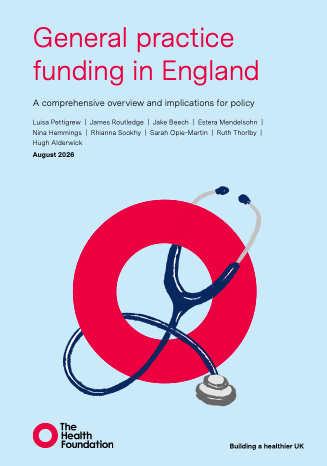
The Health Foundation published an important report this week.
Unfortunately, their comm’s department, in an exuberance to create a macchiato headline for the press, eclipsed the cuppa-builder's issues the report actually reveals.
One in ten GP partners earns more than £250,000 a year… blah, blah... red meat for the Red-Tops...
…game over… the newspapers had their story…
...GP pay… partnership profits… fat cats.
This excellent report got tangled in a cat's cradle of tropes.
Which is a pity because £250,000 is not the most important number in the report.
£219 is…
£219... about £4.20 a week… 60p a day...
... roughly what the NHS spends on general practice, per patient, per year.
For that, primary care provides the front door to the NHS;
- diagnosis,
- prescribing,
- prevention,
- vaccinations,
- referrals,
- long-term-condition management,
- mental-health support,
- end-of-life care,
- reassurance and…
… an increasingly complicated job of looking after an ageing population with several things wrong at once.
But, £219 is interesting for another reason.
It is not the price of seeing your GP. It is, in effect, your annual share of a giant risk pool.
We all put our notional £219 into the pot. Some of us hardly use it. Others need repeated consultations, investigations, prescriptions and continuing care.
The healthy subsidise the sick. The occasional patient subsidises the frequent attender.
That’s how pooled healthcare works, and…
… it works best when not everybody needs to knock on the door at once.
Except, more people are knocking, more often, with more complex problems.
GP appointment numbers have been rising. That matters because a capitated system does not automatically receive more money every time another consultation is added.
The same pooled sum has to stretch across more contacts, more complexity and more follow-up, and…
… government policy is designed to send even more work through that same door.
The whole NHS strategy now rests on the great ‘left shift’...
- Move care out of hospitals.
- Closer to home.
- Into neighbourhoods.
- Do more prevention.
- Diagnose earlier.
- Manage more long-term illness outside acute settings.
- Reduce emergency admissions.
- Take pressure off A&E…
… all sensible.
Almost all of it means asking primary care to do more, and here comes the awkward number.
In 2015/16, general practice accounted for 8.8% of NHS spending.
By 2024/25 it was down to 8.3%.
Half a percentage point may not sound much? Well…
…at today’s spending levels, it is about £875m a year. Had general practice simply retained its share of the NHS budget, it would have had approaching £1bn more to spend last year.
We’ve spent years talking-left while the money has been drifting-right. Now, we are proposing an even bigger shift.
More diagnostics in the community.
More neighbourhood teams.
More prevention.
More monitoring.
More work transferred out of hospitals.
In other words, we're deliberately increasing the call on the pool while reducing its share of the water.
That's not a funding detail. It is the central management problem.
Activity does not move because a minister makes a speech. It moves because there are people, buildings, equipment, appointments and time available to do it.
That’s capacity. Capacity costs money.
Yup, the GP earnings figures are worth knowing.
Average partner income is around £164,000 compared with about £74,500 for salaried GPs.
There are legitimate questions about fairness, transparency and the huge spread in rewards.
But, allowing those figures to dominate the coverage risks missing the strategic point, and…
… if being a partner is so well paid, how come so few new GPs want the roll? Think bureaucracy, liability, employment costs, cash flow, consequences and heavy handed governments and you are in the right place.
Since 2015 the number of full-time-equivalent GP partners has fallen by about 30%. More than 6,500 doctors.
HMG is trying to redesign the NHS around primary and community care without demonstrating that it’s prepared to redesign the flow of money.
You cannot tell hospitals to do less and primary care to do more while leaving the resource pattern largely untouched.
Someone has to carry the work.
Someone has to employ the staff.
Someone has to find the rooms.
Someone has to create the appointments, and…
Someone has to pay.
The Health Foundation’s £250,000 figure is eye-catching.
The £219 figure is revealing.
But, 8.8% falling to 8.3% is the warning.
If ministers genuinely want to shift care left, there is a simple test. Don’t read the speeches. Follow the money.
This isn’t a strategy...
... it’s directions for a journey, without the bus-fare.
|