The Business Transition & Valuation Review
November 21, 2017
Next issue: Tuesday, December 5
|
|
In this issue
Lead Commentary:
Business Transition: Eureka, no one blames the Advisors!
& eight news commentaries that discuss Artificial Intelligence, Big Data, Fake News, International Trade, Private Equity
|
|
|
|
Business Transition: Eureka, no one blames the Advisors!
|
Synopsis
: A discussion of whether those advising business owners need to assume at least partial responsibility for the failure of many business owners to rigorously plan for the transition of their businesses.
|
|
A special 'thanks' to subscriber David Serber
David Serber – a Toronto based RBC Portfolio Manager – is an interested subscriber to this Newsletter. David suggested the Newsletter’s new ‘look and feel’ reflected in this edition. I greatly appreciate David’s unsolicited interest and initiative. Learn about David at
DavidSerber.com
.
|
|
Topic Request
Want commentary on a specific business transition or valuation topic?
Write to me at icampbell@ircpost.com. I will write a commentary on your suggested topic, or find someone better equipped than me to write one.
|
|
|
|
Please forward this Newsletter email to a colleague, friend or client interested in Business Transition and Valuation
|
|
Comment: I believe corporate consolidation puts smaller businesses at ever greater risk. This because it seems obvious that technological advances, combined with size advantages lessens the competitiveness of many family and other smaller businesses.
As I see things, size advantages include:
1. organic growth expenditures advantages.
2. input cost advantages.
3. other economy of scale advantages.
4. perhaps most importantly the ability to spend on technology adaption advantages.
This article reports on recent E&Y studies and comments that suggest – according to the article that:
1. 56% of firms surveyed – on the face of the report ‘worldwide’ – are looking to make at least one acquisition in the next 12 months.
2. the main M&A deal motivation relates to businesses need to integrate digital technologies (read data analysis) into their businesses.
3. keeping up and getting ahead technologically trumps geopolitical concerns (no pun intended).
4. 50% of companies surveyed expect private equity to become increasingly involved in M&A.
The family business owners I speak with are very aware of consolidation going on not only in their industry, but among their suppliers and customers. Some worry about loss of competitiveness going forward. Few seem yet concerned that this may negatively impact their generational business transition plans to a significant degree. I suggest all family and small business owners focus hard on these ongoing consolidations. Their advisors also need to do this.
|
|
|
Do you prefer the formatting in this newsletter over prior newsletters? If yes by how much?
|
|
|
|
Comment: As anyone with access to ‘news’ – which pretty much means everyone – knows President Trump frequently uses the term ‘fake news’. This article differentiates between:
1. fake news, calling such ‘news’ outright disinformation that spreads widely, often through the internet.
2. biased news, defined as news where ‘strategic edits’ surreptitiously advance the views of a journalist, an editor, or a broadcaster.
Business owners and their advisors need to be particularly careful when reading and listening to economic, government and business news to exercise street smarts and a healthy dose of cynicism and skepticism when determining what ‘news’ ought to be relied upon.
|
|
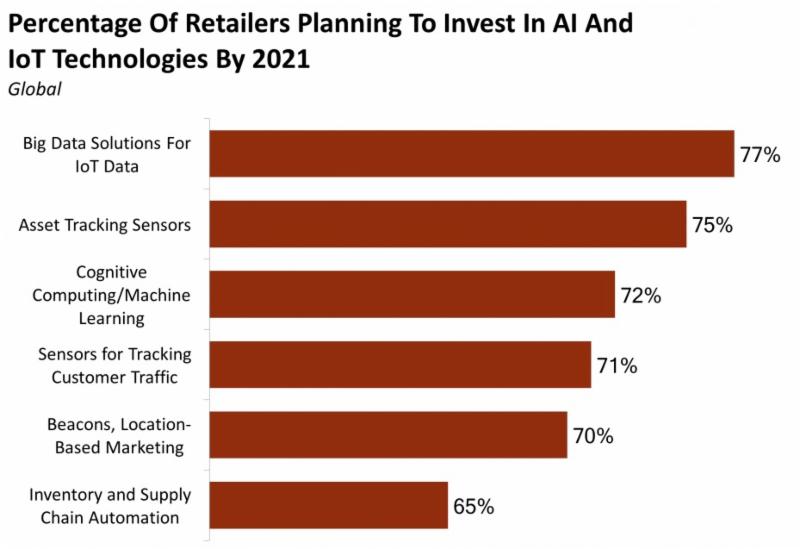
Comment: Look no further than the following chart and read the referenced article if you need reinforcement of the important issues of:
1. keeping up with – which doesn’t cost much – information on technology advances generally and related to specific industries of interest in particular.
2. integrating – which can cost a lot in both direct and indirect costs – technology advances into each and every business.
3. business size and its potential impact on business suppliers, customers and competitors.
This article is focused on retailers. However it seems hardly a stretch to suggest that one could pick any industry and find the same six ‘artificial intelligence’ and ‘internet of things’ categories apply to them as well – albeit perhaps in differing degrees.
Image source: Zebra Technologies, 2017. n=1,700.
|
|
Comment
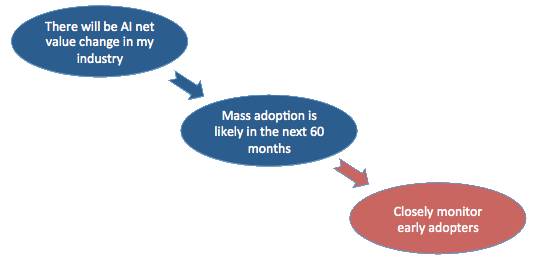
: The graphic shown here is my attempt to sum up McKinsey’s messaging to business owners who believe they are or will be unable to influence or change the mass adoption of AI in their industry.
AI is but one facet of ongoing technological change that is influencing and changing much in contexts of businesses and societies in both developed and developing countries.
McKinsey’s view is that business leaders (read owners) need to – with some urgency – continually study AI applications and scenarios applicable to their business as those applications develop. McKinsey then discusses how business owners – and by proxy their advisors – can define and build an AI strategy applicable to specific businesses.
This article is recommended reading relevant to both business valuation and business transition.
|
|
Comment
: This article begins with the sub-title AI is a fundamental risk to the existence of human civilization. It goes on to say that Stephen Hawking is concerned with Artificial Intelligence (AI) and what it may portend, as is Bill Gates.
The concerns expressed have to do with the achievement of superior to “human level” intelligence AI itself will develop independent of human intervention. This where AI will possess raw intelligence but will be without (1) loyalty to humans, (2) emotion, (3) compassion, (4) fatigue, (5) etc.
Science fiction, maybe. But then again maybe not. An article worth thinking about, curiously at a time when the European Union is strongly promoting AI – see
EU unsure how to ‘make most’ of AI.
|
|
Comment
: Marc Harris is the New York based Head of Global Research at RBC Capital Markets. He canvases a number of things in this article. What caught my eye in particular were his comments on big data where he said (paraphrased) a defining factor in business success or failure going forward will be the ability to create “true information” out of Big Data. By “true information” I assume he means “meaningful information results that can be used to create competitive advantage”
Generation of good Big Data analysis for me is one large positive ‘tick mark’ on the company size competitive advantage ledger. Something business owners and their advisors need to reflect on as they develop business value and transition plans.
|
|
Our information/reference book receives
|
|
|
Comment
: This Reuters article reports that the renamed Comprehensive and Progressive Agreement for Trans-Pacific Partnership (CPTPP) – formerly called the Trans-Pacific Partnership (TPP) – has been agreed but not as yet finalized by 11 countries, including Canada. The article quotes Canadian Prime Minister Justin Trudeau as saying Canada will always be “extremely closely linked to the American economy” but there was a need to diversify trade through other deals. Recall one of President Trump’s first initiatives after he took office in January was to oversee U.S. withdrawal from the TPP initiative.
The U.S. is far from an isolated island in an increasingly globalized world. All one has to do is look at U.S. trade deficits since August 1971 – when then President Nixon embraced a fiat currency world – to see how globally dependent the U.S. economy currently is. Or so I think.
Also see a New York Times article,
Trans-Pacific Trade Partners Are Moving On, Without the U.S. One quote from a former U.S. NAFTA trade negotiator stands out: “The U.S. has been the driving force, not just behind the global economic order, but also pursuing higher standards on free trade … if the U.S. abdicates that role, it puts us in uncharted territory”.
|
|
No financial markets news articles are included in this issue.
|
|
Ian R. Campbell
is the principal contributor to this Newsletter. He has given business valuation and transition advice to both public and private company owners for over 45 years. Other contributors are experts in business transition or specific disciplines relevant to business transition and valuation.
|
|
Newsletter content ('Content') does not constitute individualized business transition, valuation, technology, economic or investment advice. The ideas, views and opinions expressed in the Content are solely those of the authors/contributors. Provided 'as is', Content may change without prior notice, may be incomplete, inexact, incorrect or jurisdiction specific. It is used at the reader's own risk.
|
|
Copyright © 2017 Transitus Publishing Inc. All Rights Reserved.
|
|
|
|
|
|
|