Our Mission


Ignatians West is a community of mature adults rooted in Ignatian Spirituality. We share our skills, talents, experience, and hearts as part-time volunteers in nonprofit agencies. We assist and companion poor and marginalized persons, making real the transformative power of God’s love in both those who serve and those who are served.


The summer has flown by and now, ready or not, it’s time for a new school year.


One of my granddaughters Facetimed me this week to show off her new school supplies. She was excited about all the new “stuff.” So excited with it all that she proceeded to show me what her younger brothers had in their bags as well. I was struck by her delight over something as simple as school supplies and grateful that even though she was going into eighth grade, she still had a joyful childlike spirit.


Yesterday, one of my grandsons brought five of his friends over to spend the afternoon. They ate, swam, laughed and had a good time as my husband and I kept reloading the chips and cookies before they devoured hamburgers and mac and cheese.


 Each is going off within the next week or so to places across the country to begin college. Watching them over the last four years as they matriculated through high school, I was struck that the boys who were so unsure of themselves four years ago are now young men. They know change is coming and they are spending as much time as possible together before they go off in very different directions.


My oldest granddaughter will also be a college freshman. She is excited and nervous all at the same time. She is leaving a warm cocoon that has been her school for six years. She gave it all and knows what lies ahead is terrific, but there are still jitters. I have been commissioned to send chocolate chip cookies as often as possible. There is a special twist to this as her uncle, my youngest child, received cookies in the same mail room she will most likely accept them.


From my vantage point as a grandmother, I cannot imagine raising children without faith that God is with us on the journey. How can a mother or father take on the awesome responsibility of child rearing unless united with the Creator?


The second reading today is about faith. It lays out the faith of Abraham. It begins with, “Faith is the realization of what is hoped for and evidence of things not seen,” and continues offering examples of faith in the life of Abraham. His examples are far greater than any of ours, but when we take on the role of parents, we, too, must dig deep into our faith. We enter into something that offers hope without fully understanding the outcome.

Faith is a decision. It is fluid. It ebbs and flows. It is a gift that embraces trust and courage. It is giving over control to the unknown, although a known at some level for most of us.


As this new school year begins let us do our best to accept the faith that God is with us even in times that confuse us. Let us live this faith and do our best to pass it on to our children and grandchildren, which is often done in deed more than in word.


Let us say a prayer for all the parents who are sending their children off for the first time to a new world, whether that world be kindergarten, college, the military, or the workforce and let that prayer reach to the far ends of the earth, where conflict and violence disrupt family life and education in ways we cannot imagine.


Peace, 

Anne                                                                                        

Paste


Even though we may think of paste as a kind of glue, we might also be familiar with how the word is employed in digital formatting, as in “cut and paste.” The analogy is appropriate, for only something already existing can be pasted onto something else. Children, and adults too, have spent time gathering images, words, and letters which they paste together into collages, which convey meanings far different from the intent of the various sources in themselves.


Just as we can look at a scene, an object, or a person and appreciate the subject of our viewing, we can also make mental collages that change the original meaning of images by mentally bringing others into conjunction with them. For example, we could at one moment simply admire the beauty of a sunset, and at another, bring it together with thoughts about ageing, or with images of self or others who are in the later stages of life, and thereby receive a different set of perceptions even though the original subject has not changed.


We do not cut thoughts or images from one place within us and paste them somewhere else, but we often metaphorically glue together some imaginative thoughts that affect us differently from the previously individual mental pieces. Or we might bring forth specific memories, which, when gathered, reveal to us new ideas and cause different interior movements than any one of them had suggested to us before. This capacity is, according to how we choose to exercise it, a means for greatly enhancing our lives.


Either on our own, or as suggested by others, we can take almost anything that comes to us through our senses, thoughts, and memories, and deliberately add to them a belief, ideal, or other spiritual consideration from within us. Doing so transforms the original movement into one that literally lifts our spirits to a higher and better reality without altering, changing, or denying whatever we had at first received or perceived. 


Another way of observing this activity of which we are capable is to reflect on some of the ways we pray. When we recite written or memorized prayers, we might intend or “direct” them for a specific personal intention that is not contrary to the prayer but is clearly an addition, which enhances this manner of praying. When we pray spontaneously, whether in our own words or in any other way that we open our minds and hearts to God, the implicit or explicit belief that God is present, loves us, and “hears,” us, is always a blessing for us. Sometimes we receive perceptible feelings of consolation, at others a simple awareness that this moment of prayer is right, good, and true.


No training is required, nor do we need anyone’s permission, to use our ability to paste together spiritual components that are pleasing to us and to God.


Randy


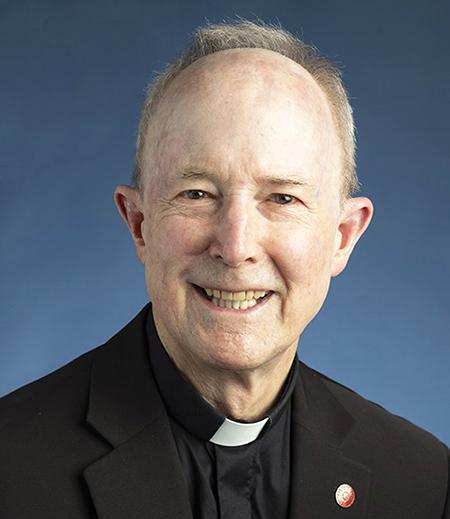
Randy Roche, SJ

University Chaplain

Loyola Marymount University


MAILING ADDRESS

8601 Lincoln Blvd., Suite 180-306 • Los Angeles, CA 90045


ADMINISTRATIVE OFFICE

Center for Catholic Education • University Hall, LMU


PHONE

805-443-0812 (C)

Facebook  Instagram  YouTube