Bytes and Insights Logo

Learn21's Weekly EdTech Update

April 10, 2025

Using Online Discussions to Improve Critical Thinking Skills

by Kialo Edu

Critical thinking is among the most valuable skills for students to develop, laying the foundation for independent thinking, effective problem solving, and informed decision making. 


Classroom discussions are a powerful way to nurture this skill. A free tool like Kialo can enhance these conversations by guiding students to build well-reasoned arguments and collaborate with peers in a structured, visual format.


What are Kialo discussions?

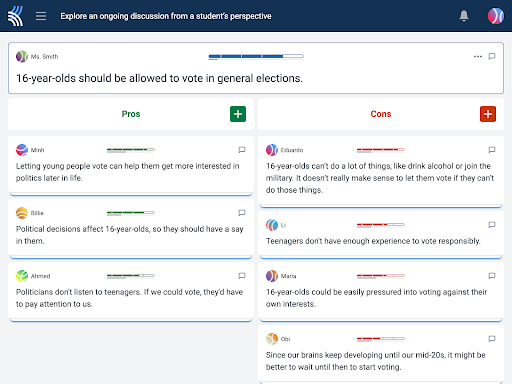
Kialo discussions allow students to collaboratively navigate a topic through an interactive, visual map of structured arguments. Teachers present students with an engaging central thesis and in response, students add their own pro and con claims to support or challenge it.

Kalio Edu Image
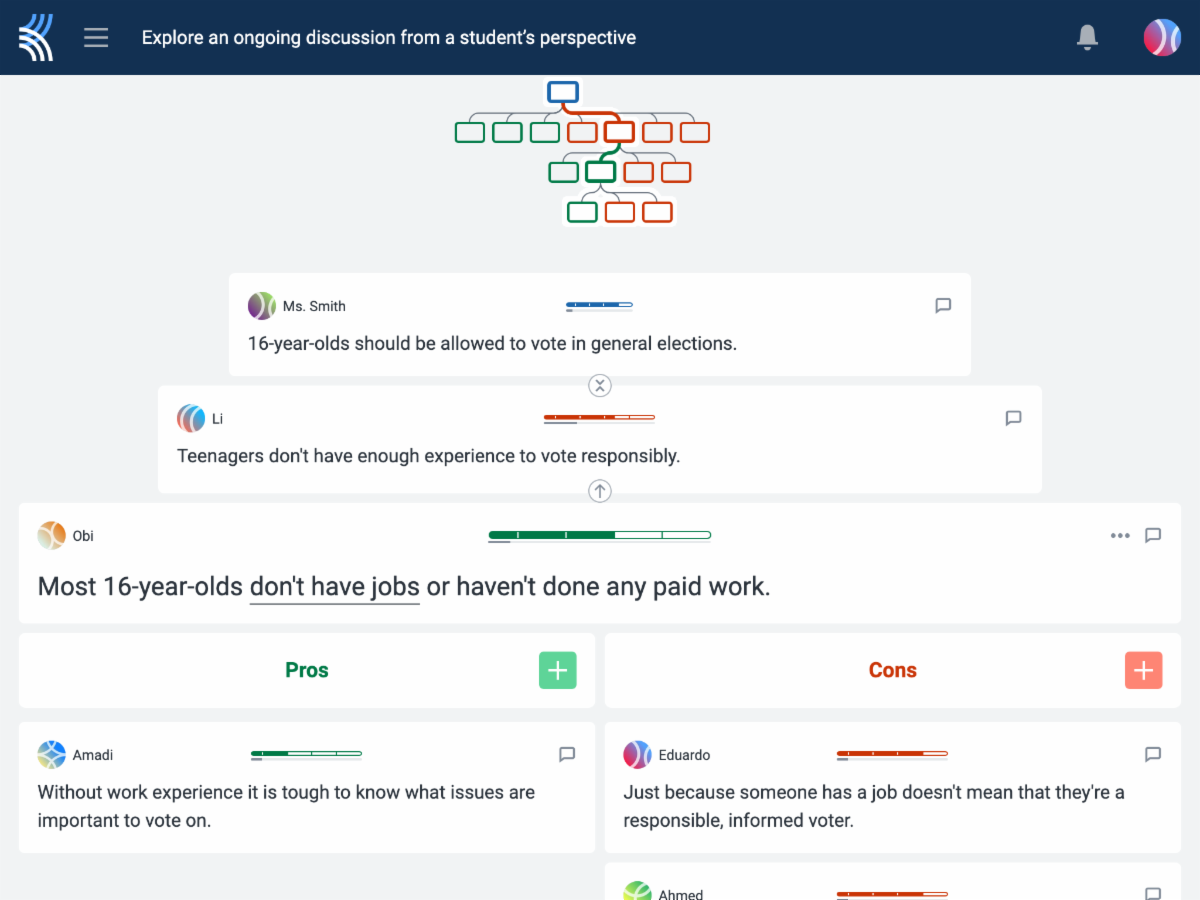
Kailo Image 2

Each pro and con claim can branch into its own supporting and opposing claims, creating a dynamic, evolving discussion. This visual map of reasoning helps students better understand how ideas develop, connect, and build on one another.


Developing critical thinking skills with Kialo discussions

On Kialo, students actively engage with ideas — presenting claims, challenging assumptions, and weighing multiple perspectives to build a deeper understanding. 


As they build and refine their reasoning in an easy-to-follow format, they also deepen their subject knowledge and analytical skills.


Whether students are exploring creative solutions to real-world issues, debating ethical dilemmas, or learning to use credible sources, Kialo provides a safe, structured space for rich, critical analysis.


Encouraging thoughtful, inclusive discussion

Kialo discussions give students the space for thoughtful expression, helping them feel confident by participating and engaging with different perspectives.


  • Simultaneous contributions: Students can jump in to share their ideas without interrupting or waiting for their turn to come around.
  • Time to think: The text-based format eases common traditional class discussion anxieties. Students can think, reflect, and respond thoughtfully.  
  • Peer-to-peer engagement: Students interact directly with their classmates’ ideas, fostering a deeper dive into arguments and counterarguments.  
  • Option for anonymity: Enabling Anonymous Participation mode lets students engage more freely, creating space for honest, respectful dialogue — even on more challenging topics. 


By lowering these barriers to participation, Kialo ensures more perspectives and voices are heard in a discussion and helps create a more inclusive classroom culture. 


Start having richer, more productive class discussions by using one of our Topic Library's ready-to-go discussion resources covering a range of subject areas, from curricular to fun. Kialo is 100% free and integrates seamlessly with Canvas, Google Classroom, Moodle, and all other major LMSs, making it easy to bring meaningful student engagement, critical thinking, and civic discourse to the classroom. Kialo has also signed a DPA with the Student Data Privacy Consortium.


To see this in action, explore our demo discussion, where students develop arguments to shape the discussion in collaboration with their peers.

Media Literacy Minute

Media Literacy Minute

Information Week: Winning the War Against Social Media Disinformation

This piece from Information Week emphasizes the growing role of enterprise IT leaders in combating social media disinformation. It explores strategies like algorithm transparency, AI moderation tools, and partnerships with fact-checkers. The article also argues that improving media literacy—especially among employees and users—is key to stopping the spread of false narratives. 


Psychology Today: The Effects of Influencers on Teens

Psychology Today explores how influencer culture impacts teenagers' self-esteem, media trust, and digital behavior. The article notes that while influencers can offer community and identity, they often blur the line between authenticity and promotion. It encourages teaching teens to question the intent, source, and emotional pull of the content they consume. 


A Scoping Review of Misinformation Detection Interventions in Formal Education"

This peer-reviewed study presents a scoping review of existing interventions designed to help students detect misinformation within formal K–12 and higher education settings.


Key findings include:

  • Most interventions focus on news-related misinformation and often employ techniques such as lateral reading, source evaluation, and credibility scoring.
  • Lateral reading was identified as the most frequently used and empirically supported approach.
  • The majority of studies were conducted in the U.S. and targeted students between ages 11–18.
  • Few interventions addressed emotional responses to misinformation, despite growing awareness that emotion plays a critical role in susceptibility.


The authors call for more comprehensive, diverse, and culturally responsive media literacy interventions, especially in early education and outside the U.S. context.

Beyond Break-Fix: Building a Stronger IT Community in Your District

by Kevin Ghantous

School IT departments are the backbone of modern education, keeping everything from student devices to critical infrastructure running smoothly. But too often, IT teams operate under a “fix and leave” mentality—focused on resolving technical issues as quickly as possible before moving on to the next ticket. While efficiency is essential, this approach can create distance between IT staff and educators, missing an opportunity to build trust, collaboration, and a sense of community within the district.


Technology doesn’t work in isolation—it’s an integral part of teaching and learning. By shifting from a transactional mindset to one rooted in support and partnership, IT teams can enhance their impact, improve job satisfaction, and create a more positive school culture.


Why Building a Strong IT Community Matters

Trust between IT staff, educators, and administrators is not automatic—it’s built over time through meaningful interactions, clear communication, and mutual understanding. When IT professionals are seen as collaborators rather than just problem-solvers, technology integration becomes more seamless, and educators feel empowered rather than frustrated by the tools they rely on every day.


Research from CoSN (Consortium for School Networking) and ISTE (International Society for Technology in Education) shows that the most successful school technology programs prioritize relationship-building, proactive communication, and shared decision-making between IT teams and instructional staff. Schools that foster these relationships experience smoother technology adoption, fewer support tickets, and higher retention among IT staff and educators alike.


So, how can your technology department—whether you’re a CTO, a helpdesk manager, or a field technician—actively build a stronger community in your district?


Five Simple Ways to Build Trust and Collaboration

1. Be Visible and Approachable

  • Don’t wait for teachers and staff to come to the IT office only when there’s a problem. Instead, spend time around the school—walk the halls, visit classrooms, and attend staff meetings when possible.
  • A friendly, proactive presence helps teachers see IT as a supportive partner, not just a last resort when things break.

2. Turn Tech Support Into a Learning Opportunity

  • Instead of just fixing an issue and leaving, take a minute to explain what happened and how educators can prevent it in the future.
  • This builds confidence in technology and reduces repeat issues.

3. Say "Yes" More Often (or Find a Way to Get to “Yes”)

  • Rather than defaulting to “no” when a teacher wants to use a new app or tool, ask about the instructional goal and explore safe, approved alternatives if necessary.
  • Being seen as a problem-solver instead of a gatekeeper builds trust and encourages collaboration.

4. Involve Educators in Tech Decisions

  • When evaluating new tools or planning major technology rollouts, get input from teachers and administrators early.
  • A district-wide tech advisory group that includes teachers, students, and IT staff can help ensure that new technology actually meets classroom needs.

5. Create a Feedback Loop

  • After resolving an issue, follow up to ask if the solution worked or if more support is needed.
  • Proactively seek feedback on IT services through quick surveys or informal check-ins—and act on it.


The Impact of a Collaborative IT Culture

When IT teams move beyond break-fix mode and actively build relationships, the entire district benefits:

✔️ Teachers feel supported and become more comfortable integrating technology into instruction.

✔️ IT professionals gain respect and job satisfaction as they see their work making a direct impact.

✔️ Technology rollouts and changes go more smoothly because there’s trust and buy-in from educators.


As David Schuler, Superintendent of Township High School District, put it: “You must have trust in your CTO [...] You must also unleash them to dream and to have new ideas”. When technology teams feel trusted, they’ll find ways to support teachers and students you never imagined.


At the end of the day, school IT is about more than just devices and networks—it’s about people. By building stronger relationships, fostering trust, and working alongside educators, IT teams can transform from tech support to true partners in education.


Take Action Today!

Want to strengthen collaboration in your district’s IT department? Start small: schedule a check-in with a teacher, spend time observing a classroom, or ask for feedback on how IT can better support instruction. Little actions like these can make a big difference.


What strategies have worked for your team? We’d love to hear from you! Share your experiences with us at info@learn21.org.

Big Ideas

Beavers: Nature’s Unexpected Engineers

Beavers have unknowingly saved Czech taxpayers millions by flooding an abandoned military training site, transforming it into a thriving wetland. These "eco-engineers" remind us that sometimes, nature knows best. What if we worked with wildlife instead of against it?


🤖 Humanoid Robots Are Coming Home

Figure, a robotics startup, is planning to begin alpha testing its humanoid robot in homes by 2025. While robots have long been used in factories, this marks a major step toward integrating them into daily life. Will these robots become household helpers—or just another tech novelty?


London’s Hidden Tunnels Go Public

After decades of secrecy, London is opening its vast underground tunnel network to the public, turning it into a major tourist attraction. These tunnels, once used for wartime and espionage, now offer a glimpse into the city's hidden history. Would you take the tour?


Personalized Audio Without Headphones

Researchers have developed a groundbreaking technology that directs sound to specific individuals without the need for headphones. Using self-bending ultrasound beams and nonlinear acoustics, this method creates "audible enclaves" where only the intended listener can hear the sound. This advancement could revolutionize personal audio experiences, allowing private listening in public spaces without disturbing others.

If you'd like to take a hiatus from Bytes & Insights, please use the Update Profile link below. This will allow you control over which emails you receive from Learn21.

X Share on X
LinkedIn Share on LinkedIn

www.learn21.org

LinkedIn        X        YouTube        Instagram