Bytes and Insights Logo

Learn21's Weekly EdTech Update

August 7, 2025

Digital Boundaries for Educators: Tech That Helps You Log Off

by Carly Ghantous

Educators know the school year can feel like a whirlwind. With the demands of lesson plans, meetings, grading, emails, and the constant ping of notifications finding moments to step away can seem impossible. But here’s the truth: you don’t have to be available all the time to be effective. In fact, building intentional boundaries with technology is one of the most powerful ways to preserve your energy, focus, and well-being.


And here’s the even better news: the very tech that keeps you connected can also help you disconnect, on your terms.


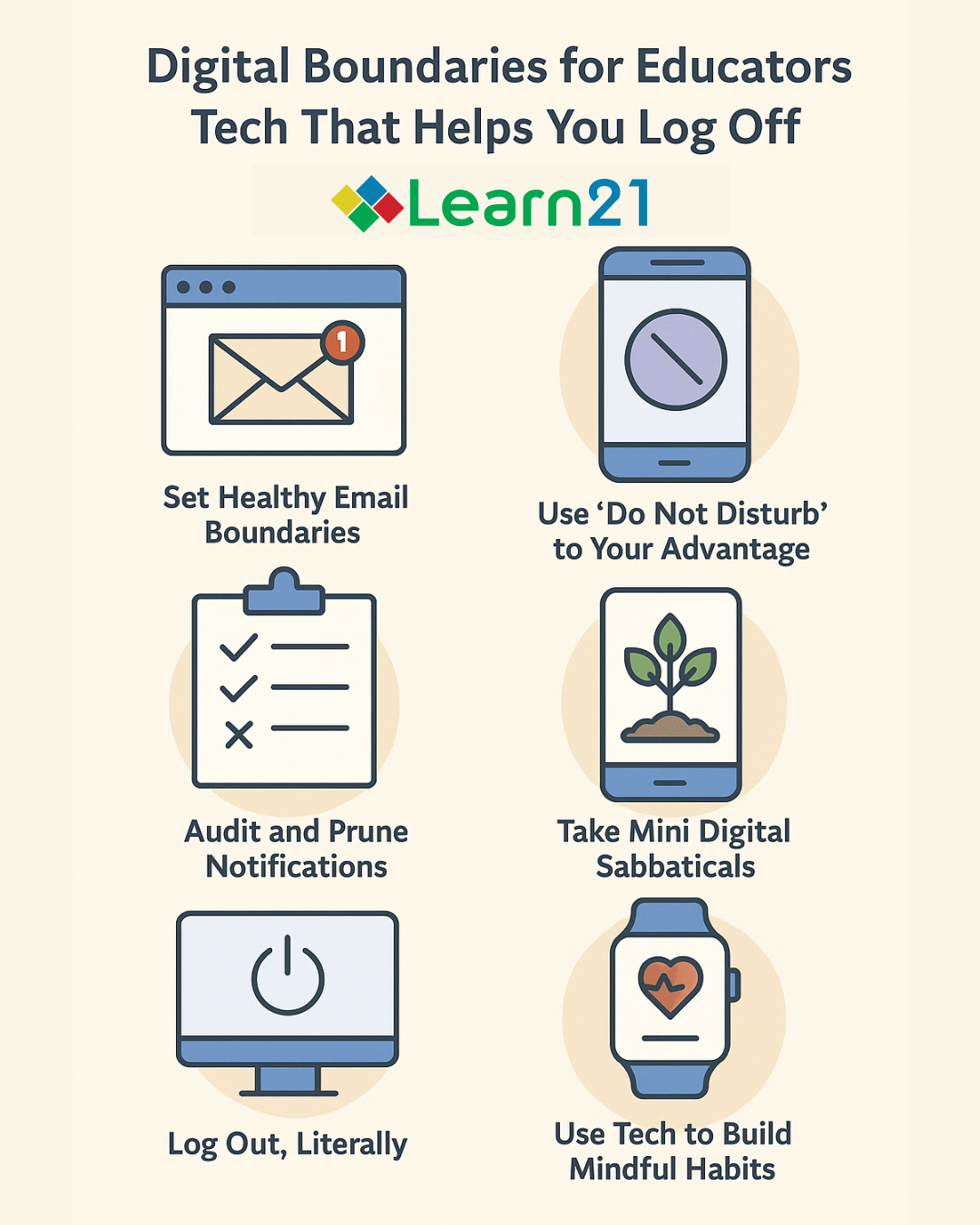
Set Healthy Email Boundaries

Email has a sneaky way of creeping into your evenings, weekends, and even classroom time. Combat the 24/7 inbox by using tools like Gmail’s scheduled send or Outlook’s delay delivery features. This way, you can draft emails when it works for you without signaling constant availability. Setting up auto-replies during evenings or weekends can reinforce your boundaries with colleagues, families, and even yourself. Don’t be afraid to say, “I’ll get back to you during my working hours.” Studies have shown that even the expectation of being available outside of work hours increased stress levels significantly. Pairing those auto-replies with scheduled sending tools, educators can draft responses on their own time without signaling 24/7 availability, setting clear boundaries. 


Use ‘Do Not Disturb’ to Your Advantage

Your phone and computer are loaded with settings designed to protect your attention. Take advantage of features like Focus Mode on iOS, Do Not Disturb on Android, and custom notifications on your laptop. You can even set up specific school hours and home hours profiles to filter out work-related distractions when you're off duty. Want to reclaim your dinner time or get through a Netflix episode without a Canvas alert? This is how you do it.


Take Mini Digital Sabbaticals

Of course, the goal isn’t just to block out work; it’s to cultivate space for joy, rest, and reflection. That’s where apps like Forest, Opal, or Freedom come in. These tools gamify unplugged time, encouraging you to stay off your phone in order to grow a tree, increase your focus score, or earn a streak of distraction-free days. For some, this gentle nudge is just enough to put the phone down and pick up a book or take a screenless walk instead. Many educators find success combining these tools with analog breaks: journaling, reading for pleasure, or simply taking walks without a phone.


Audit and Prune Notifications

Start the school year with a clean slate by auditing your app and device notifications. Do you really need to know the second someone posts in a school group chat? Probably not. Take 15 to 30 minutes to adjust your notification settings across devices and silence non-urgent alerts. Muting or batching notifications allows your brain to reset so that when you do respond, you’re more focused and less frazzled.


Log Out, Literally

This might sound simple, but it works: log out. Remove school email from your phone or browser tabs after hours. Use separate profiles or browsers for school and personal life. Some educators even set a visual cue, like a new background or lock screen that says, “You’ve done enough today,” to reinforce their decision to power down.


Use Tech to Build Mindful Habits

Smartwatches and wearables aren’t just for step counting. Set timers to stretch, breathe, or stand during planning periods. Use reminders to take mindful breaks, drink water, or step away from your screen. Just be sure to turn off notifications from your LMS or email, because a break shouldn’t bring your inbox to your wrist.


Final Thought: Disconnecting Isn’t Disengaging

Creating boundaries doesn’t make you less committed. It makes you more sustainable. When educators prioritize rest, reflection, and real life, they show up as more present, more grounded, and more effective in their roles.


Logging off is not a sign of laziness. It is a practice in longevity. Your students don’t just need you, they need the version of you who is rested, focused, and ready. Not just in June, but every month of the school year.

Media Literacy Minute

Media Literacy Minute

The news is going vertical

Social video has officially become the dominant way many people, especially younger audiences, encounter the news. This World Economic Forum article shows how platforms like TikTok, Instagram Reels, and YouTube Shorts are reshaping news delivery. The challenge for educators? Helping students distinguish between news content and news-like content in an environment where the two often blur.


AI and critical thinking: partner or threat?

Some researchers see AI as a thinking partner, others fear it could deskill us. The mixed research findings highlight a core truth for educators: AI is only as effective as the critical thinking we bring to it. Teaching students to ask better questions and verify AI-generated answers is the new baseline for media literacy.


Digital literacy ≠ digital fluency

Being able to use technology is not the same as being able to understand, adapt, and create with it. This explainer makes the case for building fluency, the ability to apply digital skills in new, complex, and unpredictable situations. In schools, that means moving beyond “how-to” tech lessons and toward authentic, problem-based digital learning.

Universal Design in the Digital Age: A UDL Con Recap

by Erica Shumaker

Have you ever tried to tell your non-EdTech friends and family what you do at work? Are you also met with enthusiasm that quickly turns into either glazed-over eyes or a rant about how AI will take over the world? Are we in the same family?


While this is how many of my conversations with friends and family begin, when I told them about my recent attendance at UDL Con, they were instantly engaged. As I explained Universal Design for Learning (UDL) and what the folks at CAST were doing to make learning accessible for all learners, I was met with the same response: "That's how learning should be!"


I couldn’t agree more. UDL is how education should be. Every learner deserves access to high-quality instruction, the ability to engage with materials in ways that work for them, and multiple options to demonstrate what they know.


What is UDL?

Universal Design for Learning is a framework developed by CAST that emphasizes flexible approaches to teaching and learning. It recognizes that barriers don’t exist in the learner, they exist in the design of the learning environment. UDL calls on us to design proactively, not reactively.


UDL is built on three core principles:

  • Multiple Means of Engagement – tapping into learners’ interests, offering appropriate challenges, and increasing motivation.


  • Multiple Means of Representation – presenting information in different ways to support understanding for all.


  • Multiple Means of Action and Expression – giving learners varied ways to show what they know.


At its heart, UDL is about honoring the variability of all learners.


Whether a student has a disability, is learning English, or simply learns differently, UDL creates a space where every student can succeed.


Highlights from UDL Con

This year’s UDL Con, hosted by CAST, brought together educators, researchers, designers, and innovators who are passionate about transforming education through inclusive design. Here are a few standout themes from the event:


Intentional Design in the Digital Age

In a world saturated with digital tools, it’s easy to assume technology automatically makes learning more accessible. But tech is only as inclusive as the design behind it. UDL Con sessions emphasized the need for purposeful digital learning environments that are built with access in mind from the very start.


Learner Voice and Choice

From session designs to student-centered practices, UDL Con celebrated the importance of empowering students to make choices about their learning.


AI, Equity, and the Future of Learning

Yes, even the AI skeptics in our families would have perked up here. Sessions explored the potential of AI to enhance accessibility through real-time captioning, personalized supports, and responsive tools while also cautioning against bias and inequity.


Bringing UDL Back Home

Walking away from UDL Con, I felt energized and affirmed. The work we’re doing in EdTech isn’t just about devices, platforms, or software, it’s about people. It’s about creating a world where every learner can access, engage with, and express their learning in ways that work for them.


So the next time someone asks what you do, don’t be afraid to tell them. You might just start a conversation that ends with: “That’s how learning should be.”

Big Ideas

Big ideas image

AI-generated Physics Experiments Are Weird… and Right

In a bold test of AI’s creativity, researchers fed GPT-4 advanced physics knowledge and asked it to invent experiments. The results were not only wildly imaginative, like using a neutrino detector to measure tiny particles in a fluid, but many were also scientifically valid. This raises a big idea: could future breakthroughs come not from refining existing methods, but from unleashing AI to break the mold of how science is done? [Quanta Magazine]


What Does AI Mean for Learners with Disabilities?

AI holds promise to personalize learning in ways that empower students with disabilities, but only if accessibility is built in from the start. Stanford researchers argue that inclusive design must become a non-negotiable in AI development. The challenge (and opportunity) is clear: let’s make sure the tools of tomorrow don’t unintentionally exclude the learners who need them most. [Stanford's Accelerate Learning]


Elon Musk’s Neuralink Takes on the Bionic Eye

Neuralink is diving into visual prosthetics, aiming to help blind patients perceive their surroundings through a brain implant paired with camera data. While still early days, this pivot signals that Musk’s company may impact sensory restoration even before broader brain-computer interfaces become mainstream. If successful, it could redefine how we think about sight, disability, and the boundaries of human perception. [Bloomberg]

X Share on X
LinkedIn Share on LinkedIn

www.learn21.org

LinkedIn        X        YouTube        Instagram