Learn21's Weekly EdTech Update
May 1, 2025
| | |
Preparing for the Future: Reflections on the New AI Executive Order in Education
by Stacy Hawthorne, Ed.D.
| | |
On April 22, 2025, the Trump Administration issued an Executive Order focused on advancing artificial intelligence (AI) education for American youth. The order establishes a White House Task Force on AI Education, prioritizes AI literacy across K–12 schools, calls for investments in teacher training, and promotes workforce alignment through AI-related courses and certifications. It signals a national recognition that AI is not just a futuristic concept but an essential skillset today’s students need to navigate tomorrow’s workforce.
While the Executive Order opens exciting opportunities, it also places new responsibilities on K–12 leaders — particularly those leading educational technology initiatives. The call for building AI literacy, empowering educators, and integrating AI thoughtfully into schools requires strategic leadership, intentional design, and a deep commitment to equity and innovation.
As I reflect on this Executive Order, I am encouraged to see national attention moving from AI hype to long-term strategic planning. Elevating AI literacy — not just the ability to use AI tools, but also understanding their societal, ethical, and workforce impacts — is critical. However, success will hinge on whether the voices of educators, EdTech leaders, and school administrators are actively included in shaping these initiatives.
For EdTech leaders, this is a pivotal moment. We must be at the forefront, helping to guide how AI is introduced, used, and scaled in ways that align with strong pedagogy, privacy protections, and learner-centered values. Forming cross-functional teams, investing in professional learning, updating curriculum and licensing standards, and advocating for inclusive leadership in national initiatives are all key steps forward.
Ultimately, the integration of AI into education can be transformational — but only if it is designed with, not just for, educators, students, and communities. This Executive Order is a call to lead boldly, with clarity of purpose and a commitment to innovation and opportunity for all learners.
We’ll be following developments closely as the Task Force takes shape and new initiatives emerge. In the meantime, this is our moment to help shape the future of learning.
| |
Make It Matter: 6 Principles for Meaningful Professional Learning
by Stacy Hawthorne, Ed.D.
| | |
Too often, professional learning for educators is designed around convenience rather than impact. It’s slotted into early dismissals, wedged between grading windows, or downloaded from a cookie-cutter catalog. The result? PD that feels more like a checkbox than a catalyst.
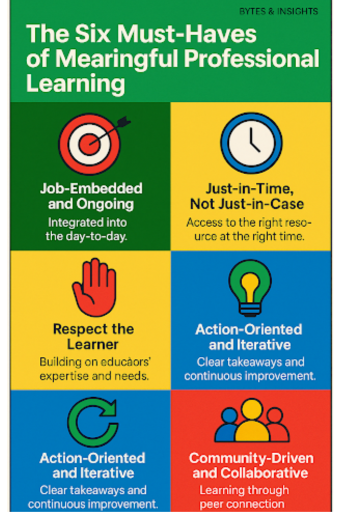
But meaningful professional learning—the kind that ignites practice, builds capacity, and truly respects educators—looks and feels different. Here are six key principles that elevate professional learning from passive to powerful:
1. Job-Embedded and Ongoing
PD shouldn’t be something that happens outside the real work. It should be integrated into the day-to-day. Coaching cycles, team teaching, reflective practice, and instructional rounds allow educators to learn while doing, making the learning stick because it’s immediately relevant.
❝Professional learning should feel like support, not interruption.❞
2. Just-in-Time, Not Just-in-Case
Educators deserve access to the right resource at the right time. Whether it’s a quick how-to on using an edtech tool or a deeper dive into instructional strategies for multilingual learners, relevance and timing are key. On-demand video libraries, microlearning modules, and searchable knowledge bases can transform how (and when) PD meets the educator.
3. Grounded in UDL and Adult Learning Theory
If we wouldn’t stand and lecture students for hours without differentiation or choice, we shouldn’t do it to teachers either. Meaningful professional learning reflects the principles of Universal Design for Learning (UDL) and honors adult learning theory by offering multiple means of engagement, expression, and representation. Flexibility, voice, and ownership are non-negotiables.
4. Respect the Learner
Every educator brings their own expertise, context, and challenges to the table. Professional learning must start with listening—respecting where teachers are and what they need. Surveys, empathy interviews, and co-design opportunities ensure the learning experience isn't “done to” educators, but in partnership with them.
5. Action-Oriented and Iterative
The best professional learning doesn’t end with a slide deck. It creates momentum. PD should include clear takeaways, support for implementation, and a mechanism for feedback and iteration. This builds a cycle of continuous improvement—PD that evolves with the learner.
6. Community-Driven and Collaborative
Learning together beats learning alone. When professional learning is built around peer connection—through professional learning communities (PLCs), teacher-led workshops, or digital forums—it fosters trust, shared leadership, and collective efficacy.
Final Thought
Professional learning is only meaningful when it treats educators like the professionals they are. When done right, it doesn't just change practice, it inspires growth, builds culture, and supports every student through better teaching.
Let’s stop settling for “good enough” PD. Let’s make it matter.
| | |
USF Study Finds Smartphone Use Can Benefit Kids
A new study from the University of South Florida challenges common assumptions about kids and smartphone use. Researchers found that, when guided by responsible habits, smartphones can actually enhance communication, foster friendships, and support learning. The study highlights how context matters—usage patterns, content type, and adult involvement all influence whether smartphone interactions are harmful or helpful. The findings suggest that media literacy education should focus not just on limiting screen time, but also on helping students build intentional, healthy digital habits.
World Economic Forum Tackles Disinformation and Online Governance
At this year’s Davos gathering, world leaders, tech executives, and academics focused on global strategies to combat online disinformation. The World Economic Forum emphasized the need for shared responsibility across governments, platforms, and civil society to safeguard democratic values and reduce harmful content online. The panel discussed regulating algorithms, increasing media literacy, and investing in content authenticity tools as proactive steps toward global resilience. The conversation underscored that media literacy is no longer optional—it’s a civic necessity.
Why Data Literacy Should Be the Foundation of Modern Education
In this Built In article, experts argue that data literacy must be treated with the same priority as reading and math in today’s classrooms. With students constantly consuming information through digital platforms, the ability to interpret statistics, detect misleading visuals, and understand how data is used in storytelling is critical. The article calls for cross-disciplinary approaches, embedding data literacy into subjects from science to social studies, and suggests that cultivating these skills prepares students for both civic life and the modern workforce.
| | |
Enhancing Professional Learning with the EdTech Leaders Alliance
by Erica Shumaker
| | |
Continuous professional development is essential for educators to effectively integrate new tools and methodologies into their teaching practices. The EdTech Leaders Alliance (ETLA) stands at the forefront of this mission, offering a comprehensive platform designed to make professional learning both meaningful and impactful.
A Hub for Collaboration and Innovation
ETLA serves as a central hub for EdTech professionals, fostering collaboration, innovation, and excellence in education. By affiliating with esteemed organizations such as the CoSN, ISTE+ ASCD, SETDA, and the SDPC Alliance, ETLA provides its members with unparalleled access to a wealth of resources and leadership opportunities. These affiliations empower educators to stay abreast of the latest trends and best practices in educational technology.
Engaging Webinar Series
ETLA's commitment to ongoing professional development is exemplified by its dynamic webinar series that is freely open to all. These sessions cover a broad spectrum of topics, from integrating emerging technologies into the classroom to strategies for building leadership teams. By participating in these webinars, EdTech leaders can stay up to date on the latest trends and best practices in educational technology. Our next webinar:
-
Accessibility’s Got Talent: Kelli Suding, Accessibility Specialist with CAST and Michelle Soriano, Professional Learning Specialist on CAST’s Accessibility Team happening May 15th at 12pm ET - Register today.
These webinars not only offer valuable insights but also encourage interactive participation, allowing educators to share experiences and learn collaboratively.
Annual Conference: A Convergence of EdTech Leaders
A highlight of ETLA's offerings is its annual conference, a premier event that brings together EdTech leaders from across the U.S. Scheduled for October 19-21, 2025, at the Nationwide Hotel and Conference Center in Columbus, Ohio, this conference focuses on the integration of emerging technologies in education. Attendees can look forward to engaging workshops, innovative sessions, and dynamic keynote addresses that explore topics such as artificial intelligence in education, data privacy, cybersecurity, adaptive learning, and immersive technologies like augmented and virtual reality. The conference provides an excellent opportunity to connect with peers, share best practices, and deepen professional learning.
Membership Benefits and Opportunities
Joining ETLA offers numerous benefits designed to support and enhance the professional growth of educators:
- Unlimited Access to Resources: Members gain access to a vast array of resources tailored to the needs of EdTech professionals.
- Committee Participation and Advocacy: Opportunities to engage in committees and advocacy efforts, influencing the direction of EdTech initiatives.
- Corporate Council Access: District members can connect with key vendors and leaders within the K-12 educational technology sector through the Corporate Council.
- Personalized Webinars and Conference Discounts: Access to tailored webinars and reduced registration fees for the annual conference.
- Data Privacy Agreement (DPA) Services: Comprehensive support to ensure compliance with data privacy standards.
The EdTech Leaders Alliance is dedicated to transforming education through technology by providing meaningful professional learning opportunities. Whether through engaging webinars, a dynamic annual conference, or a host of membership benefits, ETLA empowers educators to innovate and excel in their practice. By joining ETLA, educators become part of a vibrant community committed to shaping the future of education
| | |
Apple’s iPhone to Finally Allow Default App Changes for WhatsApp
In a move that could shake up smartphone norms, iPhones in the EU may soon let users set WhatsApp as the default messaging and calling app. This shift—prompted by regulatory pressure—hints at a future where users, not tech giants, get to choose their digital defaults. What would your students choose? Read in The Verge
Claude in the Classroom: How College Students Use AI
Anthropic’s new report reveals how university students are using Claude AI for brainstorming, research, and editing—but not for cheating. Students value transparency and use Claude more like a study buddy than a shortcut. Could this reshape how we teach academic integrity in an AI era? Explore the Report
The Most-Read Book Genres by State
Romance reigns in Texas, thrillers rule in Pennsylvania, and self-help dominates in California. This map of America’s reading preferences invites us to reflect on regional identities—and perhaps even rethink summer reading lists. See Your State’s Favorite
| | If you'd like to take a hiatus from Bytes & Insights, please use the Update Profile link below. This will allow you control over which emails you receive from Learn21. | | | | |