|
The em dash (—) is under siege.
Once celebrated as a mark of versatility and flair, it has recently been dragged into an unlikely controversy: critics now point to it as a telltale sign that a piece of text was generated by artificial intelligence. The thinking goes like this — large language models have taken a liking to it, sprinkling em dashes liberally in their prose, and thus it has become suspect.
But here’s the thing: As someone who has devoted a career to studying and teaching the English language, I’ve been in love with the em dash far longer than the robots have. And I’m not ready to let it go.
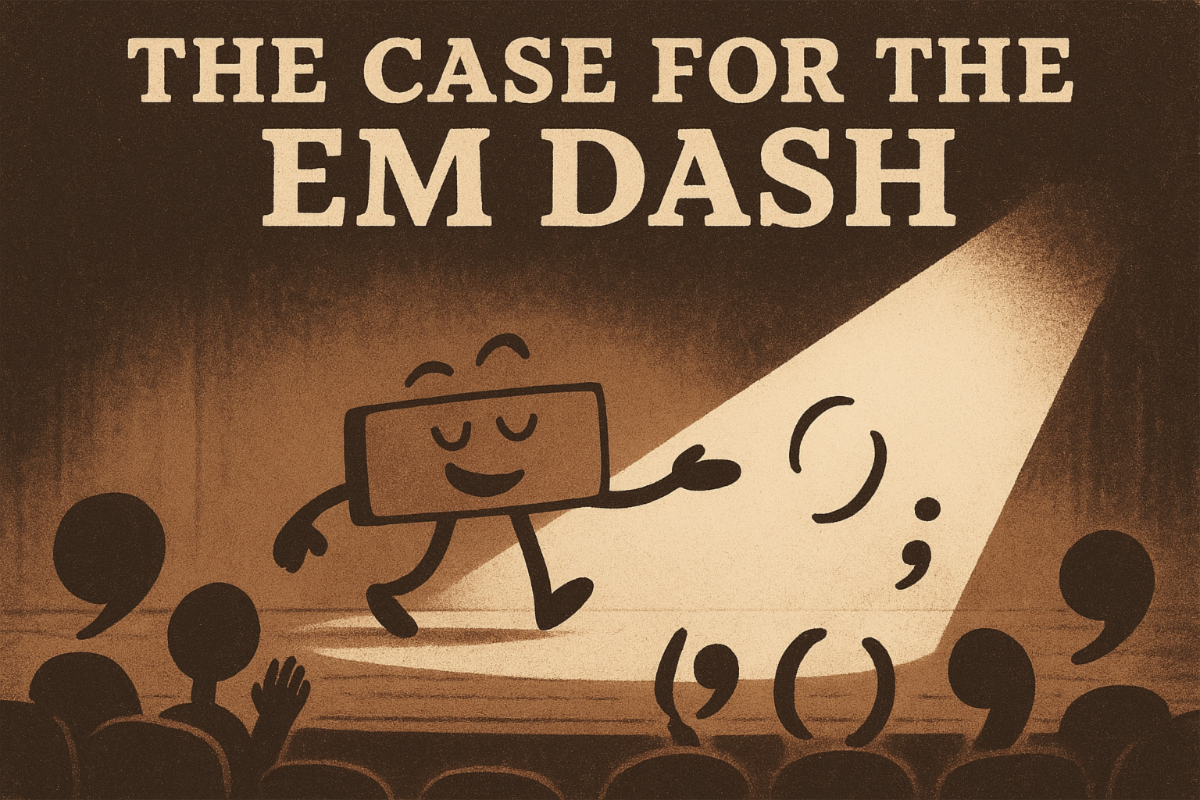
The Case for the Em Dash
The em dash is the Swiss Army knife of punctuation. It can connect, interrupt, clarify, or emphasize. It’s a shape-shifter — a subtle scene-changer — and in the right hands, it’s a tool of rhythm, tone, and personality.
- Flexibility: Unlike the comma, which often needs strict grammar rules, the em dash is freer. It can replace a parenthesis for a softer aside, or a colon for a more dramatic pause.
- Voice: It mimics the patterns of real speech — the sudden swerve, the moment of emphasis — giving writing an almost conversational heartbeat.
- Clarity: Used well, it can cut through complexity by breaking a thought into digestible pieces without feeling abrupt.
The AI Problem — and Why It’s Not a Problem
Yes, AI tools have embraced the em dash. But they’ve also embraced semicolons, sentence fragments, and the Oxford comma — which I also defend as integral elements of language and expression. The real issue isn’t the punctuation itself, but how it’s used. AI-generated writing can overuse the em dash as a crutch, replacing variety with repetition. That’s not a fault of the mark — it’s a fault of the craft.
Human writers have the advantage of intent. We choose the em dash not because it’s statistically likely to appear, but because it’s the right choice for the sentence’s music and meaning.
A Call to Keep It
To abandon the em dash because it has been “tainted” by AI would be like giving up on the guitar because computers can play chords. The em dash belongs to all of us — to the playful, the precise, the dramatic. It’s a part of the human writer’s toolkit, and in skillful hands, it will never feel robotic.
So I say: keep your em dashes. Use them boldly, sparingly, slyly — but use them. And if someone mistakes your human-made dash for a machine’s? Let them. The real giveaway will always be the thought, care, and personality behind the words.
|