Learn21's Weekly EdTech Update

January 29, 2026

The Cost of Being Dependable

By Dr. Stacy Hawthorne

Dependability is one of the most praised traits in education and technology leadership.


We celebrate the people who always get it done, the ones who respond quickly, work late, fill the gaps, and quietly absorb more responsibility without complaint. In many organizations, dependability becomes synonymous with trust.


But there is a cost to being dependable and it’s one we don’t talk about often enough.


Recently, a colleague came to me asking for feedback. She wanted to grow, wanted to contribute more strategically, and wanted to understand how she could stretch beyond her current role. What made the conversation powerful was her honesty.


“I feel like I’m too busy accomplishing tasks,” she said, “and it’s not helping my growth.” She added, “Sometimes I feel stuck in the monotony.”


This is not someone who lacks work ethic. Quite the opposite. She is highly capable, deeply committed, and exceptionally reliable. She works nights. She works weekends. She takes pride in doing high-quality work and being someone others can count on.


And that is precisely where the risk lies.


High performers are often rewarded with more work, not more opportunity. Their competence becomes a magnet for additional tasks, and over time, the role narrows instead of expands. The organization benefits in the short term, but the individual slowly trades growth for throughput.


One of the patterns we discussed was her reluctance to accept help. When I had previously offered to bring in outside support, her response was familiar: “It will take more time to train someone, and I’ll just get further behind.”


That mindset feels practical. It also guarantees that nothing changes.

Over time, this is how capable doers find themselves stuck doing work they have outgrown, efficiently, reliably, and without space to reflect on whether the work itself still makes sense.


Since my early days in the classroom, I’ve tried to approach tasks differently. There are parts of every role that are tedious, repetitive, or simply not energizing. I still do them. But I refuse to do them without asking a follow-up question:


What needs to change so I don’t have to do this the same way again?


Sometimes the answer is as easy as delegation, bringing in another person, even if it takes time upfront. Sometimes it’s technology, finding ways to streamline or automate without compromising quality. And sometimes the answer is more uncomfortable: redesigning or eliminating the task altogether after asking whether it still adds value.


What I don’t do is assume that monotony is the price of competence.

This habit, stepping back after execution to rethink the work, is what creates space for growth. It’s why I intentionally protect time on my calendar for reading, learning, connecting, and thinking, not as a luxury, but as a leadership responsibility.


There is an important systems-level lesson here. When organizations rely too heavily on their most dependable people to carry the operational load, they unintentionally limit those individuals’ growth. Over time, that leads to burnout, disengagement, or attrition, not because people weren’t capable, but because the system never made room for them to evolve.


Dependability should be a foundation, not a ceiling.


The good news is that redesigning work is a skill that leaders and teams can learn and practice. The next step is moving from awareness to action: identifying the work that drains energy, adds friction, or no longer serves its original purpose and then intentionally reshaping it.

The shift from busy to better is where growth actually begins.

Media Literacy Minute

Using Licensed Digital Comics to Boost Reading Habits

A License Global article explains how a licensed digital comics strategy can help spark children’s interest in reading by blending familiar characters with interactive storytelling. According to the piece, when kids read digital comics tied to their favorite brands or franchises, they’re more motivated to read regularly—which educators can leverage to support both literacy and media comprehension. 


How a YouTuber Dominated the Political Conversation

An MPR News report breaks down how YouTuber Nick Shirley became influential in political discourse by using consistent branding, audience engagement, and algorithm-friendly formats to spread his perspective widely. Yayu Feng, assistant professor and media literacy expert in the College of Arts and Sciences at the University of St. Thomas, highlights that understanding why certain voices gain traction online—beyond just what they say—is an important part of media literacy for students today. 


LEGO Education Brings AI Literacy to K–8 Classrooms

According to EdTech Innovation Hub, LEGO Education is expanding its hands-on platform to include AI literacy content for K–8 students, combining physical play with digital experiences that teach fundamental AI concepts. The initiative aims to make abstract technological ideas accessible and engaging, giving students early exposure to the logic and ethics behind emerging technologies.

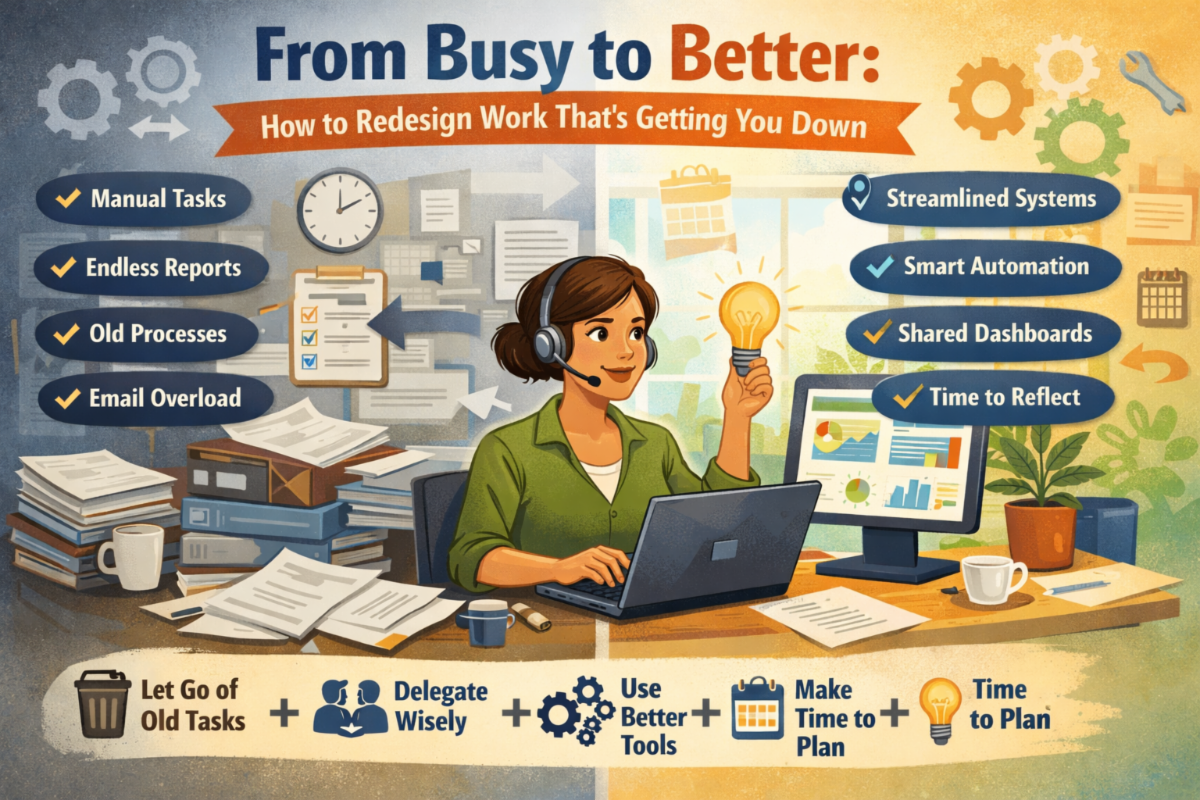
From Busy to Better: How to Redesign Work That’s Getting You Down

By Dr. Stacy Hawthorne

If the cost of being dependable is getting stuck in execution, the antidote is redesign.


Not redesign in the abstract, but practical, intentional changes to the way work gets done. Especially in education and EdTech, where roles evolve quickly and legacy processes tend to linger long after they stop being useful.


Here are five practical ways to begin redesigning work that feels monotonous, inefficient, or draining.


1. Name the work you’ve outgrown

Start by identifying one task, or category of tasks, that consistently drains your energy. Not because it’s hard, but because it’s repetitive, manual, or disconnected from impact.


In education and EdTech, this often includes:

  • Manual data entry or reporting
  • Repetitive vendor coordination
  • Compliance-driven tasks that have grown more complex over time
  • Processes built for tools or systems you no longer use


If a task requires expertise but not judgment, it’s a redesign candidate.


2. Separate “only I can do this” from “I’ve always done this”

Many leaders hold onto work out of habit, not necessity. Ask two questions:

  • Does this truly require my expertise?
  • Or am I the default owner because I’ve always handled it?


In schools and districts, this is especially common with technology coordinators, instructional coaches, and directors who built systems from scratch and never revisited ownership as teams grew.


Redesign often starts with redistribution, not elimination.


3. Use technology to remove friction, not add complexity

Technology should reduce cognitive load, not increase it. Look for places where tools can:

  • Auto-generate reports instead of manual compilation
  • Standardize workflows instead of relying on memory
  • Replace email chains with shared dashboards or forms


If a tool requires constant workarounds, the problem isn’t your effort, it’s the process. 


Redesign means choosing tools that serve people, not the other way around.


4. Question the structure, not just the speed

Efficiency improvements only go so far if the underlying structure is flawed.


Ask:

  • Why does this task exist?
  • Who benefits from it?
  • What would happen if we stopped doing it or did it half as often?


In education systems especially, tasks often persist because they once solved a real problem. Redesign requires revisiting those assumptions with fresh eyes. Doing something a certain way because that’s the way the district has always done it is synonymous with insanity!


5. Schedule thinking time like operational time

Redesign doesn’t happen in the margins. It requires protected time.

Block time on your calendar, not for meetings or deliverables, but for:

  • Reflecting on recurring pain points
  • Mapping workflows
  • Learning from peers
  • Exploring better models


If your calendar only reflects execution, your work will never evolve.


A simple place to start

Choose one recurring task this month and complete it with intention. Then ask:

What would I change if I never wanted to do this the same way again?


Write the answer down. Share it with a colleague. Experiment with one small change.


Moving from busy to better isn’t about doing less, it’s about designing work that creates space for growth, learning, and leadership.


And that work is worth the effort.

Big Ideas

Big ideas image

Hey, you, get off of my cloud

Data centers, which are the engines of the AI revolution, are sprouting up everywhere…when the local community lets them. According to one organization, Data Center Watch, who is tracking the increasing numbers of data center developments, community resistance is stiffening. In fact, “Between April and June alone, its latest reporting period, it counted 20 proposals valued at $98 billion in 11 states that were blocked or delayed amid local opposition and state-level pushback. That amounts to two-thirds of the projects it was tracking.” Community members fear the loss of rural land and increasing energy costs as their main points of contention. More here. 


D’s get degrees, right?

The Future of Life Institute recently scored the major players in the AI space around their ethical practices, using six categories to guide their analysis. The project looked at the company’s actual documented practices, not just their pledges, to score the risk factors.  The news isn’t awesome. The two highest rated companies, Anthropic and OpenAI, could only muster a C+ and a C, respectively. Some of the overseas players scored solid F’s. All this and more in an infographic format here.


So that’s how they make their money, continued.

Coming soon to an AI chat session with you, targeted advertisements. Google is now selling ad placements that are contextually relevant to the conversation you’re having with Gemini (it should be noted that this does not apply to .edu versions). Google claims that the ads don’t shape or steer the AI’s conversation, but just pop in when appropriate. More on advertising and Gemini AI. 

X Share on X
LinkedIn Share on LinkedIn

www.learn21.org

LinkedIn        X        YouTube        Instagram