Learn21's Weekly EdTech Update

May 28, 2026

From Classroom Coach to Data Privacy Champion: Inside the ETLA Certified Coach Program

By Amy Tudor and Danni Tymitz

What does it look like when a professional development experience truly meets educators where they are? For me, Amy Tudor, the answer came through the ETLA Coaching Certification Course. This course is currently wrapping up its inaugural cohort this month, and it is already proving its value in real classrooms and schools.


A First Cohort Worth Celebrating

The first cohort was intentionally designed to allow participants to fully engage. Participants met online each month for two-hour learning sessions alongside regular meetups designed for networking and conversation. In these spaces, we unpacked how the concepts being introduced were actually showing up in our day-to-day coaching work. That blend of structured learning and peer dialogue turned out to be one of the program’s most powerful features.


The collaboration between coaches was so helpful for the learning. When practitioners share what's working, what isn't, and how they're adapting new ideas in real time, the learning goes deeper than any single session can.


Learning That Flexes With You

One of the hallmarks of the program is its flexibility. The portfolio project at the heart of the certification is designed to apply across a wide variety of coaching roles. This means participants aren't forced to retrofit their work into someone else's framework. Instead, they build something genuinely useful for the context they're in.


For me, that flexibility opened a door I hadn't initially planned to walk through. I entered the cohort focused on classroom and technology coaching but, as the program unfolded, my focus shifted toward data privacy. This pivot allowed me to focus on my current role and responsibilities at the EdTech Leaders Alliance. Rather than being a detour, this shift became the foundation of my portfolio work.


Putting Standards Into Practice

My portfolio spans all three domains of the Core of Coaching Framework: Building Relationships, Advancing Sustainable Change in Teacher Practice, and Leading Organizational Shifts, with each piece of evidence aligned to specific standards that reflect my current work in data privacy coaching.


Rather than starting from scratch, the portfolio process gave me a structure for recognizing and documenting the coaching work I was already doing. Domain 1 looks at artifacts that demonstrate how I build trust and communicate my role clearly to the educators and administrators I support. Domain 2 captures how I help technology leaders develop and reflect on their practice around student data privacy, helping them move from awareness to genuine, lasting shifts in how they approach digital tools. And in Domain 3, my work connects to Standard 3.3, empowering technology leaders and building systems that keep the work going even when a coach isn't in the room.


That last piece is where my focus on data privacy becomes especially powerful. The goal isn't just to answer districts' questions about which tools are safe but to build their capacity to ask those questions themselves. Some of the work I am connecting to this standard was developed collaboratively, and the portfolio process gave me a way to situate that shared work within my own coaching practice and articulate the role I played in moving it forward.


Why This Program Stands Out

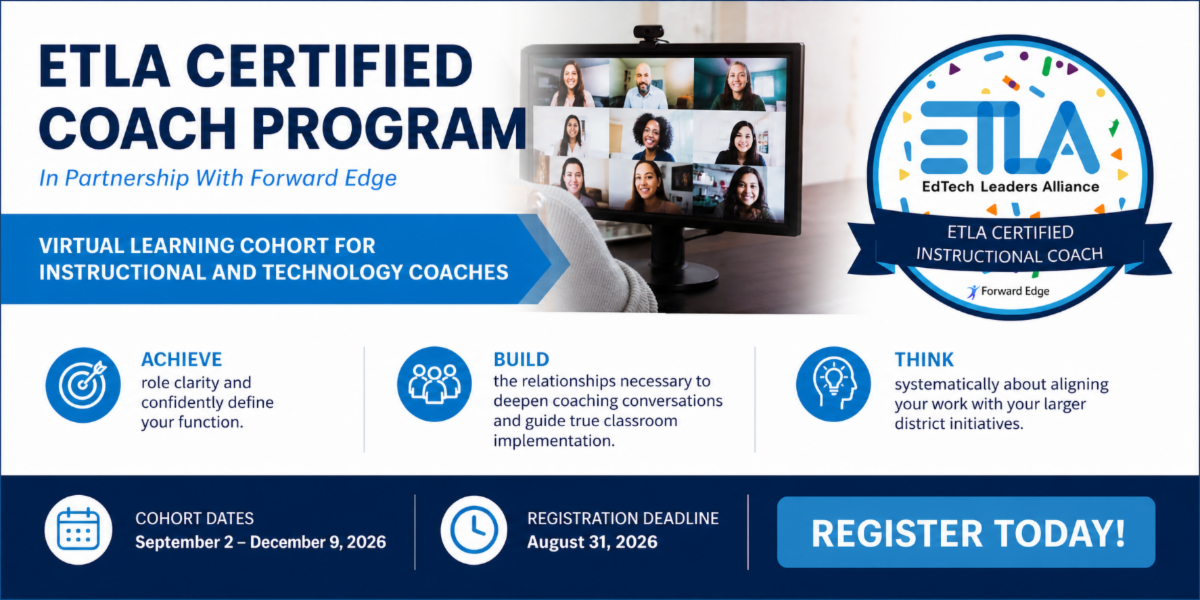
For anyone considering the upcoming fall cohort, Amy's experience points to something important: this isn't a generic professional development course. It's a focused, practical opportunity to differentiate yourself as a coach and deepen the skills that matter most in the work.


Participants come away with sharper skills in building relationships, advancing sustainable change in teacher practice, and leading organizational shifts. These competencies translate directly into impact. The cohort structure itself reinforces this, creating a community of practice where coaches learn from one another as much as from the curriculum.


The ETLA Certified Coach Program is developed in collaboration with Forward Edge, a partner that has been instrumental in bringing this experience to ETLA members.

Fall 2026 Cohort: Registration Is Open Now

Ready to build your coaching credentials? The fall cohort begins September 2, 2026, and registration is open through August 31, 2026.


Key Takeaways from the Program

  • Refine Your Coaching Skillset — Deepen your practice across multiple coaching domains with aligned standards
  • Positively Impact Your School — Build tools and systems that outlast your direct involvement
  • Drive Data-Informed Decisions — Ground your coaching work in evidence and outcomes
  • Join a Collaborative Network — Learn alongside fellow coaches in a supportive cohort community
  • Earn a Respected Credential — Earn the ETLA Certified Instructional Coach designation


Don't miss your chance to be part of the next cohort. Registration closes August 3. Visit the link above to secure your spot.

Media Literacy Minute

Australia's Social Media Ban Has an Unintended Consequence: Less-Informed Teens

A new study from researchers at Western Sydney University, Queensland University of Technology, and the University of Canberra found that 51% of Australian teens reported getting less news as a direct result of the country's social media ban, which took effect in December 2025. This Conversation piece makes a pointed case that banning platforms without creating alternative pathways to news and civic engagement leaves young people less informed, not just less distracted. For educators and policymakers watching U.S. states consider similar restrictions, it's a timely data point worth knowing.


Students Notice the Internet Feels Different — and They're Right

A UCSD student columnist makes a surprisingly sharp observation in this Guardian opinion piece: the internet increasingly feels empty and exhausting not just because of AI-generated content, but because algorithms, content moderation, and platform design have reshaped how humans communicate — even off-screen. The piece introduces students to the "dead internet theory" and the concept of "algospeak," and raises questions about what authentic online community and information-seeking even look like anymore. For media literacy educators, it's a student-voiced entry point into rich conversations about platform design, authenticity, and digital agency.


Digital Literacy Is No Longer Just an Education Issue — It's a National Priority

Governments around the world are shifting how they think about digital literacy and moving from measuring how many people can access the internet to whether citizens can actually navigate it critically and safely. This analysis from the Digital Watch Observatory argues that in an era of AI-generated content, deepfakes, and algorithmically driven misinformation, digital literacy has become intertwined with democratic resilience, cybersecurity, and economic competitiveness. For educators, the key takeaway is clear: schools are increasingly the first line of defense and the pressure to deliver meaningful AI and media literacy instruction has never been higher.

Acronym Bingo

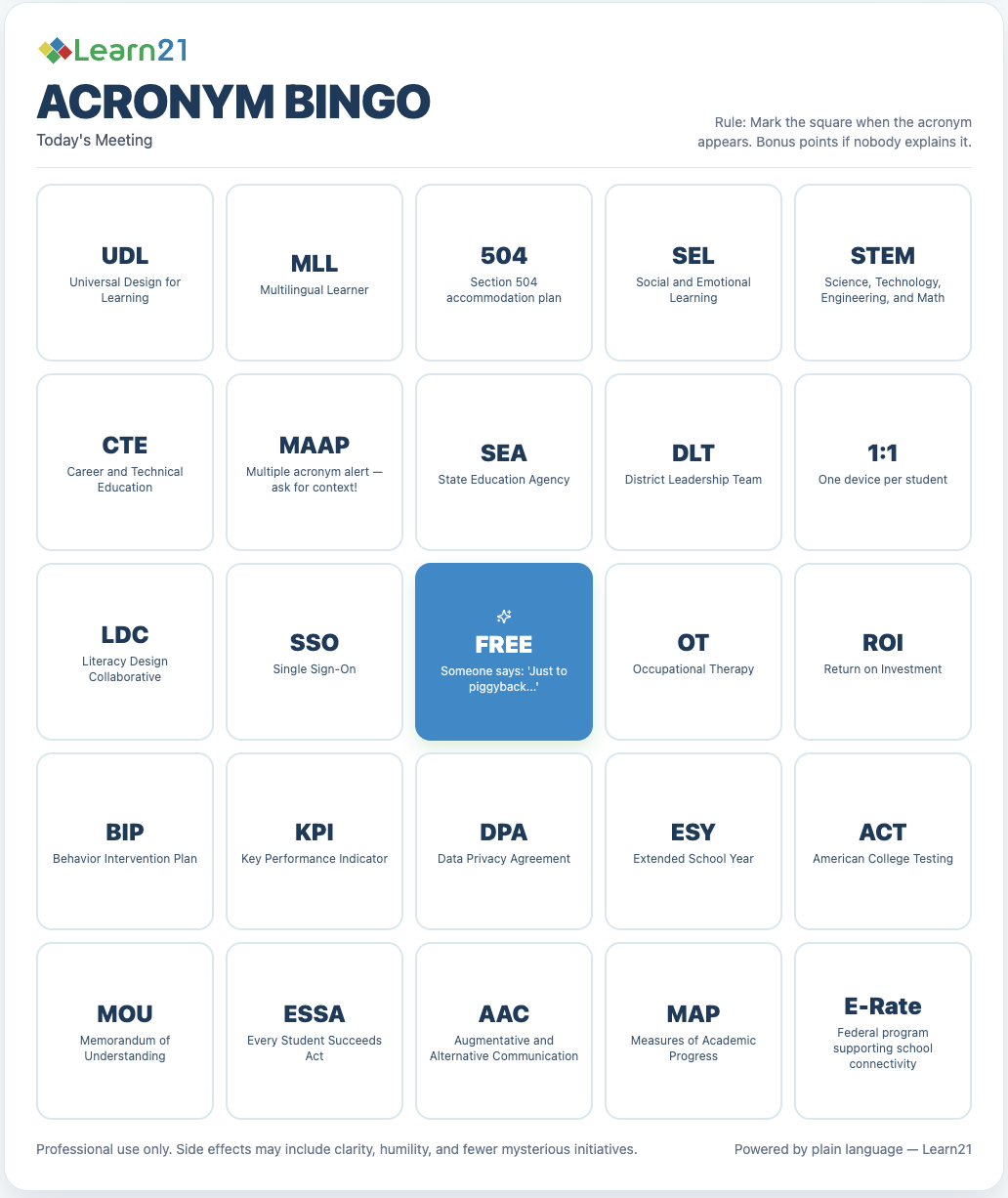
Last week in Bytes & Insights, my colleague, Danni, made a strong case for jargon-free communication with families. The article began with a sentence so full of education-speak that somewhere, a perfectly lovely parent probably whispered, “I’m sorry… what?”


And honestly, we have all been there.


Education has its own language. We do not just “meet.” We convene PLCs. We do not just “help students.” We provide Tier 2 interventions within an MTSS framework while monitoring formative assessment data to ensure instructional fidelity.


That sentence may be accurate. It may even be important. But it also sounds like something you would hear right before someone passes out a 47-page strategic plan and says, “We’ll just go through this quickly.”


This is where Acronym Bingo comes in.


Imagine sitting in a meeting with your very own bingo card. MTSS? Mark it. IEP? Mark it. UDL, SEL, PBIS, FERPA, DPA, LMS, SIS? Congratulations, you are one “stakeholder engagement” away from winning.


Of course, the game is funny because it is familiar. Acronyms are not inherently bad. In fact, they are often useful among people who share the same context. The problem happens when we forget that not everyone is carrying the same decoder ring. The point is not to ban acronyms. Education already has enough bans to debate. The point is to translate them.


Enjoy Acronym Bingo. Laugh when your card fills up before the meeting agenda reaches item three. But then ask the bigger question: if this meeting were full of parents, students, or community members, would they feel included or lost?


Because the real prize is not getting five acronyms in a row. The real prize is communication people can actually understand.

Acronym Bingo Card

Big Ideas

Big ideas image

The Honor Code Is Dead. Long Live the Proctor.

For 133 years, Princeton University trusted its students not to cheat. Students actually asked for that arrangement back in 1893, replacing supervisors with a written pledge and a duty to report anyone who broke it. It was idealistic, it was elegant, and for most of a century, it mostly worked.


Then came the Information Age and AI capable of rendering written exams moot. 

On May 11, 2026, Princeton's faculty voted nearly UNANIMOUSLY to put proctors back in every exam room (which begs the question - when is the last time the entire faculty agreed on something?) The numbers that drove the vote were hard to argue with: 29.9% of seniors admitted to cheating. 44.6% had witnessed a violation and said nothing. Only 0.4% had ever reported a peer. A system built on mutual accountability had quietly become a system where everyone looked the other way.


Princeton isn't alone. Cornell professor Chris Schaffer walks students into a room with no laptop, no phone, no pen, and no paper, and asks them to explain what they learned. His description of the format is the most clarifying sentence in education right now: "You won't be able to AI your way through an oral exam."


Here's the uncomfortable question for K-12: if the honor system broke at Princeton - where students asked for it and defended it for over a century - what does that mean for academic integrity everywhere else? And more importantly: are we designing classrooms that require students to actually think, or just ones that are increasingly easy to route around?


The oral exam is older than the university. Turns out, it might also be the future.


The Robot Didn't Do the Science. But It Kind of Did.

Donald Knuth, the father of algorithmic analysis wrote a paper on “Claude’s Cycles” based on his careful reading of a printed chat log between a colleague and Claude. In it, a mathematician named Filip Stappers spent thirty-one methodical sessions prompting Claude to explore a class of combinatorial objects Knuth had studied for decades. Claude identified a pattern nobody had documented. Knuth verified it by hand, wrote it up, and named it "Claude's Cycles." He admitted he might need to rethink his position on AI.


So who (or what) did the science for this newly identified pattern?

Writer Alejandro Piad Morffis argues that's the wrong question. Looking across four major AI-in-science breakthroughs, including AlphaFold and Google's materials discovery work, he finds the same loop structure every time: a human poses the question, the AI generates candidates, an independent verifier filters them, a human decides what matters. The discovery lives in that loop, not in any single participant.


For educators, the implication is pointed: if generating candidates is now cheap, the scarce skill shifts upstream. The people who matter most will be the ones who know what the right question is and what a correct answer would have to look like. That's what we've always called critical thinking. We just have a sharper reason to mean it now - and even more motivation to fight cognitive surrender.

X Share on X
LinkedIn Share on LinkedIn

www.learn21.org

LinkedIn        X        YouTube        Instagram