Learn21's Weekly EdTech Update

October 8, 2026

The EdTech Graveyard
By Kevin Ghantous

A Halloween stroll past the tools that promised to change everything

Someone has been keeping a body count on Google. Killed by Google lists 308 products, services, and devices the company has shut down, each with its own little tombstone and a cause-of-death blurb. Grab a flashlight and scroll for a few minutes and you'll spot some familiar faces from school buildings: Jamboard, Expeditions, Science Journal, Socratic, and Google Sites (Classic).


Google has company out here. EdTech has a graveyard of its own, and October feels like the right month to take a walk through it.

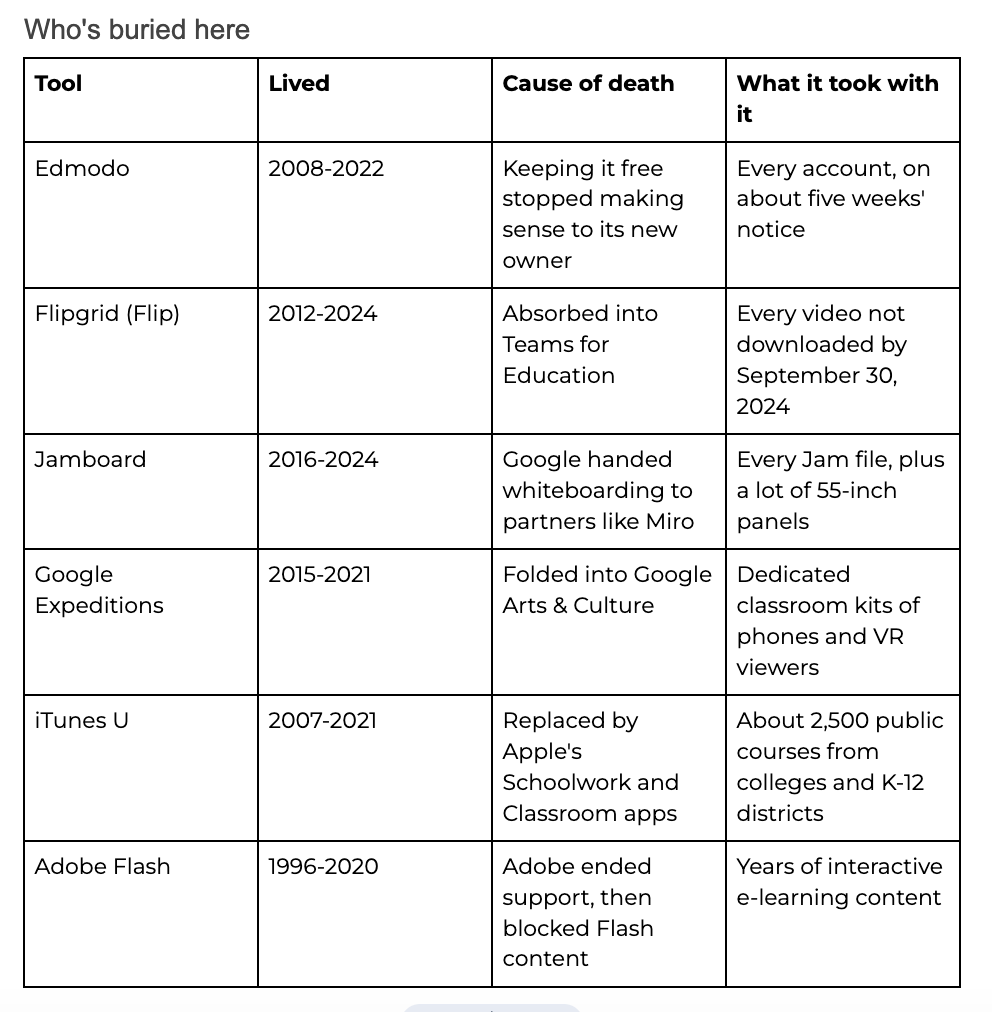
Every one of these showed up with big promises, and a lot of them delivered. Teachers built real classroom practice on Flipgrid and Edmodo. Plenty of kids took their first virtual field trip through a cardboard viewer.


Reading the death certificates

Stare at that cause-of-death column long enough and the same culprits keep turning up.


Acquisitions show up early in a lot of these stories. NetDragon bought Edmodo in 2018. Microsoft bought Flipgrid the same year. A new owner makes a fresh call about what a product is worth to them, and sometimes the answer is a lot less than it was to the people who built it.


Free shows up often, too. When Edmodo closed, it said plainly that keeping the platform free was no longer viable. Districts tend to give free tools a lighter review than paid ones, which gets the risk backwards. A paid contract gives you terms to stand on when things change. A free tool gives you a terms-of-service page the vendor can rewrite whenever it likes.


Big companies also like to tidy up. Microsoft moved Flip into Teams to cut down on the number of apps teachers juggle. Google moved Expeditions into Arts & Culture. A popular standalone tool inside a giant platform company is always one roadmap meeting away from becoming a feature somewhere else.


When hardware is involved, the ghosts turn into zombies. A Jamboard panel in offline mode is still a 55-inch display that powers on and looks ready for class. It just can't open a Jam anymore.


The ghost of shutdowns future

Back on Killed by Google, a few entries have a guillotine instead of a tombstone. Those are products Google has already scheduled for execution. One of them is ChromeOS.


In late September, Google posted the details on its Chrome Enterprise and Education Help site. ChromeOS devices will get regular updates and security patches through mid-2034. Newer devices whose 10-year support window runs past that date will get help moving to Googlebook OS, the Android-based successor, and Google says many will have a direct migration path. The Register reports that the move will require new management licenses, since current ChromeOS upgrade licenses won't carry over.


Eight years is a long runway, and Google gave far more notice than Edmodo ever did. For a lot of districts, though, ChromeOS runs more than the 1:1 program. Testing carts, libraries, and front offices might depend on it too. A Chromebook you buy this year comes with a 10-year support promise that runs about two years past the end of ChromeOS. Whether it gets there depends on a migration list Google hasn't published yet. Ask your reseller about it before the next purchase order, and add 2034 to your refresh plan.


Before the next headstone goes up

Most of us evaluate tools on the way in. Does it work? Will it integrate? Does it meet our privacy requirements? What will it cost? The way out gets far less attention, and the way out is where every story above went sideways.


A few questions worth adding to your next review:


  • How much notice do we get if the product is discontinued?
  • Can we export our data in a format we can actually use? A PDF of a Jamboard is a photo of something that used to be interactive.
  • Where does student work go if the platform closes?
  • If the company is acquired, do our terms carry over?


If your district uses the National Data Privacy Agreement (NDPA), it already includes a section on disposition of data at the end of the agreement. Give it a read now, while it's still a hypothetical.


Then try one exercise this month. Pick your three most-used instructional tools and export everything. Open the files and ask whether a teacher could pick up where they left off. If the answer is no, you just found the tool most likely to haunt you.


The spooky part

Microsoft's support forums still get posts from teachers and former students looking for their old Flipgrid videos. The answer has been the same every time: if it wasn't downloaded by September 30, 2024, it's gone.


Those people did nothing wrong. They used a tool that worked, from a company with a name everyone trusted. Most of the tools in the graveyard were good ones, and that's what makes walking through it a little unsettling.


Happy Halloween. Go check your exports.

Media Literacy Minute

Massachusetts Tests Are Missing Media Literacy

Massachusetts says it wants graduates who can judge the credibility of information, yet its state ELA, civics, and biology tests do not measure those skills, according to two education advocates. Because what gets tested tends to get taught, they argue assessments must catch up, pointing to North Carolina and New York as proof it can be done. This CommonWealth Beacon op-ed is a useful prompt for educators and parents asking whether schools truly teach students to evaluate sources.


Beyond Social Media Bans: Helping Young People Flourish Online

Bans on youth social media use are meant to manage real harms, but young people can still flourish in digital spaces such as social media and online gaming. The analysis points to digital literacy, digital resilience, and creative confidence as the strengths that help them do so. Parents and educators weighing restrictions against skill-building will find a useful lens in this Conversation piece.


Schools Are Adopting AI Faster Than the Evidence

AI is entering K-12 classrooms faster than research can show what works, leaving many educators to rely on personal judgment rather than reliable data. The analysis flags low-quality AI-generated content, student data privacy risks on EdTech platforms, and the reality that not all screen time is equal. Educators weighing new tools can find a useful starting point in this Furman University analysis.

The 3,000-App Problem

By Stacy Hawthorne, Ed.D

Three thousand and one.


According to Instructure, that is the average number of unique digital tools available in a K-12 district.


Now for the more surprising number. Four.


Their EdTech Top 40 report found that the average student interacts with four LTI tools annually. So does the average educator. Taken together, those numbers offer a striking contrast: districts are managing enormous technology ecosystems while individual students and educators regularly interact with a relatively small set of integrated tools.”


That doesn't mean districts should immediately start canceling software. But 3,001 should make us ask some questions.


How Did We Get Here?

For most of the last two decades, educational technology has been additive. A teacher discovered a great tool. A department purchased another. A grant funded something else. The district adopted a new curriculum with its own digital platform. Another application solved an administrative problem. Then came 1:1 devices, pandemic-era purchasing, artificial intelligence and thousands of increasingly specialized products promising to make some part of education better.

Many of those tools are excellent. The problem is that almost nothing ever leaves. Every application that remains in the ecosystem can carry a cost beyond its license price. Someone may need to manage accounts and integrations. Someone may need to review privacy practices. Staff need support. Students need to navigate another interface. Data may need to move between systems. Contracts need to be reviewed and renewed.


Multiply that by hundreds, let alone thousands, and tool sprawl becomes a leadership issue.


The question needs to shift from, “Is this a good tool?” to, “Does this tool deserve a place in our ecosystem?”


Good EdTech Leadership Is Becoming More Discerning

For years, a robust technology program could be measured partly by access. Did every student have a device? Did teachers have digital resources? Did the district provide enough options? Those questions still matter, but access alone is no longer enough.


A mature district ecosystem should be able to answer why its major tools are there. What problem does this solve? Who uses it? What outcome are we expecting? Does it protect student information? Is it accessible? Does it integrate with our other systems? Are we duplicating something we already own? And perhaps the question districts have historically been least comfortable asking: What would happen if we stopped paying for it?


Usage Isn't the Same as Value

A tool should not automatically disappear because its usage numbers are low. Some of the most valuable technologies in a district serve relatively small populations. Accessibility tools, specialized interventions, assistive technologies and systems supporting specific student needs may never generate enormous usage numbers.

Likewise, a highly used application is not necessarily a highly valuable one. That is why rationalizing the edtech ecosystem cannot become a spreadsheet exercise where the lowest login count loses.


Usage is evidence. Cost is evidence. Teacher feedback is evidence. Student outcomes are evidence. Accessibility, privacy, interoperability and instructional purpose are evidence. Leaders need to consider all of them.


From Collection to Curation

There is something encouraging in the new data. Instructure describes districts as beginning to move away from technology accumulation and toward more deliberate ecosystem building. That may be exactly where educational technology needs to go next.


The first generation of digital transformation was about getting technology into schools. The next generation should be about becoming exceptionally thoughtful about what earns the right to stay.

Big Ideas: Amateur Hour, Professional Results

Spooky season is here, and science is serving three stories about things crawling out of the deep, back from the dead, and stitched together from spare parts.


Something Hairy This Way Crawls

University of British Columbia researchers have identified two new sea spider species in the Salish Sea, the first new ones formally described there in nearly a century. The star is Callipallene pilosuspedes, whose name nods to the Latin for "hairy feet." It has red eyes and a triangular, three-lipped mouth ringed with sensory tendrils, which the press release helpfully compares to a tiny Sarlacc pit. Before anyone cancels their beach plans, these critters have no venom or fangs and mostly rely on camouflage to avoid becoming lunch. 


Jurassic Antibiotics Rise From the Grave

University of Oregon biologists have resurrected antimicrobial proteins dating back as far as 160 million years. Some of the extinct versions proved more potent against drug-resistant bacteria than their modern counterparts. The twist is that the oldest zombies weren't the strongest. The earliest peptides damaged bacterial membranes, but the bacteria managed to repair themselves. Versions from mammal ancestors only a few million years old hit progressively harder, sometimes outperforming the human version. Science finally brought something back from the Jurassic, and it's a peptide instead of a velociraptor. Spielberg is devastated; your immune system is thrilled. 


Frankenbrain: Two Organs, One Skull

A Stanford Medicine-led study suggests the human brain may actually be two ancient nervous systems packaged together. One is a primitive section running heartbeat and breathing. The other handles poetry, math, and existential dread. In mouse embryos, the researchers found two populations of brain progenitor cells that never overlap, and they saw the same pattern in chickens, zebrafish, and acorn worms. Lead researcher Kyle Loh says a single organ would probably be more efficient, but evolution apparently prefers the duct-tape approach. Evolution looked at two perfectly good nervous systems and said, "What if we just shoved them in the same drawer?" Relatable. 


It's alive! It's ancient! It's probably in the Salish Sea right now! Happy October.  Mary Shelley had the right idea; she just had the timeline wrong. Life doesn't need a mad scientist and a lightning storm to get weird. It's been resurrecting, recombining, and lurking in the shallows for hundreds of millions of years without supervision. The difference now is that we're finally learning to read the old blueprints and put some of them back to work.

X Share on X
LinkedIn Share on LinkedIn

www.learn21.org

LinkedIn        X        YouTube        Instagram