Learn21's Weekly EdTech Update

September 10, 2026

Mental Obesity (Patent Pending)
By
Brandon Langer, ETLA Keynote Speaker

If you swap "AI" for "social media," half of today's hot takes could have been written almost twenty years ago. Same fear, same outrage, and in some cases, the same excitement. The tech changes. The panic reruns.


Here's what nobody wants to say out loud: humanity may be headed for a permanent case of what many call "brain rot." I'd like to coin something a little more clinical for the history books: mental obesity, patent pending, royalties negotiable. 


What ultra-processed food has done to our bodies, we are now at risk of doing to our brains. If I eat nothing but Cheetos and Mountain Dew for a year, I do not need a research study to tell me what happens next. That is not a food-science mystery. 


Same deal with a student who opens a free, generic chatbot every time an assignment gets hard. It’s digital Mountain Dew: a quick hit that skips the thinking instead of building it. 


And notice what that argument is not saying. It is not an argument against the freezer.


Your freezer holds vegetables and protein just as easily as it holds ice cream and frozen pizza. Same appliance, completely different outcome, and nobody's actual objection is to owning a freezer. The debate that matters is not whether AI belongs in a school. It is what we are choosing to stock inside it, and how much of the shelf is real food vs. empty calories dressed up as convenience.


There's a quieter belief hiding underneath a lot of this panic, though, and it deserves to be dragged into the light: the idea that we are only allowed to use something once we have proven we could have done it ourselves, the hard way, first. Follow that logic all the way out and nobody ever boards a plane until they have flapped their arms hard enough to get off the ground on their own. Some things were never going to happen on unaided human biology alone, and that was never actually the point. The point was getting somewhere we could not get to by ourselves.


So here is the actual challenge, and it is a real one, not a talking point: not all struggle is protein, and not all ease is the empty calories. Some struggle builds capability. Some struggle is just carrying the groceries up ten flights because taking the elevator felt like cheating. School has spent a very long time confusing the two, protecting the busywork nobody needed while stripping out the genuine productive struggle that actually built something. Solve that distinction and you've solved a decent chunk of why school has felt like a grind for reasons that had nothing to do with rigor.


Before your district authorizes the next AI tool districtwide, four questions do more good than any policy draft ever will:

  1. Define the target. Is this friction worth protecting, or friction worth removing? Not everything hard is meaningful, and not everything easy is a shortcut.
  2. Protect the struggle that's actually productive. Does the tool support cognitive work, or hand over the answer and call it help?
  3. Check the build. Purpose-built for a classroom, or a generic assistant wearing a school-branded hoodie?
  4. Know where the off-switch is. Sometimes the right move is closing the laptop and having a human say "try that again" or "explain it to me." That is not the backup plan. That is the whole plan. Our tools should create more time for it to happen.


The day I got my first laptop, I got somewhere pencil and paper had been quietly keeping me from reaching on my own. I never went back. That's one data point. Mine. But my brain hasn't spent the last twenty years in decay. It's spent them in training.


It’s time to stop arguing about the freezer and start being honest about what's in it. And it’s worth being honest about the flights that were never meant to be flapped.


I will be talking through more of this live at ETLA this October, my guitar probably within arm's reach. I hope to see you there!

Media Literacy Minute

Scene on Radio Turns the Lens on Its Own Media Bias

Host John Biewen invited Ad Fontes Media, the company behind the widely-shared Media Bias Chart, to rate Scene on Radio itself. Founder Vanessa Otero's team scored the show "strong left" on bias but gave it a high reliability score (about 38, on par with the Atlantic and Washington Post), and Otero insists the two are independent: bias just reflects where an outlet's language lands on the left-right spectrum, not whether it's truthful. Co-host Chenjerai Kumanyika pushes back, arguing the chart's design, a "safe zone" box built around low bias and high reliability, visually equates "centrist" with "best," even though Otero herself says there's no such thing as unbiased. This Scene on Radio episode also flags an analyst note that dinged an episode for "strong left leaning" bias simply for discussing climate change, questioning whether the methodology conflates factual reporting with partisan lean.


Memes and Teens: A Media Literacy Lesson Plan

Teens scroll past dozens of memes a day without pausing to unpack the ideas, biases, or misinformation packed inside them. This New York Times Learning Network lesson gives educators a ready-to-use framework for teaching students to slow down and critically analyze meme content, tracing its sources and intended messages for a media literacy exercise built around content teens already know well. Be sure to watch the contest winning video to hear first hand how students are relating to memes and social media. 


Talking to Tweens About AI: What Experts Recommend

Nearly two-thirds of tweens use AI at least monthly, yet close to half say a parent or guardian has never talked with them about using it safely. This PBS News investigation lays out how caregivers can start age-appropriate conversations about AI’s limitations, data privacy, and the difference between a chatbot and a real relationship. It offers concrete talking points educators and parents can use to build AI literacy at home and in the classroom.

Why the ETLA Conference Stands Out

By Erica Shumaker

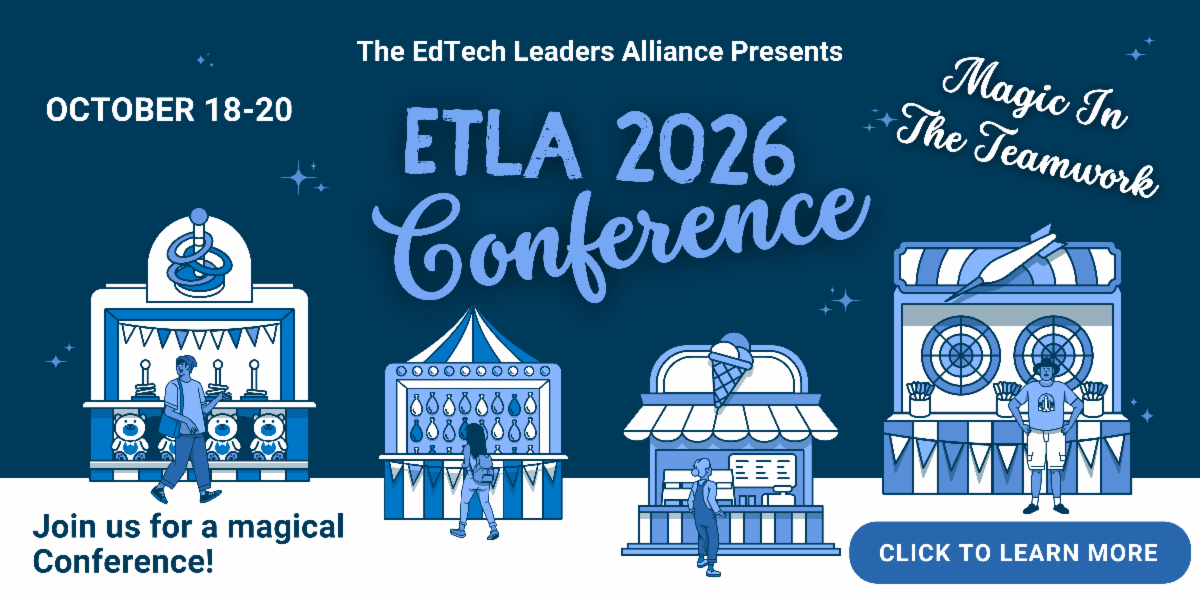
Mark your calendars, because October 18–20 at the Ohioan Hotel in Columbus, we're pulling off some serious magic together. This year's theme, Magic in the Teamwork, is all about what happens when educators, tech leaders, and innovators work to build something bigger, together.


Come for the learning. Stay for the community. Leave with your sleeves rolled up and a few new tricks in your bag.

Learn more about this year's conference and register at learn21.org/conference.


✨ Keynotes

Brandon Langer: Building What Endures

Most initiatives don't fail on merit. They collapse under the weight of the next trend, and the failure starts earlier than you think. Brandon walks through four stages for building programs disciplined and technology-agnostic enough to outlast the moment, the tool, and the person who started them. Make sure to catch Brandon's Keynote on Monday morning!


Purpose in Practice: Powerful EdTech at Every Level

What does purposeful technology look like when it's working at its best? Dr. Stacy Hawthorne moderates a panel spanning district, state, and national perspectives with Jennifer Fry, Dr. Amy DeCorvo, Jill Pierce, and Jenn Womble, moving beyond the device debates to focus on what matters: expanding opportunity and deepening learning. Join us for this amazing panel Tuesday morning.


✨ Community Building Opportunities

Emerging Technology Community Launch

AI tools are showing up in classrooms faster than anyone can evaluate them, and that's just one corner of it. New platforms, privacy questions, and vendor claims, most districts are working through it alone. This session launches the ETLA Emerging Technologies Community, a regular check in for EdTech leaders to compare notes on what's working, what's not, and what's next. Let us know you are interested in joining us here.


Women in Technology Community Kick Off

Join us as we launch ETLA's Women in Technology Community, a space built by and for women in educational technology across Ohio. Connect with peers, shape what this community becomes, and help set the agenda for the year ahead. Whether you're a longtime member or brand new to the network, bring your voice and your energy.


✨ Pre-Conference with Five Star Technology

AI, Innovation & Efficiency: A Collaboration for K-12 Technology Directors

AI is changing how school districts operate, and this interactive session with Five Star Technology Solutions gives K-12 technology leaders practical ways to put it to work.


Explore AI tools, vibe coding, and simple apps that solve real challenges and cut costs. Leave with ideas you can implement right away, plus time to connect with fellow technology directors facing the same opportunities and challenges.


Join Five Star on Sunday, October 18th from 10am to 2pm, before the ETLA Conference kicks off at 3pm.


Limited to the first 36 registrants. Already registered for the conference and want to add this session? Email Erica at conference@edtechleadersalliance.org.


✨ Social Events That Make the Teamwork Shine

Conference magic does not stop when the sessions end. This year's social lineup is built for connection, a little friendly competition, and a lot of fun.


Puttshack Social — Sunday, 3:00 to 5:00 pm. Kick off the conference with mini golf, great company, and a relaxed way to meet fellow attendees before the conference officially begins.


Dueling Brandons Guitar Night — Sunday, 6:30 to 9:30 pm. Grab a seat, sing along, and enjoy an evening of live music and friendly back and forth between two talented guitarists named Brandon.


Vendor Hall Reception — Monday, 4:00 to 6:00 pm. Explore the latest tools and solutions from our exhibitors while connecting with vendor partners over appetizers and drinks.


Electric Magic Social — Monday, 7:30 to 10:00 pm. Close out the day on the dance floor as ETLA's own DJ Jennah brings the tunes for a night of celebration with your EdTech community.


Social events are included in your conference registration. These are the moments where new ideas turn into new friendships.


✨ Register Today

As a district member, you'll save 10% off registration through the ETLA District Member registration pathway at www.learn21.org/conference,


✨ Book Your Hotel

Make sure to book your hotel room by September 20th to lock in our group rate!

Big Ideas - The Unseen Forces of Fall

Static Electricity Has Baffled Scientists for Centuries. A Coating of Invisible Carbon May Be Why

Rub a balloon on your hair and you get a shock. Ask a physicist why one object ends up positively charged and the other negative, and until recently, the honest answer was: nobody really knew. It's one of science's oldest open questions, hiding in plain sight every time your socks crackle on the carpet. A team led by physicist Scott Waitukaitis at Austria's Institute of Science and Technology found a hidden culprit: a thin, practically invisible layer of carbon-based molecules that coats almost everything, even identical materials like two grains of sand. That coating appears to be what tips the charge balance one way or the other. The implications go way beyond hair-raising party tricks — this same effect may explain volcanic lightning, dust-storm zaps, and even how swirling gas and dust first clump together to build planets.


Diamonds Were Supposed to Be Electrically Boring. Turns Out They're Not.

Diamond has a reputation problem: hardest natural material on Earth, dazzling in jewelry, but electrically dull; its rigid, symmetric crystal structure was long thought to make it incapable of generating electricity when squeezed or bent, unlike piezoelectric materials such as quartz. Researchers have now shown that's wrong, at least at very small scales. Ultrathin, flexible diamond membranes exhibit a strong, repeatable piezoelectric effect, meaning mechanical stress on the material reliably produces an electrical charge. Because diamond is also exceptionally durable, biocompatible, and stable at high temperatures, this could open doors to diamond-based sensors, medical implants, and durable electronics that could survive conditions that would destroy conventional piezoelectric materials.


Watch the Sky This Month: A Harvest Moon Rises Alongside a Brilliant Venus 

Fall's arrival isn't just about pumpkin spice and falling leaves, it's written into the night sky, too. This month brings the Harvest Moon, the full moon closest to the autumnal equinox, historically prized by farmers for the extra evening light it offered during the final harvest push. Alongside it, Venus is currently blazing as one of the brightest objects visible after sunset, making for a striking naked-eye pairing. Unlike the electricity mysteries above, this one is pure celestial mechanics: the Moon's orbital timing relative to the equinox, and Venus's position in its orbit relative to Earth, are both fully explainable and just genuinely lovely to watch.

X Share on X
LinkedIn Share on LinkedIn

www.learn21.org

LinkedIn        X        YouTube        Instagram