|
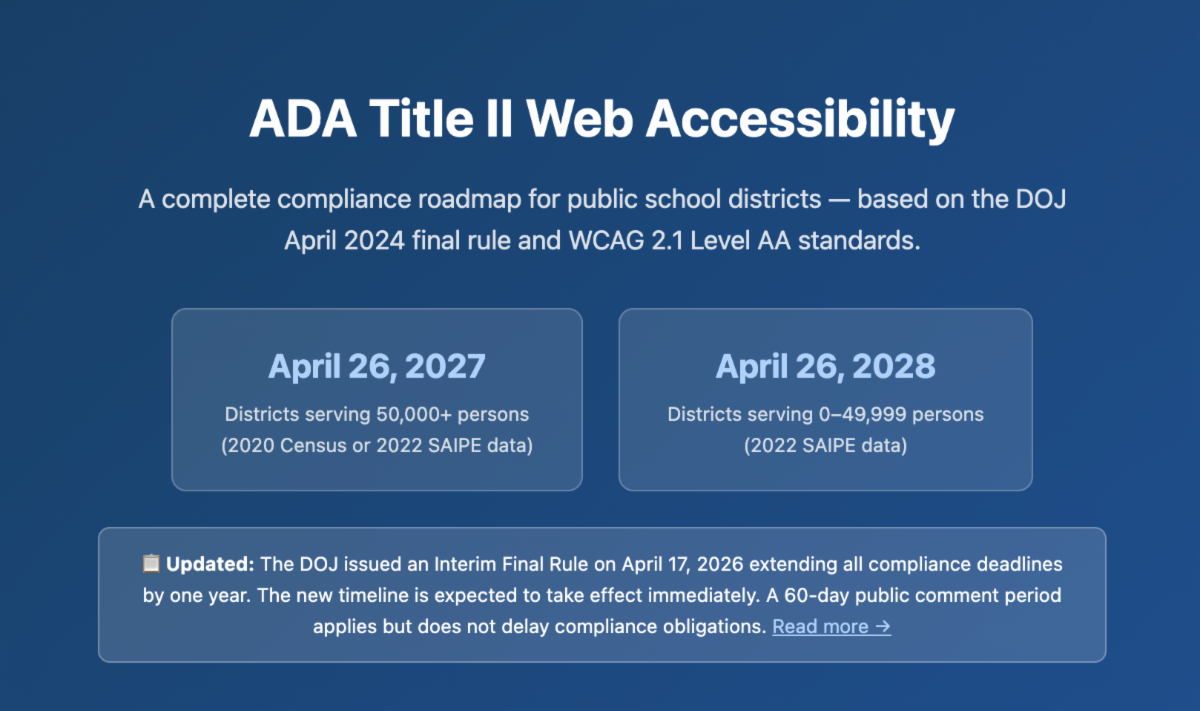
The U.S. Department of Justice has extended the compliance dates for its Title II web and mobile application accessibility rule by one year. Public entities serving populations of 50,000 or more now have until April 26, 2027, while those serving fewer than 50,000 have until April 26, 2028.
For school districts, that sounds like good news. But it would be a mistake to translate “one more year” into “we can deal with this next year.”
This Is Bigger Than the District Website
The rule establishes WCAG 2.1 Level AA as the technical accessibility standard for web content and mobile applications provided by state and local governments, including public schools.
“Web content” means much more than the homepage someone redesigned three years ago. Think about the digital ecosystem families, students and staff encounter every day: webpages, online forms, documents, PDFs, videos, images, mobile apps and other digital content used to access district programs and services.
Now think about how many people create that content. The communications office posts a PDF. Human resources uploads a job description. A principal sends out a digital newsletter. A department publishes a form. Someone posts a flyer as an image. A teacher adds material to a district-supported platform.
Accessibility cannot live solely with the technology department because digital content doesn't live there either. That is why this additional year matters.
Use the Year to Build a System
The goal should not be to spend March 2027 frantically fixing thousands of files. The goal should be to create an organization that produces accessible content as part of its normal work.
The Department of Justice itself recommends beginning well before the compliance date and points public entities toward several practical steps: establishing accessibility policies, determining who is responsible for the work, regularly testing content, creating processes for accessibility requests and training employees.
District leaders also do not have to start from a blank page. The EdTech Leaders Alliance has created an ADA Title II Web Accessibility resource specifically for public school districts that turns the federal requirements into a practical roadmap. The tool walks districts through 11 action steps, from determining the correct compliance deadline and building a cross-functional team to inventorying digital content, prioritizing remediation and reviewing vendor contracts. It also includes guidance on the rule’s exceptions, sample accessibility language, procurement considerations and a 30-item teacher accessibility checklist for everyday content creation. For districts wondering where to begin, it offers a useful way to turn a very large compliance challenge into manageable work that can start now.
For school leaders, that means starting now. Inventory the digital places where your district provides information and services. Identify your highest-use and highest-impact content. Determine who owns accessibility across departments. Build accessibility expectations into content creation and staff training. Make accessible documents, captions, alternative text and good digital design ordinary practice rather than remediation projects.
And take a serious look at procurement. One of the most important details in the rule is that using a vendor does not transfer the district's responsibility. If a district uses a contractor, licensed platform or other third party to provide web content or mobile applications on its behalf, those services may still need to meet the accessibility requirements.
That should change some conversations with vendors. “Is your product accessible?” is a start. “What accessibility standard do you meet? How do you test it? How do you address known issues? What documentation can you provide us?” is much better. Accessibility belongs in procurement before the contract is signed, not in a support ticket after a student or parent discovers a barrier.
Compliance Is the Floor
There is another reason not to treat April 2027 or April 2028 as the starting point. Students, employees, parents and community members with disabilities need access today.
The DOJ makes clear that the ADA's broader requirements for effective communication, reasonable modifications and equal opportunity continue to apply before these new compliance dates arrive.
The deadline moved. The responsibility to serve people did not. Districts have been given something extraordinarily valuable: time to do this thoughtfully instead of reactively. We can use it to chase inaccessible PDFs one at a time, or we can use it to build better habits, better procurement practices and better systems.
By the time the new deadline arrives, accessibility should not feel like one more compliance initiative. It should simply be how we do digital.
|