CAAHEP Communiqué  

February 2026

From the President

Barry S. Eckert, Ph.D., FASAHP

2023-2026 CAAHEP President


Charting CAAHEP's Path: Strategic Planning for 2026-2029


On January 15 and 16, the CAAHEP Board of Directors, members of the Planning and Development Committee, and staff convened in Orlando to chart CAAHEP's path forward through 2029. As we near the end of our current 3-year strategic plan, which has delivered strong results (a report will follow in an upcoming Communique), this strategic planning retreat brought together key leaders to shape CAAHEP's future direction based on stakeholder input, highlighting the importance of your contributions in guiding our progress.

Under the guidance of facilitator Erin Gordon from Vista Cova, participants embarked on a process that drew on three key research sources: results from our stakeholder survey, insights from a recent board-conducted SWOT analysis, and input from attendees representing CAAHEP’s communities of interest. This approach ensured that our emerging priorities truly reflect the needs of our accreditation community. Through collaborative discussions and small-group activities, we transformed the research data into a vision and turned challenges into opportunities.

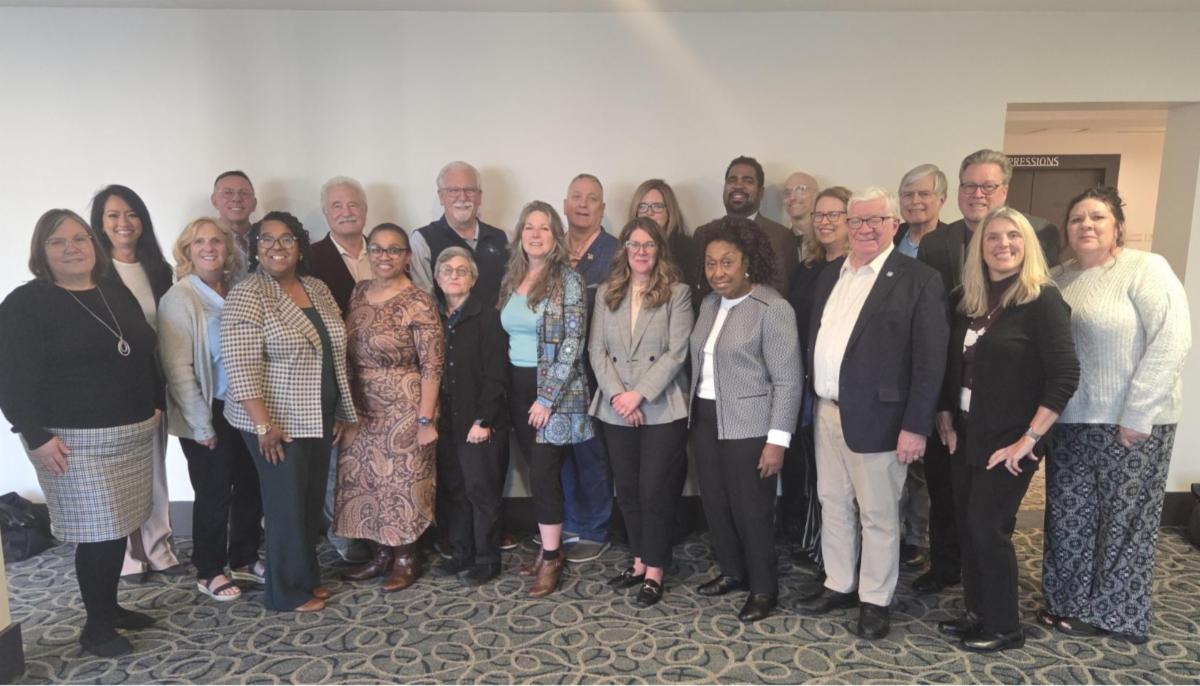
The CAAHEP Board of Directors, Planning and Development Committee members, and CAAHEP staff meet to plan the next three years.

Participants examined not only where we've been but also where the landscape of allied health education is heading. By synthesizing stakeholder feedback, analysis, and collective wisdom, a clear set of objectives emerged that will propel CAAHEP toward 2029. The goals that emerged from these discussions will serve as CAAHEP’s next roadmap for navigating the opportunities and challenges ahead.


While work remains to finalize the plan, the foundation has been laid for a 2026-2029 strategy. Once approved, this blueprint will be shared across all our communities, with implementation beginning July 1. The future we're building together starts now.


As we look ahead, we're also monitoring the federal and state landscape affecting the accreditation of post-secondary health professions programs. The Department of Education's growing focus on accreditation—expanding from institutional to programmatic oversight—signals changes on the horizon. The recent CHEA conference highlighted the Department’s interest in revising its regulations and examining accountability measures. CAAHEP will continue to inform you about these ongoing changes in the higher education environment, ensuring we remain responsive in support of health professions education quality.

Barry S. Eckert, Ph.D., FASAHP

President

(Questions about this article may be directed to Dr. Eckert at beckert@caahep.org)

CAAHEP Adopts Quality Framework for Health Professions Education

Outcomes Task Force

Chair: Donald A. Balasa

Members: Megan Corry, Rebecca Dail, Janice Grewatz, Don Martin, Julie O’Sullivan-Maillet, Thomas Platt, Ben Thompson

Ex-Officio member: Barry Eckert

Staff: Gina Scarboro


The CAAHEP Outcomes Task Force was established in accordance with CAAHEP's 2023-2025 strategic plan to ensure that the outcomes used to evaluate program effectiveness are relevant, meaningful, and aligned with contemporary educational practices. The work of the Outcomes Task Force is data-driven and research-based, incorporating extensive reviews of accreditation practices across health professions education.

CAAHEP Strategic Plan 2023-2025, Goal and Objective

Strategic Plan Goal 1.B. Assess the CAAHEP outcomes-based accreditation model to validate relevancy and update requirements.


The importance of accreditation in preparing competent healthcare providers who serve society at large is often overlooked, but recent work by Frank et al. (2020) emphasizes that it warrants recognition as a critical component of supplying the healthcare workforce. While compliance with standards is an essential component of accreditation, the ultimate purpose of outcomes assessment extends beyond compliance to ensure and enhance program quality that directly impacts graduate preparation for professional practice. To that end, the Task Force aimed to develop a revised CAAHEP quality framework that promotes innovation, supports institutional autonomy, and provides stakeholders with meaningful evaluation of health professions program quality.


At its July 2025 meeting, the CAAHEP Board of Directors endorsed a position paper from the Outcomes Task Force and, in October, approved publication of the Quality Framework and communication plan to stakeholders. The Quality Framework is only the beginning of a multiphase implementation and education plan to restructure CAAHEP outcomes-based accreditation.


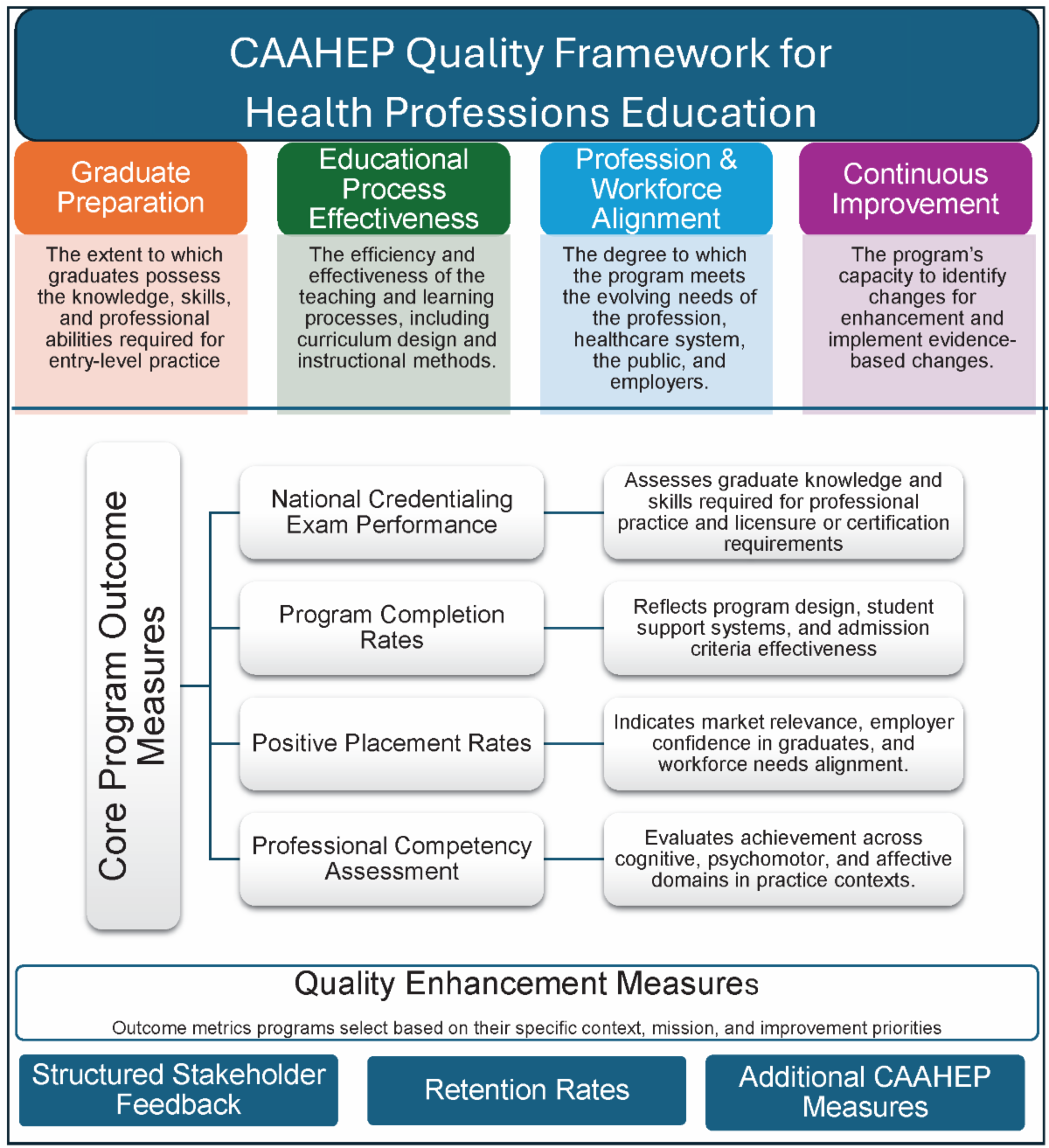
The Quality Framework represents a meaningful improvement in describing and defining CAAHEP’s accreditation philosophy by linking four quality attributes to core outcome measures and quality enhancement measures. The framework calls for program assessment to be organized around four dimensions: Graduate Preparation, Educational Process Effectiveness, Profession and Workforce Alignment, and Continuous Improvement. The framework reinforces CAAHEP’s focus on objective outcomes and evaluations of professional competence while allowing innovation in educational programs.


The CAAHEP Quality Framework not only articulates a structured methodology for assessing quality education but also emphasizes the importance of adaptability and responsiveness in accreditation processes. The revision focuses on outcomes assessment to meet the evolving needs of the workforce while providing students with relevant skills and knowledge. This stakeholder-centric approach is designed to enhance accountability and prepare individuals for professional success.


Current State of Outcomes Assessment in CAAHEP


The Task Force met over the course of a year, researching accreditation models, conducting a scan of the current programmatic accreditation landscape, and reviewing relevant research. The Board has endorsed a two-phase approach to enhancing CAAHEP's outcomes-based accreditation pursuant to the new Quality Framework.


Purpose-Driven Assessment


The Task Force's approach repositions outcomes assessment as both an accountability mechanism and a catalyst for advancement. The quality framework is an evolution from viewing outcomes as compliance metrics to recognizing them as essential tools for program improvement (Jankowski et al., 2018). By connecting specific measures to dimensions of educational excellence, the framework provides programs with actionable insights that drive meaningful progress while maintaining consistent educational quality.


As illustrated in Figure 1, quality in health professions education can be understood through several interconnected dimensions: Graduate Preparation, Educational Process Effectiveness, Profession & Workforce Alignment, and Continuous Improvement. These dimensions are assessed through two categories of outcome measures: Core Outcome Measures, which are required, and Quality Enhancement Measures, which allow programs to use additional assessment methods to demonstrate continuous improvement.


Figure 1. The CAAHEP Quality Framework shows the relationship between the four quality dimensions, Core Outcome Measures, and Quality Enhancement Measures.

Continue reading


First Program in the Nation Receives Voluntary AEMT Accreditation; 12 AEMT Programs from Five States Obtain LoR in 2025 

Congratulations to Durham Technical Community College, which is the first Advanced Emergency Medical Technician (AEMT) education program in the nation to receive its voluntary accreditation from CAAHEP, the only nationally recognized accreditation organization for AEMT and paramedic education.


An additional 12 programs in six states received their Letter of Review (LoR) from CoAEMSP in 2025. The LoR signifies that the program is in the process of seeking accreditation by CAAHEP. Beginning June 30, 2025, North Carolina became the only state to require all AEMT education programs in the state to be in the process of becoming accredited. Eight of the LoR programs are in North Carolina, as is Durham Tech.


“We are thrilled to be the first accredited AEMT education program in the nation,” said Steven Wilson, director of Durham’s program. “Our goal is to ensure our AEMT students can efficiently and effectively provide emergency medical care at the advanced life support level. The accreditation process provides a valuable framework to do just that, and we are proud to be a part of the statewide effort in North Carolina to ensure all programs meet national standards for high-quality AEMT education.”  


“Durham Tech is the first of what we hope will be many AEMT education programs in the state to receive accreditation,” said Todd Messer, Education Manager at the North Carolina Office of Emergency Medical Services. “In moving to require accreditation at the AEMT level, we are ensuring graduates in our state are well prepared for the demands of today’s workforce, and tomorrow’s. Looking ahead, we know accreditation will strengthen our EMS workforce and ultimately enhance patient care statewide.” 


Continue reading

Quarterly CAAHEP Update for Program Directors Scheduled

CAAHEP will host its next Update for Program Directors on March 4, 2026, at 3:00 PM Eastern Time. To reserve your spot, please log in to the CAAHEP Academy, and select Live Events to register.


If you have any questions, please contact academy@caahep.org.

Updates on the Department of Education & Negotiated Rulemaking for CAAHEP-Accredited Programs

By Brandon Sherman, JD, Counsel, Saul Ewing, LLP, and

Gina Scarboro, D.B.A., CAA, CAAHEP Executive Director


At the recent Council for Higher Education (CHEA) Annual Meeting, Department of Education (ED) Under Secretary Nicholas Kent addressed attendees, noting the administration’s interest in accreditation reform. He shared that the goals are to update the ED’s accreditation regulations to allow for new accreditors and increased accountability (Moody, 2026). As part of these efforts, the Department of Education announced a new Accreditation, Innovation, and Modernization (AIM) negotiated rulemaking committee to develop regulations that would:


simplify the Secretary’s recognition of emerging and existing accreditors; examine the extent to which accreditation contributes to rising higher education costs and credential inflation; safeguard against undue influence from related private trade associations; eliminate standards or policies that discriminate on the basis of immutable characteristics; and refocus quality assurance and improvement on data-driven student outcomes (Department of Education, 2026).


While CAAHEP is a programmatic accreditor recognized by the Council for Higher Education, and not the Department of Education, 90% of CAAHEP-accredited programs are within colleges/universities whose institutional accreditors are ED-recognized and therefore impacted by potential changes in these regulations. Of particular attention is the focus on the potential influence of trade associations, which is new to this administration. This concern appears to stem from the administration's belief that some institutional accreditors have become too closely aligned with related trade associations, potentially creating conflicts of interest. The ED continues to emphasize outcome measures, which aligns with CAAHEP’s commitment to outcome-based accreditation standards.


What is Negotiated Rulemaking?


Negotiated Rulemaking, or neg-reg, is a process by which the federal government, in this case the Department of Education, convenes a committee of stakeholder representatives to discuss proposed regulations before publishing a Notice of Proposed Rulemaking (NPRM) in the Federal Register. The stated goal of the process is to reach consensus before regulations are proposed. If the group reaches consensus, the NPRM is posted and proceeds; if consensus is not achieved, the ED may use language developed during the negotiated rulemaking process or make any changes needed for the new regulation posted in the NPRM (Department of Education, 2025).


The topics for negotiated rulemaking can come from the ED, the public, or new laws regarding Title IV programs that need regulations. Members of the public are allowed to attend, and committee materials are posted on the ED’s website. The negotiated rulemaking process timeline includes a February 26, 2026 deadline for submitting nominations for committee negotiators, with the AIM Committee scheduled to convene for two five-day sessions in April and May 2026.


CAAHEP will continue to monitor these developments and provide updates as they may affect our accredited programs.


Review References

Nominations for CAAHEP's

Highest Honor Sought

The William W. Goding Award for Exceptional Service is the highest honor awarded by the Commission on Accreditation of Allied Health Education Programs (CAAHEP). It is reserved for those who are or have been Commissioners and recognizes an individual who has served the Commission in word and deed, i.e., has spoken with conviction about the work of the Commission, advanced its purposes, and actively participated in the Commission's activities at a high level for a sustained period of time. The recipient is respected by other Commissioners but is not currently a Board member. 


How to Nominate

Any Commissioner may nominate someone for this award. Please complete the Nomination Form, outlining each of the criteria listed above. Letters of recommendation may be uploaded to the form, but are not required. Please contact CAAHEP staff if you have any questions.


Nominations are due February 28, 2026.


Award Criteria

The criteria for the award are as follows:


  • Advancing CAAHEP's mission and goals
  • Assuming leadership responsibilities within CAAHEP (e.g., chairing committees and task forces, serving as an officer, assuming responsibility for CAAHEP special programs, etc.)
  • Exhibiting notable participation in one or more CAAHEP activities and/or programs
  • Advancing ideas and/or new strategies to benefit the organization


Award Presentation

The William W. Goding Award for Exceptional Services is presented during a reception at the CAAHEP Accreditation Workshop, to be held July 17-18, 2026.


In addition to this award ceremony, consider joining us for the full CAAHEP Accreditation Workshop. The event provides:


  • Engaging Sessions: Participate in a variety of informative sessions focused on the latest trends in allied health accreditation and higher education. Our expert speakers will provide insights crucial to navigating today’s challenges.
  • Networking Opportunities: Connect with fellow Commissioners and peers from across the country. This is a fantastic opportunity to share experiences, discuss best practices, and build collaborative relationships that can drive positive change.
  • Visit Sponsoring Companies: Explore innovative solutions and resources from our sponsoring companies.


Visit the CAAHEP Accreditation Workshop page for additional information and updates.

DOJ Files Statement with Court in Support of Antitrust Suit against Academic Accreditor; Calls out Accreditors and Professional Licensures

by Donald A. Balasa, JD, MBA, CEO and Legal Counsel

American Association for Medical Assistants

CAAHEP Commissioner


The United States Department of Justice (DOJ) filed a December 15, 2025, Statement of Interest with a federal district court in Tennessee in the antitrust suit filed by Lincoln Memorial University, a not-for-profit school in Tennessee, against the American Veterinary Medical Association (AVMA). The Council on Education of the AVMA is recognized by the United States Department of Education as the sole accreditor of colleges of veterinary medicine (CVMs). CVMs award the Doctor of Veterinary Medicine (DVM) degree that is required for eligibility to sit for the North American Veterinary Licensing Examination and become licensed in American jurisdictions.


Factual and Legal Background


Lincoln Memorial University (Lincoln) in its June 18, 2025, complaint, alleges that the AVMA (through its Council on Education [COE]) is using accreditation “to restrict the accreditation of new and existing veterinary schools by demanding that they meet arbitrary, unreasonable, and impossible-to-meet requirements entirely unrelated to the minimum quality of education necessary to graduate day-one-ready veterinarians with entry-level competency.” An example of these unnecessary and burdensome requirements (in Lincoln’s opinion) is the mandate that students have access to “an unstated and unknowable number and amount of research faculty, research curricula, research facilities, extramural grants, and exposure to graduate students involved in research.”


The gravamen of the complaint is that: (1) these new accreditation requirements are unrelated to preparing students to become competent veterinarians; (2) they reduce the number of colleges of veterinarian medicine because private not-for-profit CVMs (such as Lincoln) do not have the financial resources to satisfy them; and (3) they reduce the number of practicing veterinarians and drive up the price of veterinary services.


Continue reading

Early-bird Registration Discount

Available through 3/31/2026

Join us for the 2026 Accreditation Workshop

at the Embassy Suites Denver Downtown Convention Center.

Watch for details in early 2026!

CAAHEP Accreditation Actions

Each profession in the Commission on Accreditation of Allied Health Education Programs (CAAHEP) system has a Committee on Accreditation (CoA) that consists of experts in the profession that are responsible for reviewing programs and making appropriate recommendations for accreditation to CAAHEP.  CAAHEP reviews recommendations received from its CoAs in each profession, assures due process was followed, and takes final action on an accreditation status. 


CAAHEP took the following actions at its January 16, 2026, meeting. Actions are identified by profession, action taken, and date of the next comprehensive evaluation. In some cases, the concentration and/or degree are also specified. Where available, a link to each program's website is provided.


The following programs were found to be in compliance with the accreditation Standards and Guidelines and were granted continuing accreditation, with the next comprehensive evaluation to occur no later than 2030. These actions require no progress report and were approved on the consent agenda.  


Medical Assisting 

Heartland Community College, Normal, IL (Certificate) 

Lake Land College, Mattoon, IL (Certificate) 

Prince George's Community College, Largo, MD (Certificate) 


The following programs were found to be in compliance with the accreditation Standards and Guidelines and were granted continuing accreditation, with the next comprehensive evaluation to occur no later than 2031. These actions require no progress report and were approved on the consent agenda.  


Diagnostic Medical Sonography 

Cincinnati State Technical and Community College, Cincinnati, OH (Abdominal-Extended) 

Cincinnati State Technical and Community College, Cincinnati, OH (Obstetrics and Gynecology) 

Cincinnati State Technical and Community College, Cincinnati, OH (Adult Cardiac) 

Cincinnati State Technical and Community College, Cincinnati, OH (Vascular) 

Collin County Community College District-McKinney Campus (Central Park), McKinney, TX (Abdominal-Extended) 

Collin County Community College District-McKinney Campus (Central Park), McKinney, TX (Obstetrics and Gynecology) 

Healthcare Training Institute, Union, NJ (Abdominal-Extended) 

Healthcare Training Institute, Union, NJ (Obstetrics and Gynecology) 

Javon Bea Hospital-Mercyhealth Rockton, Rockford, IL (Abdominal-Extended) 

Javon Bea Hospital-Mercyhealth Rockton, Rockford, IL (Obstetrics and Gynecology) 

Wallace State Community College, Hanceville, AL (Adult Cardiac) 

Wallace State Community College, Hanceville, AL (Vascular) 


Emergency Medical Services Professions - Paramedic 

Aims Community College-Windsor Campus, Windsor, CO  

Blue Ridge Community College, Flat Rock, NC  

Central Kentucky Paramedic Education Consortium, Lexington, KY  

Central Oregon Community College, Bend, OR  

Chesapeake College, Wye Mills, MD  

Cochise College, Sierra Vista, AZ  

College of Southern Maryland-Regional Hughesville Campus, Hughesville, MD  

College of Southern Nevada, Las Vegas, NV  

Colorado Mountain College Vail Valley at Edwards, Edwards, CO  

Coral Springs Regional Institute of Public Safety, Coral Springs, FL  

Delgado Community College, New Orleans, LA  

Durham Technical Community College-Orange County Campus, Hillsborough, NC  

Edward Hospital, Naperville, IL  

Gulf Coast State College-North Bay Center, Southport, FL  

Howard County Department of Fire and Rescue Services, Marriottsville, MD  

Inver Hills Community College, Inver Grove Heights, MN  

Ivy Tech Community College of Indiana-Bloomington, Bloomington, IN  

Ivy Tech Community College of Indiana-Fort Wayne, Fort Wayne, IN  

Ivy Tech Community College of Indiana-Terre Haute, Terre Haute, IN  

Kiamichi Technology Center, Poteau, OK  

Lone Star College System-Montgomery College, Conroe, TX  

McCook Community College/Mid-Plains Community College, McCook, NE  

Mercy Health System, Janesville, WI  

Mohawk Valley Health System, Utica, NY  

Navarro College-Waxahachie, Waxahachie, TX  

Northeast Iowa Community College-Peosta Campus, Peosta, IA  

Northeast Wisconsin Technical College, Green Bay, WI 

Reading Hospital, Reading, PA  

Rowan-Cabarrus Community College, Salisbury, NC  

Southern Maine Community College, South Portland, ME  

St. Charles County Ambulance District, St. Peters, MO  

Truckee Meadows Community College, Reno, NV  

Yavapai College-Prescott Valley Center, Prescott Valley, AZ  


The following programs were found to be in compliance with the accreditation Standards and Guidelines and were granted continuing accreditation, with the next comprehensive evaluation to occur no later than 2032. These actions require no progress report and were approved on the consent agenda.  


Surgical Technology 

Keiser University-Clearwater Site, Clearwater, FL (Associate) 

Southeast Kentucky Community & Technical College, Pineville, KY(Associate) 


The following programs were found to be in compliance with the accreditation Standards and Guidelines and were granted continuing accreditation, with the next comprehensive evaluation to occur no later than 2033. These actions require no progress report and were approved on the consent agenda.  


Cardiovascular Technology 

Forsyth Technical Community College, Winston-Salem, NC (Invasive Cardiovascular Technology, Associate) 


Cytology 

Rutgers, The State University of New Jersey-Rutgers Biomedical and Health Sciences, Newark, NJ 

The Cleveland Clinic Foundation, Cleveland, OH 

University of Nebraska Medical Center, Omaha, NE 


Neurodiagnostic Technology 

Mayo Clinic College of Medicine and Science, Rochester, MN (Polysomnography) 


The following programs were found to be in compliance with the accreditation Standards and Guidelines and were granted continuing accreditation, with the next comprehensive evaluation to occur no later than 2035. These actions require no progress report and were approved on the consent agenda.  


Exercise Sciences 

Gannon University, Erie, PA 

Youngstown State University, Youngstown, OH 


Surgical Assisting 

Fayetteville Technical Community College, Fayetteville, NC 


Surgical Technology 

Baton Rouge Community College, Baton Rouge, LA (Associate) 

Cabarrus College of Health Sciences, Concord, NC (Associate) 

College of Southern Idaho, Twin Falls, ID (Associate) 

Columbia Basin College, Pasco, WA (Associate) 

Community College of Denver-Lowry, Denver, CO (Associate) 

Cuyahoga Community College-Metropolitan Campus, Cleveland, OH (Associate) 

Eastern Florida State College, Melbourne, FL (Associate) 

Front Range Community College, Westminster, CO (Associate) 

Iowa Western Community College, Council Bluffs, IA (Associate) 

Nashville State Community College, Nashville, TN (Associate) 

Quinsigamond Community College, Worcester, MA (Associate) 

Rasmussen University-Hennepin/Anoka, Brooklyn Park, MN (Associate) 

Saint Paul College-A Community & Technical College, Saint Paul, MN (Associate) 

Sentara College of Health Sciences, Chesapeake, VA (Associate) 

Wayne County Community College District-Northwest Campus, Detroit, MI (Associate) 


The following programs were found to be in compliance with the accreditation Standards and Guidelines and were granted continuing accreditation, with the next comprehensive evaluation to occur no later than 2036. These actions require no progress report and were approved on the consent agenda.  


Anesthesiologist Assistant 

South University-Savannah, Savannah, GA 


Diagnostic Medical Sonography 

Bergen Community College, Paramus, NJ (Abdominal-Extended) 

Bergen Community College, Paramus, NJ (Obstetrics and Gynecology) 

Bergen Community College, Paramus, NJ (Adult Cardiac) 

Broward College-North Campus, Coconut Creek, FL (Abdominal-Extended) 

Broward College-North Campus, Coconut Creek, FL (Obstetrics and Gynecology) 

Broward College-North Campus, Coconut Creek, FL (Adult Cardiac) 

Cape Fear Community College, Wilmington, NC (Abdominal-Extended) 

Cape Fear Community College, Wilmington, NC (Obstetrics and Gynecology) 

Central Ohio Technical College, Newark, OH (Abdominal-Extended) 

Central Ohio Technical College, Newark, OH (Obstetrics and Gynecology) 

Central Ohio Technical College, Newark, OH (Adult Cardiac) 

Central Ohio Technical College, Newark, OH (Vascular) 

Wallace State Community College, Hanceville, AL (Abdominal-Extended) 

Wallace State Community College, Hanceville, AL (Obstetrics and Gynecology) 


Polysomnographic Technology 

Southeast Community College Area, Lincoln, NE (Certificate) 


The following programs were found to be in substantial compliance with the accreditation Standards and Guidelines, with one or more Standards requiring a progress report to be submitted to the appropriate Committee on Accreditation (CoA).  The programs were granted continuing accreditation, with the next comprehensive evaluation to occur no later than 2031. 


Emergency Medical Services Professions 

Bevill State Community College-Sumiton Campus, Sumiton, AL  

Chattanooga State Community College, Chattanooga, TN  

Crowder College, Neosho, MO  

Hagerstown Community College, Hagerstown, MD  

Harrison County Hospital Paramedic Consortium, Corydon, IN  

Houston City College-Northeast Campus, Houston, TX  

Imperial Valley College, Imperial, CA  

Las Positas College, Livermore, CA  

Los Angeles County Emergency Medical Services Agency, Santa Fe Springs, CA  

Maricopa Community Colleges-Glendale Community College, Glendale, AZ  

University of Arkansas at Monticello, McGehee, AR  

University of Arkansas Community College Batesville, Batesville, AR  


The following program was found to be in substantial compliance with the accreditation Standards and Guidelines, with one or more Standards requiring a progress report to be submitted to the appropriate Committee on Accreditation (CoA). The program was granted continuing accreditation, with the next comprehensive evaluation to occur no later than 2035. 


Exercise Physiology 

Gannon University, Erie, PA (Applied) 


The following program was found to be in substantial compliance with the accreditation Standards and Guidelines, with one or more Standards requiring a progress report to be submitted to the appropriate Committee on Accreditation (CoA).  The program was granted continuing accreditation, with the next comprehensive evaluation to occur no later than 2036. 


Polysomnographic Technology 

Concorde Career College, San Bernardino, CA (Diploma) 


The following programs were found to be in compliance with the accreditation Standards and Guidelines and were granted initial accreditation with the next evaluation to occur no later than 2030. These actions require no progress report and were approved on the consent agenda. 


Medical Assisting 

Edmonds College, Lynnwood, WA (Certificate) 

Great Basin College, Elko, NV (Certificate) 


Surgical Technology 

Ivy Tech Community College of Indiana-Elkhart, Goshen, IN (Associate) 


The following programs were found to be in compliance with the accreditation Standards and Guidelines and were granted initial accreditation with the next evaluation to occur no later than 2031. These actions require no progress report and were approved on the consent agenda. 


Diagnostic Medical Sonography 

Collin County Community College District-McKinney Campus (Central Park), McKinney, TX (Adult Cardiac) 

Javon Bea Hospital-Mercyhealth Rockton, Rockford, IL (Vascular) 

University of Saint Francis, Fort Wayne, IN (Adult Cardiac) 


Emergency Medical Services Professions – Advanced Emergency Medical Technician 

Durham Technical Community College-Orange County Campus, Hillsborough, NC  


Emergency Medical Services Professions - Paramedic 

Camsen Career Institute, Jacksonville, FL  

Chesterfield County Fire and EMS, Chesterfield, VA  

County College of Morris, Randolph, NJ  

Hopkinsville-Christian County EMS, Hopkinsville, KY  

Lakes Region Community College, Laconia, NH  

Southwest Texas College-Eagle Pass, Eagle Pass, TX  

Treasure Coast Medical & Fire Institute, Fort Pierce, FL  

West Shore Community College-Riemer Regional Public Safety Training Center, Free Soil, MI  


The following programs were found to be in substantial compliance with the accreditation Standards and Guidelines, with one or more Standards requiring a progress report to be submitted to the appropriate Committee on Accreditation (CoA).  The programs were granted initial accreditation, with the next evaluation to occur no later than 2031.  


Cardiovascular Technology 

Orlando Health, Orlando, FL (Adult Echocardiography, Certificate) 


Emergency Medical Services Professions - Paramedic 

Patriot Consortium for Paramedic Education, Flint, MI 


Exercise Physiology 

Appalachian State University, Boone, NC (Clinical) 


Exercise Sciences 

Appalachian State University, Boone, NC 


Lactation Consultant 

Charles R. Drew University of Medicine & Science, Los Angeles, CA 


The following programs maintained their existing accreditation statuses and next evaluation dates, and the changes in academic award were approved. 


Surgical Technology 

Madison Area Technical College, Madison, WI (Associate) 

Mid-State Technical College, Marshfield, WI (Associate) 

Santa Fe College, Gainesville, FL (Associate) 


Commission on Accreditation of Allied Health Education Programs

9355 - 113th St. N, #7709, Seminole, FL 33775-7709

W: www.caahep.org  P: 727-210-2350 E: mail@caahep.org

Website     About     Accreditation     News     Events     Contact

Facebook  Instagram  LinkedIn  Twitter  YouTube