CAAHEP Communiqué  

October 2025

From the President

Barry S. Eckert, Ph.D., FASAHP

2023-2026 CAAHEP President


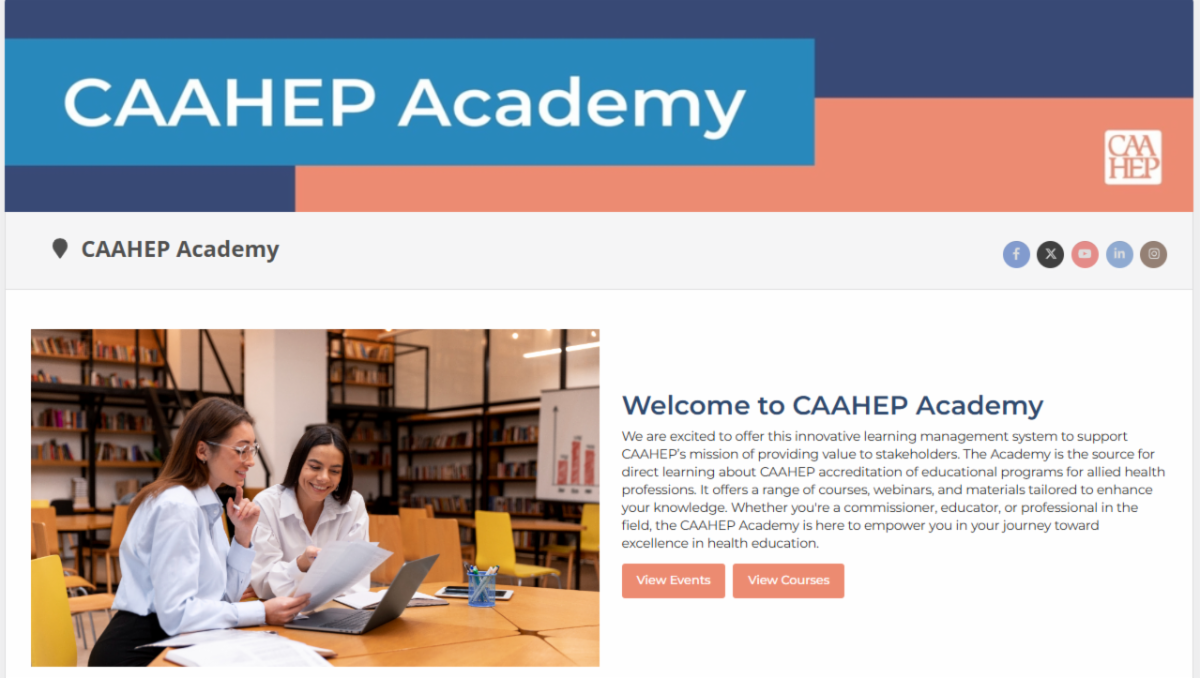
Greetings members of the CAAHEP Community - I am excited to announce the official launch of the CAAHEP Academy, a comprehensive online learning platform designed to support our communities of interest by providing resources that inform educators, sponsoring organizations, the public, and our Committees on Accreditation about the accreditation process. This issue of the CAAHEP Communiqué provides an overview of the Academy and its initial offerings.


The CAAHEP Academy is a tangible result of the 2023-2025 Strategic Plan. Academy content includes educational modules, live events, and resources to support quality education and CAAHEP’s mission to provide value to stakeholders by setting standards for quality assurance in health professions education. Among the items that are on the site are an Orientation to CAAHEP, recordings from past CoA Connections sessions, Who is Who in accreditation, Commissioner Updates, and CAAHEP Standards and Guidelines. You will also find a link to CAAHEP Academy Office Hours, which are scheduled on Tuesdays and Thursdays and provide an opportunity to ask questions about the Academy and its resources.


Going forward, CAAHEP will expand the Academy's offerings to include a curriculum of presentations that provide guidance to program directors, faculty, administrators, and other stakeholders. As a former Dean and Provost, I am very passionate about these efforts to supply learning resources, so I volunteered to lead the Educational Resource Development Task Force overseeing the structure and creation of learning resources in the Academy. Upcoming learning modules will cover topics such as initiating the accreditation process, preparing for program review, and guidance on starting a new program. Additional topics for development include the assessment of teaching and learning, as well as other aspects of an educational program. 

The Educational Resource Development Task Force has been working for months to organize and prioritize Academy learning resources, recognizing that creating quality materials takes significant time and expertise. Within the next few weeks, the Task Force expects to have a prioritized set of topics and will begin looking for content expert volunteers. CAAHEP will rely on our community members to share their knowledge in developing assets for the Academy. Collaboration is a core value of CAAHEP, so your ideas on content for the Academy are welcome.

As you continue reading this issue of the CAAHEP Communiqué, you will learn more about the new Academy. I look forward to the ongoing development of this essential new program for our organization and its positive impact on health professions education.


Visit the

CAAHEP Academy

Barry S. Eckert, Ph.D., FASAHP

President

(Questions about this article may be directed to Dr. Eckert at beckert@caahep.org)

The CAAHEP Academy is now open, and we invite you to access our innovative learning management system. This platform is designed to enhance your understanding of CAAHEP accreditation, provide valuable resources, and strengthen educational quality. Invitations to join the Academy have been sent to all program directors of CAAHEP-accredited programs, CAAHEP Commissioners, CoA leaders and members. If you haven't received your invitation, don't worry—signing up is easy and available to everyone!*


Here’s How to Gain Access:

  1. Visit the CAAHEP website at www.caahep.org and click on the CAAHEP Academy in the top right of the navigation bar, or go directly to https://academy.caahep.org.
  2. Click the "Sign In" link at the top right and use your email address as your username.
  3. Click the "Sign Up" link next to the "Don't have an account?" prompt.
  4. Complete the brief sign-up form, create a password, and then select "Sign Up."


Once You Are Signed In, Here’s What You Can Do:

  • Explore the CAAHEP Academy: Discover all the features of the platform and engage with the current educational modules available.
  • Sign Up for Upcoming Events: Don’t miss the chance to participate in our scheduled events. Check the homepage of the CAAHEP Academy to register for an upcoming session that interests you.


The CAAHEP Academy offers content tailored for everyone within our communities of interest, curated by role. For instance, potential students can access general information on CAAHEP and accreditation, while CAAHEP Commissioners will have access to internal CAAHEP activities and materials from Commissioner Meetings. Representatives of CAAHEP-accredited programs (program directors, deans, faculty, etc.) will find in-depth accreditation materials. As we expand, the Committees on Accreditation will create profession-specific portals, providing program representatives with even more valuable content.


Need Help? We’re Here!

If you need assistance or experience any issues with the CAAHEP Academy, our staff is ready to help. Please reach out to academy@caahep.org for direct assistance, or join us for an Open Office Hour every Tuesday from 12:00 - 1:00 PM Eastern and Thursday from 4:00 - 5:00 PM Eastern. Simply log into the Academy and click the event you wish to join.


What’s Next?

Stay tuned for announcements of new courses, resources, and events. Information on what is available is always at your fingertips on the Academy's homepage. With the support of our volunteer leaders and staff, CAAHEP is dedicated to developing new content, resources, and events to enhance your understanding of accreditation and provide best practices for achieving and maintaining CAAHEP accreditation.


*Please note that CAAHEP has received inquiries regarding the authenticity of the invitation to sign up for the CAAHEP Academy. This is not a spam email, and we kindly ask that you add academy@caahep.org to your safe sender list.

Updated Standards Approved

The CAAHEP Standards and Guidelines for the Accreditation of Education Programs in Polysomnographic Technology have been approved by the Board of Directors.


The updated Standards were developed through a comprehensive and collaborative process. Beginning with the transition to the new CAAHEP template, the initial draft underwent rigorous review by the sponsoring organizations of the Committee on Accreditation for Polysomnographic Technologist Education (CoA-PSG), the American Academy of Neurology, Board of Registered Polysomnographic Technologists, and Consortium of Academic Programs in Clinical Research.


Feedback from the communities of interest was invited, and the thoughtful comments and insights played a vital role in shaping the final document. The final step in the process was an open hearing that was held on July 18 in Bloomington, MN. Following the open hearing, the CAAHEP Standards Committee made a recommendation of its approval to the CAAHEP Board.


The Board approved the recommendation at its August meeting. The CoA-PSG thanks all who reviewed and commented on the Standards through the process. The new Standards take effect on July 1, 2026 and are posted on the CAAHEP website.

New CoA Approved to Review Internationally

CAAHEP's International Accreditation Review Committee has approved the Committee on Accreditation for the Exercise Sciences (CoA) to conduct program reviews internationally. The CoAES reviews programs that prepare graduates for careers in Exercise Science, Exercise Physiology, and Personal Fitness Training. The complete list of CoAs approved to review programs outside the United States can be found on the international page on the CAAHEP website.

Court Dismisses Lawsuit Against USDE Gainful Employment Rules

By Donald A. Balasa, JD, MBA, CEO and General Counsel, American Association of Medical Assistants and CAAHEP Commissioner


In my May 28, 2025, post and article, I reviewed the federal lawsuit seeking the invalidation of the United States Department of Education (DE) 2023 gainful employment rule on procedural and substantive (including constitutional) grounds. The case is American Association of Cosmetology Schools, et al. v. United States Department of Education, et al. On October 2, 2025, the United States District Court for the Northern District of Texas granted the DE’s motion for summary judgment and dismissed the case.


Facts of the case


The court first reviewed the facts of the case [citations omitted; emphases added]:

The 2023 [Department of Education] Rule has two distinct tests—both of which must be met by the school’s program to qualify as “gainful employment.” Under the 2023 Rule, the Department strips programs of their Title IV eligibility if, in two out of three consecutive years (1) the median program graduate devotes either more than 8% of their annual earnings, or more than 20% of discretionary earnings to pay down student loan debt, or (2) the median program graduate earns less than the median high school graduate in the state who is aged 25–34 and never enrolled in postsecondary education.


Breaking this down, the first test—which is called the debt-to-earnings metric—seeks to measure the “unmanageable debt” incurred by graduates of gainful-employment programs. Essentially, how much of a graduate’s earnings will go toward student loan payments? This debt-to-earnings test checks for unmanageable debt based on two metrics: one that assesses debt-to-annual-earnings and another that assesses debt-to-discretionary earnings. A program will fail the annual earnings metric if its median graduate uses more than 8% of their annual earnings to pay down debt. And a program will fail its discretionary earnings metric if its median graduate spends more than 20% of their discretionary earnings to pay down debt, with discretionary earnings defined as those above 150% of the federal poverty guideline.


The second test—which is called the earnings premium metric—purports to measure whether at least half of all program graduates have higher earnings than the median income of in-state-high-school graduates aged 25–34 who never enrolled in postsecondary education. This test is supposed to answer the question, how much better off financially is the graduate having completed this program?


To remain eligible, programs must not fail the same metric—debt-to-earnings or earnings premium—for two out of any three consecutive award years for which the metrics are calculated.


The 2023 Rule also has another requirement. Under the Financial Value Transparency (“FVT”) requirement, programs must provide warnings to current and prospective students if they fail either metric once. These warnings appear online on the admissions websites and warn a student at the failing school of the above-mentioned statistics.


Court’s disposition of the legal issues


1. Plaintiffs argued that the Department of Education’s gainful employment rule exceeded the authority granted the DE by Congress in the Higher Education Act (HEA). The court rejected this argument and concluded that the DE acted within the authority given it by the HEA in issuing the gainful employment rule.


2. Plaintiffs averred that the Department of Education violated the Administrative Procedure Act (APA) by issuing the gainful employment rule. According to Section 706 of the APA, actions of an executive branch agency must be invalidated if the actions are “arbitrary, capricious, an abuse of discretion, or otherwise not in accordance with law.” The court disagreed with the plaintiffs and ruled that the DE’s gainful employment rule is not arbitrary and capricious under the Administrative Procedure Act.


3. Plaintiffs challenged the Financial Value Transparency requirement as a “form of unconstitutionally compelled speech” in violation of the First Amendment of the United States Constitution. The court did not agree with the plaintiffs on this point.


4. Finally, the court rejected the plaintiffs’ argument that the DE’s gainful employment rule violated the Due Process Clause of the Constitution and federal statute.


Conclusion

This decision may be appealed. If it is, I will provide updates.


(Questions about this article may be directed to dbalasa@aama-ntl.org)

Important Reminder:

2026 CAAHEP Fee Changes

In March 2024, the CAAHEP Board of Directors, after careful consideration and review, approved a draft revision of Policy 701. This draft included a ten percent increase in Program Accreditation Fees beginning in 2026. Comments were invited on the draft policy revision during April 2024 via the CAAHEP website, and the Audit and Finance Committee and Board of Directors diligently reviewed and considered all comments received, ensuring a transparent and inclusive decision-making process. 


The final approved revision of the Program Accreditation fee policy supports CAAHEP’s role as an independent organization whose mission is to provide value to stakeholders by setting standards for quality assurance in health professions education. The fee increases are planned to keep pace with the average rate of US inflation based on the Consumer Price Index (CPI), thereby ensuring the continued delivery of high-quality accreditation services.   


In response to the questions received from members of CAAHEP’s communities of interest during the open comment period, CAAHEP has provided the following background information about the fee policy changes. 


1. Why was a rate of 10% chosen? 


To ensure the continuity of our mission and operations, the board has decided on a three-year cyclical Program Accreditation Fee increase, aligning with the average rates of inflation in the United States. Over the past 20 years (2004-2024), the average CPI rate of inflation has been 2.4%, with a range of -0.3 % – 8% ( https://www.bls.gov/cpi/).  


2. Why was a three-year period chosen for the fee changes? 


The board recognizes that institutional budgets are complex and require careful planning. To facilitate this, the board has chosen to implement a longer cycle for changes, opting for a three-year 10% increase rather than a 3.3% increase in a single year. 


3. Why did CAAHEP approve a fee change now? 


Following the restructuring of CAAHEP fees in 2022, we received valuable feedback from our stakeholders. Many of the comments indicated that institutions needed a longer notification period when fee changes are made. In response, the board decided to implement this fee policy change in 2024, providing program sponsors with a two-year notice before the change takes effect. 


4.   What additional services and resources will CAAHEP provide for programs in consideration of these changes in Program Accreditation Fees? 


  • New CAAHEP Academy, a learning management system, with live webinars and on-demand content designed to meet educator needs, scheduled for 2025. 
  • Expanded content and learning opportunities at the CAAHEP Accreditation Workshop. 
  • Improved annual reporting center for programs that use the CAAHEP Annual Report. 
  • Enhancements to the program listings and search capabilities in the Find an Accredited Program feature on the CAAHEP website. 


5. What are the Program Accreditation Fees for 2026 and beyond based on the fee change?


Per Program Accreditation Fee: Assessed annually in July

Number of CAAHEP Accredited Programs at a Sponsoring Location


2024 & 2025 Fees


2026-2028 Fees


2029-2031 Fees

1

$600

$660

$726

2

$500

$550

$605

3

$350

$385

$424

4

$250

$275

$303

5 or more

$200

$220

$242

For more information, please visit our website or contact us at mail@caahep.org  

CAAHEP Accreditation Actions

Each profession in the Commission on Accreditation of Allied Health Education Programs (CAAHEP) system has a Committee on Accreditation (CoA) that consists of experts in the profession that are responsible for reviewing programs and making appropriate recommendations for accreditation to CAAHEP. CAAHEP reviews recommendations received from its CoAs in each profession, assures due process was followed, and takes final action on an accreditation status.


CAAHEP took the following actions at its September 19, 2025, meeting. Actions are identified by profession, action taken, and date of the next comprehensive evaluation. In some cases, the concentration and/or degree are also specified.


The following programs were found to be in substantial compliance with the accreditation Standards and Guidelines, with one or more Standards requiring a progress report to be submitted to the appropriate Committee on Accreditation (CoA). The programs were granted continuing accreditation, with the next comprehensive evaluation to occur no later than 2030.


Emergency Medical Services Professions

Grand River Technical School, Chillicothe, MO (Paramedic)


The following programs were found to be in substantial compliance with the accreditation Standards and Guidelines, with one or more Standards requiring a progress report to be submitted to the appropriate Committee on Accreditation (CoA). The programs were granted continuing accreditation, with the next comprehensive evaluation to occur no later than 2032.


Cardiovascular Technology

St. Philip's College, San Antonio, TX (Invasive Cardiovascular Technology, Associate)


The following programs were found to be in substantial compliance with the accreditation Standards and Guidelines, with one or more Standards requiring a progress report to be submitted to the appropriate Committee on Accreditation (CoA). The programs were granted continuing accreditation, with the next comprehensive evaluation to occur no later than 2034.


Medical Assisting

Southwest Wisconsin Technical College, Fennimore, WI (Diploma)

Colorado Mountain College, Edwards, CO (Certificate)

Lane Community College, Eugene, OR (Certificate)

Mountwest Community & Technical College, Huntington, WV (Certificate)


The following programs were found to be in substantial compliance with the accreditation Standards and Guidelines, with one or more Standards requiring a progress report to be submitted to the appropriate Committee on Accreditation (CoA). The programs were granted continuing accreditation, with the next comprehensive evaluation to occur no later than 2035.


Surgical Technology

Hutchinson Community College, Hutchinson, KS

Collin County Community College District-McKinney Campus (Central Park), McKinney, TX

Central Ohio Technical College, Newark, OH


The following programs were found to be in compliance with the accreditation Standards and Guidelines and were granted continuing accreditation, with the next comprehensive evaluation to occur no later than 2028. These actions require no progress report and were approved on the consent agenda.


Cardiovascular Technology

Florida SouthWestern State College, Ft Myers, FL (Invasive Cardiovascular Technology, Associate)


The following programs were found to be in compliance with the accreditation Standards and Guidelines and were granted continuing accreditation, with the next comprehensive evaluation to occur no later than 2030. These actions require no progress report and were approved on the consent agenda.


Clinical Research

Durham Technical Community College, Durham, NC


Diagnostic Medical Sonography

Baton Rouge Community College, Baton Rouge, LA (Abdominal-Extended)

Baton Rouge Community College, Baton Rouge, LA (Obstetrics and Gynecology)

Institute of Ultrasound Diagnostics, Spanish Fort, AL (Abdominal-Extended)

Institute of Ultrasound Diagnostics, Spanish Fort, AL (Obstetrics and Gynecology)

South College-Nashville Learning Site, Nashville, TN (Abdominal-Extended)

South College-Nashville Learning Site, Nashville, TN (Obstetrics and Gynecology)

San Jacinto College, Pasadena, TX (Abdominal-Extended)

San Jacinto College, Pasadena, TX (Obstetrics and Gynecology)


Emergency Medical Services Professions

Southern Union State Community College, Opelika, AL (Paramedic)

Hudson Valley Community College, Troy, NY (Paramedic)

Kirkwood Community College, Cedar Rapids, IA (Paramedic)

Cape Girardeau Career and Technology Center, Cape Girardeau, MO (Paramedic)

Alamance Community College, Graham, NC (Paramedic)

Bay de Noc Community College, Escanaba, MI (Paramedic)


Specialist Blood Bank Technology/Transfusion Medicine

South Texas Blood and Tissue Center, San Antonio, TX


The following programs were found to be in compliance with the accreditation Standards and Guidelines and were granted continuing accreditation, with the next comprehensive evaluation to occur no later than 2031. These actions require no progress report and were approved on the consent agenda.


Perfusion

Thomas Jefferson University, Philadelphia, PA


The following programs were found to be in compliance with the accreditation Standards and Guidelines and were granted continuing accreditation, with the next comprehensive evaluation to occur no later than 2034. These actions require no progress report and were approved on the consent agenda.


Medical Assisting

Davidson-Davie Community College, Thomasville, NC (Diploma)

Northwest Shoals Community College, Muscle Shoals, AL (Associate)

Lake Michigan College, Benton Harbor, MI (Certificate)

Peninsula College, Port Angeles, WA (Certificate)

Springfield Technical Community College, Springfield, MA (Certificate)

College of Western Idaho, Boise, ID (Certificate)

Wayne Community College, Goldsboro, NC (Associate)

Wiregrass Georgia Technical College, Valdosta, GA (Diploma)


The following programs were found to be in compliance with the accreditation Standards and Guidelines and were granted continuing accreditation, with the next comprehensive evaluation to occur no later than 2035. These actions require no progress report and were approved on the consent agenda.


Diagnostic Medical Sonography

Bunker Hill Community College, Boston, MA (Adult Cardiac)


Lactation Consultant

Henry Ford College, Dearborn, MI


Surgical Technology

Ashland Community and Technical College, Ashland, KY

Southern West Virginia Community & Technical College, Logan, WV


The following programs were found to be in substantial compliance with the accreditation Standards and Guidelines, with one or more Standards requiring a progress report to be submitted to the appropriate Committee on Accreditation (CoA). The programs were granted initial accreditation for a period not to exceed five (5) years.


Anesthesiologist Assistant

Kansas City University-Joplin, Joplin, MO


Cardiovascular Technology

St. Philip's College, San Antonio, TX (Adult Echocardiography, Associate)


Surgical Technology

West Virginia University-Potomac State College, Keyser, WV


The following programs were found to be in compliance with the accreditation Standards and Guidelines and were granted initial accreditation for a period not to exceed five (5) years. These actions require no progress report and were approved on the consent agenda.


Anesthesiologist Assistant

Bluefield University at VCOM-Carolinas, Spartanburg, SC


Cardiovascular Technology

Sarasota Memorial Health Care System, Sarasota, FL (Adult Echocardiography, Certificate)

Sarasota Memorial Health Care System, Sarasota, FL (Invasive Cardiovascular Technology, Certificate)


Diagnostic Medical Sonography

Northampton Community College, Bethlehem, PA (Vascular)

Tri-County Community College, Murphy, NC (Abdominal-Extended)


Emergency Medical Services Professions

Braxton College, Fort Myers, FL (Paramedic)

West Virginia Northern Community College, Wheeling, WV (Paramedic)

Indiana University Health, Indianapolis, IN (Paramedic)


Medical Assisting

Good Samaritan College of Nursing and Health Science, Cincinnati, OH (Certificate)

Walla Walla Community College, Walla Walla, WA (Certificate)


Surgical Technology

South Piedmont Community College-Old Charlotte Highway Campus, Monroe, NC


The following programs were placed on probationary accreditation, with one or more Standards requiring critical attention and timely resolution to bring the program into compliance with the Standards and Guidelines. The letter outlining the reason(s) for probation is available upon request.


Diagnostic Medical Sonography

Medical Career Institute, Ocean Township, NJ (Abdominal-Extended)

Medical Career Institute, Ocean Township, NJ (Abdominal-Extended)

Medical Career Institute, Ocean Township, NJ (Obstetrics and Gynecology)


The following program had a transfer of sponsorship approved, with a status of probationary accreditation, with one or more Standards requiring critical attention and timely resolution to bring the program into compliance with the Standards and Guidelines. The letter outlining the reason(s) for probation is available upon request.


Diagnostic Medical Sonography

Medical Career Institute, Ocean Township, NJ (Abdominal-Extended)

Medical Career Institute, Ocean Township, NJ (Abdominal-Extended)

Medical Career Institute, Ocean Township, NJ (Obstetrics and Gynecology)


Commission on Accreditation of Allied Health Education Programs

9355 - 113th St. N, #7709, Seminole, FL 33775-7709

W: www.caahep.org  P: 727-210-2350 E: mail@caahep.org

Website     About     Accreditation     News     Events     Contact

Facebook  Instagram  LinkedIn  Twitter  YouTube