|
Collaborating for the Advancement of Interdisciplinary Research in Benign Urology
View as Webpage
| | CAIRIBU COMMUNITY COLLABORATION AWARDS | | |
Request for Applications. The CAIRIBU Interactions Core seeks highly-meritorious proposals for any aspect of urology research (no clinical trials allowed). Basic and translational projects and those from early-stage investigators are prioritized. Proposals that create new collaborations between clinicians and scientists or that aim to advance the field are particularly sought (go here to read about prior Collaboration Award recipients and their projects).
Projects requesting up to $120,000 total costs for 1 year are accepted. All proposals will be reviewed. Full application details HERE.
-
APPLICATIONS DUE: 4/20/2026 by 11:59 PM Central Time
- PROJECT DATES: 6/01/2026 to 7/01/2027
ELIGIBILITY: Applicants currently or previously engaged with a CAIRIBU initiative or event (e.g., CAIRIBU Research Interest Group, annual CAIRIBU meeting), and/or affiliated in some way with a current or prior CAIRIBU U54 or P20 Center or a CAIRIBU K12 Urology Research Program.
APPLICATION REQUIREMENTS: Research Strategy up to 6 pages + a Specific Aims page. Other required elements include a budget, NIH-style biosketches, and a brief description of CAIRIBU Collaboration Award research goals met by the proposal.
Full details available on the CAIRIBU website funding page HERE
| | |
The Research on Calculus Kinetics (ROCK) Society annual meeting was in Nashville, Jan. 30-31, 2026
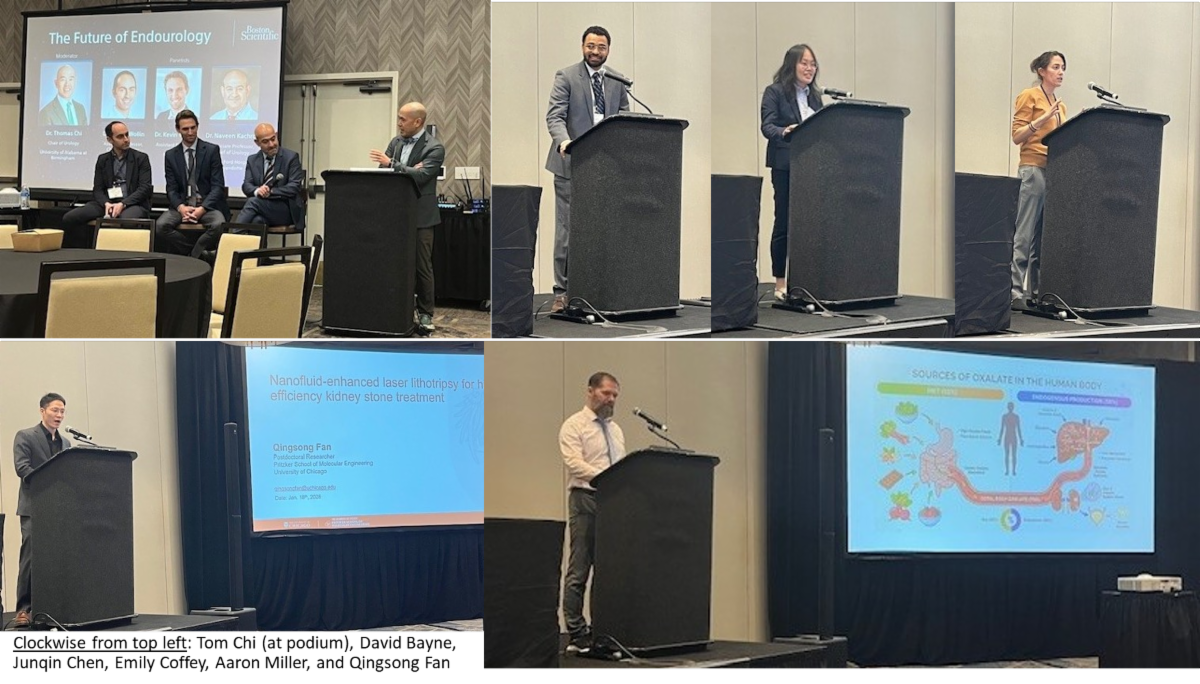
The following CAIRIBU Community investigators and trainees participated in the meeting by delivering presentations or moderating scientific sessions.
Participation from Current CAIRIBU Centers and Research Interest Groups
Duke University Urology P20 Center (PI, Pei Zhong, PhD)
-
Presentations were given by postdoctoral investigators: Junqin Chen, PhD compared mechanisms of stone dusting and fragmenting of two lasers commonly used during kidney stone removal surgeries; and Qingsong Fan, PhD (collaborating with the Center from University of Chicago) discussed research related to nanofluid-enhanced laser lithotripsy. Additionally, Michael Lipkin, MD, part of Dr. Zhong's Center leadership team, moderated a session on surgical management of kidney stones.
Mayo Clinic Rochester Urology P20 Center (PIs, John Lieske, MD and Kevin Koo, MD)
-
Muthuvel Jayachandran, PhD delivered a presentation on renal immune cell crosstalk in kidney stone pathogenesis; John Lieske, MD discussed rare genetic variants implicated in kidney stones
Children's Hospital of Philadelphia Urology P20 Center (PI, Gregory Tasian, MD)
-
Dr. Tasian described NIDDK-funded work on the development of the Urinary Stone Disease Hub Cohort, a publicly accessible database for kidney stone research
CAIRIBU Interactions Core (PI, Kristina Penniston, PhD, RD)
-
In her last year on the ROCK Society Executive Committee, Dr. Penniston received an award and commendation for 8 consecutive years in ROCK Society leadership as secretary-treasurer and president. She led the meeting's moderated poster session.
UC San Francisco Urological Epidemiology Institutional Research K12 Career Development Program (PI, Alison Huang, MD)
-
Recent CAIRIBU K12 Scholar, David Bayne, MD, MPH (UC San Francisco), described his work on patients' perspectives related to delays in care for kidney stone treatment
Investigators from the CAIRIBU Urobiome Research Interest Group
-
Delivering presentations related to kidney stones and the urobiome were: Kymora Scotland, MD, PhD (UC Los Angeles), Aaron Miller, PhD (Cleveland Clinic), and Emily Coffey, DVM, PhD (University of Minnesota. Additionally, this year's ROCK Society research training fellowship was awarded to Jose Agudelo, MD. Dr. Agudelo worked as a scientist in Dr. Aaron Miller's microbiology laboratory for several years before joining the University of Wisconsin-Madison as its current endourology fellow. Dr. Agudelo's award will pay for materials and travel related to learning an experimental technique from Duke University CAIRIBU P20 Center investigators.
| | |
Participation from prior CAIRIBU Urology P20 Centers
UC San Francisco (co-PIs Thomas Chi, MD and Marshall Stoller, MD)
-
Thomas Chi, MD, MBA (now Department of Urology chairman at University of Alabama at Birmingham) moderated a lunch session on the future of endourology. Marshall Stoller, MD delivered a presentation on thalassemia and kidney stones.
University of Alabama at Birmingham (PI, Dean Assimos, MD)
-
Joseph Crivelli, MD, John Knight, PhD, Sonia Fargue, MD, PhD, and Kyle Wood, MD each moderated a session during the meeting.
Vanderbilt University (PI, Maria Hadjifrangiskou, PhD)
-
Former Vanderbilt University fellow, Connor Forbes, MD (now at University of British Columbia in Vancouver), delivered a presentation on outcomes related to the treatment of kidney stones in the context of recurrent urinary tract infections
| | |
CAIRIBU AT AUA 2026
May 15-18
| |
CAIRIBU trainees and ESIs: was your abstract accepted? If so, get more ATTENTION and VISIBILITY for your research.
Send your abstract to the CAIRIBU Interactions Core
We will feature it in the CAIRIBU Compass, the CAIRIBU Community's e-journal, in March - BEFORE abstracts are published in the Journal of Urology.
| |
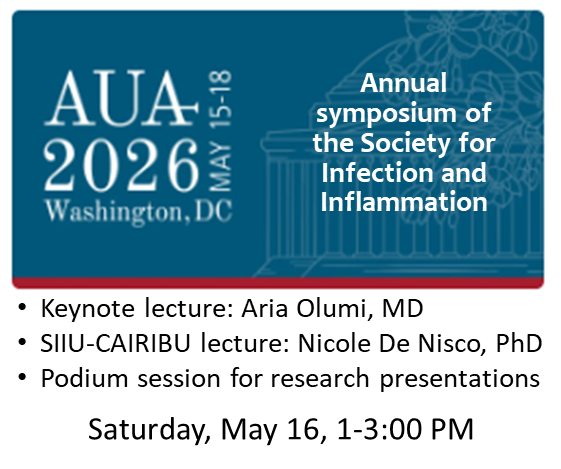
Present your research on infection and inflammation at AUA
Dr. Kymora Scotland, president of the Society for Infection and Inflammation (SIIU), invites abstracts to be presented during the SIIU symposium podium session, Sat., May 16 at AUA 2026.
Dr. Scotland is an Assistant Professor of Urology at UC Los Angeles and an investigator in the CAIRIBU Urobiome Research Interest Group.
-
Abstract deadline: March 2, 2026
- Follow AUA guidelines for abstract length and format
-
Submit abstract to: siiuabstracts@gmail.com
| |
Joint AUA and SBUR research symposium for non-malignant urology
Course co-directors are: Kristina Penniston, PhD RD (University of Wisconsin-Madison), representing the AUA Research Education, Conferences, and Communications Committee, and Jindan Yu, MD, PhD (Emory University), vice-president of the Society for Basic Urological Research.
Multiple scientists will present their research within 3 sessions: basic prostatic hyperplasia, comorbidity-associated genitourinary disorders, and bladder contractility dysfunction. Each session will then be followed by panels of clinicians and clinician-scientists who will engage in discourse about how to increase cross-disciplinary communication, inform each other about critical knowledge gaps, and move progress from the bench more quickly to the bedside. Don't mis this important symposium, Saturday, May 15 at the AUA meeting in Washington, DC.
| CAIRIBU ANNUAL MEETING PHOTOS AND SOUNDTRACK | | |
The 2025 annual CARIBU meeting was a great success, the largest ever. Best abstract winners, abstract booklet, photos, and more information is available on the CAIRIBU website HERE. Information about the 2026 CAIRIBU Meeting will be available soon.
| | View and download from among hundreds of photos taken during the meeting | | Original urology-themed music played during the meeting include: Leaky Bladder Blues, Sharp Stones in the Dark, Rollin' Like a Stone, Endless Echos of Pelvic Pain, Foggy Prostate Breakdown, and more!!! Original lyrics and music were created by Kristina Penniston and generated with Mureka AI, 2025. | | FORECAST FOR GEORGE M. O'BRIEN UROLOGY O'BRIEN CENTERS RFA | |
The National Institute of Diabetes and Digestive and Kidney Diseases (NIDDK) forecast anticipates announcing a Request for Applications (RFA) for the George M. O'Brien Urology Cooperative Research Centers Program in April 2026 with a 7/01/2026 application due date and projected start date of 2/01/2027. Total program funding is estimated to be $5.3 million. Up to 5 awards may be available. See forecast HERE.
NOTE that this is simply a forecast; NO announcement is yet made
| GEORGE M. O'BRIEN KIDNEY RESOURCE ALLIANCE (OKRA) EVENT | |
OKRA SHOWCASE FOR EARLY-STAGE INVESTIGATORS. Early Stage Investigators (ESIs) may apply for a travel award (up to $1,250) to participate in the inaugural OKRA Resource Showcase, Monday, April 6, 11:30-6:00 PM at the Johns Hopkins University Bloomberg Center in Washington, DC
The event will provide an opportunity to learn about the services and resources available through the OKRA Consortium’s seven National Resource Centers (NRC), funded by the NIDDK. ESIs will learn about the services, tools, and expertise offered. Additionally, attendees will receive guidance on writing successful proposals, guidance on developing research questions and specific aims pages, and opportunities to collaborate with the NRCs. Established investigators are also encouraged to attend to learn more about the services offered by the 7 NRCs, speak with NRC representatives, and participate in round table discussions. It is expected that this opportunity will lead to increased collaborations with the OKRA Consortium. All eligible applicants, including past travel awardees and OKRA Opportunity Pool applicants, are encouraged to apply.
ESIs: complete application by 2/23/2026 (link HERE). Project applications include: (1) Specific Aims page or summary of a proposed research project; and (2) Description of at least one OKRA resource* to be used in the proposed study/project. *OKRA NRC details and resources can be found on the OKRA website
Registration is required (submission of registration does not guarantee attendance); register on the OKRA website. After completing your registration request, you will receive a follow-up email from okrancc@uab.edu to confirm your attendance.
Full details for this funding opportunity and contact information for any questions can be found on the OKRA website here HERE
| UPCOMING CAIRIBU COMMUNITY EVENTS | | |
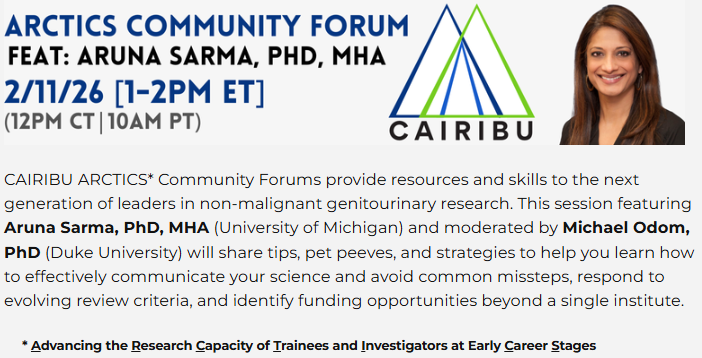
CAIRIBU ARCTICS COMMUNITY FORUMS
Primary goal: Develop the research and professional skills of trainees and early-stage investigators. 2nd Wednesdays of each month, 1:00 PM Eastern (12 PM Central | 10 AM Pacific)
| | Prior CAIRIBU ARCTICS Community forum recordings are HERE | | |
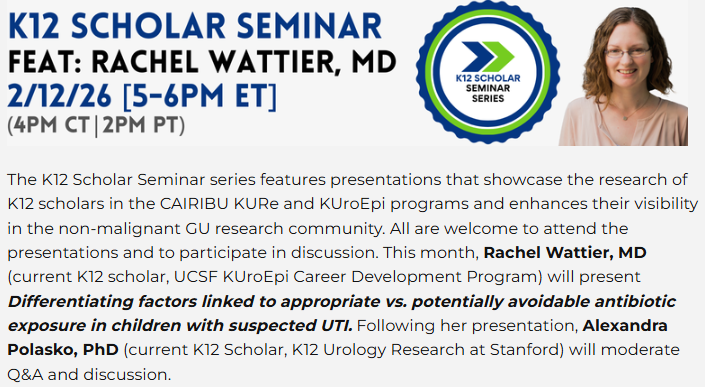
CAIRIBU COMMUNITY K12 SCHOLAR SEMINARS
Primary goal: Showcase K12 Scholars from CAIRIBU Urologic Research (KURe) and K12 Urological Epidemiology (KUroEpi) Institutional Research Career Development Programs. 2nd Thursdays of each month, 5:00 PM Eastern (4 PM Central | 2 PM Pacific)
| | Prior K12 Seminar Series recordings are on the CAIRIBU YouTube page HERE | | |
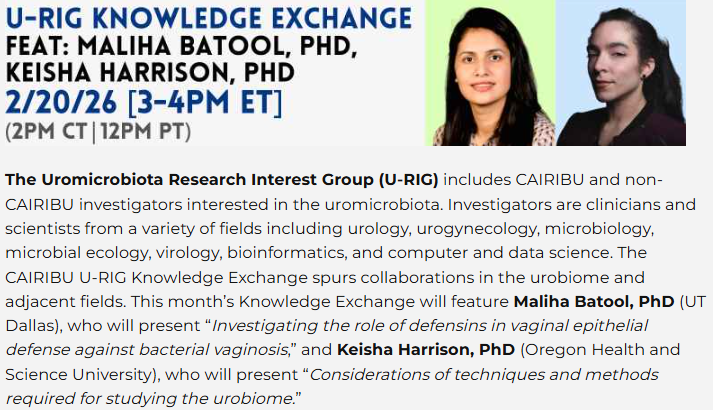
CAIRIBU UROBIOME RESEARCH INTEREST GROUP KNOWLEDGE EXCHANGES
Primary goal: Bridge knowledge gaps in urobiome and urinary tract infection research. 3rd Fridays of each month, 3:00 PM Eastern (2 PM Central | 12 PM Pacific)
| | Prior CAIRIBU Urobiome RIG forum recordings are HERE | |
|
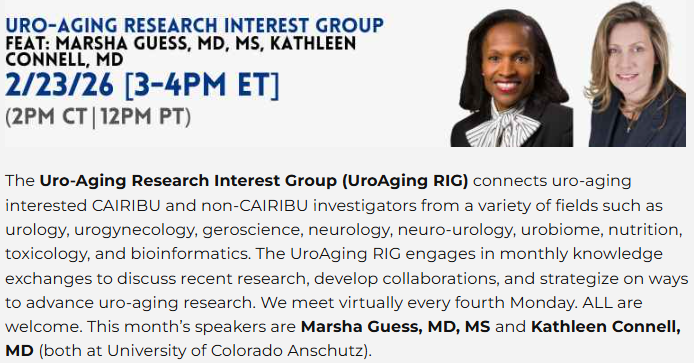
CAIRIBU URO-AGING RESEARCH INTEREST GROUP KNOWLEDGE EXCHANGES
Primary goal: Exchange knowledge and stimulate dialogue among a broad cross-section of scientists, clinicians, and clinician-scientists. 4th Mondays of each month, 3:00 PM Eastern (2 PM Central | 12 PM Pacific)
| | Prior CAIRIBU Uro-Aging RIG forum recordings are HERE | | |
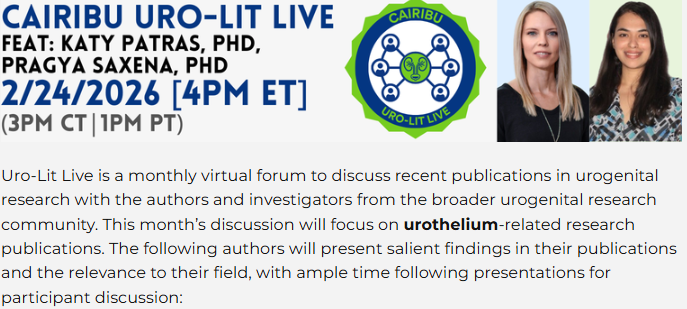
CAIRIBU URO-LIT LIVE DISCUSSIONS
Primary goal: Recognize investigators across the broader CAIRIBU research community who have recently published urology-related research, disseminate their findings, and foster new research ideas. Last Wednesdays of each month, 4:00 PM Eastern (3 PM Central | 1 PM Pacific)
| | |
Links to the papers being discussed are below:
| | NEW COLLABORATION & NETWORKING TOOL | | | |
CONNECT on the CAIRIBU Community Phone & Web App
Download the app
Currently available for I-phone users only; an Android version is in development!
Try it out and give your feedback HERE
What can you do on the CAIRIBU app?
- View list of CAIRIBU Community and other urology-related events
- Enable "push notifications" to get timely notices to join virtual events
- View recorded CAIRIBU Community presentations
- Open and read the monthly CAIRIBU Communique, quarterly CAIRIBU Compass (the CAIRIBU Community e-journal), and the quarterly CAIRIBU trainee newsletter
- Peruse CAIRIBU website research funding news
- Find and communicate with potential collaborators
- Participate in discussion threads of interest to you
| | | |
The JANUARY 2026 issue of the CAIRIBU Trainee Newsletter features a response by Aruna Sarma, PhD, MHA (co-PI of the CAIRIBU KURe K12 Program at the University of Michigan) to the question: How do you learn how to publish?
View comments about staying on track with your training expectations by graduate student Alexis Adrian (University of Wisconsin-Madison Urology O'Brien Center) and an anonymous postdoc response to a question about dealing with difficult mentor-mentee relations.
Information about trainee-focused funding sources, undergraduate research programs in urology and uro-aging, and job openings is also available. Want to ask a question for a future PI or postdoc to answer??? Send your question HERE.
| | CAIRIBU LEADERSHIP OPPORTUNITIES | | Opportunities to engage with the CAIRIBU Community by helping to plan events are available. Anyone with an in interest in supporting collaborative urology research is invited to participate. Contact information is below. | | | EVENT OR SERIES | DESCRIPTION | WHO TO CONTACT | | 2026 CAIRIBU Meeting planning (2-3 virtual meetings, decisions by email) | >> Plan the 2026 annual meeting! Decide on meeting format, speakers, and logistics. Planning begins in March. | >> Contact Kris Penniston, PhD, PI of the CAIRIBU Interactions Core at penn@urology.wisc.edu by March 1st! | | CAIRIBU ARCTICS Community Forums (1-2 virtual meetings, decisions by email) | >> Plan the 2026-27 CAIRIBU ARCTICS Forum series, identify topics and speakers of particulate interest to trainees. Planning begins in March. | >> Contact Mariana Coughlin, MS, CAIRIBU Interactions Core Research Program Coordinator at mcoughlin3@wisc.edu by end of February | | Format for CAIRIBU website funding announcements (sign up for a virtual focus group) | >> Voice your opinion. Inform how CAIRIBU Interactions Core staff gather and present research funding information in order to be most valuable to you. | >> Contact Theo Ng, CAIRIBU Interactions Core Administrative Coordinator at teng33@wisc.edu or cairibu@urology.wisc.edu | | New CAIRIBU Postdoc Seminar series (1-2 virtual planning meetings) | >> Help plan the timing, frequency, and format of this series; volunteer to give a presentation. Planning begins shortly. | >> Contact Mariana Coughlin, MS, CAIRIBU Interactions Core Research Program Coordinator at mcoughlin3@wisc.edu ASAP | | | |
To adapt to the changing research funding landscape, the CAIRIBU Interactions Core has expanded the search for urology research funding. Spearheaded by Theo Ng, the CAIRIBU website now features announcements from federal agencies AS WELL AS from professional societies, organizations, foundations, and industry. A few upcoming research funding opportunities from Theo are below. More announcements on CAIRIBU website HERE.
Edward Mallinckrodt, Jr. Foundation Grants. Supports ESIs in basic and translational research. Previously-funded areas include: biochemistry, genetics, molecular biology, medicine, immunobiology, microbiology, and more. Open to MD and/or PhD tenure track faculty members 1-4 years at their institutions who do not have current R01 or similar funding. $75K/yr for up to 3 yrs, nonrenewable, no indirects. Application icludes 5 pg project proposal, 1-2 pg lay summary, letters of approval, budget, and biosketch. Deadline: 7/01/2026
AUGS Foundation Grants. (1) Fellow Research Award for postdocs in a current training program conducting clinical/patient-oriented, educational, or lab-based/basic science research; (2) Faculty Research Award for early career researchers or affiliate members within 5 years of completion of training; and (3) June Allyson Memorial Fund Research Award for fellows engaged in lab-based/basic science research. Up to $25K for 1-2 yr projects. Must be AUGS member. Deadline: 3/12/2026, 11:59 pm ET
Resource-Related Research Projects for Development of Models and Related Materials for Studying Human Health and Diseases (sponsor: National Institutes of Health, Office of Research Infrastructure Programs - R24 Clinical Trials Not Allowed). RFA-OD-25-010 seeks applications for developing, characterizing, or improving research models of human health and diseases; developing biology-based new approach methodologies applicable to human health and diseases; or improving access to information about or generated from the use of models of human disease. Deliverables must be broadly applicable to scientific interests of at least 2 NIH Institutes or Centers and must evaluate diseases and processes that impact multiple organ systems. Applications must describe the need for and the potential impact of the proposed resources on the research community across a range of scientific disciplines. Awards are for 4 yrs with chance for renewal. Standard NIH due dates apply. [Expires 09/29/2028]
Spinal Cord Injury Research on the Translational Spectrum Grants (sponsor: Craig H. Neilsen Foundation) support research targeting a system or function affected by spinal cord injury or its sequelae during the acute or chronic injury period. Projects should demonstrate novelty, high scientific merit, and potential for substantial impact on treatment and care. Meaningful incorporation of people with lived experience in the development and management of the research is encouraged. Up to 2 yrs for preclinical studies; human subjects research may receive up to 3 yrs. Project max is $400,000 total costs. Budgets may not exceed $200,000 in any year (10% max for indirects). PIs must be independent investigators at any stage of their career. LOI deadline: 5/22/26; full application deadline: 11/12/26
Small R01s for Clinical Trials Targeting Diseases within the Mission of NIDDK (sponsor: NIDDK - R01 Clinical Trial Required). PAS-25-102 supports pilot and feasibility clinical trials in humans that lay the foundation for larger clinical trials related to the prevention and/or treatment of diseases and conditions within the mission of NIDDK. Applications for clinical trials should have clearly described aims and objectives and have a high likelihood that the trial findings will lead to more definitive, hypothesis-driven trials to improve understanding, diagnosis, prevention or treatment of the diseases studied. Preliminary data regarding intervention efficacy are not required. Standard NIH due dates apply. [Expires: 05/08/2026]
Exploratory/Developmental Research Project Grant (sponsor: NIH - R21 basic experimental studies with humans required). PA-25-307. Participating institutes include NIA, NICHD, NCCIH, NIMH, and others. 2 yr awards may not exceed $275,000. Standard NIH due dates apply.
Basic Research in Neurobiology Research Grants (sponsor: The Whitehall Foundation). Max $100,000/yr available for up to 3 yrs to investigators with <$200,000/yr in extramural funding. Funding interests include invertebrate and vertebrate neurobiology, specifically of neural mechanisms in sensory, motor, and other complex functions of the whole organism as they relate to behavior. Standard LOI and application dates begin in January, April, and October of each year.
Hamilton Research Support Grant. Up to $150,000 to qualifying research labs impacted by recent funding cuts. May apply for a single instrument or a bundle of benchtop instruments from the Hamilton Company. Documentation detailing the impact of these instruments on your research funding required. Full application information, evaluation criteria, details about instruments, and terms and conditions available HERE. Submissions accepted quarterly; 2026 deadlines: 3/31 and 6/30.
| |
FUNDING SPECIFICALLY RELATED TO AGING RESEARCH
Travel awards for trainees. Get support to attend and present your research at the NIH/NIA Multidisciplinary Research in Aging/Team Science Workshop, May 20-21, 2026, Bethesda, MD. Awards from the NIA Research Centers Collaborative Network cover travel to and from the workshop, meals, and hotel accommodations. Eligible applicants are advanced doctoral students, postdoctoral fellows or ESIs (according to NIH definition) affiliated with an institution with at least one NIA-sponsored Center (e.g., AITC, Shock, Roybal, RCMAR, OAIC/Pepper, ADRC, or CDEA). Applicants must attend the full meeting to qualify; recipients will participate in a special career development session on May 20. Learn more HERE. Application deadline: 2/27/26. Decisions announced: 3/6/26.
Funding to present aging research findings at any conference. The American Federation for Aging Research Dorothy Dillon Eweson Lecture Series provides up to $2,000 to cover travel and meeting-related expenses to encourage investigators in aging research to present their research findings at an annual scientific or medical specialty association meeting where aging-related research is not the primary focus. Applications accepted on a rolling basis.
Fund for conferences on understanding human lifespan and processes of aging. The American Federation for Aging Research Hevolution Foundation Scientific Conferences Fund provides up to $10,000 to support scientific meetings, conferences, and workshops relevant to the mission of the Hevolution Foundation. Larger support may be considered depending on factors such as number of expected attendees, meeting duration, and meeting venue. Applications are open to non-profit organizations, public and private universities, colleges, laboratories and government agencies in North America, the United Kingdom, and countries in the European Union. Meetings must be held at venues in one of the eligible countries. Annual applications deadlines: Jan 31, Apr 30, July 31, and Oct 31.
Biology of Aging Rapid Data Award (sponsor: Upstate NY Nathan Shock Center). Open to all investigators; supports acquisition of data to support grant applications or publications relevant to biology of aging and to mechanisms that link aging to disease. Requires utilization of Upstate NY NSC Research Core services. Awards are $10,000; applications accepted on a rolling basis.
| | NEED BIOSPECIMENS FOR YOUR RESEARCH? | | |
The Human Tissues and Organs for Research Resource (HTORR) Pilot Award Program (sponsor: National Disease Research Interchange) will cover all costs associated with obtaining up to ~10 human biospecimens to be used in a pilot study, including tissue preservation reagents and shipping costs, for an award period of up to 24 months. Preliminary data generated is expected to be used in at least one subsequent grant application by the end of the 2-year project period to at least one of the NIH institutes supporting the program (ORIP, NIAID, NHLBI, NEI, NIDDK, NIAMS).
-
Eligibility: ESIs or established investigators transitioning to using human biospecimens
-
Application materials to be submitted: Requested tissue information form, administrative information form, personal statement (2 pgs max), lay summary (500 words max), scientific abstract (500 words max), specific aims (1 pg), research plan (6 pgs max, references, letters of recommendation (2-3), applicant biosketch, biosketches for collaborators (if applicable), letters of collaboration (if applicable), signed HTORR pilot award program application checklist
Application Deadline: 5/1/26
| | The CAIRIBU Community website events page is your ONE-STOP SHOP for all CAIRIBU Community events as well as those from all other urology and related research organizations, societies, and initiatives. Check the CAIRIBU EVENTS LISTING on the CAIRIBU website early and often. Do you see an event within the broader urology research community that isn't listed? Let CAIRIBU Interactions Core staff know (cairibu@urology.wisc.edu). | | | | |
Kristina L. Penniston, PhD, RD
PI, CAIRIBU U24 Interactions Core
(U24-DK127726)
penn@urology.wisc.edu
Dept. of Urology, University of Wisconsin School of Medicine and Public Health, Madison, WI
| | |
George M. O'Brien (U54) Urology Cooperative Research Centers Program
- University of Wisconsin-Madison (2014-2019 and 2019-2024)
- Columbia University (2014-2019 and 2020-2025)
- Stanford University (2021-2026)
Multidisciplinary Urologic Research (KURe) Career Development Programs (K12)
- Duke University
- University of Wisconsin-Madison
- Stanford University
Urological Epidemiology (KUroEpi) Institutional Research Career Development Programs (K12)
- University of California San Francisco-Kaiser Permanente Northern California
- University of Michigan
-------------------------------------
Tracy Rankin, PhD, MPH, NIDDK KUH Deputy Director and Program Director, oversees CAIRIBU-affiliated K12 Institutional Career Development Programs
| |  | |
FORWARD P20 Urology Centers
- Mayo Clinic Rochester (2022-2025)
- Duke University (2022-2025)
- Children's Hospital of Philadelphia (2024-2027)
- Endeavor Health System (2024-2027)
CAIRIBU Interactions Core (U24)
-
PI, Kristina Penniston, PhD, RD
-
Research Program Coordinator, Mariana Coughlin, MS
-
Website, Digital, and Organizational Management, Muen Wang, BS
-
Administrative Support, Theo Ng, BS
-
Research Intern, Anna Barrett, BS
-
Social Media, Isaac Yang, BS
-
Student researcher, Edison Chiu
-
Student researcher, Raffael Ho
-
Student researcher, Ruben Mendes
-
Student researcher, Steven Lee
----------------------------------
NIDDK Program Officers who oversee the CAIRIBU Interactions Core and the U54 Urology O'Brien Centers:
| | Links to websites for current CAIRIBU Centers and Programs are on the CAIRIBU website HERE | | |
Collaborating for the Advancement of Interdisciplinary Research in Benign Urology
CAIRIBU is a community of NIDDK-funded U54 and P20 Urology Centers and K12 Institutional Career Development Programs whose overarching objectives are to address gaps in knowledge related to epidemiology, etiology, development, progression, and expression of non-malignant urologic conditions and to train the next generation of leaders in urology research. The CAIRIBU Interactions Core is the central coordinating body for the CAIRIBU Community.
| | | | |