CAPES Quarterly Newsletter | | |
Word from Our Director
We are thrilled to start out 2026 with an upcoming event, transitions, and new grant funding. First, we want to encourage CAPES faculty and colleagues to learn about the ECHO model (Extension for Community Healthcare Outcomes) through University of New Mexico's public orientation on January 27th 2025. We'll learn more about how colleagues at the American Foundation for Suicide Prevention and American Academy of Pediatrics have used the ECHO model to implement high quality suicide care on February 18th, 2025. Register here! Our hope is we can learn how CAPES faculty can test strategies to implement the ECHO model with new workflows, and suicide screening, assessment, and interventions in healthcare settings.
Second, we'd like to welcome Dr. Kathryn Sabella as the new lead of the Evaluation Unit! Dr. Sabella is an Assistant Professor in the Implementation Science and Practice Advances Research Center at UMass Chan and a member of the second cohort of CAPES scholars. We thank Dr. Pivovarova for all her hard work and congratulations on her new grant!
Third, we are pleased to announce two new funded CAPES pilot projects and new NIH grants that have been awarded to CAPES faculty. Congratulations to Dr. Davis-Martin and Dr. Zimmermann and your teams for your successful CAPES pilot projects and to Drs. Pivovarova, Sabella, and Zimmermann on your newly funded NIH projects, all of which also include other CAPES faculty!
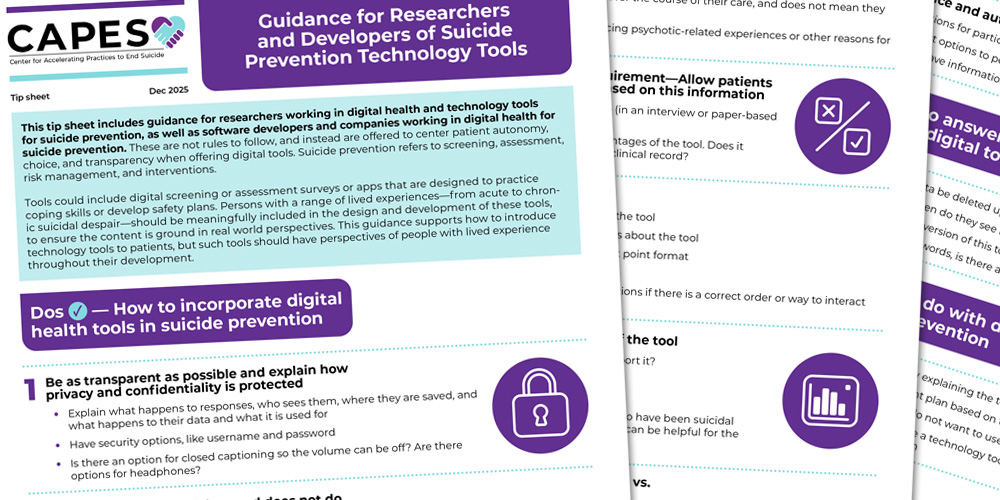
Fourth, we have two bodies of work to highlight. We have a new tip sheet from the CAPES Lived Experience Advisory Board, focused on what suicide prevention researchers and technology developers should and should not do, key considerations, and questions to ask when developing and implementing new suicide risk screening, assessment, and treatment tools into clinical care. We hope you find this tool useful when designing and refining technology-based suicide care tools and develop procedures to introduce them to patients.
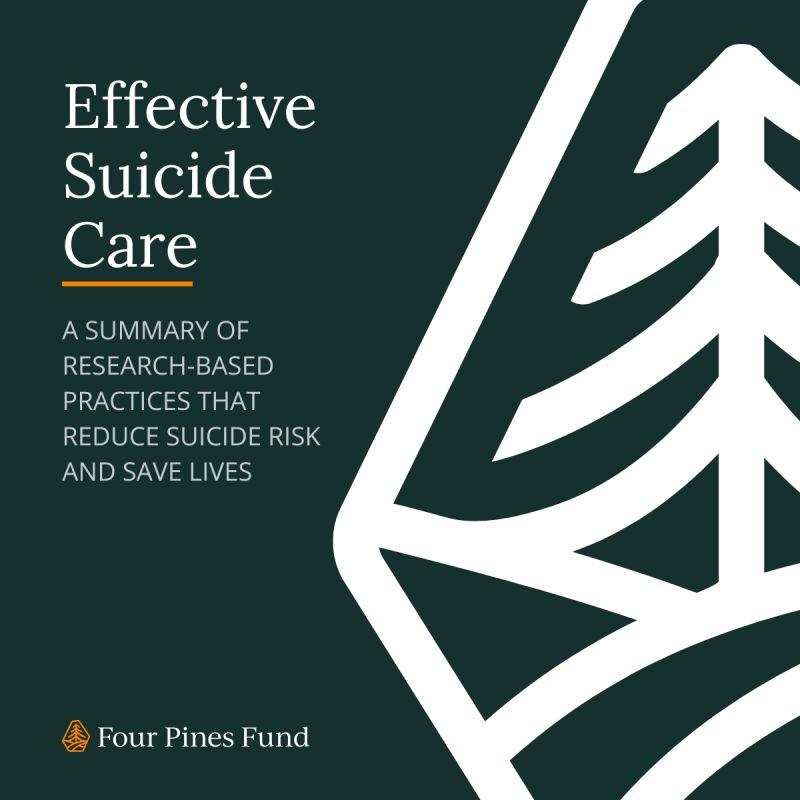
We highlight the Four Pines Fund Evidence-Based Suicide Care Issue Brief, that Drs. Boudreaux, Davis-Martin, Mullin, Kelly, and Rahmoun provided feedback and consultation on this brief that distills decades of research and lived expertise into a clear, accessible overview of evidence-based practices in suicide care - and why they remained underused in healthcare settings.
If you miss an event, be sure to check the CAPES Events page for recordings. All resources and tipsheets can be found in our Digital Health and Tech, For Clinicians, or For Researchers pages.
Sincerely,
Dr. Boudreaux
|
| Introduction to ECHO Model:
Public Session and Resources | | |
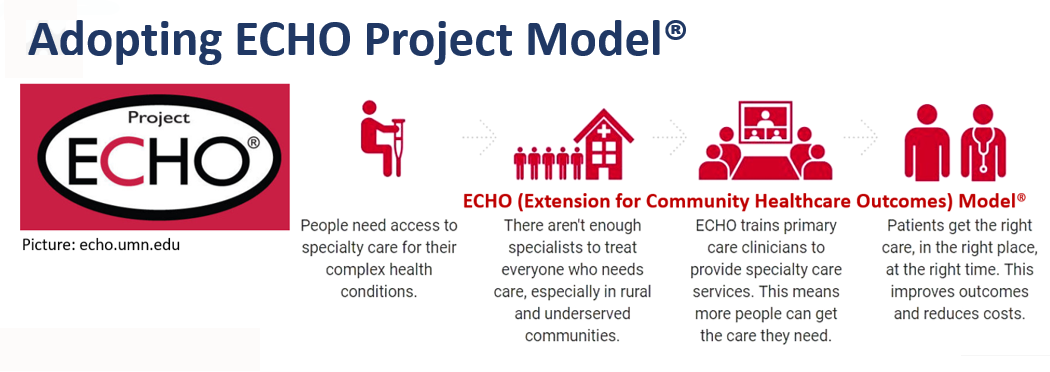
We invite all CAPES faculty, staff, scholars and consultants to attend a seminar to learn about Project Extension for Community Healthcare Outcomes (Project ECHO). Project ECHO is a continuing medical education and care management intervention and training model in which experts share knowledge with trainees, who then present cases for discussion and recommendations to receive live peer and expert feedback using video conferencing. Project ECHO has spread to many sites during its 22 years, reaching providers in nearly 200 countries.
Project ECHO can inform the decisions by proponents of other health care innovations to accelerate and broaden dissemination, fidelity, and sustainment of evidence-based practices.
We’d like CAPES faculty to consider the ECHO model in introducing new workflows that include digital health screening, assessment, and interventions for suicide risk within complex healthcare settings. Bring questions about the model and how to use it to the session below.
This is a public 90-minute interactive session with approximately 45 minutes of presentation about the ECHO model telehealth training program, followed by 45 minutes of Q&A with Project ECHO leaders, hosted by University of New Mexico.
The next public session is held on January 27th at 10:30 a.m. EST
Sign up here: iECHO | All Teach, All Learn
For more information see: The ECHO Model — Project ECHO
See here for publications using the ECHO model: Project ECHO Publications Dashboard
Get an overview of Project ECHO in 1–2 minutes: Project ECHO: Changing the World Fast and Project ECHO
| | |
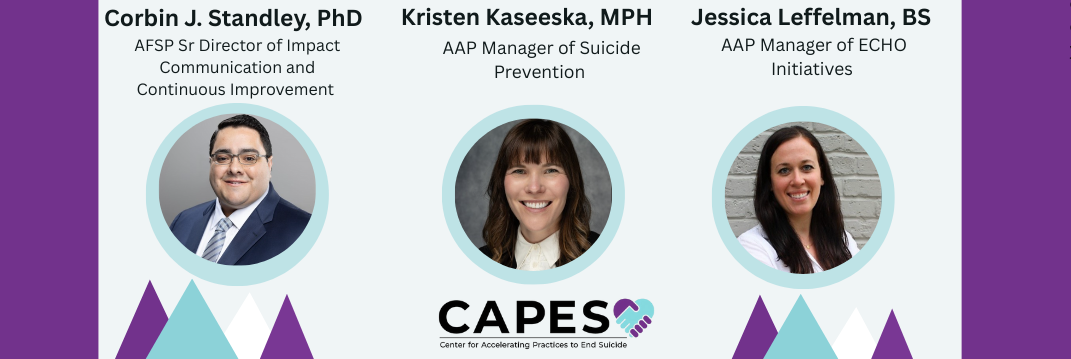
This webinar focuses on key learnings from a 3-year Suicide Prevention ECHO program developed by the American Foundation for Suicide Prevention (AFSP) and American Academy of Pediatrics (AAP) which aimed to support the implementation of suicide prevention strategies in pediatric healthcare and community settings. Attendees will learn about the Blueprint for Youth Suicide Prevention and methodology and results from the Suicide Prevention ECHO program, development of the curricula, adaptations to different pediatric health care settings, role of community ambassadors, quality assurance, evaluating the ECHO model effectiveness, and implications for future youth suicide prevention efforts in clinical and community settings.
What: Webinar with Q&A, hosted by the CAPES Dissemination and Community Engagement, and Education and Scientific Development Units
When: Wednesday, February 18th 2026 2–3 p.m. EST
Where: Virtual, Zoom
Speakers: Corbin J. Standley, PhD, AFSP Senior Director of Impact Communication and Continuous Improvement
Kristen Kaseeska, MPH, AAP Manager of Suicide Prevention
Jessica Leffelman, BS, AAP Manager of ECHO Initiatives
Free Registration here
| | New Evaluation Unit Leadership | | |
Congratulations, Kathryn Sabella, PhD, for transitioning to lead of the Evaluation Unit!
Dr. Sabella comes to the Evaluation Unit with years of experience in leadership and research. She is the director of the Transitions to Adulthood Research Center and deputy director of the Implementation Science and Practice Advances Research Center (iSPARC). A sociologist by training, Sabella's research interests focus on factors that influence health and well-being of emerging adults, their transition to various life stages, and their level of community-engagement. She collaborates with the Young Adult Advisory Board of iSPARC on many of her projects, adopting a community-engaged approach to align mental health interventions and supports with the needs and values of young people. Sabella was recently a CAPES Scholar, focused on training in more intensive longitudinal analysis to understand behavioral health trajectories across the lifespan.
Relevant to the Evaluation Unit, Sabella also took a leadership role in the iSPARC annual report to the Massachusetts Department of Mental Health. Thank you to all who have given your progress for Year 3 which will be shared soon in our annual Impact Report soon! Welcome, Dr. Sabella, and thank you for all your hard work, Dr. Pivovarova and Alexandra Boland!
| | Meet the Faculty: Dr. Daniel Coppersmith | | |
Welcome Daniel Coppersmith, PhD, to UMass and to CAPES!
Dr. Coppersmith is a new assistant professor in the Department of Psychological and Brain Sciences at the University of Massachusetts Amherst. His research program aims to advance the understanding, prediction, and prevention of suicide. His research is grounded in the theoretical orientation that suicidal thoughts and behaviors are dynamic, complex, and heterogeneous and he use new technologies, such as smartphones and wearable biosensors, to capture and model these factors. The ultimate goal of his program of research is to improve the lives of individuals with suicidal thoughts and behaviors. He earned his PhD in clinical psychology from Harvard University and completed clinical training at McLean Hospital, Massachusetts General Hospital, and the VA Boston Healthcare System. His research has been funded by the National Institute of Mental Health, National Science Foundation, and the American Psychological Foundation.
Coppersmith served on the American Psychological Association Rapid Expert Advisory Panel on use of generative AI chatbots in therapy and diagnostic assessments. This advisory was published by the APA in response to this panel: Health advisory: Use of generative AI chatbots and wellness applications for mental health
The expert panel warns that generative AI chatbots and wellness apps should not replace professional mental health care. They may offer limited support during times of stress or loneliness, can support use of coping skills in individuals own home, and can be used as an adjunct to therapy, but pose significant risks.
Risk can include:
1. Spreading misinformation
2. Providing unreliable or unpredictable support during clinical emergencies like suicide
3. Creating an unhealthy dependency
4. Privacy concerns
5. Harm to vulnerable groups, e.g., children, adolescents. those in low-resourced communities
The panel recommends that researchers study safe contexts for AI use, evaluate biases in AI algorithms, and develop standards for implementation of AI generative content as adjunct to therapy (rather than a replacement of a clinician) and that developers should adopt industry wide standards to reduce harm, and include clear disclaimers about the use of AI tools. Psychologists should also contribute to the development of safety feature and guardrails to support persons with mental health conditions.
| | New Tipsheet from the CAPES Lived Experience Advisory Board | |
We are excited to share a new tip sheet with guidance for researchers and developers of technology for suicide care, created by the CAPES Lived Experience Advisory Board. We hope you use this guidance to inform and guide any research being conducted related to digital health and suicide care, in ways that are aligned with the needs and values of people with lived experience.
Recommendations for technology based screening, assessment, and interventions for suicide risk include:
- Being transparent about what the tool does and does not do
- Describe confidentiality and data security clearly
- State clearly who has access to the data and how it will be used
-
Explain if this is an alternative—in other words, is there a paper version of the tool? Is this the only way someone can participate or complete the form?
- Show the person how to use the tool and explain if it goes in a certain order
Share this tool widely with any colleagues in research and technology and software development!
CAPES faculty and scholars are all encouraged to bring research questions or projects to the CLEAB for feedback. To schedule a consultation with the CLEAB, Lourah Kelly, PhD, lead of the Dissemination and Community Engagement Unit. Meetings are every second Friday of the month from 2:30–4:00 p.m. by Zoom.
| | Announcing Two New CAPES Pilot Projects | | |
Congratulations from the Education and Science Development Unit for the two successful pilot projects this year, who were each awarded $25,000 for 1 year projects, to test innovations in suicide care technology.
Lead: Rachel Davis-Martin (UMass Chan); Consultants: Sharon Johnson (WPI); Bengisu Tulu (WPI)
The study team will conduct co-design sessions with primary care medical and behavioral health clinicians to enhance existing EHR-integrated CAT-MH results displays, incorporating item-level questions and patient responses. Based on this feedback, we will replace current displays with improved versions that offer more detailed views of patient symptoms within the production EHR. Finally, we will compare CATS-PC implementation outcomes before and after the enhanced displays, assessing acceptability, usability, feasibility, reach, fidelity, and adoption to inform a deployment package that supports broader implementation and scalability.
Lead: Martha Zimmermann (UMass Chan); Collaborators: Anna Whelan (UMass Chan); Lourah Kelly (UMass Chan); Nancy Byatt (UMass Chan); Edwin Boudreaux (UMass Chan)
The study team will aim to identify gaps in suicide risk detection on the EPDS by analyzing existing RCT data to compare suicide risk reporting in obstetric versus research settings and examine predictors of missed risk. We will then evaluate item-level performance of the CAT-SS among perinatal participants from our CAPES Pilot Project, assessing score distributions, reliability, correlations with related measures, and item exposure. Finally, we will explore the CAT-SS’s preliminary reliability and predictive validity through longitudinal follow-up at 4, 6, and 8 months, examining changes in scores and their associations with mental health symptoms.
| | New NIH Funding Awarded to CAPES faculty! | | |
Martha Zimmermann, PhD, assistant professor of psychiatry and behavioral sciences, and of the first cohort of CAPES Scholars, received a Mentored Patient-Oriented Career Development Award from the National Institute of Mental Health (NIMH) to test the effectiveness of a text message-based intervention aimed at preventing perinatal anxiety. The award titled "Reaching Calm: A Digital Intervention to Prevent Perinatal Anxiety Disorders" is $650,000 over 5 years and includes funding for both training and a research project. Drs. Byatt (CAPES Established Investigator) and Boudreaux serve as mentors on this award. Read more here.
| | |
Kathryn Sabella, PhD, assistant professor of psychiatry and behavioral sciences, a member of this past year's cohort of CAPES scholars, and newly transitioned to Evaluation Unit Lead of CAPES, has been awarded a $100,000 R03 award from the National Institute on Alcohol Abuse and Alcoholism (NIAAA). Dr. Sabella’s project, An Investigation of Sex Differences in Excessive Alcohol Use in Young Adulthood and Middle Age: Characterizing the Influence of Multiple Social Roles, Stress, and Poor Mental Health, is a secondary data analysis of two groups of data of the National Longitudinal Study of Adolescent to Adult Health (Add Health) to assess sex differences in excessive alcohol use (e.g., binge drinking, frequency of drinking, and heavy drinking) in young adulthood and early middle-age. Lourah Kelly, PhD, of the Dissemination and Community Engagement Unit is also a co-investigator. Read more here.
| | |
Kate Pivovarova, PhD, associate professor of family medicine and community health, and emergency medicine, has been awarded a $3.5 million award from the National Institute on Drug Abuse to implement Clinical Organization and Legal Agency Alliance Building (COLAAB) in 16 adult drug courts in Massachusetts and Florida. This study uses the Using the Exploration, Preparation, Implementation, and Sustainment (EPIS) framework to conduct a hybrid type 3 effectiveness-implementation mixed methods, stepped-wedge, cluster randomized controlled trial and deliver life-saving treatments to individuals with opioid use disorder and justice involvement, who are at very high risk of suicide. Bruce Barton, PhD (co-lead of the Design, Data, and Analysis Unit of CAPES), is also a co-investigator. Read more here.
| | |
What actually works in suicide prevention? A new brief commissioned by the Four Pines Fund distills decades of research and lived expertise into a clear, accessible overview of evidence-based practices—and why they remain underused in real-world care.
The guide highlights strategies shown to reduce risk and save lives such as:
- Collaborative safety planning
- Lethal means counseling
- Caring contacts and continuity of care
We’re proud that three CAPES faculty contributed expert review to this resource:
- Edwin Boudreaux, PhD — Director of CAPES and nationally recognized leader in suicide risk screening, clinical decision support, and continuous quality improvement
- Rachel Davis-Martin, PhD — Clinical psychologist and co-lead of the CATS-PC project, specializing in integrated behavioral health and technology-supported suicide care in clinical settings.
- Daniel Mullin, PysD, MPH - Clinical psychologist, collaborator on the CATS-PC project, specializing in evidence-based care in primary care settings
- Lourah Kelly, PhD — Assistant professor; lead of the Dissemination & Community Engagement (DanCE) Unit, focused on digital, emergency-department-based suicide prevention.
-
Basheer Rahmoun - Lead of the Operations Unit, expertise in implementing clinical research methodologies and testing technologies in clinical settings
| | |
Recent Publications by CAPES Faculty
Ahluwalia, M., Sehgal, S., Lee, G., Agu, E., & Kpodonu, J. (2025). Disparities in Artificial Intelligence-Based Tools Among Diverse Minority Populations: Biases, Barriers, and Solutions. JACC. Advances, 4(5), 101742. https://doi.org/10.1016/j.jacadv.2025.101742
| Meyerhoff, J., Coppersmith, D. D. L., & Fox, K. R. (2025). The ethical imperative of self-directed tools in crisis helplines to prevent suicide at scale. Nature. Mental health, 3(3), 269–270. https://doi.org/10.1038/s44220-025-00384-9 | Boudreaux, E. D., Ardelean, A. J., Ciminelli, J., Arias, S. A., Camargo, C. A., Jr., & Miller, I. W. (2025). Patients Who Screen Positive for Suicide Risk Incidental to Their Chief Complaint in the Emergency Department: Characteristics and Post-Visit Suicide Outcomes. Archives of Suicide Research, 1–21. https://doi.org/10.1080/13811118.2025.2574516 |
| |
Thank you for taking the time to review our 11th quarterly newsletter!
Stay tuned for more Center-wide announcements and opportunities!
| | Share and follow us on social media! | | | | |