 |
Stanislaus County Office of Education - Child & Family Services
The fundamental work of the
is distinct and focuses on the period of life where the foundation for future success is built; ages zero to five. It's the time when the brain grows the most, where support and early intervention makes a huge difference for children and their families, and where the investments you make pay off. Child & Family Services gives children a head start in school, work, and life by educating children, supporting parents, and developing the professionals who work with them.
---------------------------------------------
|

Family Resource and Referral Center-Children and Youth Day Event- May 18, 2019
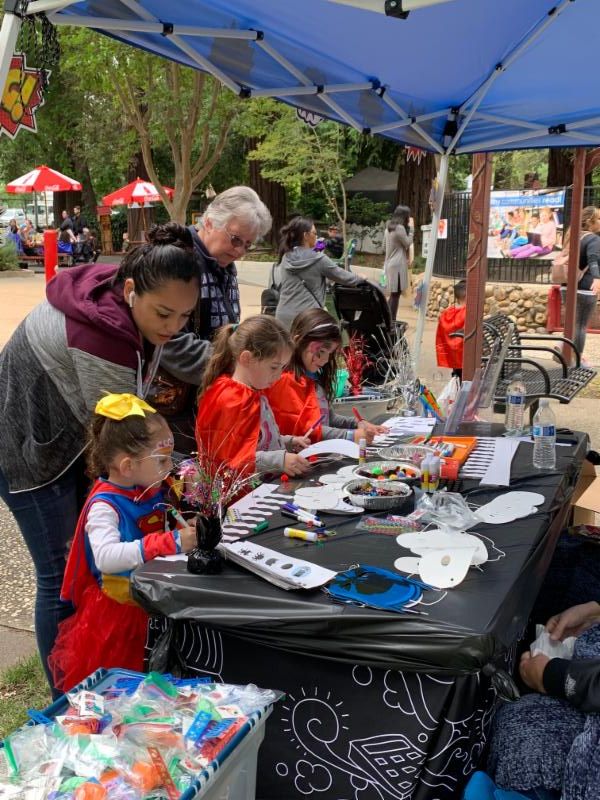
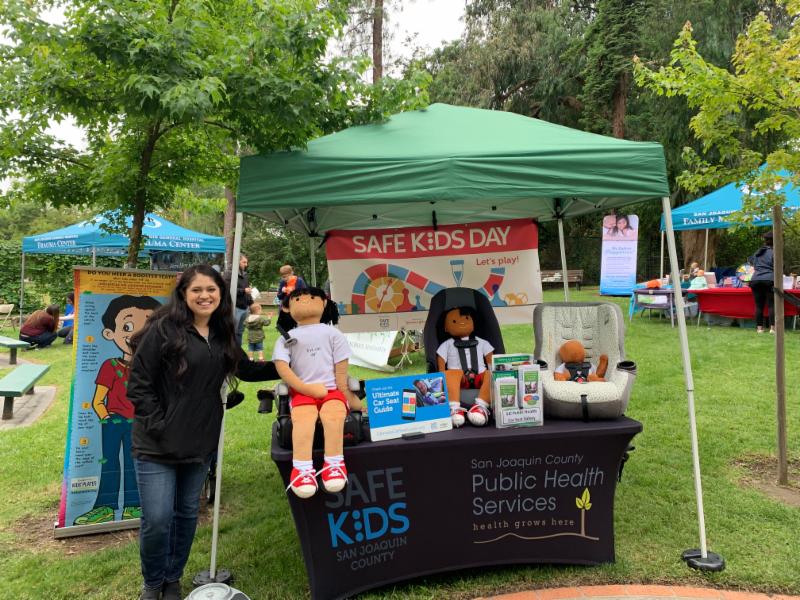
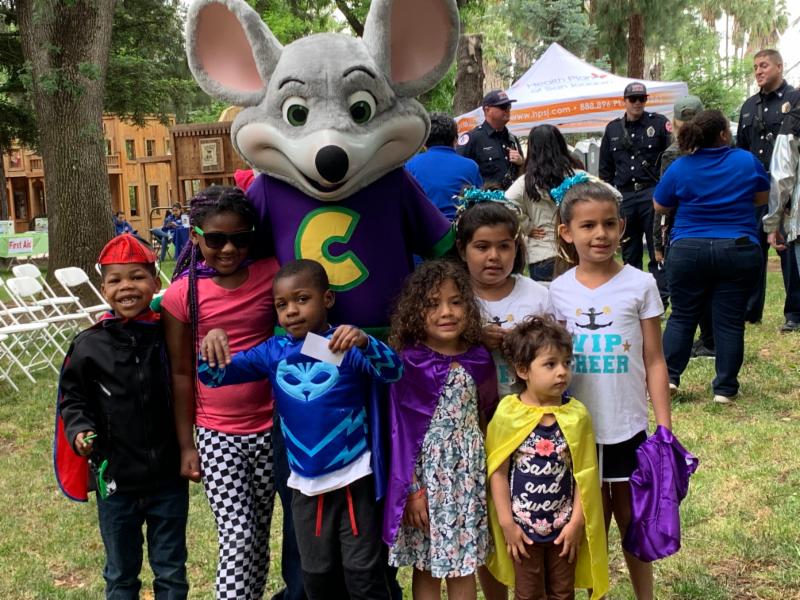
Family Resource and Referral Center hosts an annual Children and Youth Day event at Pixie Woods at Louis Park in Stockton, CA. Children & Youth Day at Pixie Woods is a free community event for families of San Joaquin County and surrounding areas. This year's theme was Super Heroes and the first 700 hundred children received a free super hero's cape. Businesses and non-profit agencies attend and provide their resources and information on health, literacy, nutrition, physical activity, and each offers a fun activity for the children. Everyone can participate in the mascot parade and dance their way throughout the park with the mascots or join the mascots and staff for music and movement activities, which continues throughout the course of the day. There are activities such as arts and crafts, face painting, and interactions with reptiles. For many children, this is a once a year opportunity to enter the beautiful setting of Pixie Woods free of charge and ride the carousel, train, boat and participate in the many numerous fun activities throughout the day.
-----------------------------------------
Do you have success news to share with us?! We love to hear what our members are up to and where they're going! Submit your accomplishment(s) big OR small by emailing us!
|
|
|
CAPPA Member Only Benefits
|
|
Hotel Discounts
CAPPA has secured an amazing hotel offering for our members. As a CAPPA member, you have access to exclusive negotiated rates at thousands of hotels worldwide. This program can be utilized two ways; as an employee perk, and for corporate travel. Visit the
Member's Only website to register today!
CAPPA Member Benefits now available on the Members Only website:
|
Just added to the Member's only website are two AP 101 webinars on Enrollment;
Enrolling Clients into the CalWORKs Program and
Enrollment Overview:
Welcome to the Alternative Payment Program
.
|
|
|
CAPPA's
2018-19 Board of Directors
|
|
Rick Richardson
Child Development Associates
Karen Marlatt
Valley Oak Children's Services
Beth Chiaro
Child Care Resource Center
LaVera Smith
Supportive Services Fresno
Martin Castro
Mexican American Opportunity Foundation
Jeffrey Moreira
Crystal Stairs, Inc.
Public Policy Co-Chair
Phillip Warner
Children's Council San Francisco
Tina Barna
Choices for Children
Abby Shull
YMCA Childcare Resource Service
Leslie Reece
Family Resource & Referral of San Joaquin County
Jeanne Fridolfs
Napa County Office of Education
Mike Michelon
Siskiyou Child Care Council
Marco Jimenez
Central Valley Children's Services Network
San Mateo 4Cs
Michelle Graham
Children's Resource & Referral of Santa Barbara County
Joie Owen
Glenn County Office of Education
Denyne Micheletti Colburn
CAPPA CEO
|
|
|
ELCD/CDE, DSS & CCLD Updates
|
|
July 2, 2019
June 19, 2019
Implementing Optional Staff Training Days
State Median Income and Income Ranking Table for Fiscal Year (FY) 2019-20
MB 19-04:
Family Fee Schedule for Fiscal Year 2019-20
May 14, 2019
Early Childhood Mental Health Consultation Services and Adjustment
Factors
The ELCD will host a webinar on
Thursday, March 14, 2019 from 10 a.m. to 12 p.m. to provide technical assistance with the CDMIS.
January 28, 2019
January 4, 2018
The California Department of Social Services (CDSS) has amended regulations pertaining to CalWORKs, within the Eligibility and Assistance Standards Manual. The changes are detailed in
CDSS Manual Letter No. EAS-18-05
|
|
|
Is Your Organization Hiring?
Post your job announcement here for thousands to see!
There is no charge for CAPPA members.
Non-members will be charged a fee of $75.
MCT Technology
Child Care Resource Center
Community Action Partnership of San Luis Obispo County, Inc.
Pomona Unified School District- Child Development
Child Care Coordinating Council, Inc. of San Mateo County
|
The CAPPA Board has made it a priority to support our field with a coordinated calendar to note upcoming statewide conferences, federal conferences of relevance, CDE and DSS stakeholder meetings and legislative and budget deadlines and hearings.
NOTE: If you would like to share your newsletter or items of interest with our field via the Monday morning e-Newsletter, then please
email us
a link. Please make sure that you have a link included to an online version or viewing.
|
|
|
Become a Monday
Morning
Update
Partner!
|
|

Our Monday Morning Update supports our Early Learning & Child Care field with timely information about what is going on in California and nationally; as well as dates to be aware and upcoming events.
Our weekly (50 times per year) Monday morning distribution is to more than 4,000 federal and state local agencies, resource and referrals, contractors, legislators and their staffs', centers, parents, providers, state departments and advocates.
To help support the continuation of this resource and or advertise in the Monday Morning Update, click
HERE.
You can also make a donation to CAPPA and CAPPA Children's Foundation
The Children's Foundation is a non-profit organization (501(c)3), Taxpayer Identification Number is
03-0521444. Your generous donation is tax deductible.
|
|
|
|
|
|
|
URGENT!! Stand Up for Immigrant Families in California
|
|
Two weeks ago, the President announced that U.S. Immigration and Customs Enforcement (ICE) would begin the process of deporting millions of undocumented immigrants across the country. While these raids were temporarily halted, new information suggests that ICE may begin conducting enforcement actions in 10 cities, including San Francisco, as early as yesterday Sunday, July 14.
In California, where many kids are growing up in "mixed status" families (where some members are citizens and others are not), this policy will have devastating effects. The fear of losing a parent can negatively impact a child's ability to grow, learn and thrive.
Please click here to read, download and share resources regarding rights, information if detained, information to support early childhood providers and information regarding the recently enacted California Values Act (SB 54).
|
|
*The Legislature is currently on summer break and will return in August!*
Monday, August 12, 2019:
- SEN Appropriations (Portantino, Chair) 10:00am - Room 4203
Click here
to see all of the legislation identified of interest to our field. Below are a couple of highlights of the results from the recent Appropriations committees:
Click here to see calendar of field events/interests and legislative hearings and deadlines. If you would like something added to the field calendar, click here and submit details.
|
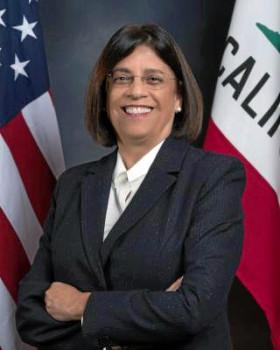
PROFILED BILL OF THE WEEK
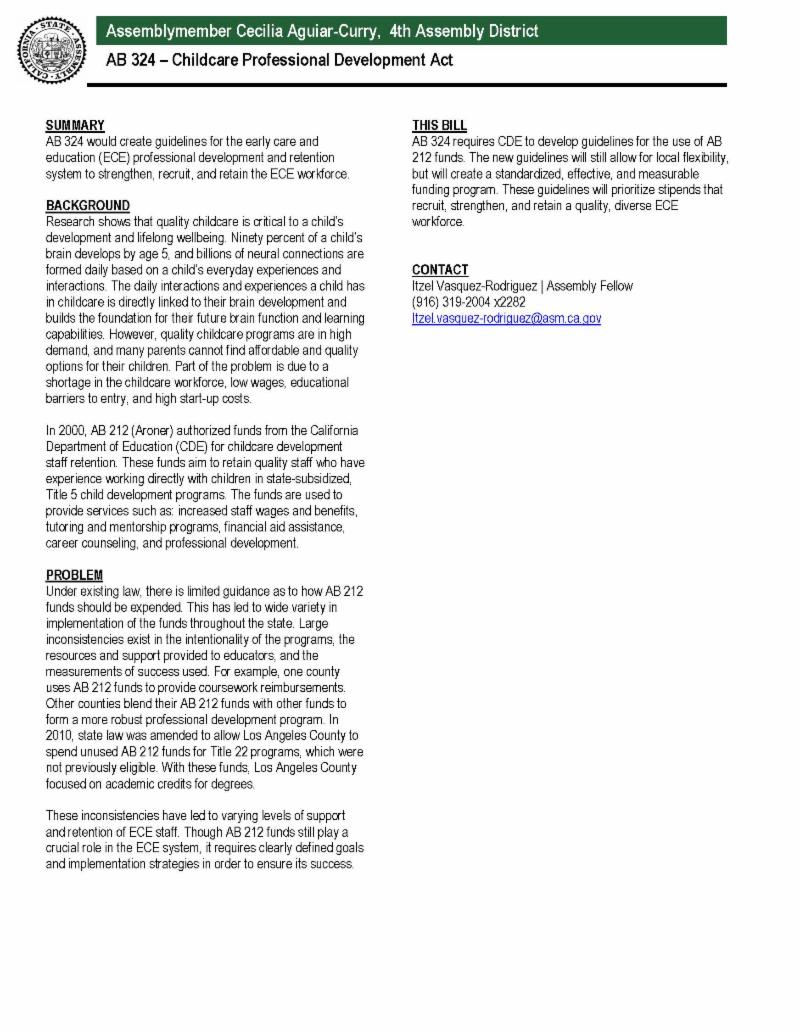
AB 324 ~ Assemblymember Cecilia Aguiar-Curry
The Childcare Professional Development Act
AB 324 aims to strengthen the Early Childhood Education (ECE) workforce by expanding educational attainment opportunities for our state's child care providers and teachers. This bill would require the development of guidelines for AB 212 programs based on a set of principles to ensure a standardized and effective AB 212 professional development and retention system.
T
his bill is currently in SEN Appropriations.
|
 2
2019-20 State Budget Information
|

Changes to the implementation date of Assembly Bill 603 provision regarding notification to providers
To all Executive Directors and Program Administrators of California Alternative Payment Programs (APPs), including California Work Opportunity and Responsibility to Kids (CalWORKs) Stage 2 (C2AP), CalWORKs Stage 3 (C3AP), Migrant Alternative Payment Program (CMAP), and Family Child Care Home Networks (FCCHN),
Recently, California's Governor signed Senate Bill (SB) 75, adopted as part of the omnibus trailer bill to the Budget Act of 2019-20. Among other things, SB 75 amended Education Code (EC) Section 8227.7,
which was added to EC, when the Governor signed Assembly Bill (AB) 603, (Chapter 706, Statutes of 2017). This section of EC, requires APPs, as of July 1, 2019, to provide notice to a child care provider of a change in reimbursement amounts for child care services, a change in the hours of care, rates, or schedules, an increase or decrease in parent fees, or a termination of services, at least 14 calendar days before the effective date of the intended action.
This notice is to inform you that SB 75 has changed the implementation date of this section of EC from July 1, 2019, to July 1, 2020.
Further direction on the implementation of this section of EC will come at a later date.
If you have any questions regarding the information in this email, please contact your assigned ELCD Field Services Consultant. A list of consultants can be found at
https://www.cde.ca.gov/sp/cd/ci/assignments.asp
or by phone at 916-322-6233.
|
Fiscal Year 2019-20 Initial Payments
Dear Executive Directors of Child Care and Development Programs:
The Child Development and Nutrition Fiscal Services (CDNFS) Office is providing you with information about FY 2019-20 initial payment timelines.
Child development contracts must be signed and returned to the CDE Contracts Office prior to initial apportionments being authorized by CDNFS. The CDNFS Office authorizes payment for all executed contracts on July 1, provided that the budget has been enacted.
In previous years, contractors who returned their original contracts prior to the final budget enactment typically received initial apportionments in the second or third week of July. Due to the implementation of a statewide accounting system (FI$Cal) this year, additional time is required by the State Controller's Office (SCO) to set up child development budgets, causing up to a ten-day delay in processing initial apportionments. Initial 2019-20 apportionments will, therefore, be authorized mid-July and are expected to be received by contractors in the last week of July.
As a standard practice, the CDE recommends contractors have three months of operating capital, through cash or a line of credit, to operate their program during the contract period prior to receiving their first apportionments or in the event apportionments are withheld, delayed, or lost in the mail. The CDE will continue to work diligently with the SCO to process payments as quickly as possible.
Sincerely,
Andrea M. Johnson
Staff Services Manager III
Child Development and Nutrition Fiscal Services
Fiscal and Administrative Services Division
(916) 324-6562
|
Contingency Funds Application Process
Dear Alternative Payment Program Contractors:
The purpose of this letter is to provide Alternative Payment Program (CAPP) contractors with information regarding the process to apply for contingency funds.
Pursuant to Education Code Section 8222.1, per the Budget Act of 2018, the California Department of Education (CDE) shall reallocate funds as necessary to reimburse CAPPs for actual and allowable costs incurred for additional services. A CAPP contractor may apply for reimbursement of up to three (3) percent of their contract amount, or for a greater amount subject to the discretion of the Department, based on availability of funds. Applications may be submitted as early as May 1, 2019, but no later than September 30, 2019. The CDE will approve or deny applications submitted pursuant to this section, but will not consider applications received after September 30, 2019, of the current calendar year for additional costs incurred during the 2018-19 fiscal year.
The CDE will distribute reimbursement funds for each approved application within 90 days of receipt of the application if it was filed between May 1 and July 20 inclusive of the current calendar year. Applications received after July 20 are not subject to the 90-day requirement for the distribution of funds. If requests for reimbursement pursuant to this section exceed available funds, CDE will assign priority for reimbursement according to the order in which it receives the applications.
Funds received by a CAPP contractor pursuant to this section that are not substantiated by the program's annual audit must be returned to CDE and are not subject to the appeal process.
If you have any questions regarding this process, please contact me at 916-324-6611, or email JClegg@cde.ca.gov.
Sincerely,
Jordan Clegg, Staff Services Manager I
Child Development & Nutrition Fiscal Services
Fiscal and Administrative Services Division
|

Regional Technical Assistance Trainings - Summer 2019
Go Kids, Inc.
9015 Murray Ave. Suite 110
|
July 30, 2019
Grass Valley
Sierra Nevada Children's Services
420 Sierra College Drive, Suite 100
Grass Valley, CA 95945
|
|
|
CAPPA member agencies, with the support of CAPPA & Children's Foundation, are putting together a series of Technical Assistance (TA) trainings that will be
coming to a region near you!
This series will be delivered in a format that is very participatory.
We encourage all participating to come with questions, as well
as samples for each of the topics that will be discussed.
Topics to include:
Best Practices Session (10:00am-11:45am):
- Ongoing Review for Input on Draft GAU Review Guides and pending 12-month Regulations, which are both anticipated to go into effect in October/November.
- Ideas for Procurement process overhaul. This will be a Q&A and open discussion format.
- 12-Month Eligibility in Stage 1. This will be a Q&A and open discussion format.
- How to implement the two-week written notice regulation (AB 603)-Update will also be provided on the CAPPA concerns that are included in the budget conversations.
- Management Bulletins Discussion- We will review those Management Bulletins that you continue to have questions on, including 18-09 & 18-09(a) Electronic Banking & Direct Deposits
- Transfers- This will be a Q&A and open discussion format; Inter-county transfers and clarification on stage 2 transfers to be included
Lunch (11:45am-12:15pm)
CAPPA Budget and Legislative Discussion and Updates
(12:15pm-1:00pm)
- AB 378- Child Care Provider Union Bill
- Variable Work Schedule- is a remedy in site?
Peer-to-Peer Networking Session (1:00pm-2:00pm):
This portion of the agenda will allow attendees to share their successful strategies, tools and ideas.
|
CAPPA Training: "Everything Fiscal"
Wednesday, August 14, 2019
9:30am-2:00pm
University of Phoenix
2860 Gateway Oaks Drive
Bldg. B, Ste. 100
Sacramento CA 95833
Classroom #121/122/123
CAPPA will be delivering a training focused specifically on APP fiscal issues on August 14th in Sacramento. Workshops will include "Fiscal Essentials" and a Q&A and open discussion session with CDE Fiscal and Agency Projections so that agencies can better monitor their contracts and also learn best practices!
9:30am-10:45am
Fiscal Essentials, CDE
CDNFS representatives will present a variety of fiscal topics affecting Alternative Payment contracts, including CalWORKs Stage 2, Stage 3 and CAPP. A wide variety of topics will be covered including the importance of reporting caseload and expenditure data accurately, how reported data affects projected earnings, payments and future year funding. Additionally, this presentation will include information regarding reporting procedures related to multiyear contracting for CAPP contracts. Whether the attendee is new to the agency or a seasoned accountant, everyone will benefit from this session.
10:45am-12:00pm
Fiscal Q&A Session
This session is all about getting your fiscal questions answered! This session will provide attendees the opportunity to get their questions answered, learn more about the topic as it relates to their circumstances and to get clarification. We ask that you submit your questions ahead of time so that we can plan this session and make it a valuable opportunity that will allow attendees to deepen their understanding of a specific topic.
Please submit your fiscal questions to CAPPA.
12:00pm-12:30pm
Lunch
12:30pm-2:00pm
Fiscal Projections:
Sean Tubridy, YMCA Childcare Resource Service; Michelle Ruggles, Community Child Care Council of Sonoma County (4Cs), and others TBA
Come prepared to hear how some agencies are doing their budget projections in light of 12-month eligibility, and data and trends that ought to be considered as part of any budget forecasting exercise. This workshop will help you better monitor your contracts and learn best practices that work efficiently. This workshop will take you step by step with interactive worksheets and templates.
**In the last part of this workshop, we will be breaking everyone into groups based on the system they use for projections. This will give attendees a chance to network with others that are using a similar method and make contact with someone they could follow-up with if they want more time to discuss.**
|

Network and CAPPA Joint Annual Conference 2019
October 2-4, 2019
DoubleTree Hotel Sacramento
Sacramento, CA
The California Child Care Resource & Referral Network and the California Alternative Payment Program Association look forward to hosting our 7th Joint Conference together this fall.
Registration- Available end of this month:
The preliminary program and final conference registration form, including the ability to list all conferees individually and to select workshops, will be released later this month.
We are hard at work creating a conference program that includes a variety of workshops to meet the needs of staff working with parents; staff providing training and technical assistance to child care providers; staff administering AP programs, program staff-supervisors; managers and directors.
Partnership Information:
Exhibitor and Sponsor Information is now available!
|
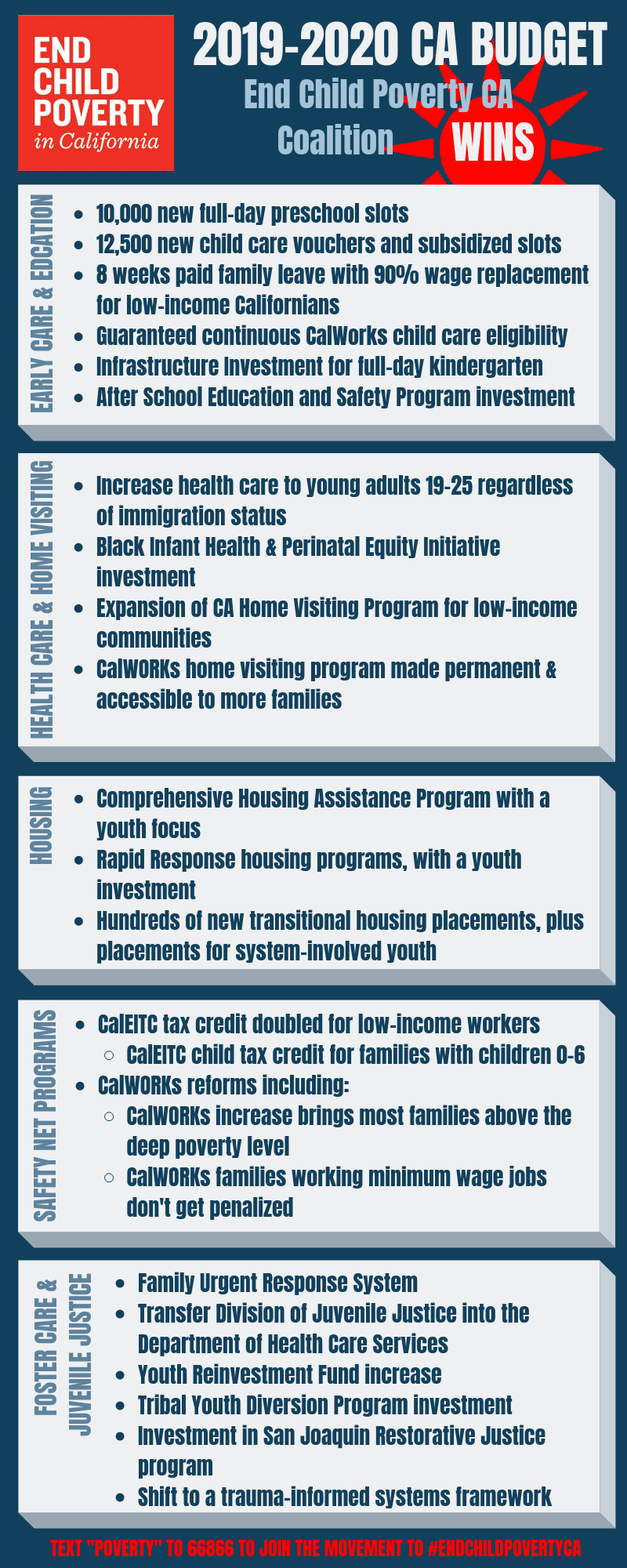
Western Center Victories in the 2019-2020 Budget
The new California budget more than doubles the
California Earned Income Tax Credit (CalEITC),
which provides support to low- and moderate-income working parents. The budget also ends the "senior penalty" for accessing Medi-Cal, and expands Medi-Cal to undocumented young adults. It also provides a major boost to CalWORKs grants, which is cash aid for food, housing and basic necessities for eligible families with children, and provides a significant investment in affordable housing and homelessness programs.
|
|
The Country's First Child Allowance (Almost)
 Last week, the California legislature passed a budget that spends
billions
of dollars to attack poverty in the state. Democratic Governor Gavin Newsom signed it into law, in so doing increasing funding for cash welfare, providing $1.5 billion for affordable housing, and also providing more resources for eviction defense, the state's Medicaid program, homelessness aid, and
myriad
other anti-poverty programs. In what Newsom
termed
"perhaps the most significant anti-poverty initiatives that we'll be passing this year," the new budget also more than doubles the state's Earned Income Tax Credit (EITC) and creates what might be the country's first child allowance-or at least, the closest thing yet to one. Last week, the California legislature passed a budget that spends
billions
of dollars to attack poverty in the state. Democratic Governor Gavin Newsom signed it into law, in so doing increasing funding for cash welfare, providing $1.5 billion for affordable housing, and also providing more resources for eviction defense, the state's Medicaid program, homelessness aid, and
myriad
other anti-poverty programs. In what Newsom
termed
"perhaps the most significant anti-poverty initiatives that we'll be passing this year," the new budget also more than doubles the state's Earned Income Tax Credit (EITC) and creates what might be the country's first child allowance-or at least, the closest thing yet to one.
Under the state's new child tax credit, all families in poverty will receive a
$1,000 refundable tax credit for each child under the age of six. The only catch is that families must have at least $1 in earnings to be eligible.
"We could call it a universal allowance, you might call it a guaranteed income," says Jessica Bartholow, policy advocate at the Western Center on Law and Poverty. "It says to households with children that they will have minimally an annual income of $1,000." If, of course, they report some earnings.
Bartholow said anti-poverty advocates tried to get the earnings requirement down to $0, but they couldn't. Legislators wanted to be able to say that this benefit was going to families that were earning, throwing a bone to the narrative that only those who work deserve government help.But as a step toward an omnibus program to end poverty, a mere $1 earnings requirement is the next best thing to no earnings requirement at all.
How the tax credit will be paid for deserves some attention-there are no new taxes, not really. The $1 billion cost of the new credit and the expanded EITC will be funded by a new tax
conformity law also passed by the state legislature. Essentially, the state is raising taxes on corporations and wealthy individuals equal to the tax cuts they have received under the GOP's tax reform-meaning they will be paying the same rates they've been accustomed to paying. The resultant money will go into California's coffers to fund the child tax credit. "It's the closest thing I've seen to a pure wealth redistribution in the state of California," Bartholow says.
|

First Look: 2019-20 Budget Includes Balanced Investments, Leaves Opportunities to Improve the Economic Well-Being of More Californians
On June 27, Governor Gavin Newsom signed into law the 2019-20 state budget, an agreement with state legislative leaders that makes a series of investments in creating economic security and opportunities for Californians, while also fostering the state's fiscal health.
The budget includes revenues and transfers of $146 billion for 2019-20. This represents an increase of more than $4 billion over the enacted 2018-19 budget, driven largely by the state's continued economic growth.
The budget package includes a mix of one-time and ongoing investments vital to low- and middle-income Californian's economic prosperity, including: a significant expansion of the state's Earned Income Tax Credit (CalEITC), additional investments in early childhood development, extending paid family leave, continuing to expand health coverage, boosting investments in the K-12 and state higher education systems, and promoting greater access to mental health services. The 2019-20 budget also provides funding for housing affordability and to address homelessness, recognizing that the high cost of housing continues to burden and destabilize many Californians. These proposals, individually and in combination, will significantly improve the health and well-being of millions of Californians, most notably low- and middle-income people of color, immigrants, and women and children.
The 2019-20 budget also continues to bolster the state's fiscal resilience by building up reserves and paying down state debts and liabilities. While the budget package expands a variety of programs, some of these investments could sunset within a few years, providing state leaders with an opportunity to revisit these investments depending upon the state's economic and fiscal conditions.
These proposals - a combination of one-time and ongoing investments, building up reserves, and paying down debts - represent a mostly balanced approach to managing the state's fiscal health, while leaving opportunities to further enhance the state's fiscal resilience and extend support to more Californians in future years. The 2019-20 budget leaves room to further improve the economic and social well-being for all Californians, including older adults and people with disabilities, working immigrants who file their taxes and who are left out of the CalEITC expansion, and low-income immigrant adults who remain locked out of access to state-subsidized health care coverage.
|
|
Checking In on the Child Care Landscape - 2019 State Fact Sheets
Research tells us that quality early childhood education care provides a solid foundation for future success and has long term academic and social benefits for the child and society. The evidence is clear - children who participate in high-quality programs during their early years demonstrate lasting effects on IQ, boosted academic and economic achievement, and lower incidences of childhood obesity and chronic illness. Even so, every state has its own unique child care landscape.
Child Care Aware® of America's 2019 State Fact Sheets
provide an overview of child care availability, quality rating systems, and other programs occurring at the state level. Data was gathered from federal and national sources and from our state Child Care Resource and Referral (CCR&R) agency networks and other state-level contacts surveyed in 2019. Please join us in spreading the word about child care facts in your state.
Want to compare your state's fact sheet to last year's? Read 2018 State Fact Sheets here.
|
Why don't Americans talk about child care?
The Democrats recently held two nights of debate, each two hours long, and in both sessions the two words that most American families talk about, worry about and sweat about behind closed doors were barely mentioned. Those two words are "child care." Finding it is a challenge; paying for it can be crippling; it's an issue that resonates with voters regardless of party, race or geography; and, as of yet, we aren't talking about it in a serious way.
It's never been a top-line issue in presidential politics, but
the relative silence on the matter this year is surprising.
Most though not all of the candidates have children, and many of those are still young. And while
most of the candidates are quick to praise spouses, aunties, in-laws and siblings who hold it down while they chase votes, few have talked candidly about their own reliance on outside help. And yet this quiet crisis percolates in millions of homes.
Why don't we talk about it? Because we don't want to admit that we need it so badly. Every parent knows the terror that jolts through the body when a provider calls in sick or the day-care center has to close for a few days because someone sent their child in with a contagious illness. Women don't talk about it because we want to project that we are fully in control of the work-life balance, that ridiculous phrase that calls to mind some kind of Zen-like pose when in fact the whole process is a constant clutch of nerves. Every parent knows this, and most employers know it, too.
Almost half of all parents miss work
at least once every six months because child care goes off the rails.
Child care needs to be easier to find and easier to afford. It needs to be better regulated with stronger local or state standards. And this is where things get really complicated.
|
|
Judge says SF correct in passing two tax measures on simple majority vote
A San Francisco judge ruled Friday that city officials did not break the law when they allowed two ballot measures that raised business taxes to pass last year with a simple-majority vote.
The rulings mark a major development in what's likely to be an ongoing legal fight to unlock as much as $500 million in annual tax revenue for San Francisco. It's a dispute that could reshape the ways local governments pass new taxes in California.
San Francisco Superior Court Judge Ethan Schulman's rulings followed a lengthy hearing on the two measures - both called Proposition C - on Wednesday. The city attorney's office and lawyers representing the Howard Jarvis Taxpayers Association and pro-business organizations argued over whether San Francisco violated the state Constitution and its own City Charter by allowing the propositions to pass with a simple-majority threshold and not a two-thirds majority.
June's Prop. C sought to raise $146 million annually for early education and child care by raising taxes on commercial landlords. That measure squeaked by with just under 51% of the vote.
|
|
World Cup winner Jessica McDonald says childcare is the support athletes need
Jessica McDonald is now a World Cup winner, but she's also the only member of the U.
S.
women's soccer team who is a mom.
So when the team won the World Cup this past weekend, McDonald had not only her 23 teammates to celebrate her win with, but also her 7-year-old son, Jeremiah.
McDonald is the only mother on the U.
S.
team right now, but there have been many other mothers who combined parenthood and professional soccer.
According to the AP, the U.S.
Soccer Federation has been paying for nannies since 1998, but when McDonald is playing on her regular team, the North Carolina Courage in the National Women's Soccer League, childcare still eats a huge chunk of her paycheck.
"If anything as simple as childcare was covered by the league or your organization, that would be life-changing for moms, especially when we're scraping pennies," McDonald told The Oregonian. "Maybe we would have more moms in this league if something like that was there for us, but I feel like we're far from that. The situation is way different for us than it is for male athletes and it would be nice to have better support from our league in that area."
McDonald has previously said that the National Women's Soccer League doesn't really support mothers, but hopefully that will change soon.
The country just saw what a mom can do when she's got support on and off the field.
|
|
|
|