|
News and views from a private school perspective
CAPSO
Monthly E-Mailer
California Association of Private School Organizations
| | The Voice of Private Education in California | |
Mission Statement
The California Association of Private School Organizations (CAPSO) is the voice of K-12 private education in California. Its primary mission is to preserve the independence of California’s private schools and to uphold parental choice in education. CAPSO, independently and in collaboration with other community and governmental institutions, is an advocate, catalyst, and creative leader for strengthening and advancing K-12 private education in California. CAPSO’s mission is based on the belief that a healthy, pluralistic society depends upon educational options, parental choice, and dialogue and collaboration between educational entities.
| | | |
|
In This Issue...
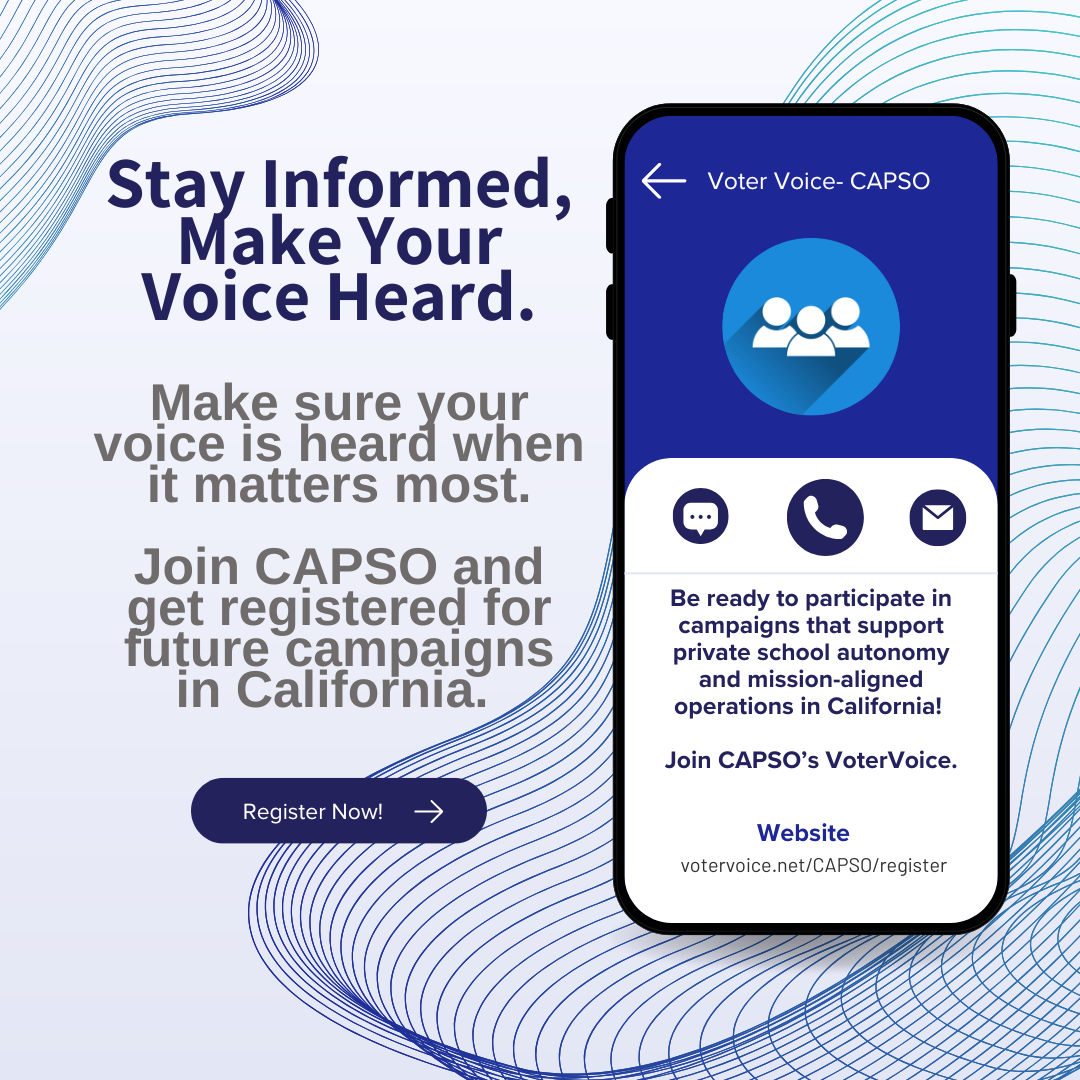
Reminder! Join CAPSO VoterVoice
Closing of 6 Offices in the US Department of Education
New Dashboard Shows Modest Student Gains in CA
New Resource from CAPSO: Communications Timeline- CDE
Reminder: Private School PD Consultation Survey (CDE)
Apply to Become a Green Ribbon School
No-Cost Private School PD through Title IIA Funds
Legislative Call to Action
What I've Been Reading
| | | |
Why CAPSO is Using VoterVoice and Call to Register
In the months ahead, California’s legislature will consider bills that could profoundly impact private schools—how we operate, how we serve families, and how we preserve the independence that defines our communities. To ensure that the voice of California’s private schools is heard clearly and effectively, CAPSO is launching a new advocacy platform: VoterVoice.
VoterVoice is a trusted, easy-to-use tool that empowers school leaders, educators, and parents to take part in legislative advocacy with just a few clicks. Once registered, you’ll receive timely alerts when your action can make a difference. With one simple email or message, your voice joins thousands of others across California to speak up for the rights and values that guide private education. CAPSO has traditionally managed legislative matters without the need for formal advocacy campaigns. However, as the political landscape grows increasingly dynamic, being organized for collective action—should the need arise—demonstrates our commitment to preparedness for the protection of private education rights.
This new platform will allow CAPSO to:
- Mobilize our network quickly when legislation demands attention.
- Provide accurate, up-to-date information about key bills affecting private schools.
- Help members connect directly with their state and federal representatives.
- Strengthen our collective impact on policy decisions shaping the future of education in California.
By registering now, you’ll ensure that you’re ready to participate in upcoming campaigns—whether defending parental choice, preserving private school autonomy, or supporting funding access for equitable services. CAPSO will continue to provide analysis, updates, and talking points to make advocacy easy and effective, but it starts with registration.
Your voice matters. Together, we represent hundreds of thousands of educators, students, and families who believe in the value of private education. When we speak together, policymakers listen. Click the button below to register!
| | | |
|
Closing of 6 Offices in the US Department of Education
From Council for American Private Education (CAPE):
On November 18, the U.S. Department of Education announced six interagency agreements with four other federal agencies, dramatically changing the administration of federal education programs.
According to a fact sheet released by the Education (ED) and Labor (DOL) Departments, "DOL will take a growing role in administering select elementary and secondary education programs funded under the Elementary and Secondary Education Act, as amended. These enumerated programs are currently managed by ED’s Office of Elementary and Secondary Education (OESE)."
ED officials indicated that funding for federal programs should not be affected. The administration of special education programs was not included in the changes, though there has been speculation that these functions could be moved to the Department of Health and Human Services at a later date.
View the Press Release Here
Access the Fact Sheet Here
Access a Related Article Here: NPR
| | | |
|
New Dashboard Shows Modest Student Gains in CA
California’s new (public) School Dashboard shows modest academic gains alongside indicators that have generally plateaued. Graduation rates reached a record high, and college- and career-readiness continued to improve, while areas such as absenteeism and English-learner progress showed little change. The results provide a snapshot of current statewide performance and highlight where progress is holding steady and where additional attention may be needed.
Regarding absenteeism, which has been a topic of emphasis in public and private schools since the pandemic: "Chronic absenteeism, for example, which soared to 30% during the pandemic, fell only 1 percentage point last year. After several years of steep declines, the rate all but stalled at just over 19%. Before the pandemic, about 11% of students were chronically absent, which means they missed 10% or more of the school year."
Access the Full Article Here: US News
| | | |
|
New Resource from CAPSO: Communications Timeline- CDE
Although private schools in California operate largely independently of the California Department of Education, there are several points throughout the year when key interactions or notifications may occur. CAPSO has created a new document that offers a tool to help private schools understand when to expect key communications from the California Department of Education (CDE) throughout the year. By outlining the typical timing of these messages, we hope to make it easier for school leaders to recognize important correspondence, respond in a timely manner, and feel confident distinguishing official notices from unsolicited emails. The goal is to support clearer communication and provide schools with a helpful reference point for the year ahead. This document will be updated ongoing basis to ensure it represents as many points of contact as possible for our members.
Access the full resource here
| | | |
|
Reminder- Complete the Private School Consultation Survey (from CDE)
From the California Department of Education, Private Schools Professional Development Department (IIA):
"As part of Title II Part A, Equitable Services, we participate in consultation with our private school community to receive feedback on professional learning needs. Please take a few moments to complete our survey to assist us in future planning of free professional learning for all private school educators. Your feedback is extremely valuable and helps us make decisions for future programming.
The survey will remain open until December 19, 2025. Please find the live link below."
Click Here to Complete the Survey
| | | |
Apply to Become a Green Ribbon School!
Did you know that private schools that participate in the Green Ribbon School process have the opportunity to be recognized at both the State and national levels?
The Green Ribbon School process is an opportunity to showcase efforts and be recognized for progress towards sustainability across three pillars:
-
Pillar I: Reduce environmental impact and costs;
-
Pillar II: Improve the health and wellness of schools, students, and staff; and
-
Pillar III: Provide effective environmental and sustainability education
Each June, the California Department of Education launches the California Green Ribbon Schools (CA-GRS) application process, inviting public and private schools, districts, and county offices of education to showcase their achievements in sustainability. Participating schools have the opportunity to demonstrate achievement and earn points in pillar categories recognized in one of four tiered levels:
-
Bronze Level (Entry Level Commitment): 55-64.9%
- Silver Level (Mid Integration): 65-74.9%
- Gold Level (Full Integration): 75% or better
-
Green Achiever: Exemplary Achievement with Full Integration - Green achievers are nominated for Federal recognition in the U.S. Department of Education Green Ribbon Program (ED-GRS).
Schools don't need to wait to apply until they have met full integration. Schools that apply will be supported with mentorship and resources, and schools with a 55%+ will be recognized with Bronze achievement by the California Department of Education!
Ready to Learn More?
California Green Ribbon Schools Achievers and Applicants Network: The CA Green Ribbon School Achiever and Applicant Network meets quarterly and aims to unite past, current, and future CA Green Ribbon Schools applicants dedicated to promoting sustainable practices and programs within their school communities. The network gives participants the chance to network with each other to inspire and share best practices.
The application opens in June and schools are encouraged to begin learning about the application process starting in January. A comprehensive toolkit is available. Use the link below to learn more!
Green Ribbon School Toolkit and Resources
| | | |
No Cost Private School PD Available
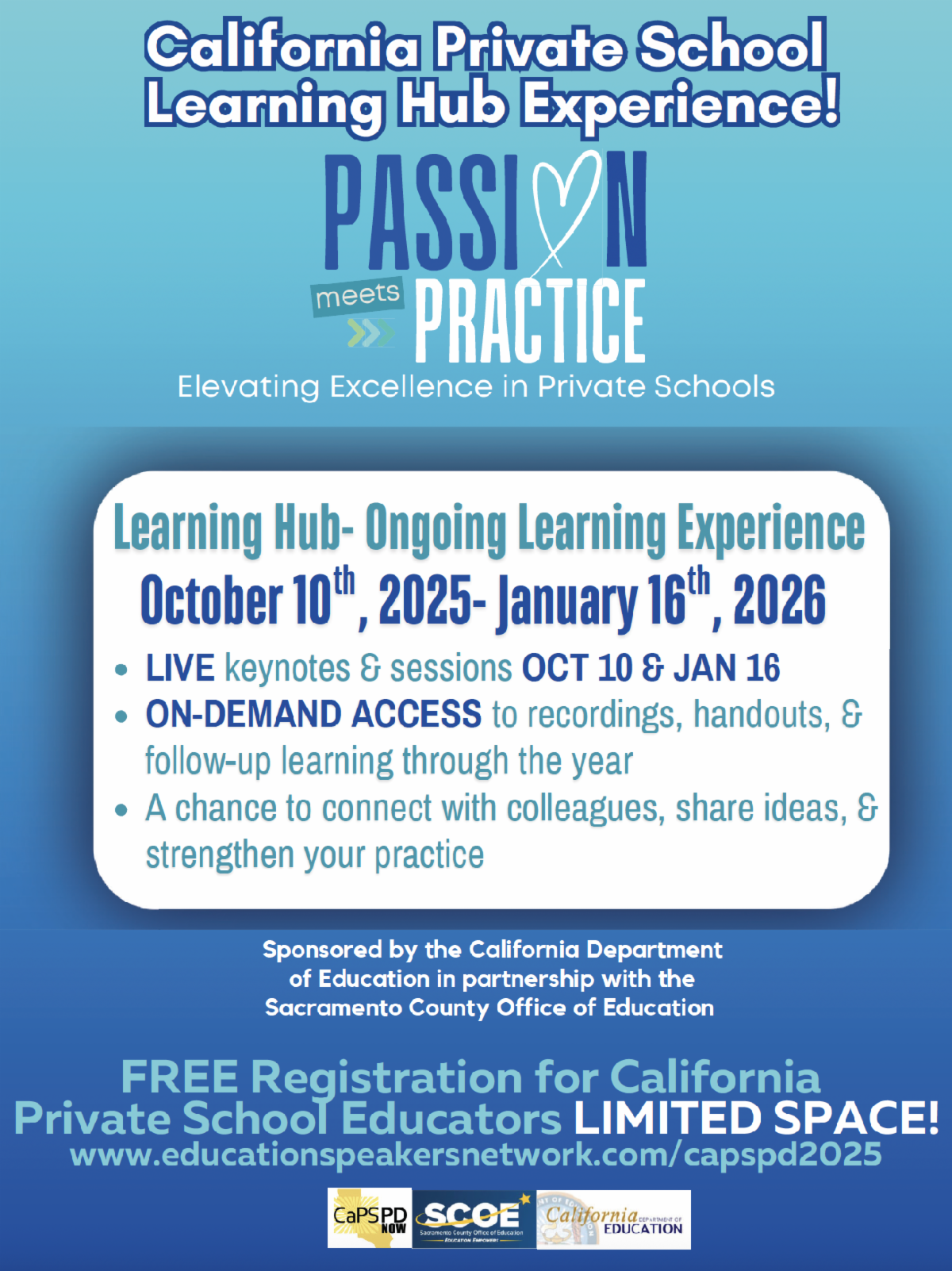
The California Department of Education receives funds through Title II, Part A, Equitable Services to provide no-cost professional development to private school educators.
The website, https://www.capspdnow.com, offers over 1000 no-cost courses available to schools and teachers in an on-demand format. Private school teachers and administrators can join the CaPSPD email distribution list to receive notifications about upcoming development opportunities by sending a blank email to join-private-school-professional-development@mlist.cde.ca.gov
Learn More About CaPSPDNow
| | | |
Legislative Call to Action | | | |
|
Participate in the Presidential AI Challenge!
Content below is directly from the Presidential AI Challenge website
WHAT: Student participants will complete a project that involves the study, development, or use of an AI method or tool to address community challenges, while educators will focus on creative approaches to teaching or using AI technologies in K-12 learning.
WHY: The Presidential AI Challenge seeks to inspire young people and educators to create AI-based innovative solutions to community challenges while fostering AI interest and competency. Students and educators of all backgrounds and expertise are encouraged to participate and ignite a new spirit of innovation as we celebrate 250 years of independence and look forward to the next 250 years.
The Presidential AI Challenge will foster interest and expertise in AI technology in America's youth. Early training in the responsible use of AI tools will demystify this technology and prepare America’s students to be confident participants in the AI-assisted workforce, propelling our Nation to new heights of scientific innovation and economic achievement.
WHEN: Online registration is open now! Project submission deadline is January 20, 2026.
HOW: Click here to visit the Presidential AI Challenge website to learn more & to register
| | | |
What I've Been Reading... | | | |
|
|
|
Questions?
Please don't hesitate to contact us!
| | | | |
Effective July 1, 2024 CAPSO has a new mailing address and phone number:
CAPSO
PO Box 1077
Novato, CA 94948
(415) 295-6333
| | The California Association of Private School Organizations (CAPSO) uses AI as a tool to support administrative and operational efficiency. All AI-generated content is subject to professional expertise, careful review, and formal approval before use. | | Stay part of the conversation and follow our page on LinkedIn! |
| | | |