|
News and views from a private school perspective
CAPSO
Monthly E-Mailer
California Association of Private School Organizations
| | The Voice of Private Education in California | |
Mission Statement
The California Association of Private School Organizations (CAPSO) is the voice of K-12 private education in California. Its primary mission is to preserve the independence of California’s private schools and to uphold parental choice in education. CAPSO, independently and in collaboration with other community and governmental institutions, is an advocate, catalyst, and creative leader for strengthening and advancing K-12 private education in California. CAPSO’s mission is based on the belief that a healthy, pluralistic society depends upon educational options, parental choice, and dialogue and collaboration between educational entities.
| | | |
|
In This Issue...
CA Private School Enrollment Trends
US Department of Education Discontinues Blue Ribbon School Program
CAPSO Resource: What to Consider When Contemplating Government Funding
OCR Staff Return to Work at US DOE
CA Supreme Court Ruling in Iloff v. LaPaille
AI Policies in Education
Apply to Become a Green Ribbon School
No-Cost Private School PD through Title Funds
Legislative Call to Action
What I've Been Reading
| | | |
CA Private School Enrollment Trends
The California Department of Education (CDE) has released private school enrollment figures for the 2024–2025 school year. At first glance, overall private school enrollment appears to be down 1.14% compared to 2023–2024. However, the picture is more nuanced.
Private school enrollment data are derived annually from the filed Private School Affidavits (PSAs). Schools that fail to file are not included in the count, which directly impacts the accuracy of the data. For 2024–2025, there were only three fewer PSAs filed than in 2023–2024. These missing affidavits likely reflect a combination of schools that have closed and administrators who, unfortunately, neglected this important task. This count also does not account for newly opened schools, which may offset additional closures or missed filings.
Based on PSA data, overall enrollment in California’s private schools remains steady, with only a modest decline observed this year.
Between 2023–2024 and 2024–2025, total private school enrollment declined by 5,673 students, dropping from 500,137 to 494,464—a decrease of 1.14%. Enrollment declined across most grades, with exceptions in grade 3 (+51), grade 5 (+176), grade 9 (+465), and grade 11 (+368). The largest declines were in kindergarten (–1,625), grade 1 (–1,897), and grade 8 (–10,135).
By school size, 37 more schools reported enrollments under 100 students in 2024–2025, accounting for a population increase (+1,554 students) in schools <100 (53,727 compared to 52,173 in 2023–2024). Conversely, 10 fewer schools reported enrollments exceeding 300 students, with total enrollment in these larger schools declining by 2,593 students (272,130 compared to 274,723 in 2023–2024).
The trend suggests growth in both the number of smaller schools (<100 students) and their total student populations, alongside a decline in both the number and total enrollment of larger schools (>300 students). Primary grades continue to show notable declines, including a 3.8% decrease in kindergarten and a 4.99% decrease in grade 1. Particularly striking is grade 8, where enrollment dropped by 25.8% and 31 additional schools reported eighth-grade classrooms with fewer than 20 students.
CAPSO will continue to monitor private school enrollment trends in California and share updates as they become available. In the meantime, schools are reminded of the importance of timely PSA filing. To access publicly available enrollment reports through the CDE, please use the link below.
View Private School Enrollment Reports
| | | |
US Department of Education Discontinues Blue Ribbon School Program
The U.S. Department of Education announced it is discontinuing the National Blue Ribbon Schools program, returning responsibility for recognizing exemplary schools to state education leaders. The Department explained that, “Awards conceived by those closest to the communities and families served by local schools will do more to encourage meaningful reforms than a one-size-fits-all standard established by a distant bureaucracy in Washington, D.C.” (Letter from the Office of Communications and Outreach, August 29, 2025). States are encouraged to design recognition programs that reflect their unique educational priorities, such as literacy, science achievement, workforce readiness, or postsecondary preparation.
As far as CAPSO is aware, the State of California will continue operating the Green Ribbon Schools program. CAPSO will also share updates on any new state initiatives that may be developed to replace the discontinued National Blue Ribbon Schools program as information becomes available.
| | | |
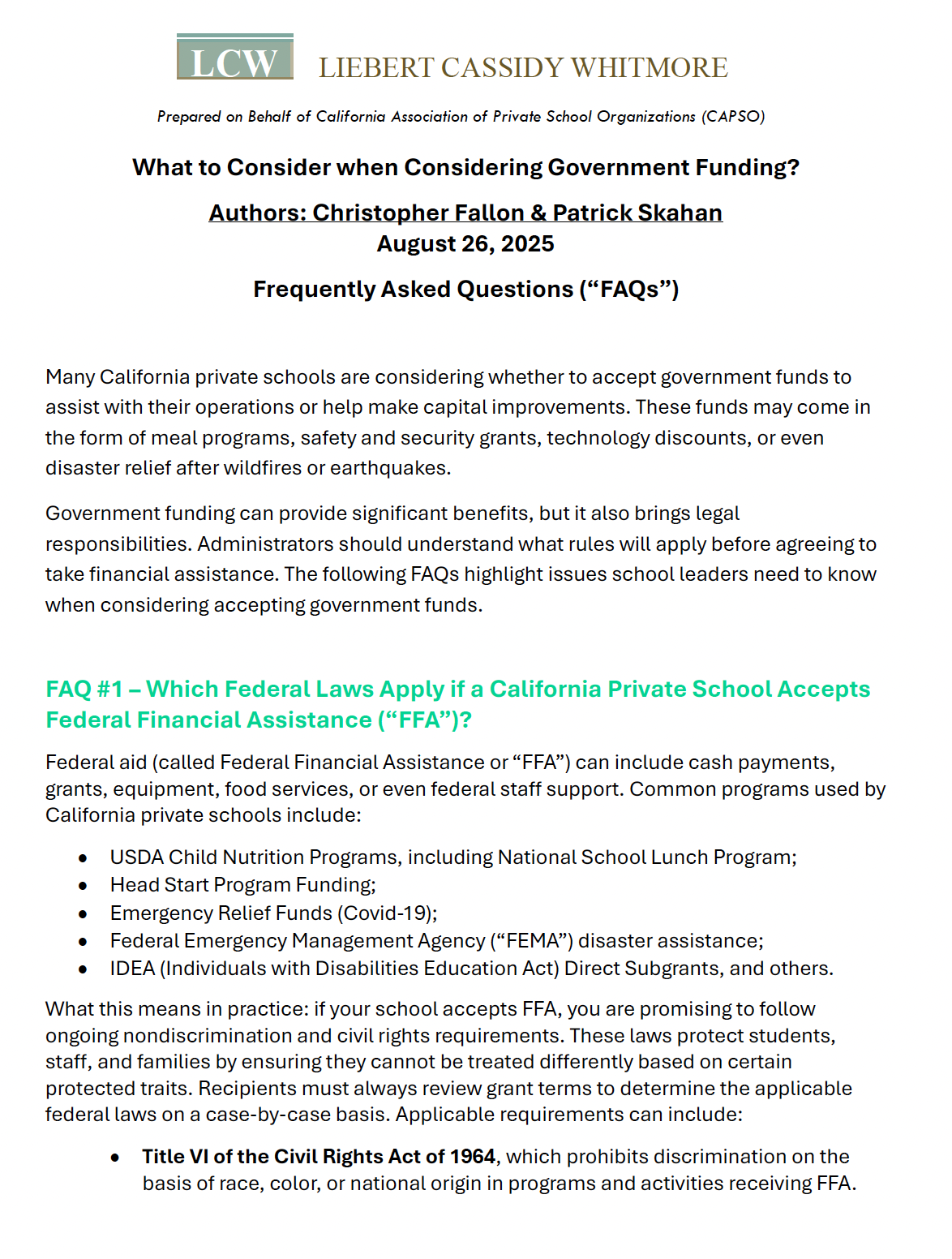
CAPSO Resource: What to Consider When Contemplating Government Funding
The California Association of Private School Organizations (CAPSO) commissioned this memo from Liebert Cassidy Whitmore as a service to our membership, in response to frequent inquiries regarding the acceptance of government funding. CAPSO is not a legal firm and does not provide legal advice. This memo is intended to highlight key issues for consideration, and all private schools are strongly advised to seek their own legal counsel and carefully weigh these and other specific factors before deciding whether to accept government funds.
It is important to note that this memo does not apply to programs such as IDEA or ESSA/ESEA, where private schools participate but are not considered direct recipients of federal funds. Instead, this memo addresses direct grant and other programs in which government funds are received directly by the private school.
Many California private schools are currently evaluating whether to accept government funds to support operations or make capital improvements. Such funds may include school meal programs, safety and security grants, technology discounts, or disaster relief following wildfires or earthquakes. While government funding can provide meaningful benefits, it also brings legal responsibilities. Administrators should understand applicable rules and obligations before accepting any financial assistance.
The following FAQs are intended to highlight key considerations for school leaders when evaluating whether to accept direct government funding.
CAPSO remains committed to providing resources and guidance to support informed decision-making among California’s private schools.
Access the full memo here
| | | |
|
OCR Staff Returns to Work at US DOE
The U.S. Department of Education will reinstate more than 260 staff members to its Office for Civil Rights (OCR) after a federal court ordered the agency to restore its capacity following mass layoffs earlier this year. The employees, who had been on paid administrative leave at a cost of roughly $1 million per week, will return in staggered groups beginning September 8 and continuing through November 3, 2025. The phased return is expected to address concerns that the office has not been able to carry out its statutory functions.
Read the full article here: K12Dive
| | | |
|
CA Supreme Court Ruling in Iloff v. LaPaille
On August 21, 2025, in Iloff v. LaPaille, the California Supreme Court clarified critical points for California’s nonprofit employers, including private and independent school employers, regarding wage-and-hour compliance. Of primary importance, it held that employers cannot claim ignorance of the law as a "good faith" defense to avoid paying liquidated damages; instead, an employer must demonstrate they made “reasonable efforts” to understand legal requirements. Additional clarification regarding previously unasserted Paid Sick Leave claims is also provided.
Private schools are reminded of the importance of being vigilant in the maintenance and updating of employment practices and are encouraged to review this ruling in full to ensure understanding and compliance as applicable.
Read the full article here: Liebert Cassidy Whitmore
| | | |
|
AI Policies in Education
As schools face the rapid growth of artificial intelligence, it is essential they adopt informed policies to guide its safe and effective use in education. The TeachAI “AI Guidance for Schools Toolkit” (2023) provides seven guiding principles along with practical resources—such as sample policies, staff letters, and classroom guidance—to support responsible implementation. Complementing this, PACE’s 2024 policy briefs highlight leadership, AI literacy, professional development, and innovation as key priorities, offering school leaders a clear framework for developing thoughtful AI policies.
Access Resources Here: Policy Analysis for CA Education (PACE)
| | | |
Apply to Become a Green Ribbon School!
Did you know that private schools that participate in the Green Ribbon School process have the opportunity to be recognized at both the State and national levels?
The Green Ribbon School process is an opportunity to showcase efforts and be recognized for progress towards sustainability across three pillars:
-
Pillar I: Reduce environmental impact and costs;
-
Pillar II: Improve the health and wellness of schools, students, and staff; and
-
Pillar III: Provide effective environmental and sustainability education
Each June, the California Department of Education launches the California Green Ribbon Schools (CA-GRS) application process, inviting public and private schools, districts, and county offices of education to showcase their achievements in sustainability. Participating schools have the opportunity to demonstrate achievement and earn points in pillar categories recognized in one of four tiered levels:
-
Bronze Level (Entry Level Commitment): 55-64.9%
- Silver Level (Mid Integration): 65-74.9%
- Gold Level (Full Integration): 75% or better
-
Green Achiever: Exemplary Achievement with Full Integration - Green achievers are nominated for Federal recognition in the U.S. Department of Education Green Ribbon Program (ED-GRS).
Schools don't need to wait to apply until they have met full integration. Schools that apply will be supported with mentorship and resources, and schools with a 55%+ will be recognized with Bronze achievement by the California Department of Education!
Ready to Learn More?
California Green Ribbon Schools Achievers and Applicants Network: The CA Green Ribbon School Achiever and Applicant Network meets quarterly and aims to unite past, current, and future CA Green Ribbon Schools applicants dedicated to promoting sustainable practices and programs within their school communities. The network gives participants the chance to network with each other to inspire and share best practices.
The application opens in June and schools are encouraged to begin learning about the application process starting in January. A comprehensive toolkit is available. Use the link below to learn more!
Green Ribbon School Toolkit and Resources
| | | |
No Cost Private School PD Available
The California Department of Education receives funds through Title II, Part A, Equitable Services to provide no-cost professional development to private school educators.
The website, https://www.capspdnow.com, offers over 1000 no-cost courses available to schools and teachers in an on-demand format. Private school teachers and administrators can join the CaPSPD email distribution list to receive notifications about upcoming development opportunities by sending a blank email to join-private-school-professional-development@mlist.cde.ca.gov
Learn More About CaPSPDNow
| | | |
Legislative Call to Action | | | |
|
Reminder! Invite Your Legislators to Come Visit Your School
WHAT: Extend an invitation to your legislative representatives to come visit a special event at your school site.
WHY: It is imperative that private schools remain present in the minds of legislators. Further, there often needs to be more understanding about the demographics and needs of private schools in the California political landscape. You can help! Senate and Assembly representatives are often willing to visit schools for special events- but they need to be invited well in advance. If you have a special event coming up or want to offer a tour and a chance to connect with constituents, consider contacting your legislators and inviting them to your campus. It will be a great experience for your students and a great way to remind them that you are active and attuned to their role as your representative.
WHEN: Legislative calendars fill quickly, so early planning and inviting well in advance will give you the greatest chance of success.
HOW: Use the button below to locate your representatives. You can have students send letters, or you can send a letter as the head of the school.
| | | |
What I've Been Reading... | | | |
|
|
|
Questions?
Please don't hesitate to contact us!
| | | | |
Effective July 1, 2024 CAPSO has a new mailing address and phone number:
CAPSO
PO Box 1077
Novato, CA 94948
(415) 295-6333
| | The California Association of Private School Organizations (CAPSO) uses AI as a tool to support administrative and operational efficiency. All AI-generated content is subject to professional expertise, careful review, and formal approval before use. | | Stay part of the conversation and follow our page on LinkedIn! |
| | | |