|
Dear CDOC Community,
Like many of you, I have lost too many colleagues and friends to colorectal cancer. Thus, it is with great importance that we redouble our efforts to promote March as Colorectal Cancer Awareness Month. I am proud to share that colorectal cancer (CRC) control has been a priority for CDOC for years, and our efforts continue to increase CRC screening, reduce late stage diagnoses, and support individuals and families affected by CRC. The current CDOC Cancer Plan includes resources and other information to promote Colorectal Cancer Awareness Month, and CRC is showcased in its own section of the 2021-2025 State Cancer Plan. In addition, the Breast and Colorectal Cancer Screening Implementation Project (BCCSIP) is pleased to announce the following FQHC successfully navigated the merit review process and began their projects on January 1, 2024. BCCSIP distributed $185,000 for the Cycle 2 awards. BCCSIP reflects a collaborative effort between the Department of Health Care Services (DHCS) Every Woman Counts (EWC) program, the California Department of Public Health (CDPH) Comprehensive Cancer Control Program (CCCP), the California Dialogue on Cancer (CDOC), and the California Colorectal Cancer Coalition (C4). Visit the CDOC website to read more. With our strong, established partnerships with the California Colorectal Cancer Coalition (C4) and others, CDOC will continue to strive towards achieving our CRC goals.
Lastly, please consider continuing or deepening your collaboration with CDOC by attending our upcoming in-person meeting! Our 2024 CDOC Stakeholder Engagement meeting will be held in-person on June 5th at the California Endowment in Los Angeles. More information will be forthcoming.
| |
|
Sincerely,
Sora Park Tanjasiri, DrPH, MPH
CDOC Chair
University of California, Irvine
Chao Family Comprehensive Cancer Center
Alison Herrmann, PhD
CDOC Co-Chair
UCLA Fielding School of Public Health Jonsson CCC, Kaiser Permanente Center for Health Equity
| |
|
|
SAVE THE DATE:
CDOC Biennial Stakeholder In-Person Meeting
Please join us on
Wednesday, June 5th, 2024
at the California Endowment in Los Angeles.
We are excited to engage with you all.
The 2024 CDOC Stakeholder Meeting will be focused on the 2025-2036 State Cancer Plan. This meeting provides a great opportunity to learn, meet and engage with fellow CDOC members and other representatives from a variety of organizations, constituencies, and interest areas in cancer prevention and control.
Registration and more information to follow.
| |
|
Quarterly HPV Vaccination Learning Collaborative
2024 Dates and New Registration Link
| |
|
Dates and Times for 2024:
The third Wednesday for each quarterly month
January 17, April 17, July 17, October 16
12:00-12:45pm
| |
|
The California HPV Vaccination Roundtable will continue The HPV Vaccination Learning Collaborative in 2024. We will continue to meet on the third Wednesday of January, April, July and October. Please register for 2024 dates (2025 dates are included as well) even if you have registered before. Make sure you choose to “add to your calendar” as you must choose that option after you receive a confirmation email.
Anyone interested in increasing HPV vaccinations are invited to join this quarterly, virtual, lunchtime, learning opportunity. The collaborative format features a teaching topic presented by HPV vaccination experts, updates from the field, and an open forum for sharing best practices, challenges, and announcements. To participate and for more information please visit our webpage at www.cahpvroundtable.org. Help spread the word and forward it to anyone in your network who may be interested in participating.
| |
Have you implemented a project that aligns with the State Cancer Plan?
If so, we want to know about it! If you have you implemented a project, plan, or other relevant work that relates to content in the State Cancer Plan? Please click here to fill out our survey to let us know what you have been working on and how it aligns with the cancer plan.
| |
|
|
|
Spotlight your project or a cancer control stakeholder on the CDOC website!
To nominate a project or an outstanding stakeholder, click here.
| | | |
UPCOMING
CDOC
MEETINGS
AND
EVENTS
(to read more click here)
| |
|
Executive Committee
Monday, March 18, 2024, 1-3pm
Lung Cancer Screening Workgroup
Tuesday, April 2, 2024, 1-2pm
CDOC Cancer Centers Collaborative
Wednesday, April 10, 2024, 11am-12:30pm
Health Equity Workgroup
Thursday, April 11, 2024 2-3pm
Survivorship Workgroup
Monday, April 15, 2024, 11am-12pm
HPV Vaccination Learning Collaborative
Wednesday, April 17, 2024, 12-12:45pm
Colorectal Cancer Workgroup
Tuesday, May 7, 2024, 12-1pm
| | |
2021-2025 State Cancer Plan Corner
March 2024 Cancer Plan Corner Highlight
Early Detection & Screening Chapter Highlight
Cancer Plan Reference: Chapter 8 Early Detection & Screening: In this chapter, the cancer plan narrates recommended cancer screening guidelines that can prevent many deaths from cancer if positive screens are followed up with prompt and appropriate treatment. Early detection is an effective way to reduce mortality rates. Screening can prevent colorectal cancer by detecting and removing precancerous growths at an early stage when it is easier to treat and outcomes are more favorable. Low-cost screening tests can prevent nearly half of all colorectal cancer cases diagnosed at a late stage. Despite being one of the most preventable types of cancer, one in four adults have never been screened for colorectal cancer, with underutilization more common among the Medi-Cal insured, uninsured, racial, and ethnic minorities. Additionally, there has been an increase in young-onset colorectal cancer (diagnosed under age 50). To learn more of the objectives with accompanying strategies detailing the steps that can be taken to reduce the morbidity and mortality from colorectal cancer and other cancers (e.g. lung, breast , cervical), please visit the CDOC website. You may also access the chapter here.
Efforts in California that worked toward this strategy were led by the California Colorectal Cancer Coalition (C4). C4 and other partners worked for several years to ensure more Californians can get screened for colorectal cancer by adding this measure. CDOC collaborated on these efforts and had dedicated support through the Colorectal Cancer Screening Engagement Project. This project aimed to build upon current efforts to improve colorectal cancer screening (CRCS) rates in seven states.
The Breast and Colorectal Cancer Screening Implementation Project (BCCSIP) reflects a collaborative effort between the Department of Health Care Services (DHCS) Every Woman Counts (EWC) program, the California Department of Public Health (CDPH) Comprehensive Cancer Control Program (CCCP), the California Dialogue on Cancer (CDOC), and the California Colorectal Cancer Coalition (C4). This project is funded by the Centers for Disease Control and Prevention (CDC) with funding for California Federally Qualified Health Centers (FQHC) starting on January 1, 2024. This pilot project provides funding to FQHC based in California that are EWC providers to help them improve their screening rates in both breast and colorectal cancer (CRC) through expanded use of evidence-based interventions (EBI) on clinic populations of similar age (50-74 years old for breast cancer, 45-75 years old for colorectal cancer). An additional requirement of funding is that the applicant organization is required to designate an EBI clinic champion, an advocate in the clinic who provides support to clinic staff implementing the EBI, as a key component of the application. Project outcomes will be evaluated with the aim to increase screening rates, decrease the number of patients diagnosed with late-stage disease, and reduce the overall mortality in patients provided care through FQHC.
The BCCSIP is pleased to announce eight FQHCs successfully navigating the merit review process and began their projects on January 1, 2024. We distributed $185,000 for the Cycle 2 awards. Click here to read more.
| |
MEETINGS, CONFERENCES & EVENTS
| |
OTHER RESOURCES & OPPORTUNITIES | |
|
American Cancer Society Leadership in Oncology Navigation (ACS LION)
American Cancer Society is excited to share an opportunity for your organization and teams to be a part of transforming cancer care through a new patient navigation training and credentialing program, American Cancer Society Leadership in Oncology Navigation (ACS LION). ™
Effective January 1, 2024, CMS created the first reliable reimbursement pathway by updating the Physician Fee Schedule to include services addressing health-related social needs:
- Community Health Integration (CHI) Services
- Social Determinants of Health (SDOH) Risk Assessment
- Principal Illness Navigation (PIN) Services
To submit for reimbursement, the person providing the navigation services must be trained or certified in accordance with CMS requirements. ACS LION was developed to specifically meet CMS requirements and aligns to professional oncology navigation (PONT) standards. If you would like to learn more, please visit our website: Patient Navigator Training & Credentialing | American Cancer Society. The program is $495 per learner. Opportunities for program access assistance are available. For more information, please contact us at ACSLION@cancer.org or call 800-227-2345.
| |
|
National LGBT Cancer Network The Lesbian Health Fund (Due March 15)
ACS The Role of Health Policy and Health Insurance in Improving Access to and Performance of Cancer Prevention, Early Detection, and Treatment Services (Due March 21)
Centers for Disease Control and Prevention Strengthening Public Health Systems and Services through National Partnerships to Improve and Protect the Nation's Health (Due March 31)
ACS Advancing Health Equity and Addressing Cancer Disparities Awards (Due April 1)
City of Hope – The California Cancer Care Equity Act (CCCEA) The California Cancer Care Equity Act (SB 987, Chapter #608, 2022), which took effect January 1, 2023, expands access to optimal cancer care for historically disadvantaged Californians by requiring Medi-Cal managed care plans (MCMCPs) to make a good faith effort to contract with National Cancer Institute-designated and other specified cancer centers so that patients with a complex cancer diagnosis may more easily access care at these centers. The law also authorizes Medi-Cal members diagnosed with a complex cancer to request a referral to any of those centers and requires MCMCP to notify all members of their right to do so. You may read more about it here.
Read about the National Cancer Plan! We know that our continued progress against cancer is the direct result of advances made possible by investment from federal, state, and local governments, along with private investment, and by the sustained efforts of researchers around the world and millions of people with cancer, their caregivers, and advocates. Read more about the National Cancer Plan here.
| |
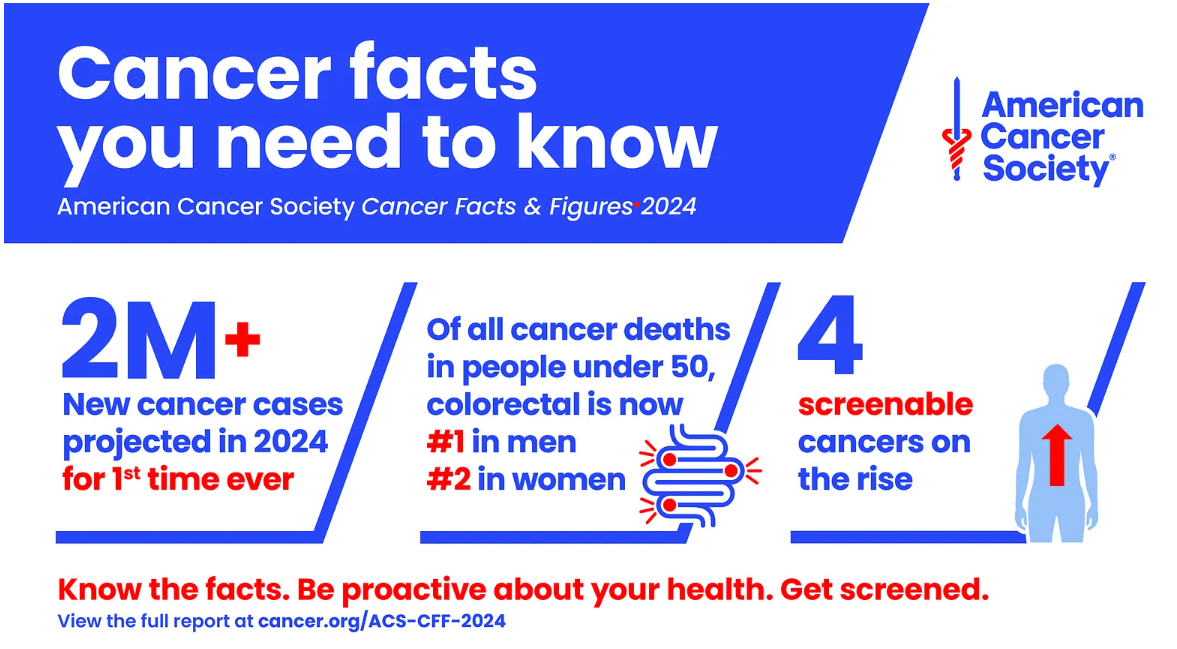 | |
American Cancer Society (ACS) has recently published their 2024 Cancer Facts and Figures Report. This report provides the latest cancer data including estimated numbers of new cancer cases and deaths in 2024 by cancer site and US state, current cancer incidence, mortality, and survival statistics as well as information on cancer symptoms, risk factors, early detection, and treatment.
Overall cancer mortality has continued to decline, resulting in more than 4 million fewer deaths in the US since 1991. However, this progress is being jeopardized by increasing incidence for 6 of the top 10 cancers as the projected number of new diagnoses tops 2 million (2,001,140) for the first time. These are just some of the findings revealed in Cancer Statistics, 2024. These findings are published in CA: A Cancer Journal for Clinicians and its consumer-friendly companion, Cancer Facts & Figures 2024, on cancer.org.
Lead Time Messaging Guidebook
The American Cancer Society’s National Colorectal Cancer Roundtable (ACS NCCRT) has released their Lead Time Messaging Guidebook: A Tool to Encourage On-Time Colorectal Cancer Screening. It is intended to provide you with information and tools to motivate individuals at average and heightened risk for CRC to discuss screening prior to the recommended screening age to increase the likelihood that they will prioritize getting screened on-time for CRC. This guidebook is a culmination of findings from ACS NCCRT messaging-related research, relevant information from ACS NCCRT signature resources, and driven by concerning data reflecting increases in CRC in younger populations. This guide will support and catalyze current efforts to increase CRC screening rates. Learn more and access the guidebook here: 2023 Lead Time Messaging Guidebook - American Cancer Society National Colorectal Cancer Roundtable (nccrt.org)
| |
HEALTH EQUITY, CANCER & HEALTH DISPARITIES | |
|
Scout, Executive Director of the National LGBT Cancer Network and David Russo, Founder of Cheeky Charity, presented on the challenges faced by members of the LGBTQ+ community related to colorectal cancer screening and offered helpful strategies that could be used to achieve better outcomes. Both sessions highlighted available resources and promoted the value of collaborations and partnerships when working to reach people within their communities. These discussions are part of ongoing efforts by the Foundation to advance health equity and improve access for all individuals, as we work towards our vision of a world where cancer is preventable, detectable and beatable for all.
Cancer Support Community Releases Report: "Addressing Health Equity in Supportive Cancer Care for Black Cancer Patients and their Families." This report is the result of a collaborative effort with UC Berkeley Public Health graduate students, involving research and a survey of local cancer patients and their families. Cancer Support Network team is also available for virtual and in-person presentations to discuss the report's findings and recommendations. Read more here.
The Indian Health Service adds SOGI questions and pronouns to its Electronic Health Record. CMS and ONC-HIT require certified EHR systems to capture SO/GI data. UDS includes SO/GI data elements, providing standardized information on health centers serving underserved communities. Collecting SO/GI data improves patient-centered care, fostering trust and better health outcomes for 2SLGBTQ+ individuals. Exciting progress in our journey towards equitable healthcare! This is a significant development for health equity as American Indians and Alaska Natives are the groups most likely to lack health insurance, according to the Kaiser Family Foundation. SOGI questions are available here.
| |
FACT SHEET: Biden Cancer Moonshot Announces Commitments from Leading Health Insurers and Oncology Providers to Make Navigation Services Accessible to More than 150 Million Americans. Through the Biden Cancer Moonshot, President Biden and First Lady Jill Biden have prioritized supportive services for people who are touched by cancer, including by championing the importance of patient navigation services. Navigators guide families through every step of their cancer journey. Navigators have been shown to improve health outcomes and the patient experience by reducing times between diagnosis and treatment, and increasing treatment completion. These services also lower healthcare costs by reducing ER visits and hospitalizations and reduce health disparities, including by facilitating access to services to address unmet social determinants of health, such as food and housing insecurity and transportation needs. Until President Biden and Dr. Biden prioritized increasing these services, Medicare and other health plans largely did not pay for navigation, leaving this service out of reach for too many people, especially in low-resourced settings. Read more. | |
|
CDOC Newsletter and Announcement Content
Submission Process
| | |
|
CDOC is made up of a diverse group of stakeholders that engage in important and impactful work we'd like to showcase. We have a new process for submitting your trainings, events, articles, grant opportunities, and more.
We kindly ask you to email us any content by the 15th of each month to cdocshare@gmail.com. If there is time-sensitive information (e.g. upcoming training) that you would like to share, we will do our best to include, but cannot guarantee that it will make the newsletter or announcements.
Submission requirements:
- Include a title
- Include the exact verbiage you'd like for us to include. Please do not include an attachment and ask us to share, a title and verbiage must be included.
- Include a contact person for any inquiries
- Include any attachments in a pdf file if possible
We appreciate your patience and support at this time, and we look forward to your submissions.
| | | | |