|
Dear CDOC Community,
October is Breast Cancer Awareness Month. National Breast Cancer Awareness Month is recognized each October to raise awareness about the importance of early detection and access to timely, high-quality care for breast cancer. Breast cancer is the most common cancer among females in the U.S., accounting for 32% of newly diagnosed cancers (ACS, 2024). Although it is rare, males can also get breast cancer. About 1 out of every 100 breast cancers diagnosed in the United States is found in a
male (CDC, 2024). Fortunately, early detection and effective treatments have combined to improve the prognosis of individuals experiencing breast cancer. There are over 4 million breast cancer survivors living in the U.S. today, a larger group than for any other cancer (ACS, 2024). Yet, persistent gaps in cancer prevention and control practices contribute to significant disparities in breast cancer outcomes. Like other health disparities, breast cancer disparities are affected by social and political determinants of health, behavior, genetics, implicit biases and learned behaviors, health system and other structural barriers, as well as lack of tailored guidance for patients. Black and Hispanic or Latinx individuals in the U.S. experience the largest disparities in breast cancer screening, incidence, mortality, and survival as a result of systemic inequities (ACS, 2021). Recent data demonstrate that rates are rising most quickly among those in the Asian American and Pacific Islander community who are under the age of 50 (ACS, 2024). Staying physically active, maintaining a healthy weight, and limiting or avoiding alcohol consumption are important breast cancer prevention strategies.
Fall is shaping up to be a busy season for CDOC. We recently announced the release of the RFA for Cycle 3 of the Breast & Colorectal Cancer Screening Implementation Project (BCCSIP). Applications are due October 18th. Last month, the American Childhood Cancer Organization (ACCO) invited CDOC to accompany their advocates to the White House Roundtable on State Advocacy for Childhood Cancer. ACCO led a critical discussion on disparities in the lack of inclusion of childhood cancer language in state comprehensive cancer control plans. CDOC Co-Chair, Alison Herrmann joined several members of the California State Cancer Plan’s Childhood Cancer Subcommittee. Misha Mehta, Ashley Margol, and Sarva Channarajurs, had the opportunity to take part in this important meeting. California was recognized for its inclusionary process in adding childhood cancer content to the next iteration the State Cancer Plan.
Please read on to learn more about general CDOC updates including workgroup activities, as well as the State Cancer Plan revision, at the next CDOC All Members Meeting on October 15th at 11 a.m. Register here.
| |
|
Sincerely,
Sora Park Tanjasiri, DrPH, MPH
CDOC Chair
University of California, Irvine
Chao Family Comprehensive Cancer Center
Alison Herrmann, PhD
CDOC Co-Chair
UCLA Fielding School of Public Health Jonsson CCC, Kaiser Permanente Center for Health Equity
| |
|
|
REGISTER NOW!
CDOC All Members Meeting
October 15, 2024 |11 am - 12:30 pm
CDOC All Members Meetings are held for all of our members to be more connected with the coalition and learn more about all CDOC activities. These meetings also serve as a venue for information exchange and provide opportunities for open dialogue. The fall meeting will inform our coalition on upcoming learning opportunities, Cancer Plan Revision updates, and collaborative opportunities. Register here.
| |
Cancer Plan Revision Corner
CDOC hosted the first Quarterly Cancer Plan Revision Check-In Webinar on September 10th. This was an opportunity for each subcommittee to provide high level updates and identify areas of alignment, duplication, and collaboration. In case you missed it, view the recording here.
2nd Quarterly Cancer Plan Revision Check-In Webinar
The second Quarterly Cancer Plan Revision Check-In Webinar will be on December 10th @ 12pm. Register once to attend all meetings. After registering, you will receive a confirmation email containing information about joining the meeting.
| |
|
Let Us Know How You Use
The State Cancer Plan!
| | |
|
|
State Cancer Plan Implementation Reporting Tool
Have you implemented a project, plan, or other relevant work that relates to content in the State Cancer Plan?
If so, we want to know about it! Please click here to fill out our 10 min reporting tool.
Your submission will provide insight on how the State Cancer Plan is being utilized.
| | |
UPCOMING
CDOC
MEETINGS
AND
EVENTS
(to read more click here)
| |
|
Cancer Centers Collaborative
Tuesday, October 8, 2024, 11:00am - 12:30 pm
Health Equity Workgroup
Thursday, October 10, 2024 2-3pm
HPV Vaccination Learning Collaborative
Wednesday, October 16, 2024, 12-12:45pm
Lung Cancer Screening Workgroup
Tuesday, November 1, 2024, 1-2pm
Colorectal Cancer Workgroup
Tuesday, November 5, 2024, 12-1pm
Survivorship Workgroup
Monday, December 2, 2024, 12-1pm
Executive Committee
Monday, December 16, 2024, 1-3pm
| | |
2021-2025 State Cancer Plan Corner
October 2024 Cancer Plan Corner Highlight
Chapter 8: Early Detection & Screening (Breast Cancer)
October is Breast Cancer Awareness Month. Learn about the burden of breast cancer in chapter 8 of the 2021-2025 State Cancer Plan.
Breast cancer is the second leading cause of death in American women, only second to lung cancer. Screenings, increased awareness, and evolving treatment options have contributed to a decrease in the death rate of breast cancer. Identifying the biases and stigmas different minority groups experience may translate to increased early-stage breast cancer diagnosis and decreased late stage diagnosis.
Please visit the CDOC website to read more on the cancer plan's Early Detection & Screening chapter. You may also read more about the specific chapters here.
Contact info: cdocshare@gmail.com
| |
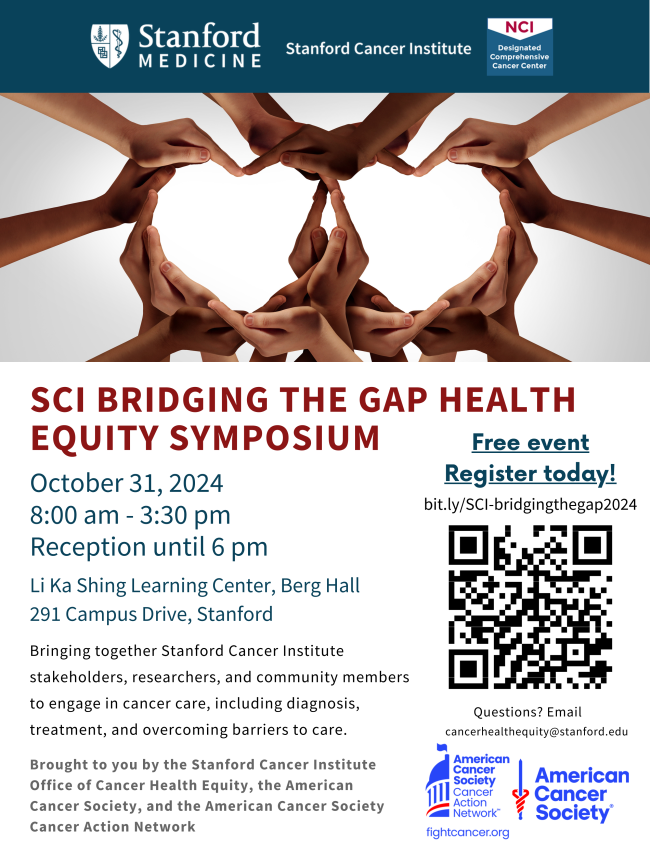
MEETINGS, CONFERENCES & EVENTS
| |
OTHER RESOURCES & OPPORTUNITIES | |
|
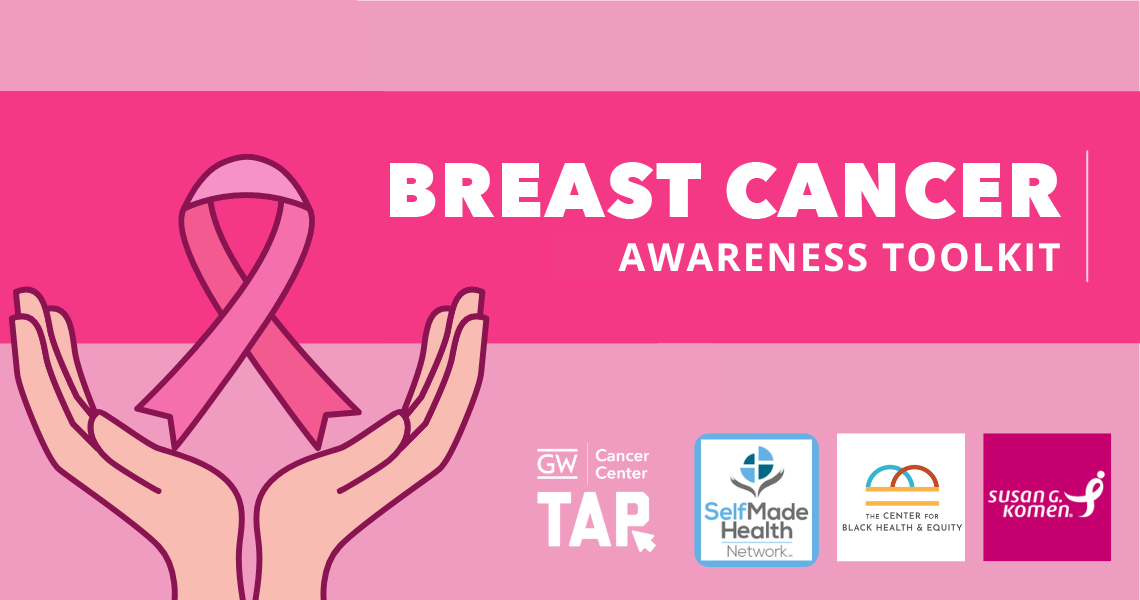
For the first time, GW Cancer Control TAP partnered with other organizations to produce this toolkit. Special shout out to co-branding partners for their contributions to this project:
Extended gratitude and thanks to advising partners for their guidance and support:
| |
 | |
The Upstream Research Center is pleased to announce its second round of fellowship opportunities. Uniting diverse community partners and scientists from Stanford University, the University of California, Davis, and the University of California, San Francisco, the Center is evaluating and scaling innovative income supplementation programs and policies that can address the fundamental causes (e.g., upstream factors such as housing, income, structural racism) of cancer inequalities in these areas.
The goal of the Upstream Research Center Fellowship Program is to develop a diverse cadre of interdisciplinary early-career scholars committed to advancing cancer health equity through research, practice, and capacity building in persistent poverty areas. Applications are due February 14, 2025, 5:00 pm Pacific Time. Appointments are for one year with the option to renew for a second year.
Fellowships are open to full-time post-baccalaureate, graduate, medical, predoctoral, postdoctoral students, instructors/assistant professors at Stanford, UC Davis, and UC San Francisco and require a primary mentor at these institutions by the due date of the application. Three scholars will be funded, one from each participating institution.
The Program offers unique learning and networking opportunities:
Mentored research experience. Fellows will receive support and mentoring from a transdisciplinary team (e.g., social and cancer epidemiologists, sociologists, health economists, behavioral scientists, and methodologists) at Stanford, UC Davis, and UC San Francisco.
Opportunities to conduct community-engaged research. Community engagement is the spine of the Center, integrated throughout its projects, cores, and activities. Fellows will have the opportunity to collaborate with the Center’s extensive network of community partners.
Vertical and peer networking within the Upstream Research Center and across the Persistent Poverty Initiative Network. Upstream fellows will be part of a cross-institution transdisciplinary peer cohort. Fellows will be encouraged to participate in the Center’s research projects and cores, monthly seminar series, journal club, pilot grant program, Persistent Poverty Initiative Network annual meeting (travel costs will be covered by the Center), and the Upstream Research Center’s annual retreat.
Access to career and professional development activities across institutions. Upstream fellows will be able to participate in an integrated set of career and professional development activities at Stanford, UC Davis, and UCSF (e.g., grant and science writing online workshops, team science training sessions, leadership development programs, and workshops on utilizing real-world data).
| |
CHIME Maternal-Infant Health Equity Research Mentorship Program
CHIME (Comparing Health Interventions for Maternal Equity) is seeking post-doctoral fellows and early-stage faculty investigators to participate in a groundbreaking, PCORI-funded maternal health equity project. Benefits include completion of a mentored research project, salary support (100% FTE for fellows; 30% FTE up to $200,000 for faculty), annual travel support for a national research meeting, and training in comparative effectiveness research, community-engaged research, and implementation science.
Please visit the CHIME website for more information. Phase One applications (CV and one-page aims) are due October 15, 2024. For questions, email partnerequity6@gmail.com.
| |
CDPH Announces Grants to Improve Vaccine Confidence for Under-Vaccinated and Hard-to-Reach Populations
The California Department of Public Health (CDPH) Immunization Branch is excited to grant $1.9 million in three Requests for Applications (RFAs) to increase vaccine confidence in under-vaccinated and hard-to-reach populations in California.
For questions, please contact VaccineConfidenceRFA@cdph.ca.gov.
Eligible entities include California:
- Non-profit organizations
- Community-based organizations (CBOs)
- Federally qualified health centers and rural health clinics (FQHCs)
- Multi-county entities (health care providers operating in multiple counties) (MCEs)
- Community clinics.
- Local Health Departments are ineligible but encouraged to share this announcement with eligible partners.
Applicants may partner with other agencies or organizations to deliver any element of the proposed project, including providing vaccinations. Applicants may include administrative entities that subgrant project elements to specialized organizations. The applicant entity assumes all responsibility for partner entities, subgrantees, and their work.
Projects must be completed by June 30, 2025. Please share this communication with organizations that could benefit from this funding.
1. Improve Vaccine Confidence for Hard-to-Reach Populations, including Rural Communities
Up to five (5) grants of up to $306,000 each will be awarded. Eligible California entities will develop and implement local projects to:
· Improve vaccine confidence in under-vaccinated and hard-to-reach California communities and
· Increase vaccination or facilitate referrals to vaccination resources.
· At least one award will be given to projects focusing on residents in rural California.
· Strong consideration will also be given to proposals addressing COVID-19 vaccine inequities among underserved populations such as Latinx, Black, Native American, migrant farmworkers, people with disabilities, people experiencing homelessness, immigrants/refugees and people living in Healthy Places Index (HPI) Quartile 1 regions of California.
· Activities must include vaccination against COVID-19 vaccination but may also include vaccination against influenza or respiratory syncytial virus (RSV).
Visit California Communities RFA page for additional details and RFA application materials.
2. Improve Vaccine Confidence via Adolescent Peer-to-Peer Outreach
Up to eight (8) grants of $25,000 will be awarded to Eligible Entities to employ, recruit, and train adolescents (ages 14-18) to develop and implement youth engagement and education campaigns to improve vaccine confidence and access among adolescents across California.
· Efforts must address vaccination against COVID-19 and human papillomavirus (HPV) but may also include other vaccinations (e.g., flu, Tdap, MenACWY, MenB).
Visit the Adolescent RFA page for additional details and RFA application materials.
3. Improve Vaccine Confidence to Latinx or Immigrant Communities working with Community Health Workers
One (1) grant of up to $200,000 will be awarded to train and educate promotores or community health workers (CHWs) to increase vaccine confidence in their communities.
· Training must emphasize increasing COVID-19 vaccine confidence among persons who are Hispanic, Latinx and/or immigrants residing in Healthy Places Index Quartile I regions of California.
· Additional training on RSV and flu vaccines is highly encouraged but not required.
· Promotores or CHWs should develop a culturally-sensitive outreach plans for Hispanic, Latinx and/or immigrant communities.
Visit Latinx or Immigrant Communities RFA page for additional details and RFA application materials.
For questions, please contact VaccineConfidenceRFA@cdph.ca.gov.
| |
|
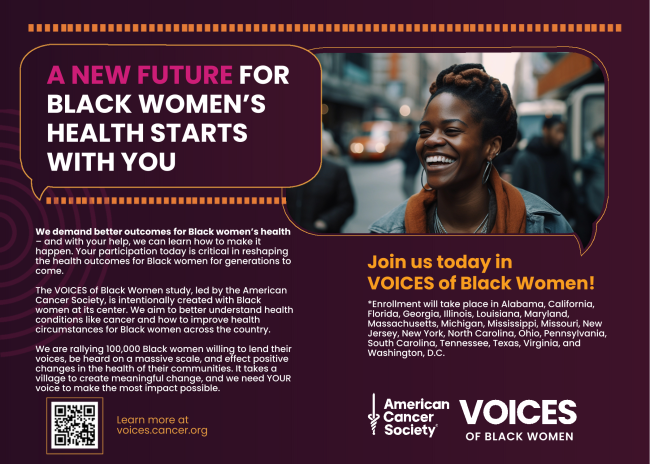
We need your help to change the future of cancer as we know it. Support our goal of reaching 100,000 Black women for VOICES of Black Women, a pivotal long-term study led by the American Cancer Society (ACS). This groundbreaking initiative will help us better understand health conditions like cancer to learn how to improve overall health and well-being among Black women. ACS is looking to mobilize local partners to share the study with their networks.
If you are interested in learning more about how you or your organization can support VOICES, please reach out to bridget.freeley@cancer.org for or if you have questions about the study, you can also contact thevoices@cancer.org.
| |
|
NCI Addressing Barriers to Healthcare Transitions for Survivors of Childhood and Adolescent Cancers (due 10/11)
Robert Wood Johnson Foundation Evidence for Action: Innovative Research to Advance Racial Equity (due 11/1)
Prevent Cancer. Cancer Prevention Works Summer 2024 issue is out now! In the latest edition of Cancer Prevention Works, you'll learn exactly what a skin check entails, what you need to know about skin cancer if you have a darker skin tone, alcohol's role in increasing cancer risk and key updates from the Hill on cancer prevention legislation. Explore this and more in your Summer issue. Read here.
The UCSF Helen Diller Family Comprehensive Cancer Center and The California Prostate Cancer Coalition (CPCC) co-hosted the 4th Annual Patient Conference on Prostate Cancer at the UCSF Medical Center at Mission Bay. A stellar faculty, including Eric Small, MD; Peter Carroll, MD, MPH; Matt Cooperberg, MD, MPH; Mack Roach III, MD; June Chan, ScD; Rahul Aggarwal, MD; and Thomas Hope, MD, presented at the conference. View the event recording here.
Funding Opportunity: Robert Wood Johnson Foundation Evidence for Action: Innovative Research to Advance Racial Equity (Open Until Filled)
The Leukemia & Lymphoma Society (LLS) - support resources available. Visit their website to learn more click here
Assessment Instruments for Measuring Community Engagement Validated instruments to assess meaningful community engagement including Trust. To learn more click here.
| |
HEALTH EQUITY, CANCER & HEALTH DISPARITIES | |
|
Cancer affects everyone, but it does not affect everyone equally. LGBTQ+ individuals face unique obstacles in accessing health care, leading to disparities in cancer prevention and treatment. Explore the resources on the Prevent Cancer Foundation Website to find information on cancer screenings, tools to talk to your health care providers and much more.
Fact Sheet: ACS Cancer in People who Identify as Lesbian, Gay, Bisexual, Transgender, Queer, or Gender Non-conforming
Dr. Mandi Pratt-Chapman Advances Work on Sexual Orientation and Gender Identity Data in Cancer Continuum Mandi Pratt-Chapman, PhD, Associate Director, Community Outreach & Engagement, has co-authored a paper in the American Society of Clinical Oncology Journal on the significance of SOGI data in cancer research. She also gave an interview with The American Journal of Managed Care, which highlights factors affecting adequate, accessible health care for transgender patients and what she sees as the most pressing need to address in this community, and explores the potential for policy-level changes to benefit transgender patient care and experiences in clinical settings.
| |
|
Prevent Cancer - Prevention in Action: “Cancer Moonshot funding announced.” Last month, as part of the Cancer Moonshot, President Biden and the First Lady announced $150 million in Advanced Research Projects Agency for Health (ARPA-H) awards to develop technologies that will allow surgeons to provide more successful tumor-removal surgeries for people facing cancer. This announcement follows other recent cancer prevention and early detection efforts by the administration. In early August, the U.S. Department of Health and Human Services awarded $9 million to 18 HRSA-funded health centers to enhance access to life saving cancer screenings in underserved communities. This initiative is part of the Accelerating Cancer Screening grants--established under the Biden Cancer Moonshot in 2022--aiming to improve patient access to cancer screenings and treatment through partnerships with National Cancer Institute-Designated Cancer Centers. Additionally, ARPA-H launched the POSEIDON program to develop new technologies for multi-cancer early detection (MCED) tests, potentially enabling at-home cancer screenings to improve outcomes for millions. In a related move, the Centers for Medicare and Medicaid Services proposed a new rule to allow Indian Health Services and Tribal facilities to receive separate payments for high-cost drugs for Medicare patients, facilitating better cancer treatment and other health care services in Tribal communities.
NATIONAL CANCER INSTITUTE (NCI). “FDA Approves HPV Tests That Allow for Self-Collection in a Health Care Setting.” On May 14, the Food and Drug Administration (FDA) expanded the approvals of two tests that detect cancer-causing types of human papillomavirus (HPV) in the cervix. Both tests are used as part of screening for cervical cancer. Under these expanded approvals, people can now be offered the option to collect a vaginal sample themselves for HPV testing if they cannot have or do not want a pelvic exam. However, the collection, which involves a swab or brush, must be done in a health care setting, such as primary care offices, urgent care, pharmacies, and mobile clinics. The tests included in the approvals are Onclarity HPV, made by Becton, Dickinson and Company (BD), and cobas HPV, made by Roche Molecular Systems. Read more here.
| |
|
CDOC Newsletter and Announcement Content
Submission Process
| | |
|
CDOC is made up of a diverse group of stakeholders that engage in important and impactful work we'd like to showcase. We have a new process for submitting your trainings, events, articles, grant opportunities, and more.
We kindly ask you to email us any content by the 15th of each month to cdocshare@gmail.com. If there is time-sensitive information (e.g. upcoming training) that you would like to share, we will do our best to include, but cannot guarantee that it will make the newsletter or announcements.
Submission requirements:
- Include a title
- Include the exact verbiage you'd like for us to include. Please do not include an attachment and ask us to share, a title and verbiage must be included.
- Include a contact person for any inquiries
- Include any attachments in a pdf file if possible
We appreciate your patience and support at this time, and we look forward to your submissions.
| | | | |