|
|
The entire Akumal community has witnessed several changes regarding the commercial use and protection of the bay in the last months. Since Akumal was decreed a Refuge Area for Marine Species last April the federal authorities (PROFEPA and CONANP) have settled in with permanent offices in Akumal pueblo and Tulum. Their role is the enforcement of the environmental laws (mainly federal) on coastal ecosystem-related issues as well as aiming at establishing new regulations regarding the use and exploitation of the natural resources of Akumal Bay.
To establish these new regulations, CONANP has organized several meetings with all the local community with the purpose of building bridges between all members of the society while elaborating the protection program. This protection program will eventually define the activities and include the
official regulations that would apply to all zones within the Refuge Area for Marine Species.
Under the federal framework, Management Plans are used for Natural Protected Areas (NPAs). Akumal is not officially designated as an NPA, but rather has been declared a Refuge Area, which would fall under the scope of a Protection Program. However, combined with the Fish Refuge of Akumal, there should be the necessary elements to create deeper awareness among all members of society to ensure the protection and conservation of the wonders of Akumal and to give the authorities the appropriate tools for enforcement.
As a community member of Akumal, it is our responsibility to participate actively in the design and support of the Protection Program and, once the official rules are established and published in the Official Diary of the Federation (Diario Oficial de la Federación), to assist in the dissemination of the information.
|
|
|
Every second Wednesday of the month is the Coastal Cleanup. Staff, volunteers and anyone wishing to join in for an hour or so to remove the marine debris from the shores is welcomed to join.
So far, in just three months, we have collected a total of
145 kilograms of marine debris!
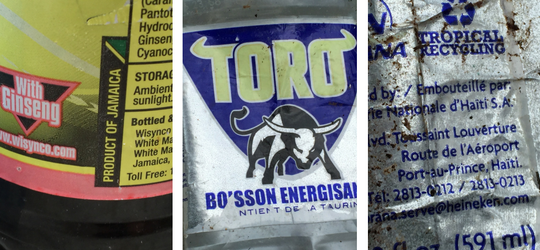
Some of that debris has come from Jamaica and Haiti.
|
For anyone who would like to join us on one of our beach cleanup days, drop us a line for more information or follow our Facebook page for further details.
communications.ceakumal@gmail.com
|
|
14th Annual Turtle Festival
|
|
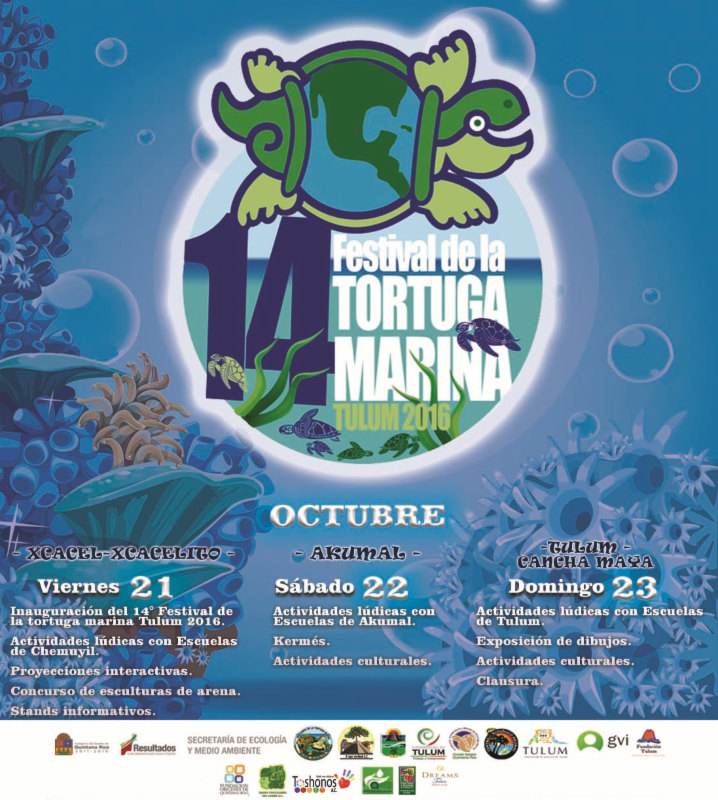
Save the date for October 21, 22 and 23 for the 14th Annual Sea Turtle Festival held in Xcacel-Xcacelito, Akumal and Tulum.
|
|
What's going on with the buoys? What's going on in the bay?
In the May/June newsletter, we wrote about the buoys that were found washed ashore late one evening and, with further inspection, it was evident that the lines were deliberately cut. (READ MORE)
It seems that yet again, the buoys have undergone further change/vandalism.
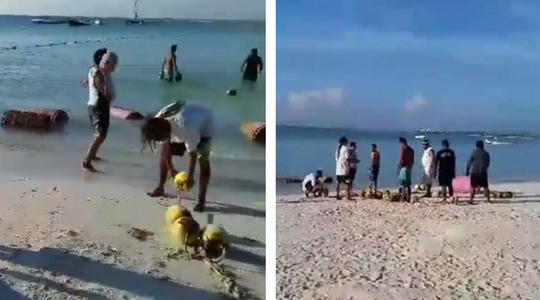
On August 25, a group of guides from various cooperatives decided to take it upon themselves to reconfigure the buoy lines in Akumal. The same buoy lines were established under the federal "Safe Beaches Program" by the Harbour Captain of Playa del Carmen. On August 26, in a workshop for the explanation of the Protection Program in Tulum, the Port Captain, along with CONANP and PROFEPA, recognized the reconfiguration as an illegal and unauthorized act.
The self-directed modification of the buoy lines has resulted in an area less than two-thirds the original size, effectively removing the specified area where swimmers/snorkelers were to cross through the boat channels, which now leaves swimmers and snorkelers more vulnerable and boat captains worried. Yet the cooperatives claimed the reason for the reconfiguration was purely for safety reasons.
|
|
It appears, however, that the purpose of the changes may have been based on ulterior motives. More and more we are receiving reports from guests and visitors who have shared with us their confusion and frustration of inaccurate information being given to them from the guides, who have stated such things as:
- Swimming can ONLY be done inside the buoys---nowhere else in the bay.
- No snorkeling is allowed inside the buoys. Snorkeling must be outside the buoys, but it is illegal to go there without a guide.
- This snorkeling area is now a private snorkel area for cooperatives only. You need to pay to snorkel and only we can take you.
- It is mandatory to have a guide/take a tour.
These "rules" are in fact NOT RULES at all. While each snorkeler and swimmer should be aware of their abilities and limits and respect the marine flora and fauna, there is no official rule or law, by any of the authorities, that prohibits or limits swimming/snorkeling inside the bay. In addition, there is no rule that states you must have a guide or that it is illegal if you do not have a guide. While the authorities recommend having a guide, it is not mandatory.
Unfortunately there is a lot of misinformation and underhanded tactics being used by guides to sell tours to visitors, including varying levels of harassment and threats by some. Visitors have been intimidated to rent equipment from the guides and threatened with legal repercussions. Moreover, there are increasing reports of aggressive physical contact of pushing, shoving and grabbing guests both in and out of the water.
There is also a lack of clear and official information disseminated by the authorities which makes things even more confusing for guests and visitors to Akumal.
Until a complete and final protection program with specific rules is created, we continue to direct people to the Code of Ethics for Swimming with Turtles, published by CONANP (National Commission of Natural Protected Areas).
|
|
|
|
Monitoring the reefs with Healthy Reefs for Healthy People
|
Led by
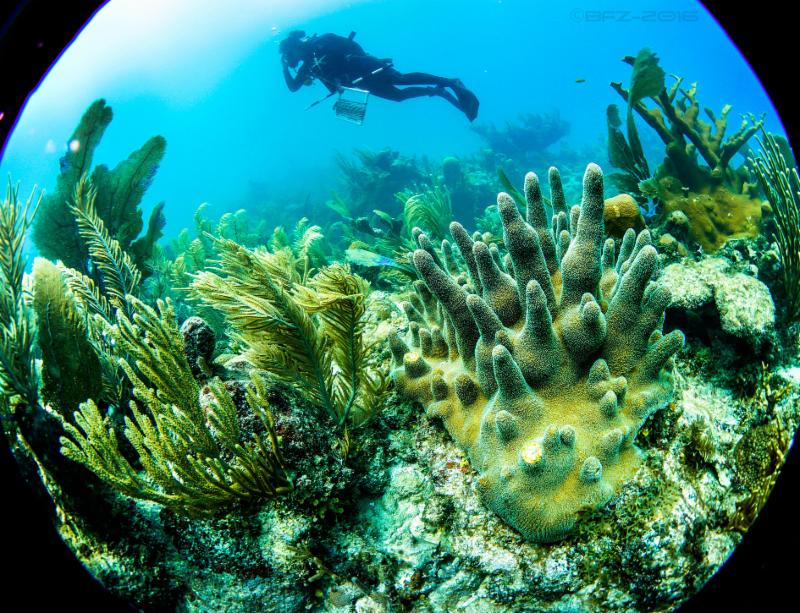
Healthy Reefs for Healthy People and in collaboration with CEA's Coastal Ecosystem Program staff, reef monitoring in Quintana Roo for the 2017 Report Card on the status of reefs wrapped up with work in Mahahual and Xcalak.
Healthy Reefs for Healthy People has been monitoring the reefs of Quintana Roo since 2006.
|
|
Our ongoing monitoring of coral health and biomass of fish continues in and around Akumal Bay. Volunteers and staff will be collecting data over the coming months.
|
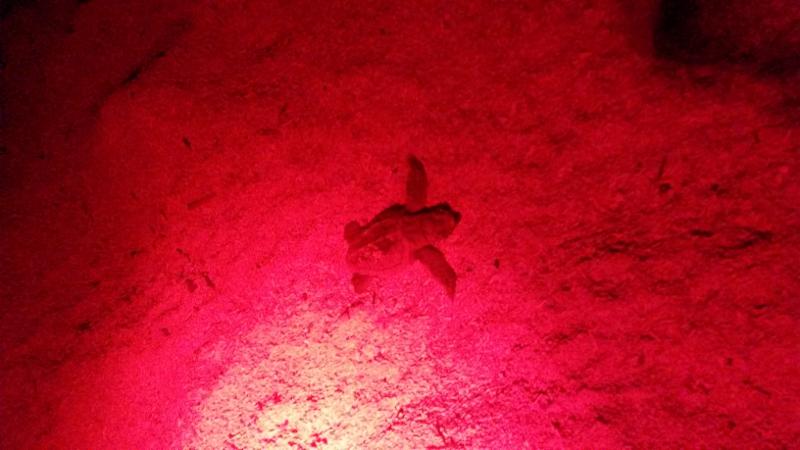
On June 28, 2016, the first Loggerhead hatchlings made their appearance on Half Moon Bay. Our Tortuguero was there to capture the moment.
While we are winding down from the peak of hatchings, hatchlings will still be making their way to sea until November.
|
|
Kids' Camps + CEA's Turtle Team
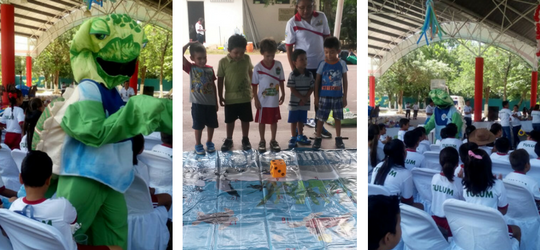
Throughout July and August, CEA's Sea Turtle Protection Program got involved with the summer course Baaxlo'ob Paalalo'ob for kids aged 7 to 12 to lead interactive learning sessions focused on "Water Quality and Sea Turtles."
|
|
Nesting Count
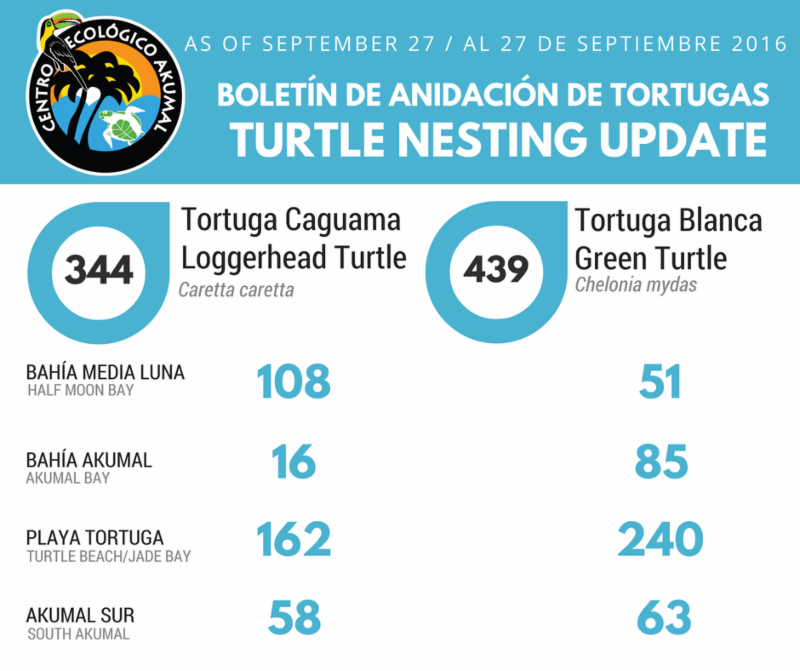
As of September 27, across the four beaches of Akumal patrolled by CEA, there are a grand total of
783 nests.
But the season for Greens isn't finished just yet.
|
|
FAQ: Are there fewer Green turtle nests this year than last? Why is that?
The short answer: Yes and no.
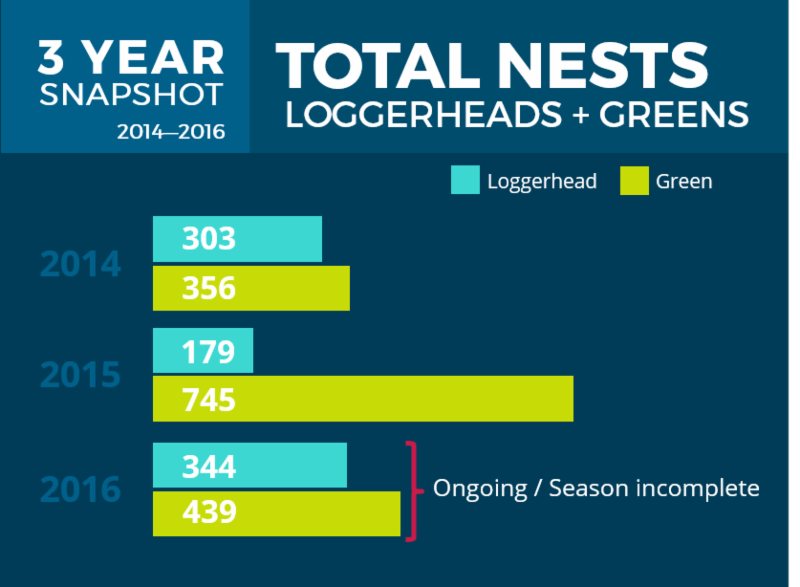
The longer answer: When comparing two years---2015 and 2016---yes, the number of Green nests is fewer this year compared to last. However, it is important to know that it is completely normal for the numbers to fluctuate from year to year. This is not a new trend, nor is this an isolated incident only in Akumal. Since the first data were recorded in early '90s, the long-term trend has shown to be increasing for both species with the same patterns of ups and downs every other year along the coast of Quintana Roo.
|
|
The majority of the turtles are on a biannual cycle; they will nest every other year or every two years. And during their nesting year, they can lay up to seven nests during the six-month season. It is a logical conclusion, from the data and trends over time, that the population which is nesting this year is smaller than the population that nested last year. Fewer nesting mamas equals fewer nests.
And even though this year's numbers for Greens are lower than 2015 (so far), the numbers are higher than 2014. The ebb-and-flow cycle that has been ongoing since the '90s continues.
Once nesting season is completed and our full data set is compiled and analyzed, results will be shared in our 2016 Turtle Report.
|
|
Illegal fishing in Akumal's refuge zone continues
|
|
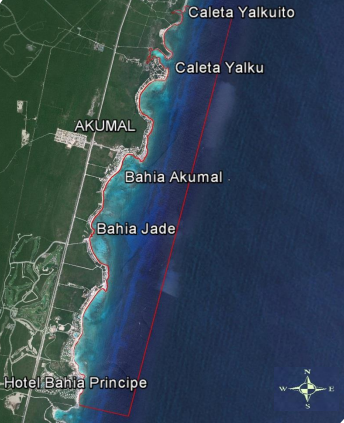
In April 2015 SAGARPA established Akumal as a
Zona de Refugio Pesquero Akumal (ZRPA) or "Akumal Fish Refuge" with an area of 9.88 km2, being the only one in Mexico declared outside the boundaries of a Natural Protected Area.
|
|
|
| Zona Refugio Pesquero Akumal (ZRPA) |
Subsequently, on March 7 of this year, SEMARNAT issued the decree to establish the
Área de Refugio para Protección de Especies Acuáticas (ARPEA /Refuge Area for Protected Marine Species.) However, in practice, neither of these enacted decrees has translated into real protection of the fishery resources or the marine-coastal ecosystem of Akumal.
The increasing publicity about the potential of Akumal as a tourist destination has been the precursor to a dizzying and disorderly increase in commercial activities, which has led to greater pressure and over-exploitation of the valuable marine and coastal ecosystems, especially of the fishery resources.
Since the ZRPA decree in April 2015,
tour operators, residents, workers and even visitors to Akumal have continued to report various events of poaching or illegal fishing off various points along the coast. Some of the fishing techniques reported being used include long lines and gill nets, which are particularly destructive to the reef habitat.
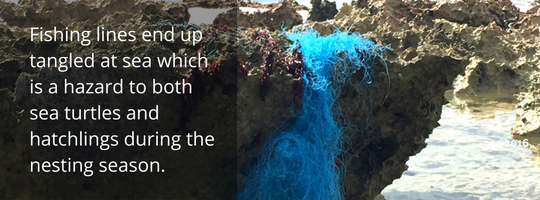
In recent months, line fishing from the shore has intensified. Most often, fishing lines end up tangled at sea which is a hazard to both sea turtles and hatchlings during the nesting season.
|
|
|
|
Fishing line washed ashore on the Rocky Point between Half Moon Bay and Akumal Bay. Photo taken August 2016
|
|
Poaching or illegal fishing is typically carried out at the same sites, mainly on the reefs, where it has been prohibited under NOM-017-PESC-1994, long before the ZRPA was even decreed. Local guides and divers using spearguns have been observed within Akumal Bay which provides a high risk potential to public safety.
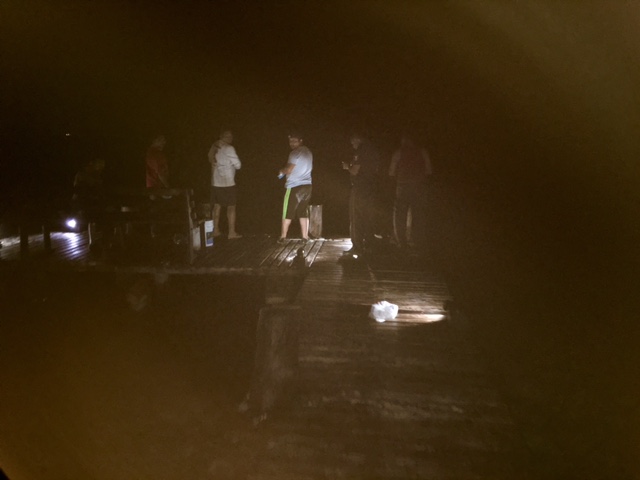
To make matters even worse, illustrating the degree of ignorance of the legal framework associated with the ZRPA, members of the municipal police have been seen "accompanying" the poachers during their fishing activities.
|
|
|
| Municipal police officer (second from right) with men illegally fishing in Half Moon Bay, within the ZRPA. |
It should be noted that the ZRPA decree published in 2015 in the Diario Oficial de la Federación (DOF) sets out the following:
Article 3: only commercial fishing or fishing for domestic consumption of lionfish can be carried out via freediving with band or pneumatic spearguns and any other capture of aquatic flora and fauna is forbidden. Recreational sport fishing can only be done in the form of catch and release.
Article 5: people who violate this agreement, shall be subject to the Article 133 of the
Ley General de Pesca y Acuacultura Sustentables and other applicable laws.
Therefore, an appeal is being made to the competent authorities to monitor and enforce the guidelines established in the existing legal framework for the protection of the environment and fishery resources in Akumal. In particular, the installation of necessary informational signs on land and at sea (buoys) is a primary step to enforce respect for an established ZRPA.
In addition, it is urgent for environmental education campaigns to be implemented. This will create a greater awareness and establish a method to inform the local community and visitors to Akumal about the ZRPA. Time is critical to develop a coordinated operation between different authorities including
CONAPESCA, PROFEPA, Capitanía del Puerto, SEMAR and the Seguridad Pública Municipal, so that they can stop the perpetrators in the act of poaching and illegal fishing in Akumal and can prevent further devastation to the marine-coastal ecosystem of this important destination.
TO REPORT ILLEGAL FISHING / POACHING ACTIVITY
If you would like to report illegal fishing activities, please document as much information as possible---times, dates, location, fish/species caught, number of people, fishing gear used (spear guns, rods, traps, nets etc.), and any other relevant information. Photographs are great assets which provide visual support to your report.
Information can be sent in an email to
info@ceakumal.org
where the details will be compiled and sent to CONAPESCA, PROFEPA and CONANP.
|
|
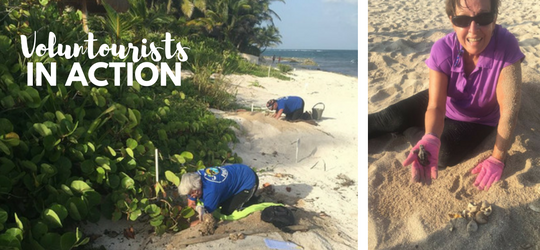
Volunteers are the heart and soul of CEA. Whether they are in the field monitoring and collecting data or inputting it for reports, their work plays a critical role in fulfilling our mission of conservation and protection through research, education and outreach.
|
|
What exactly is a voluntourist?
|
You can find out more about our voluntourism program on the CEA blog. Of course, if you are curious to get involved, drop us a line.
|
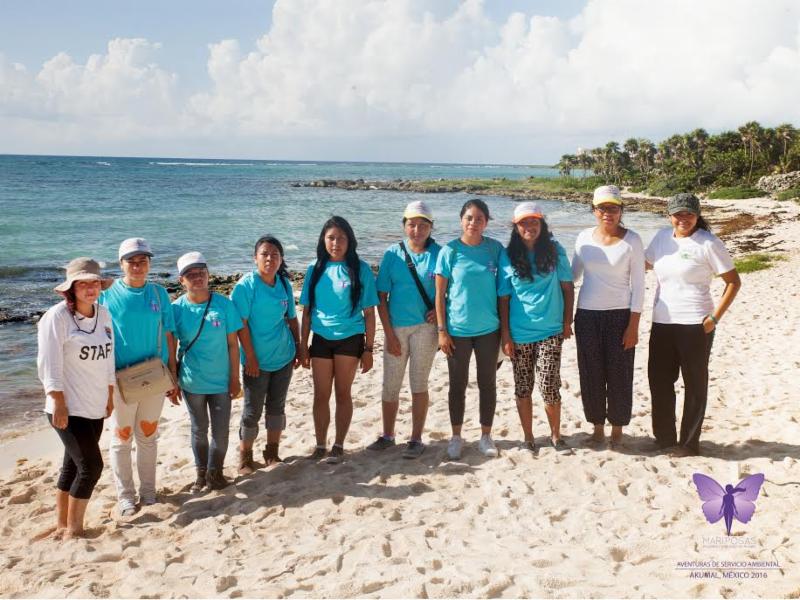
At the end of July, a group of young women from Puebla, came to Akumal to participate in Environmental Service Adventures Program with Mariposas: Mujeres Cambiando el Mundo. Mariposas works with young women from marginalized communities in Central Mexico to empower them to break the cycle of poverty through education.
The eight young women, most who have never been to the ocean in their lives, worked with CEA a few hours each day. They learned about biodiversity, conservation, and of course turtles. They also took part in workshops, beach patrols and a beach cleanup.
It was our hope not only share the importance of environmental conservation and to have these young women witness and participate with these efforts, but also be inspired by working with our two female tortugueras on the beach.
|
|
Reaching Out to Communities
|
Akumal Bay Beach and Wellness Resort recently donated 1,500 items to CEA, which included pillows, curtains, bedspreads and mats. We then connected with other non-governmental organizations in Akumal, Puerto Aventuras, Playa del Carmen and Cancun so that those donations could be forwarded to people in the communities that they serve.
|
|
Making Jessie's Wish Come True
|
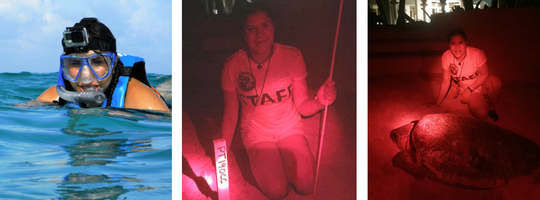
It was an honour to collaborate with the Make a Wish Foundation to help make Jessie's wish come true. She joined us at the end of July to learn about turtles and be a tortuguera for an evening.
While Jessie spent the afternoon snorkeling with the turtles in the bay, the highlight for her was working alongside the tortugueros to monitor for nesting females. Luck was on Jessie's side that night as she assisted our team with a nesting female.
|
|
Giving a Lift for Education
|
|
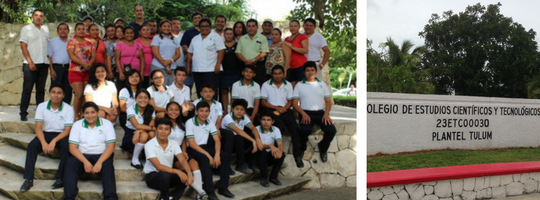
For the third consecutive year, CEA has covered the transportation costs for students in the Akumal community to commute to the CECYTE campus in Tulum. Without the support, the daily cost of transportation strains financial resources and students would abandon their studies.
In the past three years more than 65 students have benefited.
For the 2016-17 school year, there are 29 students participating---17 are in the first semester of their studies, 5 are in the third semester and 7 are in their fifth. So far the students receiving the support have excelled academically.
Due to the number of students participating this year, two transport vans are required. In an agreement with the Sindicato de Taxistas Tiburones del Caribe, the two vans are specifically designated for transport of the students to and from CECYTE Mondays to Fridays.
|
|
Who are the authorities in Akumal?
|
Our recent blog post---
Who are the authorities in Akumal?---
highlights all those acronyms of governmental organizations involved with the Refuge for Protected Species and the Fish Refuge.
|
|
2017 Volunteer Opportunities + Dates
COMING SOON
We are working on our 2017 calendar for volunteer opportunities and intake dates and should be ready for December. Updates and information can be found on our volunteer page.
|
|
Your support helps our conservation efforts.
|
|
It is our mission to produce and promote strategies for ecosystem management in Akumal, through research, education and outreach for sustainability in the Mexican Caribbean.
It is our vision that Akumal will emerge as an ecologically sustainable community and serve as an example for other coastal communities throughout Mexico and beyond.
|
|
|
|
|
|