|
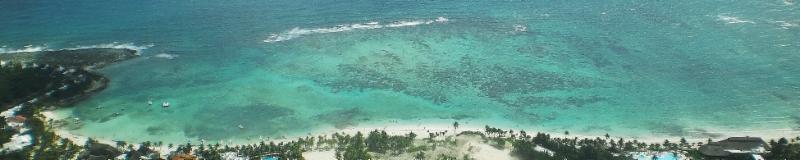
It has been four months now since the Akumal Bay Marine Refuge for Protected Species was decreed by SEMARNAT.
Actions have been taken by the federal authorities, mainly by PROFEPA, in the area and mostly on environmental impact assessment. They have shared their progress regarding the completion of their targets, however further action is still required.
Recently, PROFEPA advised each local cooperative to form their own committee, which will then take on the role of inspectors and monitors of the bay. All this has been validated and supervised by PROFEPA though training courses on topics such as marine turtles and coral reef. Yet, despite such efforts, there has been no improvement in the prevention of bad practices that substantially alter the coral reef composition, and the harassment, chasing and touching of the marine turtles persist. What is more, we have seen many tour guides who are not following the recommended guidelines themselves during their guided snorkel tours.
Besides these steps, there is still a critical piece missing: the estimate of a carrying capacity for the bay, a promise made by PROFEPA, along with SEMARNAT and CONANP earlier this year.
Unfortunately, as one of the pioneers and one of the very few non-governmental organizations working in the area for about 23 years, we have not been considered by the authorities to participate in training, actions of prevention, or promotion of good environmental practices. However, we continue to work on reef monitoring, turtle protection and conservation, water quality, environmental education, coastal management, and social activities in our capacity as an NGO and to disseminate the information and reports we generate.
CEA has always shown its interest in participating actively in any initiative that may lead Akumal towards a sustainable destination. We strongly believe that by working together in a joint effort, not only Akumal but the whole region can achieve this.
All the efforts, big and small, being made to contribute to the protection and conservation of Akumal can only make enough of a difference if they are done under a complete and comprehensive management plan including a capacity limit for the entire bay.
|
|
|
Changes in Akumal Bay
As we go to publish this newsletter, several things have been implemented in Akumal by PROFEPA in the past few days. We are working on a blog post to highlight some of these changes and it should be up in the coming week.
|
|
|
|
Coastal Cleanup
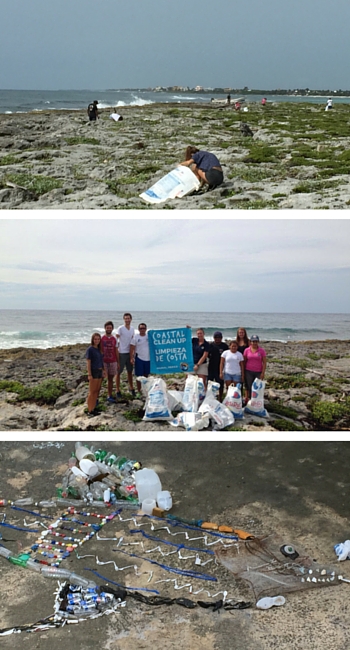
June 8 was World Oceans Day and the day CEA launched the monthly Coastal Cleanup or Limpieza de Costa. We had 11 participants (CEA volunteers and staff, along with staff from Akumal Dive Center) who collected 25kg of marine debris from the rocky shore in the north part of Akumal.
Besides an old fishing net and a dozen or so shoes and flip flops, the majority of the trash was plastic---plastic bottles, caps, toothbrushes, product containers, utensils, straws and razors.
It is no wonder that plastic trash is choking our oceans and wildlife.
The Coastal Cleanup will be a monthly activity---the second Wednesday of each month---to remove the plastics and various debris washed ashore on the local beaches.
For anyone who would like to participate, information on meeting points and times will be posted on our Facebook page, but you can also inquire by sending an email to
|
|
False Representation of CEA
Driving into Akumal these days can be a daunting experience for the first-time visitor and frustrating for the seasoned guest or resident. Newcomers are especially surprised by this "Welcome to Akumal" and have expressed disappointment in the snorkel tour street hawkers who stand on the side of the entry road and
then literally jump out in front of vehicles at least every 15 meters, less in some places of the stretch of the main entry road.
Ag
gressive and often antagonistic, they flag down cars or step in front of them to make them stop so that they can deliver their sales pitch. Each pitch is different and not only varies in levels of harassment, but also in shades of truth. The situation has indeed become not only aggravating but also has escalated into a dangerous one, in regards to traffic as well as pedestrian safety. The same situation can be experienced by virtually anyone simply trying to walk into or around Akumal, sitting in restaurants as well as harassment on the beach by these same intrusive sellers.
Over the past two years, we've addressed numerous complaints
from those tourists that feel compelled to share their experiences with us and verify whether what they were being told
was indeed valid and legitimate information.
It seems that two common threads are woven into these sales pitches. The first is the claim that a percentage of their tour fee goes to CEA to support ecological efforts. The second is that the guide and/or tour operator is a representative of CEA. Just to be clear, CEA has never received any percentage of sales donated to us from any of the
cooperatives, let alone the "freelance" and unlicensed guides in the area. And there are no guides or companies hired, contracted or affiliated with CEA to conduct snorkel tours.
But, as of late, the deceptive practice
of falsely representing CEA for financial gain is growing. There have been a couple of incidents that we are aware of whereby snorkel guides by day are claiming to be CEA staff and selling evening tours to watch nesting turtles.
This causes us great concern as it is an activity for which these guides have no authorization or permit, nor the experience or training to do so. In fact it is a punishable federal offense. PROFEPA---the environmental branch of the government---has been made aware of these illegal activities.
For those who wish to learn about sea turtles or participate in authorized night patrols with CEA field biologists or authorized volunteers, you can come to our office or email us directly (
info@ceakumal.org
) for more information.
The CEA office is located behind the arch, across from the basketball court in the Ukana Plaza.
|
|
|
|
|
Training the Trainers
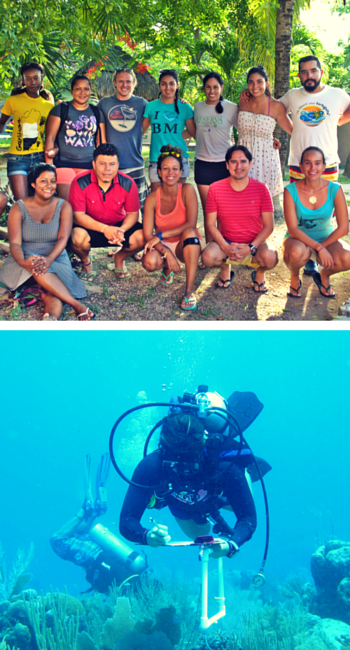
In May, individuals from Honduras, Belize, Guatemala and Mexico were in Akumal to refresh identification techniques but the key focus was to learn how to teach and train others for reef monitoring. participants for conducting surveys based on the AGRRA Protocol.
The trainers took part in a five day hands-on and classroom course that covered how to train others on the AGRRA protocol and survey methods, as well as determining indicators of reef health.
Training continues in Akumal from the beginning of July for those who are doing the monitoring and evaluating on the reefs and fish identification to determine biomass and diversity-another sign of a reef's health.
|
|
Monitoring the Reefs in Quintana Roo
|
As part of our reef monitoring work, CEA collaborates frequently with Healthy Reefs for Healthy People, an organization that produces a biennial report card, which grades the health of the Mesoamerican Reef.
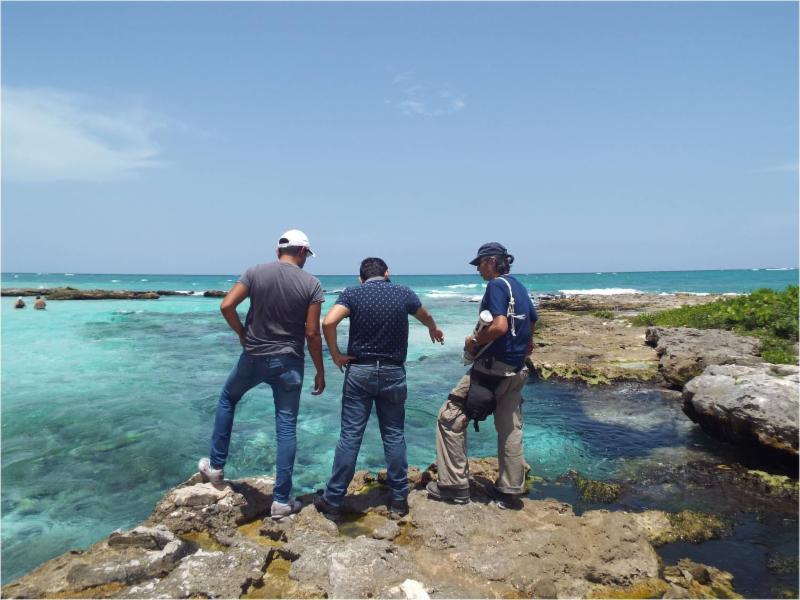
CEA staff have been active in monitoring relevant sites in Playa del Carmen alongside staff from Healthy Reefs for Healthy People to collect data for the next report card scheduled for early 2017.
Since 2006, 17 different reef sites in Quintana Roo have been monitored to gather a comprehensive summary of the reef health in Quintana Roo.
|
|
|
|
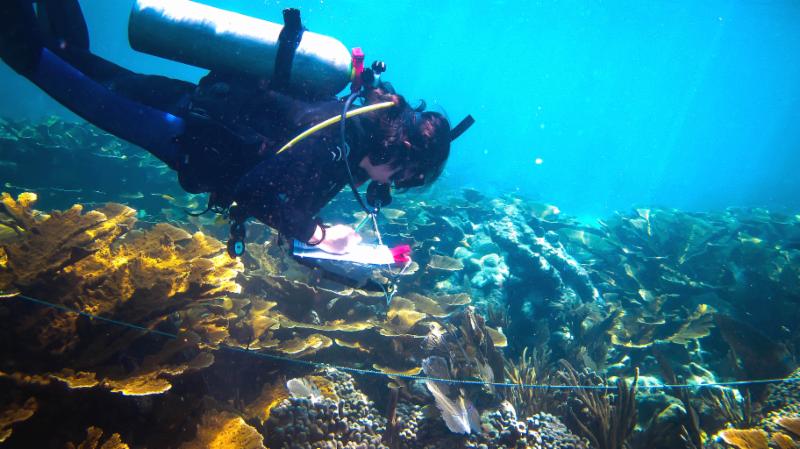
CEA staff member, Beatriz Arellano, completes a transect on the reef in Puerto Morelos.
|
|
|
It's Hurricane Season---Are you Prepared?
June 1 marked the official start of hurricane season. We have posted several links for resources and information in both English and Spanish on our blog to help you be prepared.
|
|
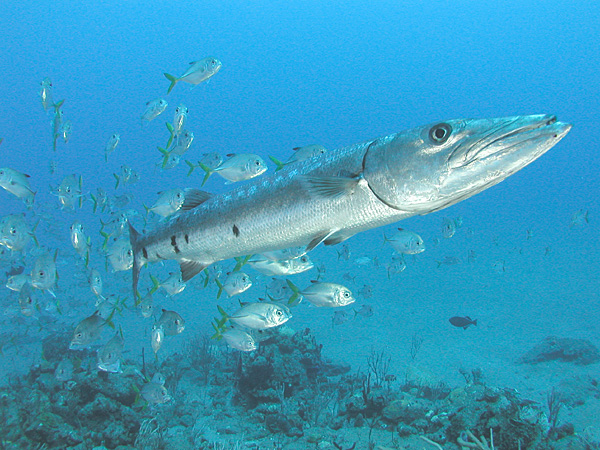
Barracudas in Akumal Bay
We have received several reports regarding the aggressive behavior of the larger barracudas in Akumal Bay. The behavior that has been witnessed is quick, frontal thrusts towards swimmers/snorkelers, a common technique that barracudas use for hunting prey.
While attacks by barracudas are rare, in light of the reported aggressive behavior, it is important to warn those swimming and snorkeling in Akumal, so that any such incidents can be prevented.
- Avoid swimming in the bay alone.
- Avoid swimming in the bay before 8 a.m. and after 5 p.m.
- Avoid swimming during poor visibility (less than 5 meters).
- Avoid swimming with jewellery, as the shine and glint is similar to prey fish.
- Avoid disturbing other fish or swimming among schools of fish.
If you see a barracuda:
- Stay as calm as possible.
- Maintain visual contact with the barracuda to watch its location and actions.
- Maintain your horizontal position and swim away from the barracuda using arms and legs.
In case of an attack/bite:
- Stay as calm as possible.
- Place pressure on the wound.
- Wave and call for help/alert lifeguards who can assist.
- If able, swim back to shore.
If you have witnessed a similar event, please consider sharing the information with us at 984-875-9095 ext.104 or email
guardavidas.akumal@gmail.com
.
|
|
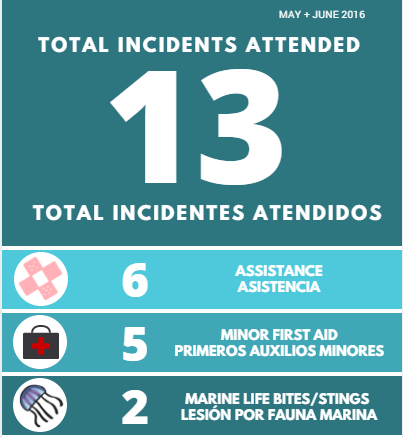
Water Security Statistics: May + June
|
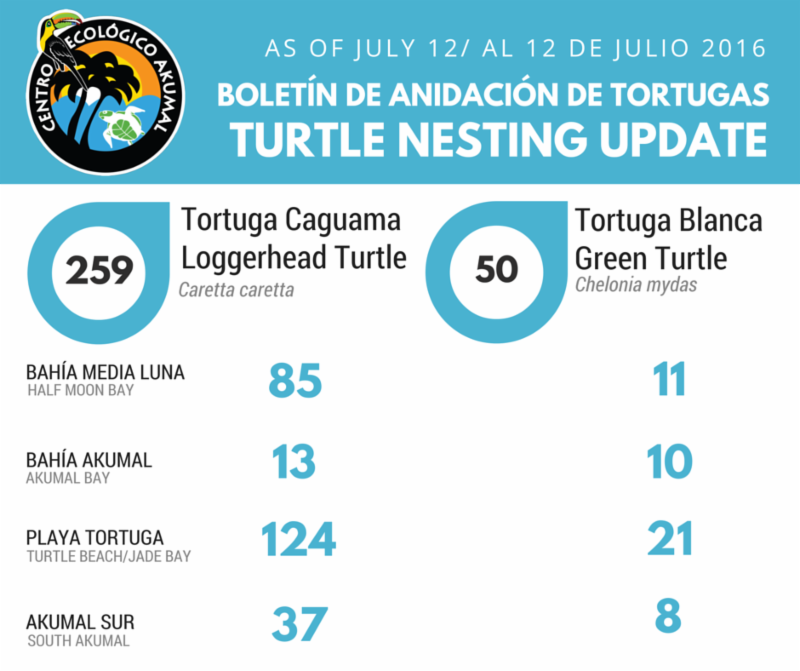
The 2016 Turtle Season officially began with the first nest on Half Moon Bay on May 1.
|
|
Nesting Count
Like last year, we update our Facebook page with the latest nest counts on Tuesdays, or as we like to hashtag it, #TurtleTuesday.
|
|
Minimizing Human Impact on Nesting Beaches
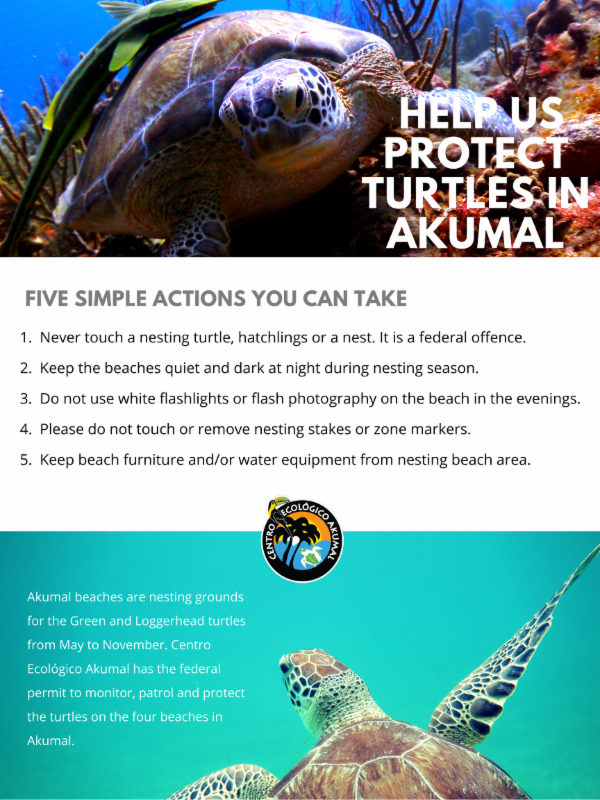
We would first like to thank the hotels and vacation homes on the nesting beaches that we patrol for their cooperation to ensure the beaches are nest-ready, by removing beach chairs and equipment off the beach each night at dusk in addition to providing educational pieces on nesting to the guests.
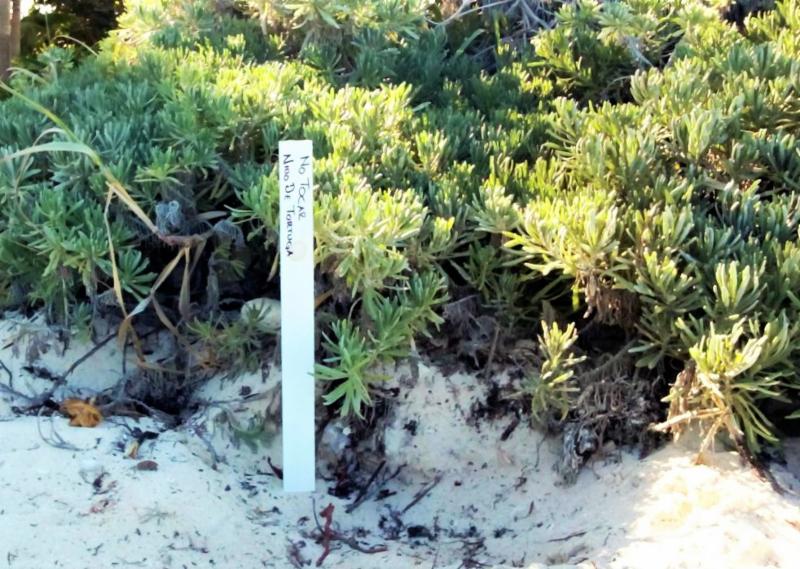
It is key for guests and visitors to know that Akumal beaches are nesting grounds for turtles and how to minimize impacts during this time. First and foremost, female turtles are sensitive to light, noise and movement on the beach. They may attempt to nest, but can be spooked and may return to the sea. This is why it is best to keep the beaches quiet and dark at night.
People can help by:
- Staying off the beaches from dusk to dawn
- Keeping pets inside in the evenings and on leash while on the beach
- Ensuring beachfront lighting is red or amber and/or directed away from the beach
- Not taking flash photography or using flashlights on the beach
- Drawing curtains or closing blinds at dusk
- Knocking over sandcastles, filling in holes, and picking up trash from a day at the beach
- Pulling up chairs and water equipment to the building at dusk
- Keeping noise and music to a minimum from dusk to dawn
- Never touching or interfering with a turtle, nest or hatchlings. (It is illegal to do so.)
Any concerns can be reported to property security staff or front desk, who will then alert CEA to the issue.
We have published informational posters that hotels or condos can download and print for their use at their properties. They can be found on our RESOURCES page on the CEA website.
Every little action helps.
|
|
|
|
Water Quality Sampling
From June 20-26, the second sampling campaign with the Red de Monitoreo de Calidad del Agua de la Microcuenca de Tulum, RMCAT (Water Quality Monitoring Network of Microcuenca Tulum) and the Red de Monitoreo de Calidad del Agua de Akumal, RMCAAk (Water Quality Monitoring Network of Akumal) took place.
Samplings were taken by members of the following institutions who also form the Comité de Cuenca de Tulum.:
- Centro Ecológico Akumal
- Amigos de Sian Ka'an
- Comisión Nacional del Agua (CONAGUA)
In addition, the following organizations supported the sampling activities:
- Centro de Investigación Científica de Yucatán (CICY)
- Comisión de Agua Potable y Alcantarillado de Tulum (Commission of Water and Sewerage Tulum).
The samplings covered a total of 28 land and coastal area points, distributed from the south and southwest of Tulum, to Caleta de Yalku, north of Akumal Bay.
Nutrient analysis and bacteriological (the latter for terrestrial points) were conducted in the CEA laboratory. The in situ parameters were taken with the Hydrolab multiparameter probe which was acquired by the CST in 2014.
Analysis of the data collected from the samples is in progress. Once the results are compiled and the report is finalized, links and/or the report will be shared.
|
|
|
|
|
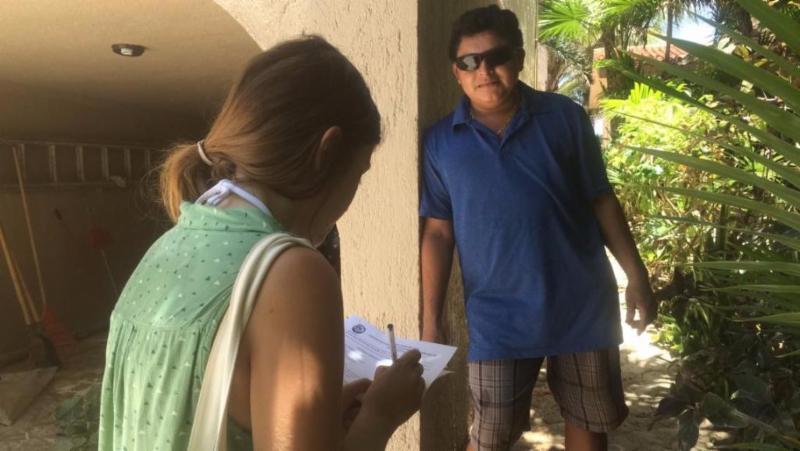
IBERO student conducts water use survey in North Akumal as part of the social service component of her studies.
|
Water Use and Users Survey
In order to update information on major water users, CEA, through its Water Quality Management Program, has been conducting the "Census of Use and Users of Water on Akumal's Coast" in the past month.
The project used CEA's documented and historical databases as well as having the support of Coco Properties, who provided information regarding the properties under their management.
In order to update this information, a questionnaire was designed to gather data on the uses and users of water along the coastal area of Akumal. The questionnaire was carried out by students from Universidad Iberoamericana who were at CEA for their Social Services requirement.
|
Volunteers are the heart and soul of CEA. Whether they are in the field monitoring and collecting data or inputting it for reports, their work plays a critical role in fulfilling our mission of conservation and protection through research, education and outreach.
|
|
Social Services Students from Iberoamerica University
Each year students from Iberoamerica University, Santa Fe campus, partner with CEA for their social services requirement. This year we have 14 students focused in three project areas:
Water Survey
Students have been conducting surveys in North Akumal to understand the water users and water usage. They have done the ground work and are working on the data entry and analysis.
Early Alert Database
Four students have been designing an online platform as a database of uploaded reports and images of diseased and bleached corals located within the Marine Refuge for Protected Species area in Akumal. The project is nearing completion and the platform is almost ready to launch.
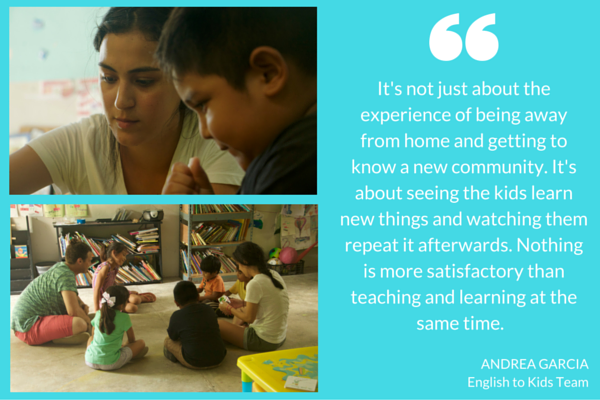
Teaching English to Kids
Like last year, students first learn how to teach English to second-language learners and for the following weeks teach the children daily at the Hekab Be Biblioteca.
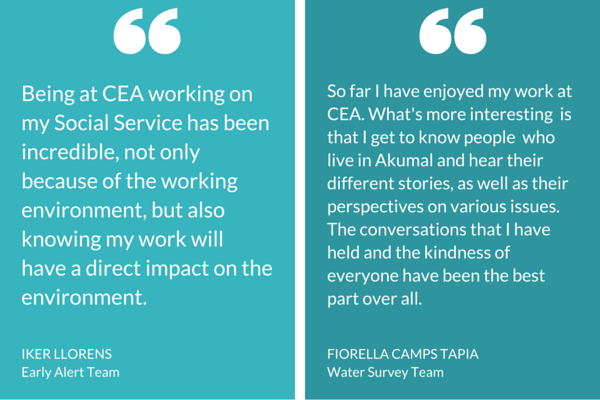
Here's what some of the students had to say about their experience and work.
|
|
|
|
|
|
Helping to Make a Wish Come True
We are excited to be working with
the Make-A-Wish Foundation to help make a young girl's wish of learning about turtles come true. She will join CEA as an honorary Tortuguera for an afternoon.
Make-A-Wish Foundation is a non-profit organization that sets out to grant the wishes of children with life-threatening medical conditions to enrich the human experience with hope, strength and joy.
|
|
|
|
Buoys
in the Bay
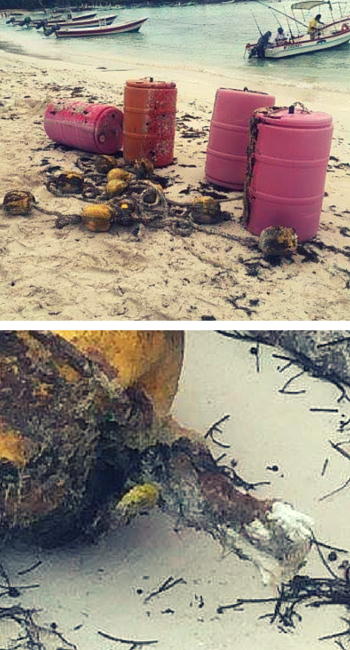
In the final week of June, the majority of the buoys in Akumal Bay were removed after they were found washed ashore late in the evening. It appears that the ropes were deliberately sabotaged as the lines were cut clean. (Normal wear and tear would fray the ropes.) It is of particular concern as the absence of these navigational and safety zoning buoys creates a challenge for boat navigation and puts swimmers and snorkelers at risk.
Various parties were involved in removing the damaged buoys and lines under the direction of the Playa del Carmen Harbour Captain (who directed the installation of the buoys under the federal Safe Beaches Program last year). Since the implementation of this project, there have been numerous incidents of vandalism including the destruction of the federally placed safety notification signs identifying the various zones to ensure safety for all.
|
Jet Skis in the Bay? No Way!
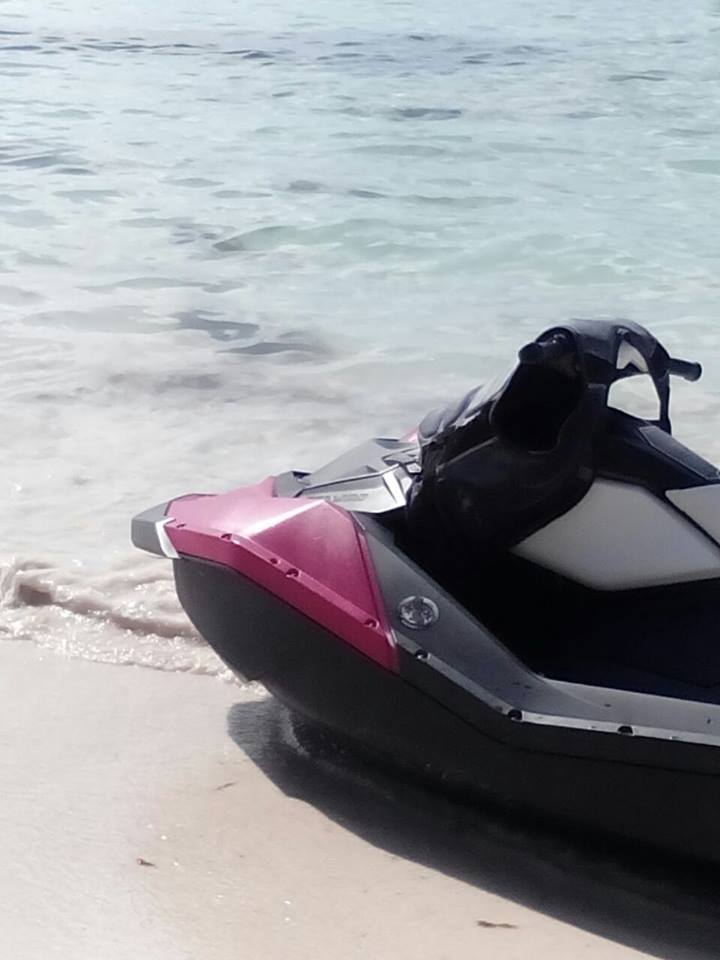
On Sunday, June 26, to the shock and surprise of many, two jet skiers entered Akumal Bay and proceeded to motor their way over the turtle feeding grounds (seagrass beds) to shore.
Authorities were immediately alerted (police, port authority, and PROFEPA) and the jet skiers were asked to leave by security. The offenders refused to give their names and left before police could arrive to intervene. It was later learned the unregistered jet skis belong to owners from Puerto Aventuras.
Special thanks to property management and security for both CEA and Hotel Akumal Caribe, as well as others who intervened in this matter.
Jet skis are prohibited from entering Akumal, as well as other unauthorized marine craft under the authority of the Harbour Captain.
|
|
Read On
In case you missed it... here are a few of the articles that we have shared through social media.
|
|
Coral Reef Monitoring and Research Volunteers
SEPTEMBER 8--DECEMBER 1, 2016
Volunteers learn to identify fish and corals before beginning to monitor and collect data on different reefs in the Akumal area by SCUBA and snorkeling.
|
|
Voluntourists
ANYTIME
Looking for more than just a vacation? Perhaps a way to enrich your travel experience? Contact us to see how we can help you add volunteering experiences to your travels.
communications.ceakumal@gmail.com
|
|
Your support helps our conservation efforts.
|
|
It is our mission to produce and promote strategies for ecosystem management in Akumal, through research, education and outreach for sustainability in the Mexican Caribbean.
It is our vision that Akumal will emerge as an ecologically sustainable community and serve as an example for other coastal communities throughout Mexico and beyond.
|
|
|
|
|
|