|
Cedric MacLeod
From the executive director's desk
| |
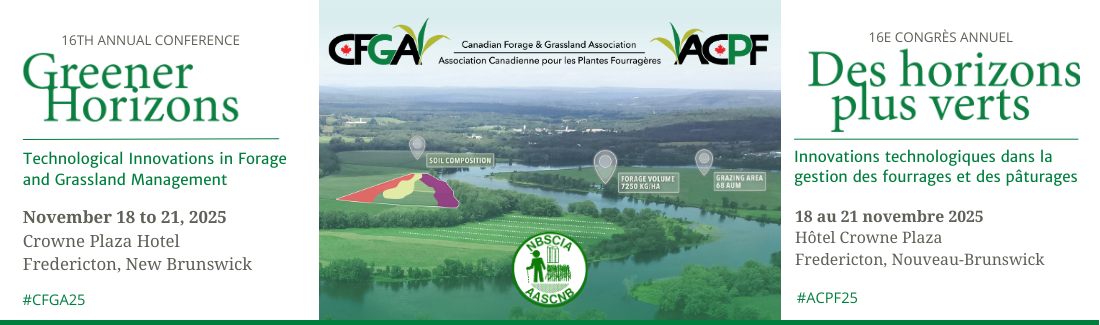
The Canadian Forage and Grassland Association’s (CFGA) 16th annual conference begins in less than three weeks and I am excited to welcome everyone to my home province of New Brunswick for this important event. This year’s theme, Greener Horizons: Technological Innovations in Forage and Grassland Management, reflects our commitment to advancing sustainable agriculture through innovation, collaboration and practical solutions.
The CFGA is proud to partner with the New Brunswick Soil and Crop Improvement Association (NBSCIA) to deliver a dynamic program that includes pre-conference workshops, expert-led sessions and a post-conference farm tour. Topics will span smart tech and digital agriculture, pasture systems, forage production and storage and market trends.
The CFGA’s annual conference brings together producers, researchers, agrologists and industry leaders to explore how forage and grassland systems can drive climate-smart agriculture, improve soil health, and support biodiversity across Canada. There’s still time to register and I hope you will join us.
You can read more about the conference in this newsletter, which also contains updates from across the country, showcasing the energy and innovation shaping our sector.
- Cedric MacLeod
| | |
Register Now!
CFGA's 16th annual conference taking place in Fredericton, N.B. Nov. 18 to 21, 2025
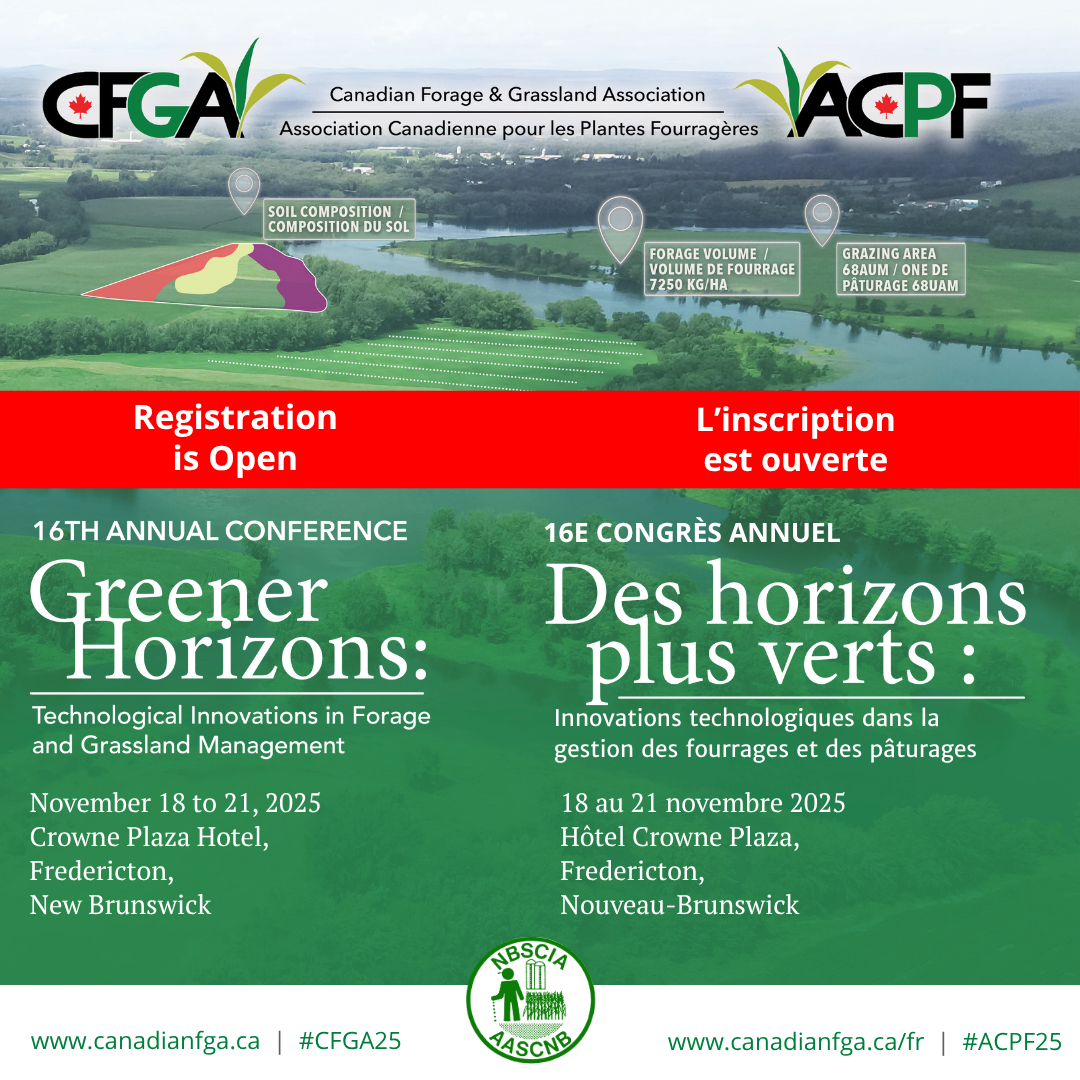
Time is running out to register for the Canadian Forage and Grassland Association’s (CFGA) 2025 Annual Conference, which takes place in partnership with the New Brunswick Soil and Crop Improvement Association (NBSCIA) from Nov. 18 to 21, in Fredericton, New Brunswick.
With the theme Greener Horizons: Technological Innovations in Forage and Grassland Management, this year’s conference will highlight the cutting-edge advancements shaping the future of sustainable agriculture.
The event includes:
- Pre-conference workshops
- Welcome reception
- Two days of expert-led sessions
- Panel discussions
- Industry trade show
- Leadership Award dinner and presentation
- Building Bridges social
- Academic poster showcase
- Post-conference farm tour
Earn CEU credits
Conference attendees are eligible to earn Certified Education Units (CEUs), making this event not only informative but also a valuable opportunity for professional development. Whether you're a producer, agronomist or extension specialist, participating in the conference sessions can contribute toward your continuing education requirements while deepening your expertise in forage and grassland innovation.
Register Now!
Register today on the CFGA website. Check out the draft agenda and watch the CFGA conference website for more details! Follow the CFGA Facebook, Instagram and X accounts for updates on speakers, schedules and special events as they become available.
| | |
Inscrivez-vous dès maintenant
Le 16e congrès annuel de l’ACPF se tiendra à Fredericton, au Nouveau-Brunswick du 18 au 21 novembre 2025
Il ne reste plus beaucoup de temps pour s'inscrire au congrès annuel 2025 de l'Association canadienne pour les plantes fourragères (ACPF), qui se tiendra en partenariat avec l’Association pour l’amélioration des sols et des cultures (AASCNB) du 18 au 21 novembre à Fredericton, au Nouveau-Brunswick.
Sous le thème Des horizons plus verts : Innovations technologiques dans la gestion des fourrages et des pâturages, le congrès de cette année mettra en lumière les avancées de pointe qui façonnent l'avenir de l'agriculture durable.
L'événement comprend :
- Ateliers précongrès
- Réception de bienvenue
- Deux jours de sessions dirigées par des experts
- Discussions de groupe
- Salon professionnel de l'industrie
- Souper et remise du Prix du leadership
- Activité « Construire des ponts »
- Présentation d'affiches universitaires
- Visite de fermes après le congrès
Gagnez des crédits CFC
Les participants au congrès pourront également obtenir des crédits de formation continue (CFC), ce qui fait de cet événement non seulement une source d’information, mais aussi une occasion précieuse de perfectionnement professionnel. Que vous soyez producteur, agronome ou spécialiste de la vulgarisation, la participation aux sessions du congrès peut contribuer à satisfaire vos exigences en matière de formation continue tout en approfondissant votre expertise dans le domaine de l’innovation en matière de fourrage et de prairies.
Inscrivez-vous dès maintenant !
Inscrivez-vous dès aujourd’hui sur le site web de l’ACPF. Consultez le projet d'ordre du jour (version française à venir) et rendez-vous sur le site web de le congrès de l'ACPF pour plus de détails ! Suivez les comptes Facebook, Instagram et X de l’Association pour obtenir des mises à jour sur les conférenciers, les horaires et les événements spéciaux dès qu’elles seront disponibles.
| | |
CFGA On-Farm Climate Action Fund Update
The CFGA is helping to distribute funds for the On-Farm Climate Action Fund (OFCAF) in the rotational grazing stream in Alberta, British Columbia, Quebec and Saskatchewan.
Between April 1, 2022, and March 31, 2025, a total of 1,338 farms applied for $30.1 million in project funding under OFCAF. Of these, 464 farms were approved for a combined total of $12.6 million in funding. Over the years 2022, 2023 and 2024, rotational grazing BMPs were implemented on 82,000 acres of farmland.
Rotational grazing implementation applications for the CFGA OFCAF program are now closed for 2025 projects. The CFGA is now reviewing applications and working as quickly as possible to send approvals in a timely manner. Approval notices will be sent from Impact and a CFGA representative will send an email if projects are approved.
The CFGA continues to accept grazing plan development applications for working with a grazing mentor to develop a rotational grazing plan (up to 85 per cent cost share) throughout the year. Applications are open on the Impact site and will be approved throughout the program year.
Important dates regarding OFCAF
- Nov. 30, 2025: Deadline for submitting OFCAF claims.
- Feb. 1, 2026: The CFGA will begin accepting rotational grazing implementation projects for the 2026 program year. Get started early!
To stay up to date on program details and promotion, register on the CFGA’s Impact portal to be included on the email list.
Numerous rotational grazing activities and events are being held across BC, AB, SK and QC. Be sure to check the CFGA calendar, social media and newsletter to stay updated on upcoming opportunities.
| | |
CFGA heading to France to represent Canada at World Alfalfa Congress
The Canadian Forage and Grassland Association (CFGA) is sending a delegation to the World Alfalfa Congress being held this year in Reims, France, Nov. 3 to 6, 2025. This international event explores the agronomic, economic and environmental dimensions of alfalfa – a key forage crop known for its high protein content, nitrogen-fixing ability and adaptability across climates.
This year’s theme, Alfalfa to Return to Planetary Limits, highlights the crop’s potential to restore ecological balance and strengthen climate resilience. The congress will convene global experts, researchers and thought leaders to exchange cutting-edge research, practical innovations and strategic approaches for building sustainable alfalfa systems that support both environmental and agricultural goals.
The CFGA is on the docket for two separate events. The first one on Nov. 4 will see CFGA board member Duane Vandenberg, CCA, participate in the Business Forum on a roundtable including speakers from China, Argentina and Pakistan. His presentation will focus on Canadian domestic alfalfa markets, highlighting the origins, challenges and strengths of the current Canadian alfalfa market. He will also give some insights on how the market is expected to evolve in the coming years, particularly with respect to the international market presence.
Then on Nov. 5, CFGA executive director, Cedric MacLeod, will represent Canada on a roundtable discussion focused on alfalfa-based cropping systems in sustainable land use for livestock production. This will include discussion on how research and business advances can be applied to national issues. This panel will include an American producer and a technical expert from Argentina.
The CFGA is eager to take part in the workshops, conference sessions and field tours, including visits to alfalfa processing operations, at this renowned international event. As Canada’s representative, the association looks forward to exchanging ideas, exploring global innovations and bringing home fresh research and insights that will help shape the future of alfalfa production.
| | |
CFGA gears up for an exciting week at Agribition
Cindy Green, CFGA Saskatchewan grazing coordinator
The Canadian Forage and Grassland Association (CFGA) is excited to participate in Agribition week in Regina, Saskatchewan Nov. 24 to 28 with an inspiring lineup of events celebrating learning, connection and growth in the livestock industry in Canada.
Monday kicks off strong with the Next Gen Agriculture Mentorship Program, featuring the CFGA’s guest speaker, Doug Wray. He will share his family’s ranching history and how their innovation and stewardship have impacted the beef industry.
Tuesday morning starts bright and early with Agri Insights: Breakfast in the Barns. Breakfast begins at 7:30 a.m. with keynote speaker Scott Moe at 8:15 a.m. His address will be followed by a Q&A session, a perfect way to start the day, connecting over insights and ideas. Limited tickets are available, so please contact adrienne@canadianfga.ca for your ticket today!
On Thursday, the CFGA is pleased to be a Topic Partner of the Indigenous Agriculture Summit (IAS), a two-day event focused on opportunity, knowledge sharing and food security in Indigenous agriculture. This year’s summit features breakout sessions designed to explore the opportunities in Indigenous agriculture, promote knowledge sharing and provide resources on how to build food security, strengthen communities and inspire through the world of Indigenous agriculture. The summit will highlight success stories, best practices, pathways for economic development and building connections for success in agriculture.
Also on Thursday, the Sheep Show takes centre stage with a full day of activities. Throughout the day, there will be sheep shearing demonstrations and hoof trimming clinics to offer hands-on learning for exhibitors and spectators. The afternoon concludes with the Commercial Sheep and Market Lamb Show and the Purebred Sheep Pen Show. The sheep yards are a busy place, filled with families proudly showcasing the best of their farms and hoping to take home a well-earned prize.
Throughout Agribition, be sure to stop by the CFGA booth. Take a break, put up your boots and chat about your grazing plan for the upcoming application year. Kids can enjoy the CFGA’s rotational grazing diorama, a fun interactive way to learn about rotational grazing.
Join the CFGA for an exciting week of mentorship, learning and community. The CFGA team looks forward to seeing you there.
| | |
CFGA virtual Young Ranchers Network meetings are rooted in connection
Cindy Green, CFGA – Saskatchewan grazing coordinator
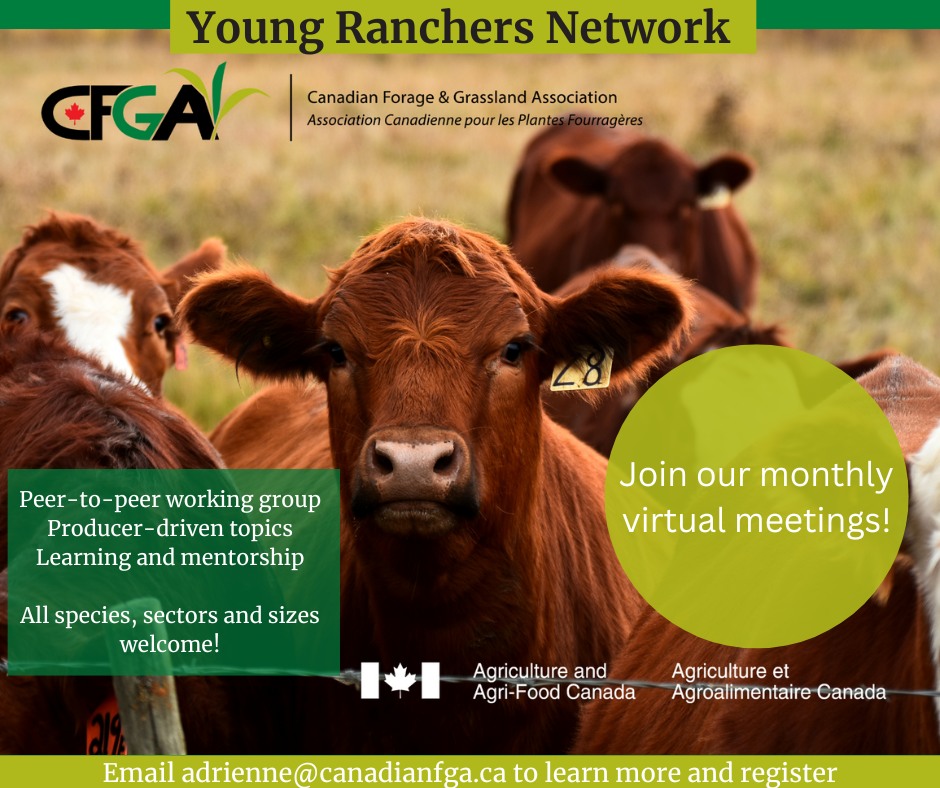
The Young Ranchers Network virtual meeting, hosted monthly by the Canadian Forage and Grassland Association (CFGA), may be a new initiative, but it is building on an age-old practice – connection.
Staying connected is essential for everyone, but it can be hard to attain in a rural setting. For young producers trying to balance the farm, a family and perhaps an off-farm job, adding one more commitment can feel impossible. Yet, connecting with like-minded producers and discussing relevant topics is an important part of both personal and professional growth. Farming can be lonely at times and sometimes you just need to bounce ideas off another producer.
Traditionally, grazing clubs offered a way to connect with producers, share ideas and learn from one another. However, attending an in-person meeting can be difficult for busy producers. That’s why the CFGA created the Young Ranchers Network – an online, low-commitment, high-value way to stay involved and informed.
The Young Ranchers Network meeting was Spearheaded by the CFGA’s national grazing coordinator, Adrienne Hanson, the Network was designed to meet producers where they are. Recognizing that many producers were seeking connection but unable to find it in their rural settings, Hanson started the initiative to provide a welcoming space online for young producers to connect, learn and support one another.
And while “Young” is in the name, there is no age limit. Producers of all ages are welcome and the CFGA hopes the Network serves as a place where everyone feels included and provides a space for connection and a sense of belonging in the livestock industry.
Meetings are held on Zoom once a month, typically on the third Wednesday of the month at 7 p.m., and last no longer than 90 minutes. Each session includes a brief CFGA update, followed by a 30 to 45-minute guest presentation and a question period. All meetings are recorded and sent out to registered participants, so even if someone can’t attend live, they won’t miss out on topics that interest them. Recordings are also available on the CFGA website for anyone to listen to.
The CFGA encourages producers to suggest speakers and topics they’d like to hear about. The CFGA selects topics that are relevant at that time of year. Past speakers have shared a wealth of knowledge and practical experience that benefit producers across the country.
In the past
October’s session hosted Dr. Bart Lardner, University of Saskatchewan, speaking about grazing standing forage, the benefits of stockpiled grass, extensive winter grazing and winter management tips.
Previous sessions included the CFGA’s Jodie Horvath sharing her insights with the Gallagher eShepherd virtual collar demonstration she is spearheading. During the September session, Horvath gave a rundown on the software abilities, the ease of use to create paddocks, manage water sites and create exclusion areas. Going along with the tech theme, Darren Wolchyn from Smart Paddock talked about tagging technology and how smart tags are changing the way we monitor livestock.
At the end of August, Natasha Wilkie from the Saskatchewan Ministry of Agriculture discussed timely late-summer and fall management topics. This covered the importance of water and feed tests and how to conduct them. Wilkie also talked about stubble grazing and how to ensure cattle are getting the proper nutrition from a low-quality ration.
Coming up
The next session takes place on Nov. 25 and features information on starting a grazing club. Register here.
Future sessions include:
- December: No meeting
- Jan. 28, 7 p.m.: OFCAF application prep
- Feb. 25, 7 p.m.: Record keeping
- March 25, 7 p.m.: Calving
The Young Ranchers Network brings producers together to learn, share and support one another in an online format. Join the CFGA each month to connect with peers, explore practical topics and strengthen the forage and livestock community. Keep an eye on the CFGA’s social media and online events calendar for the Zoom link to register for upcoming meetings.
| |
|
Riverview Ranch explores virtual fencing
Jodie Horvath, PAg forage specialist, CFGA
It is slightly cooler in the shop compared to the 30 degrees outside and a huge laminated map on the wall provides an impressive, detailed overview of the Riverview Ranch grazing plan. It is nothing compared to the stunning panorama of native shortgrass prairie, shallow snaking coulees and steep blocky cliffs framing the Old Man River just outside the door. We are talking virtual fencing and Tyler Torrie is excited. A map in real-time on his cell phone shows bulls in a paddock equipped with collars from eShepherd, Gallagher’s virtual fence technology. The bulls learned to respect the virtual boundaries quickly and with no major glitches. More collars hang along the corral fence charging in the sun, soon to be fitted on replacement heifers.
Cattle producers have a lot to consider when it comes to pasture management. A grazing plan is a valuable tool to gather relevant information that prepares the producer for the grazing season. Assessing the current condition of the land, setting goals, developing strategies and implementing a grazing plan will improve forage production and maintain or improve environmental sustainability. An advanced grazing system (AGS) uses rotational grazing practices adapted to the landscape. A grazing plan with AGS considers rest period, graze time, animal impact, stock density, soil health and biodiversity. Water access and fencing are major factors used to control the movement of animals across the landscape and determine the size and shape of paddocks.
A notable innovation in pasture management is virtual fencing which controls the distribution and movement of livestock without physical barriers. Livestock are fitted with GPS equipped collars that keep the animal in a pre-determined area using a series of auditory cues and electric shock. Virtual fencing creates small, manageable grazing areas to enable rotational grazing practices and improve overall pasture use. This technology significantly reduces the labour required to erect and disassemble temporary electric fencing. In addition, virtual fencing allows for endless possibilities of paddock design and adaptability mid-season. The ability to create exclusion zones within a paddock can keep livestock away from ecologically sensitive areas like sage grouse leks or sandy blowouts.
On the map, Tyler points out the seven miles of riverfront slopes that are not feasible to fence. Coulees riddle the pasture and restrict paddock design. Out touring the pasture, I see the advantage to fencing off the roadway virtually, both to protect the animals and as an alternative to Texas gates that dislodge and slump with traffic on the sandy base. Tyler feels the virtual fence will resolve his concerns around livestock access to the sensitive sturgeon spawning grounds and wildlife getting caught in or clipping the cross-fence wires.
There are challenges to using new technology and costs to implement it. While it is still relatively new to producers in Canada, there is great tech support offered from the virtual fence companies. Funding is available from the Canadian Forage and Grassland Association through Agriculture and Agri-Food Canada’s Agricultural Climate Solutions – On-Farm Climate Action Fund. Virtual fencing offers a promising approach for livestock grazing management in the prairies and the potential benefits make it an innovation worth exploring.
This article originally appeared in The Blade – the official publication of the Central Alberta Forage and Livestock Association (CAFLA). Featuring stories, insights and on-farm innovations from across Central Alberta, The Blade keeps you connected to the latest in forage and livestock practices. Read the latest issue and learn how to become a CAFLA member at cafla-ab.ca.
| | Provincial member news: B.C. Forage Council (BCFC) | | |
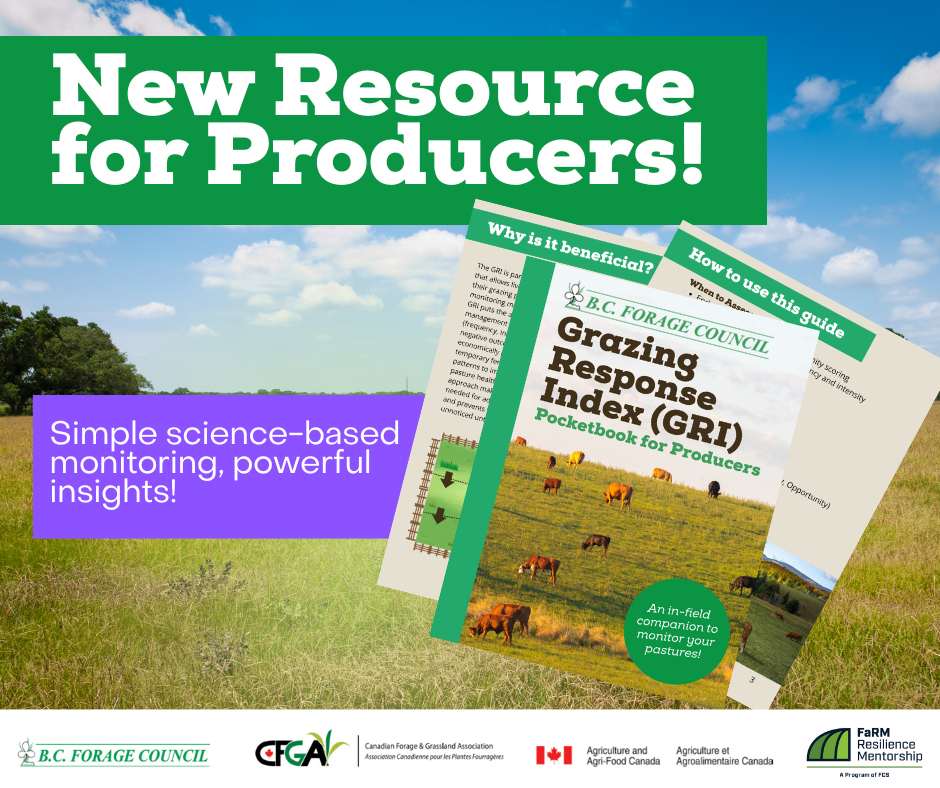
New resource
Grazing Response Index (GRI) Pocket Book: A Practical Field Guide for Sustainable Grazing Management
The BC Forage Council (BCFC), with generous funding support from Farmers for Climate Solutions (FCS) and the On-Farm Climate Action Fund (OFCAF), developed a comprehensive yet practical pocket guide to help livestock producers optimize their grazing management practices. The Grazing Response Index (GRI) Pocket Book puts science-based monitoring tools directly into the hands of producers, enabling them to make informed, real-time decisions that improve both pasture health and livestock productivity.
This user-friendly field guide centres on the GRI methodology, which evaluates three critical factors affecting plant health: frequency (how often plants are grazed), intensity (how much leaf area is removed) and opportunity for regrowth (the quality and duration of rest periods). Unlike traditional monitoring methods that require external expertise or delayed reporting, the GRI system provides immediate, actionable feedback that allows producers to identify specific areas for improvement and make timely adjustments before long-term damage occurs.
The pocket book includes everything needed for on-farm implementation: step-by-step assessment instructions, scoring worksheets, tracking charts for year-to-year comparisons and practical management recommendations. Originally developed for native rangelands, the GRI has been adapted for use on tame forages, making it applicable across diverse Canadian grazing operations. The guide also connects producers to additional resources, including information about OFCAF’s cost-share programs for grazing infrastructure improvements and B.C.’s network of grazing mentors.
The GRI Pocket Book will be available for purchase on the BCFC website starting in September 2025 for non-BC Forage Council members. BCFC members receive complimentary access as part of their membership benefits.
| | Provincial member news: Conseil québécois des plantes fourragères (CQPF) | | |
Une saison 2025 bien remplie pour les pâturages québécois
Marie-Pier Beaulieu, chargée de projet
La saison 2025 aura été particulièrement active du côté des pâturages au Québec! Par le biais de financements fédéraux, le CQPF a pu soutenir de nombreuses initiatives visant à outiller les producteurs et à propulser les pratiques de gestion avant-gardistes sur le terrain.
D’abord, le Fonds d’action à la ferme pour le climat (FAFC) a permis de soutenir directement les producteurs souhaitant mettre en place un système de pâturages sur leur ferme. Pour 2025-2026, un budget de 1,3 million de dollars a été accordé pour l’implantation de systèmes de clôtures, d’abreuvement et d’ensemencement sur des prairies destinées à être pâturées. Le programme, qui couvre 70 % du coût des projets, appuie ainsi 70 producteurs à travers le Québec, les encourageant à investir dans des aménagements durables et efficaces.
Ce même programme nous permet également d’investir dans le transfert de connaissances et l’expérimentation de technologies novatrices. Ainsi, nous avons pu faire l’acquisition des premiers colliers E-Shepherd au Québec, maintenant à l’essai sur un de nos sites de démonstration en gestion avant-gardiste des pâturages. Cette technologie de clôture virtuelle suscite déjà beaucoup d’intérêt et permettra d’offrir aux producteurs québécois des données concrètes sur son utilisation et son potentiel.
En parallèle, le programme Fermiers pour la transition climatique a rendu possible le déploiement de la Caravane des pâturages, qui a sillonné le Québec tout l’été. Avec dix arrêts répartis aux quatre coins de la province, la Caravane a permis d’aborder la gestion des pâturages sous un angle pratico-pratique, en proposant des démonstrations de matériel, des ateliers concrets et des visites de fermes laitières, bovines et ovines. Ces rencontres, tenues en collaboration avec des partenaires comme les Producteurs de bovins du Québec, le MAPAQ, Régénération Canada, le CÉPOQ et plusieurs clubs-conseils, ont donné lieu à des échanges riches et inspirants.
Le programme du FAFC, en place depuis 2022 et prolongé jusqu’en 2028, offrira d’autres occasions de déposer des projets en 2026. La saison froide est donc le moment idéal pour réfléchir aux prochaines étapes et planifier les aménagements à venir!
| | |
A busy 2025 season for Quebec pastures
Marie-Pier Beaulieu, project manager
The 2025 season was a particularly busy one for pastures in Quebec With federal funding, the Conseil québécois des plantes fourragères (CQPF) was able to support numerous initiatives aimed at equipping producers and promoting cutting-edge management practices in the field.
First, the On-Farm Climate Action Fund (OFCAF) provided direct support to producers wishing to set up a pasture system on their farm. For 2025-2026, a budget of $1.3 million has been allocated for the installation of fencing, watering and seeding systems on grasslands intended for grazing. The program, which covers 70 per cent of project costs, supports 70 producers across Quebec, encouraging them to invest in sustainable and efficient developments.
This same program also allows the CQPF to invest in knowledge transfer and experimentation with innovative technologies. As a result, the CQPF was able to acquire the first E-Shepherd collars in Quebec, which are now being tested at one of its demonstration sites for cutting-edge pasture management. This virtual fencing technology is already generating a lot of interest and will provide Quebec producers with concrete data on its use and potential.
At the same time, the Farmers for Climate Solutions’ program made it possible to launch the Pasture Caravan, which traveled across Quebec throughout the summer. With 10 stops across the province, the Caravan provided a practical approach to pasture management, offering equipment demonstrations, hands-on workshops and visits to dairy, beef and sheep farms. These meetings, held in collaboration with partners such as the Quebec Cattle Producers, MAPAQ, Regeneration Canada, CÉPOQ and several advisory clubs, led to rich and inspiring discussions.
The OFCAF program, in place since 2022 and extended until 2028, will offer further opportunities to submit projects in 2026. The cold season is therefore the ideal time to think about the next steps and plan for future developments!
| | Provincial member news: New Brunswick Soil and Crop Improvement Association (NBSCIA) | | |
NBSCIA update: AGM planning, field days recap and OFCAF funding info
NBSCIA 47th Annual General Meeting and Technical Workshop
Preparation for the New Brunswick Soil and Crop Improvement Association’s (NBSCIA) AGM is in the works and is scheduled for March 12 and 13, 2026 at the Crowne Plaza Hotel in Moncton, New Brunswick. This year’s theme is Envisioning New Brunswick's Agri-Food Sector in 2050. Stay tuned for more updates on speakers and topics that will be covered during the conference.
Summary of recent field days
This fall, the NBSCIA organized a series of cover cropping with agricultural drone field days in three regions of the province: Keswick Ridge, Sussex and Pokeshaw. The NBSCIA invited Drone Spray Canada representative Adrian Rivard to provide a presentation and demonstration of the DJI Agras T100 drone, one of the newest on the market, to show producers the many capabilities of this technology.
These field days were well attended and sparked many questions and conversations from local farmers. As the year winds down, the NBSCIA is working to organize some winter workshops that will cover relevant topics around beneficial management practices (BMPs) in nitrogen management, cover cropping and rotational grazing.
OFCAF update for N.B.
On-Farm Climate Action Fund (OFCAF) funding supports N.B. producers in their ongoing progress in adopting BMPs that reduce greenhouse gases (GHGs) and store carbon. OFCAF funds are available for the Course and Conference Education Program. This program supports agriculture producers, agrologists (P.Ags) and certified crop advisors (CCAs) who may wish to participate in conferences, workshops and training events outside the Province of New Brunswick that support the reduction of GHGs, embracing new technology for improved nitrogen management, cover cropping and rotational grazing.
Plan your next summer’s OFCAF project now. NBSCIA will be accepting applications from Jan. 1, 2026, closing when funding is fully allocated, for projects funded in the fiscal year ending March 31, 2027. Detailed program guidelines and the application process are available on the NBSCIA website.
For assistance with the application process contact a your local NBSCIA coordinator or the OFCAF program administration team: Stephen London, (506) 392-0408, ofcaf.facf@nbscia.ca; David Walker, (506) 461-6046, research@nbscia.ca; David Good, (506) 391-9424, drgood449@gmail.com; Ray Carmichael, (506) 276-3311, ofcafadmin@nbscia.ca.
Support for these activities has been provided by Agriculture and Agri-Food Canada through the Agricultural Climate Solutions – On-Farm Climate Action Fund
| | Provincial member news: Ontario Forage Council | | |
Ontario Forage Council update
The Ontario Forage Council (OFC) team has been busy travelling around Ontario for the Community Pastures Initiative, attending events like Canada’s Outdoor Farm Show and working on more great programs for forage enthusiasts. There’s a lot of exciting things in the works so stay tuned.
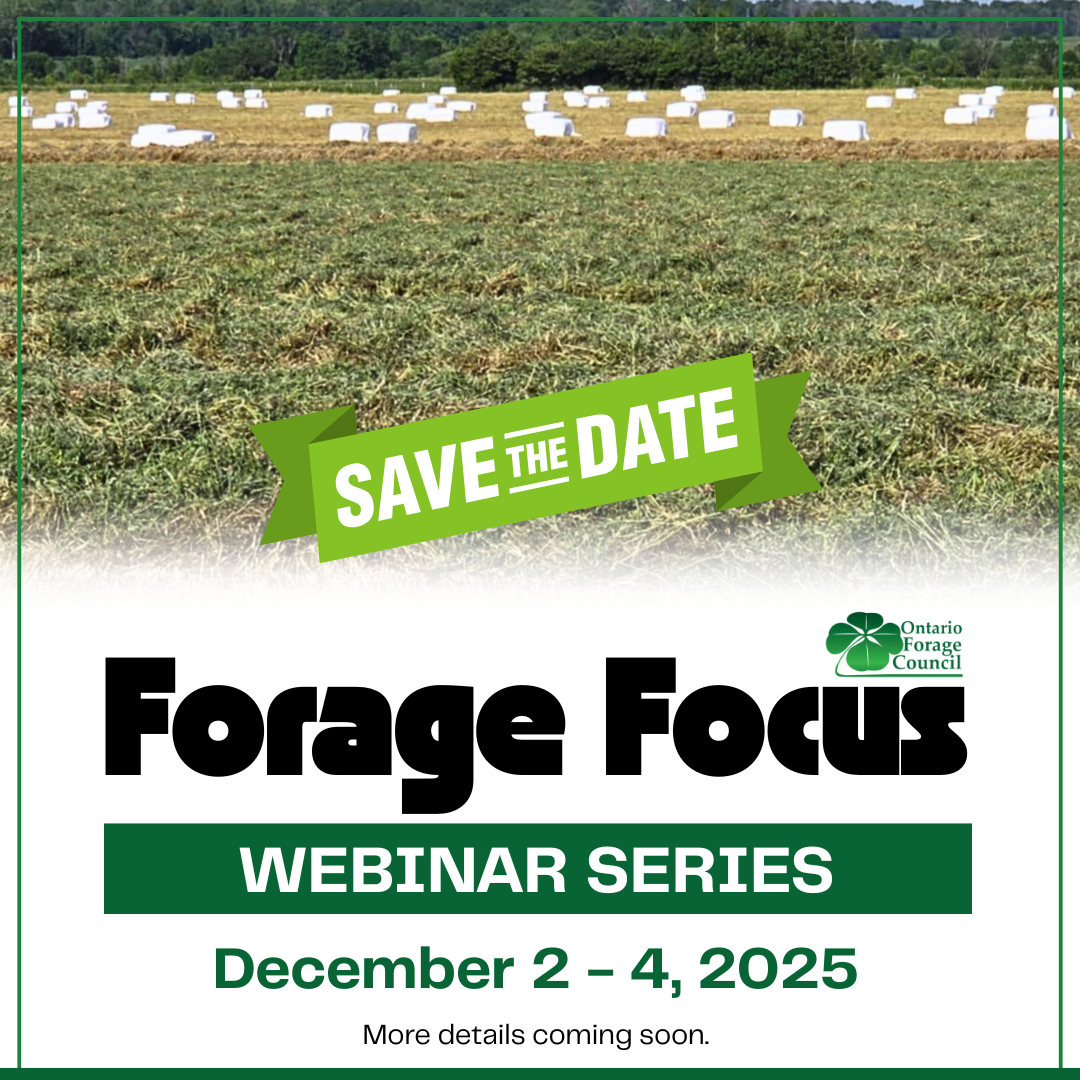
Forage Focus
OFC’s popular Forage Focus webinar series is happening Dec. 2, 3 and 4 this year. Tune in each evening at 7:30 p.m. EST to learn more from a great line-up of speakers. Topics this year include winter triticale, forage recovery after dry weather and using drones in forage production systems. Visit https://onforagenetwork.ca/ontario-forage-council/forage-focus/ to learn more and register.
Grazing Considerations for Fall Webinar Recording
Have you been looking to extend your grazing season? OFC had some of their Ontario grazing mentors share their experiences and best tips on fall grazing in a webinar. Watch the replay on the OFC YouTube channel here.
For updates on the Community Pastures Initiative, upcoming events and more, subscribe to OFC’s newsletter at https://onforagenetwork.ca/subscribe/.
| | Provincial news: Saskatchewan | | |
Youth participate in Future Grazers - Grazing Plan Challenge
Cindy Green, CFGA – Saskatchewan grazing coordinator
This summer, the Canadian Forage and Grassland Association (CFGA) - Saskatchewan hosted the Future Grazers - Grazing Plan Challenge, inviting kids from across Saskatchewan to participate. The contest offered three exciting prizes – a drone, an iPad and an Ebike - and gave kids the chance to learn and showcase their knowledge of rotational grazing.
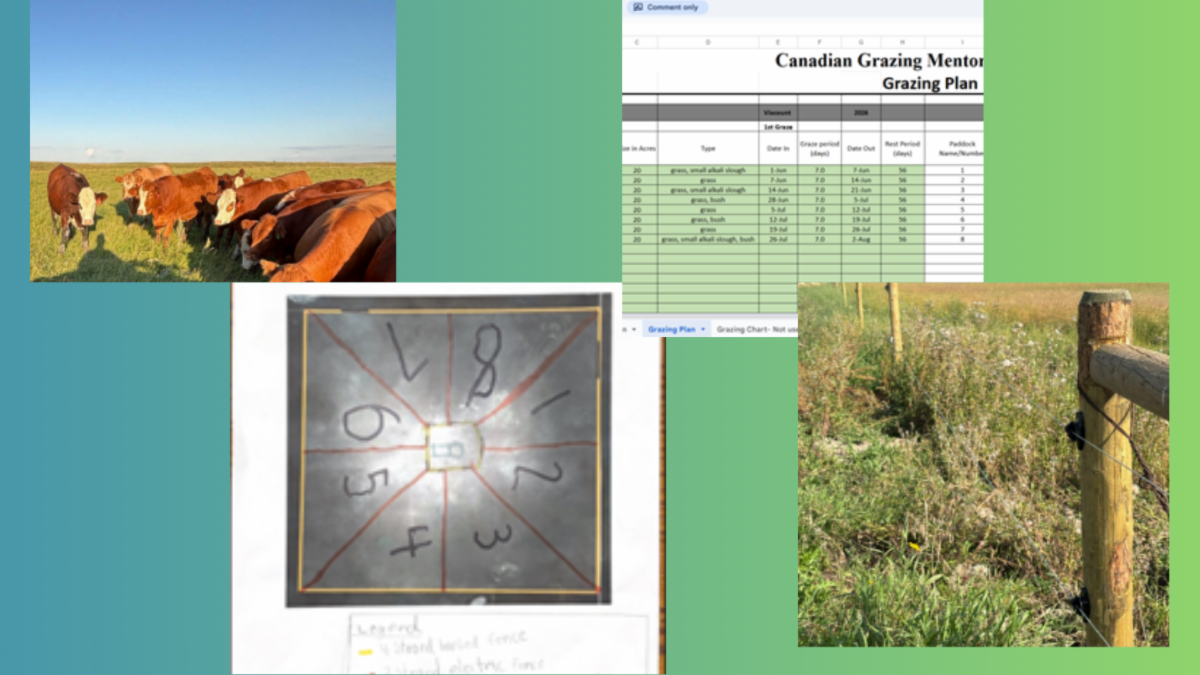
To prepare, the kids were provided with educational videos about rotational grazing, along with step-by-step instructions on how to make a grazing map with a legend, use the CFGA grazing chart and build a grazing plan. The kids were asked to provide five photos, one video and a short write-up about their project.
It was a real treat to review the submissions. Each project gave us a window into the daily lives of these young cowgirls and cowboys. We learned so much about each family’s operation and saw the kids’ unique perspectives on grazing management. It was inspiring to see how much knowledge and understanding the children had of rotational grazing and to see it from their point of view.
They showed a solid grasp of key concepts such as rest and recovery periods, the different types of fencing and their uses, water sources and livestock husbandry. The hard work, effort and enthusiasm put forth by the kids were quite inspiring. Their passion for agriculture was quite evident, reminding us that learning begins at an early age and they absorb so much of the world around them. We are confident that the livestock industry has a bright future with these young people soon becoming a part of it.
Judging the entries was not easy, as every project was impressive in its own way. To ensure fairness, submissions were evaluated on completeness, map quality, plan detail, understanding of grazing, presentation and creativity. The scores were extremely close, but in the end we awarded first place to Jylissa G, with a tie for second place between Henry G and Trace S.
In conjunction with the Grazing Plan Challenge, the CFGA Saskatchewan ran a colouring contest for children six years and younger. Words cannot describe how cute the entries were and we are so happy their parents gave them the opportunity to showcase their colouring skills.
A big congratulations to the winners and to all participants for their outstanding efforts.
| | |
Calendar of Events
At the time this newsletter was distributed, all event times and locations were accurate, but please check event websites for the most current information. Some events may have been postponed or cancelled.
| | |
Oct. 30: Lakeland College’s Livestock Research Field Day. Vermilion, A.B. More info.
Nov 4: Fall Mentor Meeting Series: Extending Your Reach - Promoting Yourself as a Mentor. Online. More info.
Nov. 5: Wintering Cattle in the Peace. Tangent, A.B. More info.
Nov. 14–15: A.B. Lamb Producers Conference & Annual General Meeting. Lethbridge, A.B. More info.
Nov. 15: Gathering Ground - A Producer Development Day. Westward, A.B. More info.
Nov. 18–21: CFGA Conference 2025. Fredericton, N.B. More info.
Nov 20: Emerge 2025 - Growing Women in Agriculture. Lloydminster, S.K. More info.
Nov. 24–29: Canadian Western Agribition, Regina, S.K. More info.
Nov. 25: 42nd Annual Canadian Bison Association Convention. Regina, S.K. More info.
Nov 25: November Young Ranchers Network Meeting: Starting a Grazing Club. Online. More info.
Nov. 30: Kids Grazing Plan Challenge for Youth in A.B. Online. More info.
Nov. 30: Kids Colouring Contest. A.B. Online, More info.
Dec. 2: Fall Mentor Meeting Series: Extending Your Reach - How to Plan a Field Day. Online. More info.
Dec. 2–4: Ontario Forage Council Forage Focus. Online. More info.
More event listings
B.C. Forage Council (BCFC)
Beef Cattle Research Centre webinar series
Canadian Forage and Grassland Association (CFGA)
Conseil Québécois des plantes fourragères (CQPF)
Gateway Research Organization (GRO)
New Brunswick Soil Crop Improvement Association (NBSCIA)
Ontario Forage Network
Saskatchewan Prairie Conservation Action Plan (SK PCAP)
| | | | |