|
Cedric MacLeod
From the executive director's desk
| |
With summer just around the corner, I hope your pastures and hay fields are thriving as we gear up for a productive season ahead. At the CFGA, we remain focused on supporting the forage and grassland industry through collaboration, knowledge sharing and innovative solutions that help drive sustainability and profitability.
I am happy to report that we recently held another successful annual general meeting. While sharing the association’s most recently audited financials is a priority of this meeting, it also serves as a great opportunity to meet the board of directors and our many contractors and to hear an overview of the many projects and activities the CFGA has on the go. If you missed the AGM, you can access a recording of the session here. (En français ici.) You can also check out our 2024-2025 annual progress report for additional information.
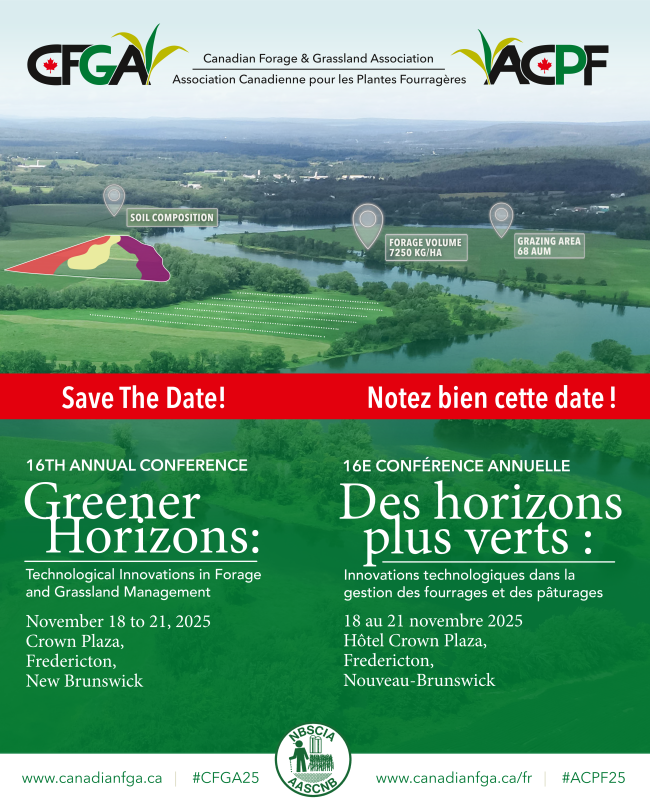
As we approach the warmer months, excitement is building for our 16th annual conference, taking place in Fredericton, New Brunswick, Nov. 18 to 21. This year’s theme is Greener Horizons: Technological Innovations in Forage and Grassland Management. The event will focus on advancing sustainable practices in forage and grassland management through cutting-edge technology and will highlight innovations that improve soil health, biodiversity and carbon sequestration while enhancing productivity for farmers and land managers. We encourage you to stay connected with us through our website and social media channels. Your involvement and support are key to shaping a thriving future for Canadian agriculture.
I wish you a successful and rewarding season ahead and, as always, if you have questions or comments, don’t hesitate to reach out to me to discuss.
- Cedric MacLeod
| | |
CFGA 2024 conference recordings available
Organized with the Ontario Forage Council (OFC), the CFGA 15th annual conference took place Dec. 3 to 6 in Guelph, Ontario. The theme was Roots to Success: The Foundation of Resilient Agriculture, and the agenda provided something for everyone.
The 2024 conference recordings are now available to registrants of the conference. (Instructions to access the recordings were emailed to all registrants.) Those unable to attend can purchase access to the recordings for $150 here.
Please email info@canadianfga.ca for more information or if you have any issues purchasing or accessing the recordings.
| | |
OFCAF
Rotational grazing implementation applications for the CFGA On-Farm Climate Action Fund (OFCAF) program are now closed. The CFGA received 271 applications requesting a total $9.6 million. Applications are now being reviewed and the review team is working as quickly as possible to send approvals in a timely manner. Approved applicants will receive an email from a CFGA representative as well as an approval notice from Impact.
Grazing plan development applications for working with a grazing mentor to develop a rotational grazing plan will continue to be accepted throughout the year. Please contact Travis Quirk at travis@canadianfga.ca to let him know you would like to submit an application for that funding.
| | |
Advanced Grazing Systems
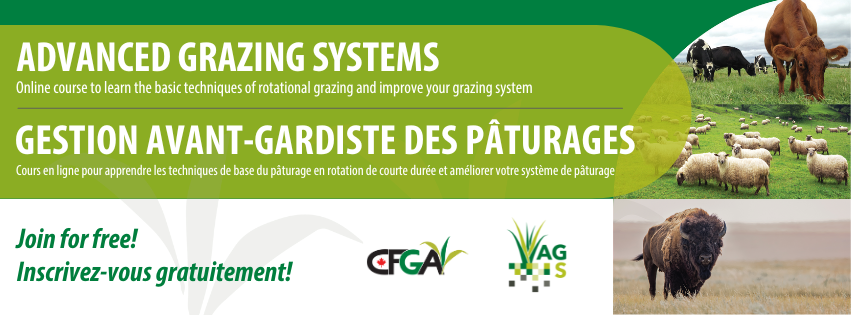
The Advanced Grazing Systems (AGS) program is a program for extension professionals and farm operators to learn the basic techniques of rotational grazing. It includes online independent learning through the learning management system (LMS) platform, one-on-one mentorship and a train-the-mentor stream, and in-person workshops.
Funded through the OFCAF and Farmers for Climate Solutions (FCS) as their FaRM program grazing arm, the AGS is delivered through provincial associations. Provincial experts provide regional nuance and knowledge.
Since Spring 2022, the CFGA has supported 5,383 producers through the AGS program via online and in-person avenues. The CFGA’s online learning management system (LMS) has had over 781 individuals take the AGS course, including 170 new enrollments in the past year. The CFGA has trained over 180 mentors across the country since 2022.
Learn more here.
| | |
Grassland Learning and Knowledge Hub
In 2024, the CFGA became part of the Grassland Learning and Knowledge Hub (GLKH) in partnership with the University of Alberta, Ducks Unlimited Canada and the Restore Assert Defend (RAD) Network. This five-year project is part of a national initiative that received funding through Environment and Climate Change Canada’s (ECCC) Nature Smart Climate Solutions Fund.
The area of focus is on the Canadian grasslands in Alberta, Saskatchewan and Manitoba. The GLKH is part of a series of Learning Knowledge Hub initiatives across Canada, each focusing on different ecosystems.
The CFGA is actively participating in research and analysis for the economics, human dimensions and grassland policy objectives, as well as the establishment of the community of practice (CoP). The CFGA is leading the learning and knowledge transfer (LKT) / knowledge technology transfer (KTT) strategy pillar of the project.
The project aims to contribute to climate change mitigation and habitat conservation through five key objectives: Economics, human dimensions, grassland policy, grassland natural climate solutions community of practice, learning and knowledge transfer plan.
People are invited to sign up for updates from the GLKH partners about the project.
| |
Tomorrow’s Prairies
The CFGA is excited to be working with Nature United on a three-year research project aimed at understanding trends in the condition and extent of Canadian grasslands. The data will inform strategies to help mitigate climate change and biodiversity loss.
Funded by ECCC's Nature Smart Climate Solutions Fund, the Tomorrow’s Prairies project will study historical baselines and projections of Canadian grasslands, foster collaboration among scientists and practitioners, develop key indicators and model future scenarios of change.
The project builds on the CFGA’s previous work on inventories and biodiversity through projects such as the Canada Grassland Protocol, the Habitat Biodiversity Assessment Tool (HBAT) and the National Grassland Inventory. The CFGA’s contribution to the project will continue work done primarily on the National Grassland Inventory. This includes building on previous satellite imagery work, doing additional ground truthing, updating the National Grassland Inventory tool and conducting further work on a grassland classification system in Canada.
The CFGA was pleased to participate in a webinar, Tomorrow’s Prairies: Baselines and projections for grasslands change in Canada, that discussed the launch of the Tomorrow’s Prairies project in late November.
| | |
HBAT
The CFGA has launched province-specific online Habitat and Biodiversity Assessment Tools (HBAT) in provinces across the country, wrapping up the sixth, and final, year of the $1.2-million project, which began in 2020 with financial support from Environment and Climate Change Canada (ECCC) as part of the Canada Nature Fund.
Designed as an extension and awareness tool, the HBAT is an online tool meant to help land managers gain an understanding of important habitats and biodiversity on their land and the stewardship opportunities they could implement to sustain them. It is based on the potential for species to occur in an area and avoids releasing sensitive information about actual native species observations.
The tool is standardized in nine provinces, providing increased consistency of messaging across Canada. Tools are now available for Alberta, British Columbia, Manitoba, New Brunswick, Nova Scotia, Ontario, Prince Edward Island, Québec and Saskatchewan.
To access or learn more about the tools, visit the CFGA HBAT website. People can also register to access HBAT Resources, including provincial tool backgrounds and demonstration videos, on the CFGA’s Learning Management System.
| | Provincial Member News: Alberta | | |
Educating the Educators! Caring For the Green Zones
During the first weekend of May, Inside Education, Alberta’s largest environmental and natural resource education charity, toured a group of fourteen teachers across central Alberta on an agriculture-focused excursion. This opportunity gave the teachers insight into the ag topics that are included in school curriculum that they may not have any firsthand knowledge about otherwise. The group of teachers had various backgrounds and taught in schools from across the province. Their tour included learning about … riparian health training at the Hadwin Cattle Co., Canadian Forage and Grassland Association (CFGA) Demo Site by Monitor …!
The Hadwin Cattle Co. CFGA Demo Site is a collaboration between CARA, Agroforestry and Woodlot Extension Society of Alberta (AWES), and CFGA intended to demonstrate the benefit of rotational grazing and restricting access to riparian areas. In 2022, hundreds of native shrub and tree species seedlings were planted by the landowners, Consort Beef 4H Club and CARA staff along the tributary of the Monitor Creek that intersect Hadwin’s pasture to increase the presence of native vegetation and woody plants that stabilize riparian areas.
Funding secured through CFGA’s On-Farm Climate Action Fund (OFCAF) allowed the Hadwin’s to purchase a Range Ward Power Grazer to electrify fence which excludes cattle from the creek while grazing the pasture. The Power Grazer also allows Hadwin’s to improve the grazing management of the pasture by adjusting the forage supply and demand at any given time, improving forage recovery by restricting cattle from areas they’ve already grazed, and improving forage utilization by intentionally being able to adjust where cattle have access for grazing.
Riparian areas are the green ribbons around streams, creeks, rivers, lakes, and wetlands that separate the open water from the upland. Riparian areas have soils and vegetation that are influenced by the presence of water. To learn more about the functions and benefits of a healthy riparian area, Janna Wowk, Riparian Specialist, led the discussion on how producers can improve the health of their riparian areas and how Riparian Health Assessments (RHA) are conducted. Janna emphasized to the teachers that most producers in Alberta are some of the best conservationists because they rely on natural resources such as streams and creeks for their ranches and livestock, that producers are familiar with their land, the wildlife that frequent it, and climate trends they experience each year.
This is an excerpt of an article about the Hadwin Cattle Co. CFGA Demonstration Site that first appeared in the Chinook Applied Research Association’s (CARA) May 2025. To read the full article, see the CARA’s MAY 2025 Newsletter.
| | |
Provincial Member News: Ontario Forage Council
| | |
Belmont Ontario Beef Farmer Receives 2025 DLF Beef Pasture Award
The Beef Farmers of Ontario, DLF and the Ontario Forage Council (OFC) were pleased to announce that Abbey Taylor of Dawn Farm in Belmont, Ontario, is the recipient of the 2025 DLF Pasture Award. The award was presented at the Beef Farmers of Ontario Annual General Meeting in Toronto in February.
Abbey is a seventh generation farmer grazing 15 to 20 heifers on 20 acres of rotationally managed pasture. She utilizes rotational grazing as a method of practicing ecological, regenerative agriculture. Abbey purchases her stock in May and her grazing season runs from May to Late October/early November, with daily moves supported by electric fencing and portable water systems. Abbey considers herself a steward of the land. She constantly strives to improve her practices to sequester more carbon, reduce emissions and build soil health.
“The passion Abbey has for what she’s doing, along with the practices she has incorporated are refreshing and inspiring,” said Scott Fisher, DLF’s sales manager for Western Ontario. “She is truly developing a grass roots initiative!”
Read the full media release here.
The deadline for applications for the 2026 DLF Beef Pasture Award is Nov. 30, 2025. Learn more.
| | |
Forage Expo heading to Bruce County, Ontario
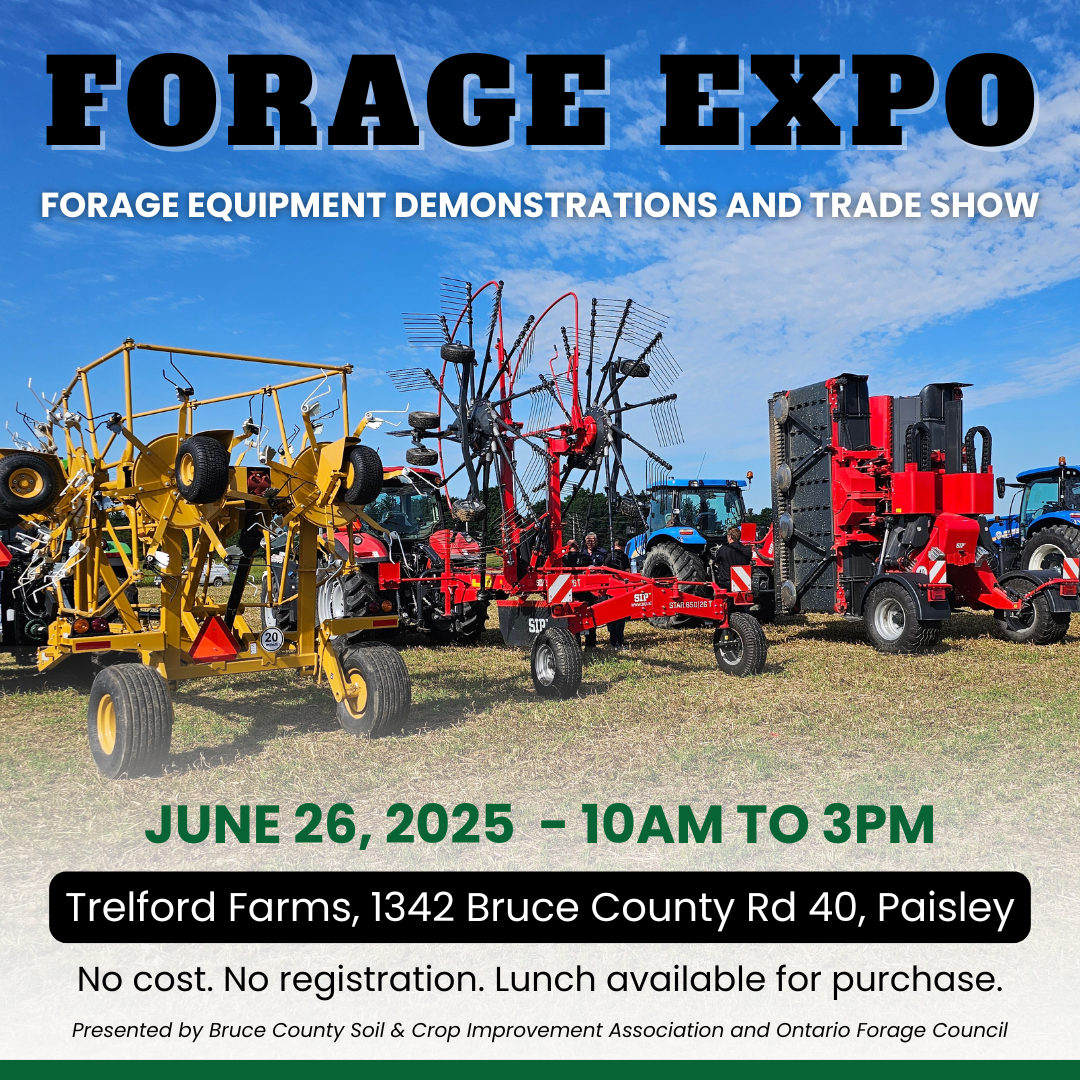
OFC and Bruce County Soil & Crop Improvement Association are pleased to announce that Forage Expo will happen in Bruce County this year. The event will be held on June 26, 2025 from 10 a.m. to 3 p.m. at Craig Trelford and family’s Trelford Farms, 1342 Bruce County Rd 40, Paisley.
Forage Expo is the must-attend event for anyone serious about forage production. This year’s
demonstrations will feature top-tier equipment from the industry’s leading manufacturers, giving
attendees an exclusive look at the latest innovations hitting the market.
More than just a showcase, Forage Expo offers head-to-head field trials where you’ll see the newest forage tools in action. From mowers and conditioners to rakes, tedders, mergers, balers and more, every piece of equipment is geared toward one thing: helping producers harvest faster, smarter and with better results.
Producers will also have direct access to trusted experts Ian McDonald and Christine O’Reilly from the Ontario Ministry of Agriculture, Food and Agribusiness (OMAFA), who will be on-site and in the field, offering insights and answering questions.
Whether you’re looking to improve efficiency, reduce harvest losses or boost forage quality and
profitability, Forage Expo 2025 is the place to see the future of forage production. This is a FREE event and no registration is required. Lunch will be available for purchase on-site.
Visit the Forage Expo website for more information. Learn more about OFC here.
| | OFC's Profitable Pastures replays | | |
Profitable Pastures replays are now available on the OFC's YouTube Channel. Don’t miss these excellent presentations that will help you get the most out of your pastures.
| | Provincial Member News: Saskatchewan | | |
CFGA hosts grazing plan workshops in Wadena and Nokomis, Saskatchewan
With the hint of spring in the air, it was a pleasure to connect with local producers in Wadena, SK and Nokomis, SK, in April to work on their grazing plans.
The mornings began with a brief introduction of the Canadian Forage and Grassland Association (CFGA) and the On-Farm Climate Action Fund (OFCAF) program by Cindy Green, the new SK grazing coordinator. This set the stage for Ralph Corcoran, a CFGA mentor, to share why he chose rotational grazing for his operation. Drawing from real-world experience, Corcoran helped producers understand the science behind rotational grazing and why it is a valuable practice to adopt. He then introduced the holistic management grazing plan and walked the group through working on the formulas. While the math can be tricky at first, it starts to make sense with a bit of practice.
After a delicious lunch break, participants returned to their grazing plans and made those numbers work. Once the producers felt comfortable with drawing a grazing plan for their operation, and completing the chart, Green returned to provide a more detailed overview of the OFCAF program. She clearly explained how to apply and walked through each step of the process.
“Producers left the meeting feeling refreshed, inspired and ready to put their grazing plans into action,” said Green. ”In person gatherings like this are incredibly valuable for local producers, offering an opportunity to grow their knowledge and understanding of rotational grazing in a hands-on, supportive setting.”
Beyond the practical knowledge gained, these events encourage connections with like-minded individuals who share similar goals and challenges on their operations. The relationships built during these sessions become a support network and can provide advice, encouragement and collaboration long after the meeting ends. These connections can make all the difference during the tough seasons and help drive long-term success on the land.
These events were delivered in part by Canadian Forage and Grassland Association (CFGA) and Farmers for Climate Solutions and the FaRM program.
| | |
Calendar of Events
At the time this newsletter was distributed, all event times and locations were accurate, but please check event websites for the most current information. Some events may have been postponed or cancelled.
| | | | |