|
Cedric MacLeod
From the executive director's desk
| |
As summer continues to unfold across our diverse Canadian landscapes, I’m inspired by the resilience and innovation that define our forage and grassland sector. From coast to coast, producers, researchers and industry partners continue to demonstrate the critical role forage systems play in sustainable agriculture, carbon sequestration and biodiversity.
This season, the CFGA remains busy advancing several key initiatives. Our team continues to deliver the On-Farm Climate Action Fund (OFCAF), supporting producers in adopting rotational grazing practices that build soil health, boost biodiversity and cut greenhouse gas emissions. These aren’t just good ideas. They’re practical, boots-on-the-ground solutions that are making a real difference. We’re also expanding our mentorship network and are investing in new educational tools for producers and extension professionals. When we share knowledge, we grow stronger together.
Planning is in full swing for the 2025 CFGA Conference, happening this November in Fredericton, New Brunswick. This year’s theme, Greener Horizons: Technological Innovations in Forage and Grassland Management, will spotlight the tools and techniques shaping the future of sustainable agriculture. We’re proud to be working alongside our provincial member, the New Brunswick Soil and Crop Improvement Association, to build a program that reflects the depth and diversity of our sector. Trust me, you won’t want to miss it. We’re rolling out the East Coast welcome mat!
Collaboration is the heartbeat of our work. Whether it’s through regional workshops, national gatherings or digital platforms, the CFGA is here to connect, amplify and support the voices of those working on the land. Whether you’re managing pastures, crunching data or advocating for better land use policy, your work matters.
- Cedric MacLeod
| | |
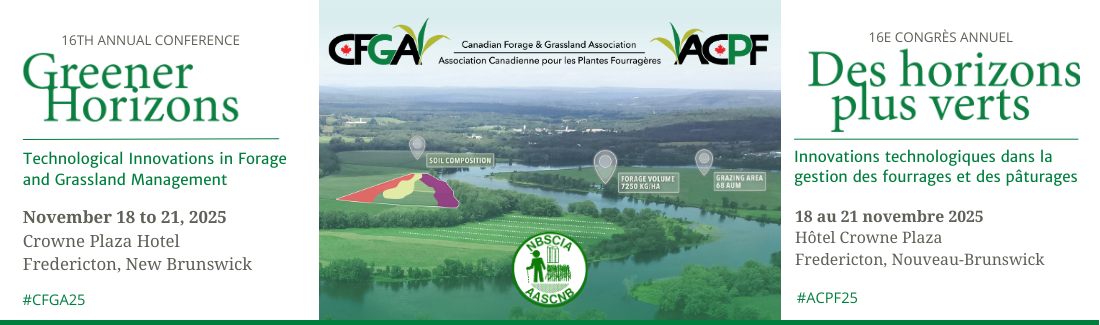
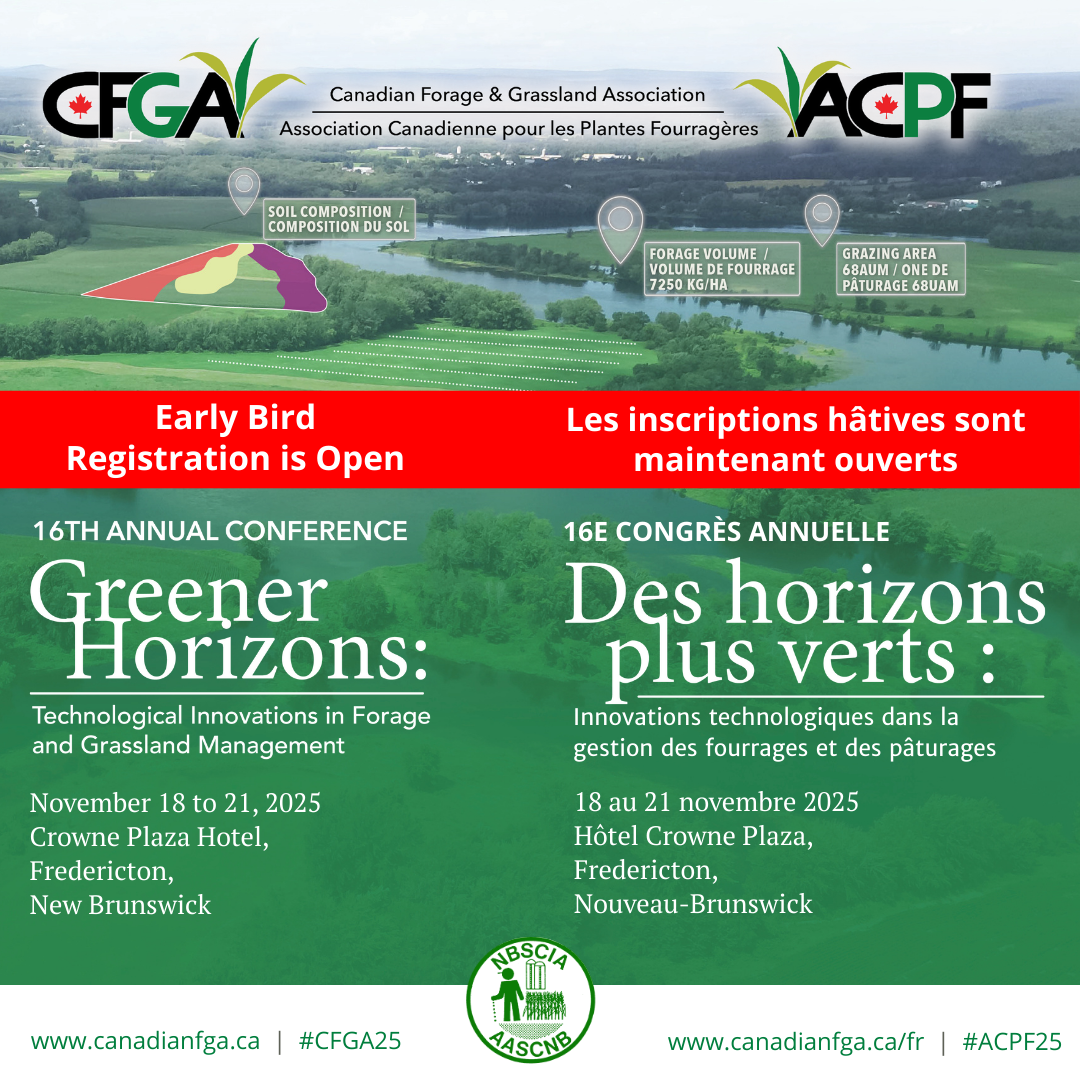
Early bird registration open for 2025 CFGA Annual Conference
The Canadian Forage and Grassland Association (CFGA) has launched early bird registration for its 16th annual conference. Organized in partnership with the New Brunswick Soil and Crop Improvement Association (NBSCIA), this year’s conference will take place at the historic Crowne Plaza Hotel in Fredericton, New Brunswick, Nov. 18 to 21.
With the theme Greener Horizons: Technological Innovations in Forage and Grassland Management, this year’s conference will highlight the cutting-edge advancements shaping the future of sustainable agriculture.
The CFGA conference has become the not-to-be-missed event for producers, agronomists, researchers and industry leaders in the forage and grassland sectors. Whether you're interested in precision agriculture, soil health, climate resilience or looking to explore new technologies in forage and grassland management, this conference offers valuable insights, networking opportunities and hands-on learning experiences.
Pre-conference workshops
The event kicks off on Nov. 18 with concurrent pre-conference workshops and seminars. The first one will include on high-level discussion and collaboration around grassland sustainability efforts. This will include ongoing research into barriers and opportunities for growth current CFGA projects are encountering. This is a closed, invitation-only seminar, but those interested can reach Kaylee Healy at communications@canadianfga.ca to discuss potential participation once further details are released later this summer.
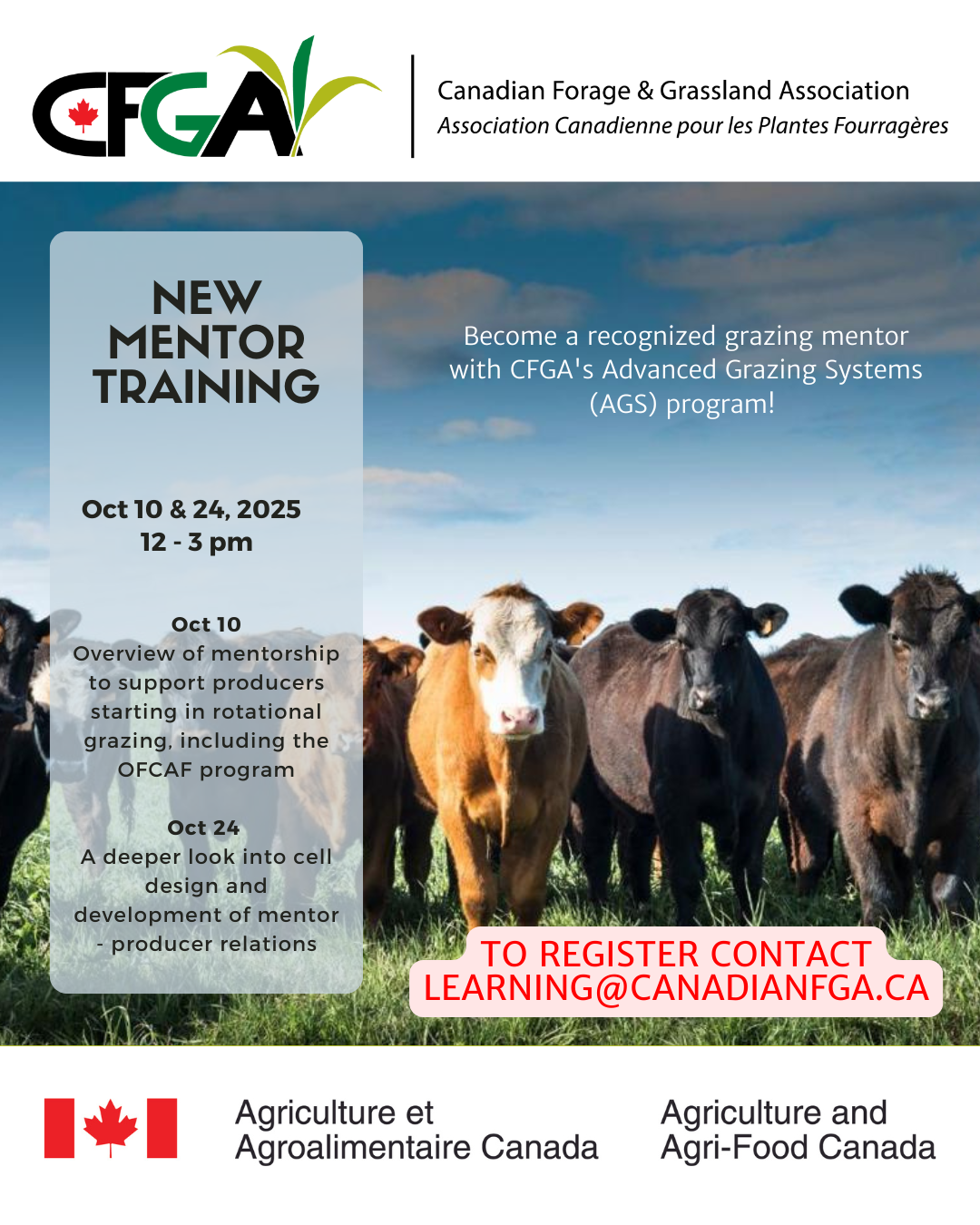
The second workshop will focus on leadership in advanced grazing to equip experienced rotational grazers and grazing extension specialists with strategies, tools and applied expertise to help them drive sustainable land management and advanced rotational grazing practices through mentorship in their communities. The day will include an overview of what AGS is along with discussion on various skills grazing mentorships need and a high-level cell-design segment that integrates advanced considerations and concepts. Those interested in attending this session will be able to find more details and register on the CFGA website.
Expert-led sessions
Two full days, Nov. 19 and 20, will be dedicated to presentations by industry leaders speaking on the themes including smart tech and digital agriculture; pasture systems; grassland and pasture management; forage production and storage; and market trends. Attendees are sure to gain valuable knowledge from leading experts, researchers and agronomists.
Networking opportunities
Attendees will have ample opportunity to connect with industry professionals, farmers and policymakers to exchange ideas and build partnerships during the many conference events and activities including the welcome reception on Nov. 18, an industry tradeshow and the annual CFGA Leadership Award dinner.
Early bird registration open
Take advantage of early bird registration and register today on the CFGA website. Follow the CFGA Facebook, Instagram and X accounts for updates on speakers, schedules and special events as they become available.
| | |
L’inscription anticipée au congrès annuel 2025 de l’ACPF est maintenant possible.
L’Association canadienne pour les plantes fourragères (ACPF) a lancé sa période d’inscription anticipée pour son 16e congrès annuel. Organisé en partenariat avec l’Association pour l’amélioration des sols et des cultures du Nouveau-Brunswick (AASCNB), le congrès de cette année aura lieu à l’hôtel historique Crowne Plaza à Fredericton, au Nouveau-Brunswick, du 18 au 21 novembre.
Sous le thème Des horizons plus verts : Innovations technologiques dans la gestion des fourrages et des pâturages, le congrès de cette année mettra en lumière les avancées de pointe qui façonnent l’avenir de l’agriculture durable.
Le congrès de l’ACPF est devenu un événement incontournable pour les producteurs, les agronomes, les chercheurs et les chefs de file de l’industrie dans les secteurs du fourrage, des pâturages et des prairies. Que vous vous intéressiez à l’agriculture de précision, à la santé des sols, à la résilience climatique ou que vous cherchiez à explorer de nouvelles technologies en matière de gestion du fourrage et des pâturages, ce congrès vous offre des informations précieuses, des occasions de réseautage et des expériences d’apprentissage pratiques.
Ateliers précongrès
L’événement débutera le 18 novembre par des ateliers et des séminaires précongrès simultanés. Le premier portera sur une discussion de haut niveau et une collaboration autour des efforts de durabilité des prairies. Nous parlerons notamment de la recherche permanente sur les obstacles et les possibilités de croissance que rencontrent les projets actuels de l’ACPF. Il s’agit d’un séminaire fermé, accessible uniquement sur invitation, mais les personnes intéressées peuvent contacter Kaylee Healy à l’adresse communications@canadianfga.ca pour discuter d’une éventuelle participation dès que de plus amples détails seront disponibles à la fin de l’été.
Le deuxième atelier portera sur le leadership en matière de pâturage avancé afin de doter les éleveurs expérimentés pratiquant le pâturage en rotation et les spécialistes de la vulgarisation du pâturage de stratégies, d’outils et d’une expertise appliquée pour les aider à promouvoir une gestion durable des terres et des pratiques avancées de pâturage en rotation grâce à un mentorat au sein de leurs communautés. La journée comprendra une présentation générale du SPA, une discussion sur les différentes compétences nécessaires aux mentors en matière de pâturage et un segment de haut niveau sur la conception de cellules intégrant des considérations et des concepts avancés. Les personnes intéressées par cette session pourront obtenir plus de détails et s’inscrire sur le site web de l’ACPF.
Sessions animées par des experts
Les deux journées complètes du 19 et 20 novembre seront consacrées à des présentations par des leaders de l’industrie sur des thèmes tels que les technologies intelligentes et l’agriculture numérique, les systèmes de pâturage, la gestion des prairies et des pâturages, la production et le stockage du fourrage, et les tendances du marché. Les participants sont assurés d’acquérir des connaissances précieuses auprès d’experts, de chercheurs et d’agronomes de premier plan.
Possibilités de réseautage
Les participants auront de nombreuses occasions de rencontrer des professionnels de l’industrie, des agriculteurs et des décideurs afin d’échanger des idées et d’établir des partenariats au cours des nombreux événements et activités du congrès, notamment la réception de bienvenue le 18 novembre, un salon professionnel et le souper annuel de remise des prix du leadership de l’ACPF.
Début de l’inscription anticipée
Profitez de l’inscription anticipée et inscrivez-vous dès aujourd’hui sur le site web de l’ACPF. Suivez les comptes Facebook, Instagram et X de l’Association pour obtenir des mises à jour sur les conférenciers, les horaires et les événements spéciaux dès qu’elles seront disponibles.
| | |
Advanced Grazing Systems
The CFGA’s Advanced Grazing Systems Course is now available in French!
The Canadian Forage and Grassland Association (CFGA) has launched its popular Advanced Grazing Systems (AGS) course in French. Originally developed in 2022, and updated in 2024, the AGS course aims to provide producers across Canada with an introductory understanding of the concepts of rotational grazing and to support them in applying these concepts to their farming operations. The course was developed with the help of forage and grazing experts across the country and in partnership with Agriculture and Agri-Food Canada (AAFC) through the On-Farm Climate Action Fund (OFCAF) and Farmers for Climate Solutions (FCS).
Incorporating a blended-learning model, the course offers a comprehensive learning curriculum that supports producers in learning core grazing principles and in developing a rotational grazing plan that is relevant to their operation. All course content can be downloaded for future reference and the course offers additional rotational grazing resources and a rotational grazing plan template. Effective delivery of the program is made possible by working closely with provincial forage associations across the country to provide their nuanced provincial insight on region-specific practices.
The course is delivered through a mobile-friendly learning platform so producers can learn and reference information wherever they are and when they have the time. It creates opportunities for producers to learn on their own or to connect with other farmers learning the same materials. It also offers many opportunities to ask questions of mentors and other rotational grazing experts and practitioners.
The AGS course is now available in both English and French through the CFGA’s LMS and can be accessed on a cell phone, tablet, computer desktop or through the Canvas App. People can access the content as a producer or as a mentor as one component of CFGA’s Grazing Mentorship Program training.
The CFGA is also developing targeted subject matter sub-courses to further round out a producer’s expertise in region- or industry-specific approaches to advance
ed grazing systems. Two of these sub-courses will be released later this month: the Advanced Grazing Systems for Dairy sub course, which focuses on applying rotational grazing concepts to dairy operations, and the Advanced Grazing Systems – Rotational Grazing in Brown Soil Landscapes sub course, which provide producers with an introductory understanding of the brown soil zone and the management considerations associated with it.
For additional information visit the CFGA AGS webpage or email learning@canadianfga.ca.
| | |
Gestion avant-gardiste des pâturages
Le cours « Gestion avant-gardiste des pâturages » de l’ACPF est maintenant disponible en français !
L’Association canadienne pour les plantes fourragères (ACPF) a lancé son populaire cours sur la Gestion avant-gardiste des pâturages (GAGP) en français. Élaboré à l’origine en 2022 et mis à jour en 2024, le cours GAGP vise à fournir aux producteurs de tout le Canada une compréhension de base des concepts du pâturage en rotation et à les soutenir dans l’application de ces concepts à leurs activités agricoles. Le cours a été élaboré avec l’aide d’experts en fourrage et en pâturage de tout le pays et en partenariat avec Agriculture et Agroalimentaire Canada (AAC) par l’entremise du Fonds d’action à la ferme pour le climat (FAFC) et de Fermiers pour la transition climatique (FTC).
Intégrant un modèle d’apprentissage mixte, le cours offre un programme d’apprentissage complet qui aide les producteurs à apprendre les principes fondamentaux du pâturage et à élaborer un plan de pâturage en rotation adapté à leur exploitation. Tout le contenu du cours peut être téléchargé pour référence ultérieure et le cours offre des ressources supplémentaires sur le pâturage en rotation et un modèle de plan de pâturage en rotation La mise en œuvre efficace du programme est rendue possible par une collaboration étroite avec les associations provinciales de producteurs de fourrage de tout le pays, qui apportent leurs connaissances provinciales nuancées sur les pratiques propres à chaque région.
Le cours est dispensé par l’intermédiaire d’une plateforme d’apprentissage mobile et conviviale, de sorte que les producteurs peuvent apprendre et consulter les informations où qu’ils soient et quand ils en ont le temps. Les producteurs ont ainsi la possibilité d’apprendre seuls ou d’entrer en contact avec d’autres agriculteurs qui apprennent la même chose. Le cours offre également de nombreuses possibilités de poser des questions à des mentors et à d’autres experts et utilisateurs du pâturage en rotation.
Le cours GAGP est maintenant disponible en anglais et en français par l’entremise du LMS de l’ACPF et peut être consulté sur un téléphone cellulaire, une tablette, un ordinateur de bureau ou par l’entremise de l’application Canvas. Les personnes peuvent accéder au contenu en tant que producteur ou en tant que mentor dans le cadre de la formation du programme de mentorat en pâturage de l’ACPF.
L’ACPF développe également des sous-cours thématiques ciblés pour compléter l’expertise d’un producteur dans des approches spécifiques à une région ou à un secteur de l’industrie en matière de gestion avant-gardiste des pâturages. Deux de ces sous-cours seront disponibles plus tard ce mois-ci : le sous-cours Gestion avant-gardiste des pâturages pour les exploitations laitières, qui met l’accent sur l’application des concepts de pâturage en rotation aux exploitations laitières, et le sous-cours Gestion avant-gardiste des pâturages - Pâturage en rotation dans les paysages de terre brune, qui offre aux producteurs une introduction à la zone de terre brune et aux considérations de gestion qui s’y rattachent.
Pour plus d’informations, visitez la page web de l’ACPF sur le cours GAGP ou écrivez à learning@canadianfga.ca.
| | |
Grassland Learning and Knowledge Hub (GLKH)
Latest news about GLKH
CFGA team members are busy with the Grassland Learning and Knowledge Hub (GLKH), a five-year research project in partnership with the University of Alberta, Ducks Unlimited Canada and the Restore Assert Defend (RAD) Network. The area of focus is on the Canadian grasslands in Alberta, Saskatchewan and Manitoba, with the project aims of contributing to climate change mitigation and habitat conservation through five key objectives: economics, human dimensions, grassland policy, grassland natural climate solutions, community of practice and learning and knowledge transfer plan.
CFGA virtual project launch
The CFGA hosted a virtual webinar on March 25, 2025, to celebrate the launch of the GLKH project. The hour-long event included a presentation by John Pattison-Williams from the University of Alberta, to provide an overview of the project and overall goals; a panel with the partner organizations and an opportunity for attendees to ask questions. Recordings are available in English and French.
Stay up to date
Check out the GLKH webpage and sign-up for the quarterly newsletter and to receive news from the project partners.
| | Provincial Member News: Alberta | | |
AFIN announces closure and transfer of representation to ARECA
The Alberta Forage Industry Network (AFIN) announced the closure of its operations effective June 30, 2025, as well as the transfer of its responsibilities for representing the Alberta forage industry to the Agricultural Research & Extension Council of Alberta (ARECA).
Read the media release.
| | Provincial member news: B.C. Forage Council (BCFC) | | |
B.C. Forage Council releases new resource for producers
The B.C. Forage Council has released a new tool for producers. The Grazing Response Index (GRI) is a practical monitoring tool that puts immediate, actionable feedback directly in producers’ hands. It helps livestock producers evaluate how their current season's grazing management affects plant health by assessing three critical factors: grazing frequency, intensity and opportunity for regrowth. Unlike traditional monitoring methods that require external expertise, this simple scoring system allows you to quickly identify what's working and what needs adjustment in your grazing practices.
The BCFC is providing hands-on demonstration of the GRI at their pasture walks this summer season. During the pasture walk, producers will see the GRI method in action and learn how small, economically productive changes - like adjusting cattle movement patterns or adding temporary fencing - can significantly improve pasture health and livestock productivity.
Originally developed for native rangelands and adapted for tame forages, the GRI provides the real-time information needed for adaptive management that prevents gradual forage degradation.
A comprehensive GRI booklet will be available at various events - free for BC Forage Council members and $15 CAD for non-members.
The BCFC will host a pasture walk in Vavenby, B.C., with producer Joseph Moilliet and mentor Mike Witt, Sept. 13, 2025. Register here. Don’t miss this opportunity to add this powerful monitoring tool to your grazing management toolkit and gain the confidence to implement this science-based tool on your own operation.
| | Provincial member news: Conseil québécois des plantes fourragères (CQPF) | | |
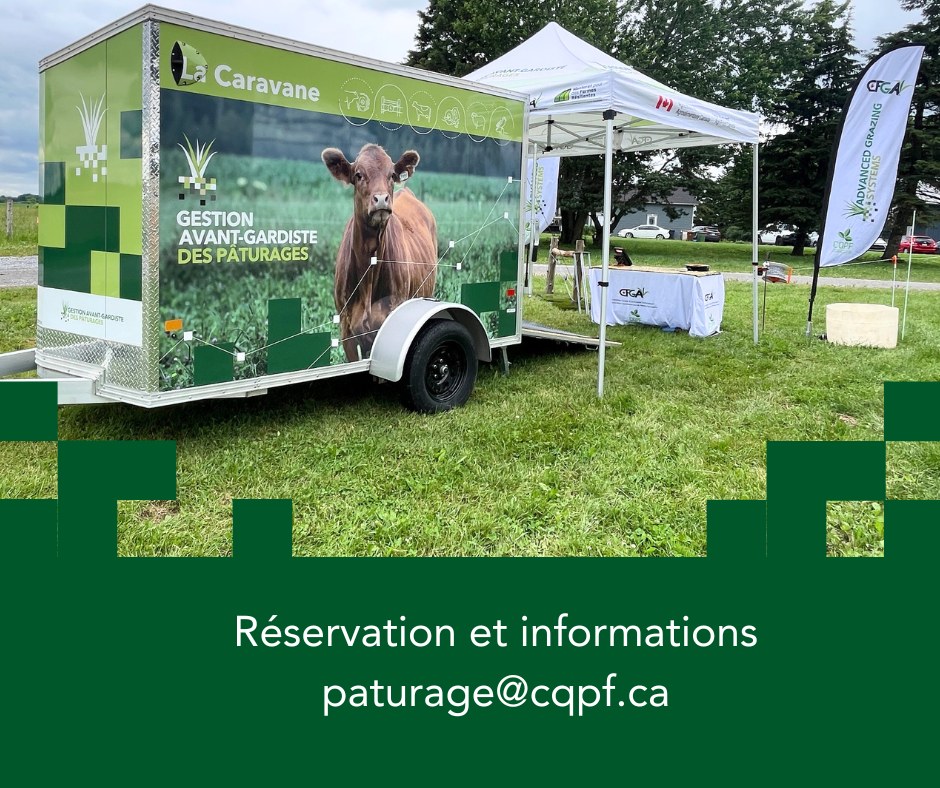
La Caravane des pâturages : un mouvement qui rallie et inspire
Une initiative du CQPF appuyée par le FAFC
La Caravane des pâturages est une idée originale du Conseil québécois des plantes fourragères (CQPF). Depuis son lancement, elle sillonne les régions du Québec pour aller à la rencontre des producteurs et productrices. Plus qu’une tournée technique, la Caravane se veut un mouvement rassembleur qui rapproche la science, la pratique et la passion du pâturage.
Son déploiement a été rendu possible grâce au financement initial du programme Fermiers pour la transition climatique. Aujourd’hui, elle poursuit sa route grâce au Fonds d’action à la ferme pour le climat (FAFC), dont le Conseil canadien des plantes fourragères (CFGA) assure l’administration nationale. Au Québec, c’est le CQPF qui agit comme partenaire provincial pour mettre en œuvre le programme et assurer son déploiement auprès des producteurs.
Des fermes hôtes comme vitrines vivantes
Chaque arrêt de la Caravane se tient dans une ferme hôte, offrant aux participants l’occasion d’observer concrètement les aménagements en place : systèmes d’abreuvement, clôtures permanentes ou temporaires, organisation des rotations ou encore modes de distribution du fumier. Ces visites transforment chaque ferme en laboratoire à ciel ouvert, où les démonstrations pratiques facilitent les échanges et donnent vie aux notions théoriques.
Favoriser le partage et le réseautage
L’un des atouts majeurs de la Caravane réside dans le maillage qu’elle crée. Producteurs, productrices, agronomes et conseillers s’y retrouvent pour partager expériences, réussites et défis. Les ateliers abordent des thèmes variés : période de repos optimale des prairies, intégration de fourrages diversifiés pour accroître la résilience, stratégies d’abreuvement adaptées aux troupeaux ou encore organisation des rotations. Ces échanges adaptés aux réalités régionales permettent à chacun de repartir avec des outils pratiques et des idées concrètes.
Les pâturages : un atout collectif
Au-delà des aspects techniques, la Caravane rappelle que les pâturages représentent bien plus qu’une source alimentaire économique. Ils contribuent au maintien de paysages vivants, à l’amélioration de la santé des sols, au stockage de carbone et à la biodiversité. Leur valorisation s’inscrit donc autant dans la rentabilité des fermes que dans les objectifs collectifs de durabilité.
Une dynamique qui dépasse les clôtures
La forte participation observée dans les différentes étapes de la Caravane témoigne de l’intérêt grandissant pour ces pratiques. Pour plusieurs producteurs, c’était l’occasion de valider leurs choix, de découvrir de nouvelles avenues et de renforcer leurs liens avec d’autres passionnés.
En somme, la Caravane des pâturages illustre parfaitement la force de la collaboration et l’élan collectif vers une agriculture plus résiliente. Chaque arrêt, chaque discussion et chaque échange plantent une graine de changement qui continuera de grandir dans les prairies du Québec. Et c’est sur ce terreau fertile, nourri par la passion et l’innovation, que se construit l’avenir des pâturages.
| | |
The Pasture Caravan: a movement that unites and inspires
An initiative of the CQPF supported by OFCAF
The Pasture Caravan is an original idea of the Conseil québécois des plantes fourragères (CQPF). Since its launch, it has been traveling across Quebec to meet with producers. More than just a technical tour, the Caravan is a unifying movement that brings together science, practice, and a passion for grazing.
Its implementation was made possible thanks to initial funding from the Farmers for Climate Solutions (FCS). Today, it continues to move forward thanks to the On-Farm Climate Action Fund (OFCAF), which is administered nationally by the Canadian Forage and Grassland Association (CFGA). In Quebec, the CQPF acts as the provincial partner to implement the program and ensure its rollout to producers.
Host farms as living showcases
Each stop on the Caravan's journey takes place at a host farm, offering participants the opportunity to see the facilities in place for themselves: watering systems, permanent or temporary fencing, rotation schedules and manure distribution methods. These visits transform each farm into an open-air laboratory, where practical demonstrations facilitate discussion and bring theoretical concepts to life.
Promoting sharing and networking
One of the Caravan's major strengths lies in the network it creates. Producers, agronomists and advisors come together to share experiences, successes and challenges. The workshops cover a variety of topics: optimal rest periods for pastures, integrating diverse forages to increase resilience, watering strategies adapted to herds and rotation organization. These exchanges, tailored to regional realities, allow everyone to leave with practical tools and concrete ideas.
Pastures: a collective asset
Beyond the technical aspects, the Caravan reminds us that pastures are much more than just an economic source of food. They contribute to maintaining living landscapes, improving soil health, carbon storage and biodiversity. Their development is therefore as much a part of farm profitability as it is of collective sustainability goals.
A dynamic that transcends boundaries
The high level of participation observed at the various stages of the Caravan demonstrates the growing interest in these practices. For many producers, it was an opportunity to validate their choices, discover new avenues and strengthen their ties with other enthusiasts.
In short, the Pasture Caravan perfectly illustrates the power of collaboration and the collective momentum toward more resilient agriculture. Each stop, each discussion and each exchange plants a seed of change that will continue to grow in the prairies of Quebec. And it is on this fertile ground, nourished by passion and innovation, that the future of pastures is being built.
| | Provincial member news: New Brunswick Soil and Crop Improvement Association (NBSCIA) | | |
New Brunswick Soil & Crop Improvement Association (NBSCIA) August Update
Applications for the 2025-2026 On-Farm Climate Action Fund (OFCAF) 2-21 project year have closed. They will open again Jan. 1, 2026 and close again when funding is fully allocated for projects funded in the fiscal year ending March 31, 2027. New rotational grazing practices are funded under this program and details about eligible activities can be found on the New Brunswick Soil & Crop Improvement Association’s (NBSCIA) website.
Recently, Agriculture and Agri-Food Canada (AAFC) shared a few OFCAF success stories on their website, one of which featured local New Brunswick beef farmer Kevin Budd. Kevin was able to improve his rotational grazing system through support from AAFC’s OFCAF program under the rotational grazing beneficial management practice (BMP) element. Learn about his story and how the program supported his improved practices here.
| | Provincial member news: Ontario Forage Council | | |
New OFC board elected at AGM on June 26
The Ontario Forage Council (OFC) elected a new board of directors at its first public annual general meeting at Forage Expo in Bruce County on June 26, 2025. The board is made up of new and returning directors, who will provide leadership, experience and fresh perspectives.
The 2025-2026 board of directors are:
- Joe Dickenson (president)
- Travis Grubb (first vice-president)
- Michael Richards (second vice-president)
- Birgit Martin (past president)
- Kerrie Jenken
- Scott Fisher
- Jake Gregory
- Lawrence Levesque
- Brian Burnett
- Denise Byers
- Donna Hancock
- Christine O'Reilly
OFC staff offer their deepest gratitude to all outgoing board members as Terry Nuhn leaves the past president position and Birgit Martin moves from president to past president. Their dedication, guidance and support have been instrumental in the OFC’s progress. They thank them for their service, time and unwavering belief in the OFC’s vision. Together, with renewed energy and continued purpose, the OFC is excited to step into this next chapter with optimism and shared resolve.
| | |
A rainy and successful Forage Expo in the books
A sunny sky and warm temps were on the menu for Forage Expo – on set-up day. By the morning of the event, it was cold and windy and then the rain started. Too much rain to hold demonstrations in the field, but not enough rain to dampen spirits.
Attendees were able to get even more time with equipment reps as we went through the line-up of equipment and had a thorough look at each piece. It was once again a fantastic chance to see the latest equipment on offer to suit a variety of needs.
Exhibitors had everything from coffee to beverages to ice cream on offer for attendees and though the weather made it necessary to hide under tents at times, everyone was blown away with the support of attendees and exhibitors alike. There were smiles everywhere, despite the wet weather. Thank you to everyone involved in making this day a big success!
| | |
Funding announced for sustainable grazing lands to help cattle farmers stay competitive
The governments of Canada and Ontario are investing up to $5 million to help make community grazing pastures in Ontario more productive and resilient. To support the Ontario government’s plan to protect Ontario, this funding will help strengthen Ontario’s agriculture and agri-food sector by helping cattle farmers improve the quality of shared community pasture lands for their herds so they can stay competitive and resilient to withstand economic uncertainly.
The Community Pastures Initiative, funded through the Sustainable Canadian Agricultural Partnership (Sustainable CAP), will provide funding to eligible community pastures so they can adopt best management practices and technologies that boost the quality of these lands for grazing animals, while also enhancing biodiversity and strengthening soil health for the long-term.
The Initiative will be administered by the Ontario Forage Council, working with the Association of Community Pastures to deliver the program and support the co-development of eligible projects.
“The Ontario Forage Council and its Board of Directors are proud to deliver the Community Pastures Initiative as part of the Resilient Agricultural Landscape Program,” says Patricia Ellingwood, OFC’s general manager. “This initiative will provide us the opportunity to work side by side with community pastures to identify and implement beneficial management practices that will support the long-term resiliency of the lands and ensure Ontario’s community pastures remain viable contributors to Ontario’s agri-food sector.”
Funding amounts will vary based on project, with up to 100 per cent of eligible costs covered for the design, construction and maintenance of projects such as:
- rotational grazing
- improving pasture quality by planting resilient perennial forage crops
- permanent grasslands (including forage)
- riparian buffers and pollinator habitats
- management of at-risk natural features
- tree buffers and shelterbelts
- integrated tree, forage and livestock grazing systems
- wetlands, water retention and runoff control
More information, including how to apply, will be available through the OFC’s website.
| | Provincial news: Saskatchewan | | |
CFGA hosts demo site tour at RM 3 Enniskillen
By Cindy Green, CFGA Saskatchewan grazing coordinator
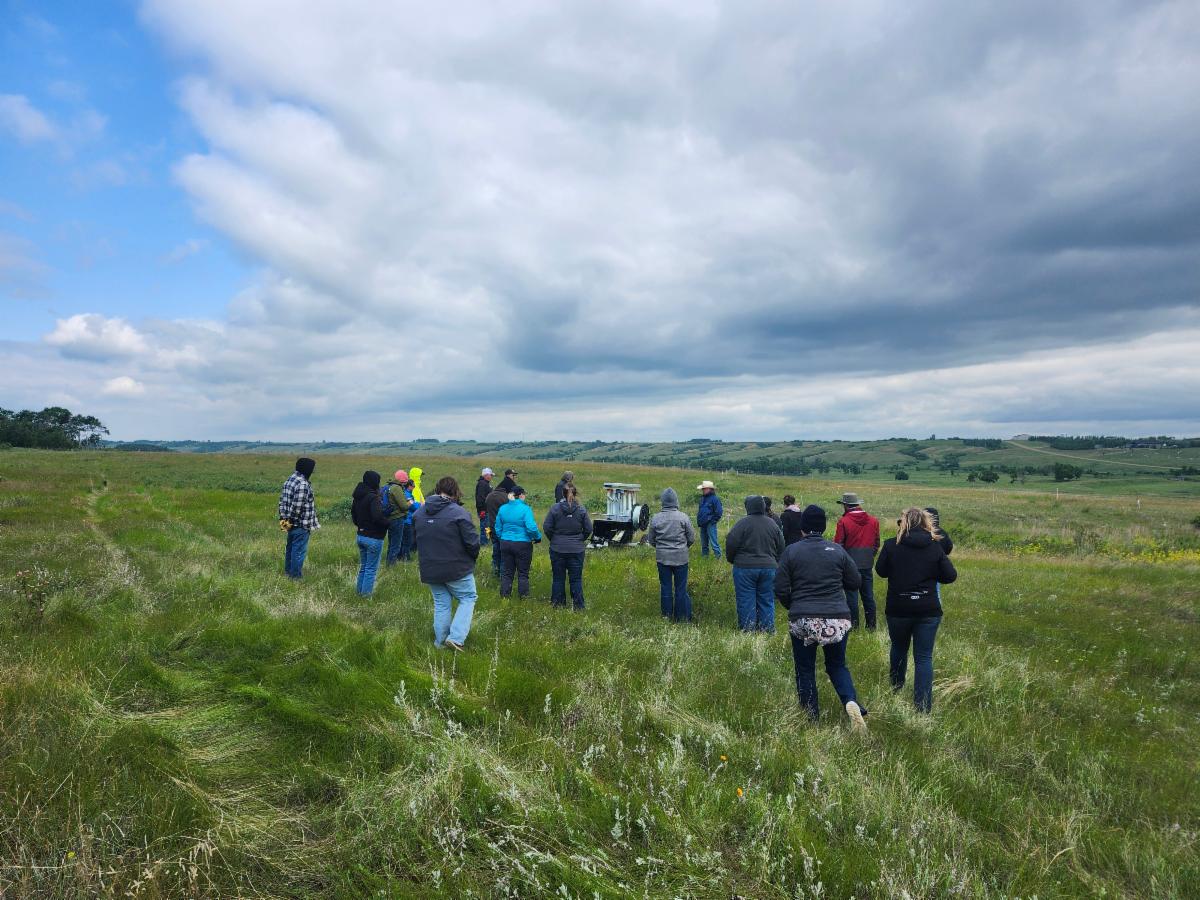
On June 23, producers and industry specialists gathered at the Canadian Forage and Grassland Association’s (CFGA) RM 3 Enniskillen demonstration site to explore forage volume and productivity. This site hasn’t had cattle on it for two years, making it the perfect opportunity to collect baseline data. As monitoring the area continues, the data will demonstrate the long-term benefits of rotational grazing.
Previous to the field day, Holistic Management Canada visited the site for a day to do an ecological outcome verification (EOV) to monitor the site and conduct baseline testing. Dana Penrice from Holistic Management Canada demonstrated how EOV assessments are done and what tests they perform. Participants enjoyed a walkthrough of the site with a plant identification session to help them better understand local species and examine different aspects of the site. The EOV package produced includes a detailed map of the site, a score of ecological health indicators, site photos, soil samples, forage quantity and forage quality.
Jesse Lawrence with Broken Arrow Consulting Inc. added a high-tech layer to the day. Prior to the event, Jesse flew a drone equipped with special sensors to collect normalized difference vegetation index (NDVI) data. This is used to assess plant health and density. He also layered this data with satellite imagery, allowing for a detailed, big-picture view of the site. By combining both types of imagery, participants saw how technology can enhance understanding land conditions from a birds-eye view.
To round out the day, Luke from the Saskatchewan Ministry of Ag led a session on how to perform a rangeland health assessment. Using the Ministry’s workbook, participants learned how to evaluate land condition and identify where it falls on the rangeland health spectrum, gaining practical skills to assess and monitor pasture health over time. This practical guide offers producers a powerful tool to assess and track the impacts of their grazing strategies over time.
Neil from Rangeward was also in attendance to provide a hands-on look at the Rangeward Razer Grazer. As there was a Razer Grazer on site, participants had the chance to see a temporary fence built from start to finish and to experience the ease of use firsthand. Neil also highlighted the versatility of the Razer Grazer, explaining how it can be adapted for use with multiple livestock species. This flexibility is particularly valuable as the CFGA is funding projects this year involving livestock other than cattle.
The RM 3 Enniskillen demonstration site is shaping up to be an exciting long-term project that blends science, technology and producer knowledge. The RM council has great members on board that are excited to showcase the site and use it as a learning tool. On May 12, they had the pleasure of having over 70 students attend the site and learn about rotational grazing, plant ID and invasive species, watersheds and water testing, soil sampling, holistic management practices and the CFGA.
We look forward to getting cattle on the land and seeing how rotational grazing continues to improve the health of soil in seasons to come.
| | |
R.M. 3 Enniskillen demo site wins provincial award
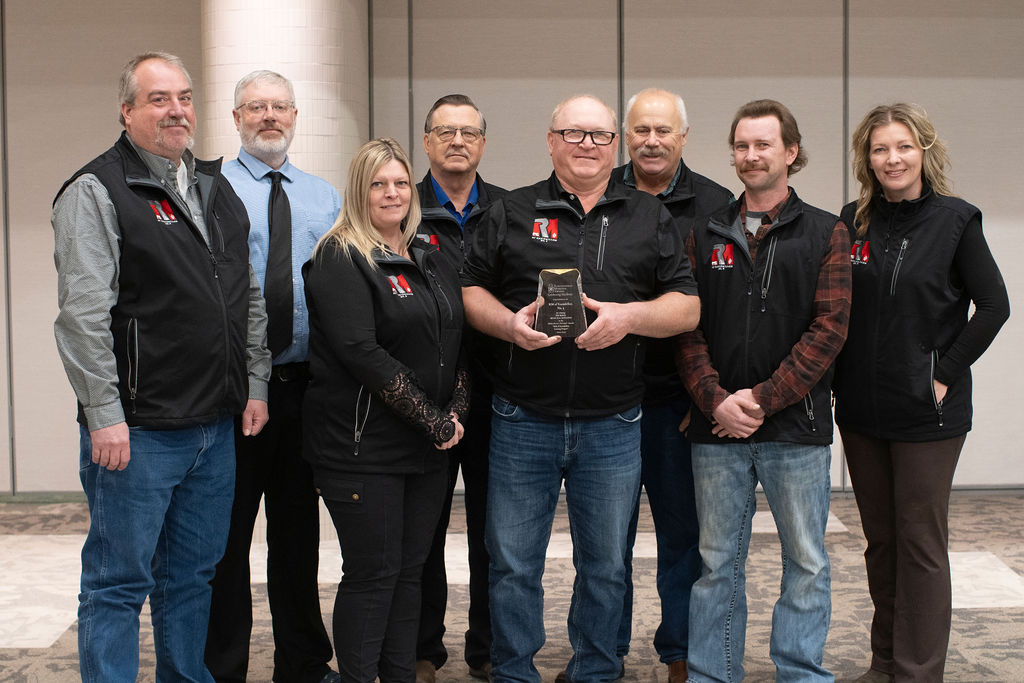
The R.M. 3 Enniskillen 3 demonstration site was the recipient of the Top Rural Municipal Initiative Award through Affinity CU Saskatchewan Municipal Awards.
Check out their grazing project video in partnership with the Government of Saskatchewan Resources and Grants and the CFGA here. The Saskatchewan Municipal Awards also shared a video about R.M. 3 Enniskillen winning the award here. Finally, learn more about the R.M. 3 Enniskillen demo site on the CFGA website.
| | |
The award was presented at the SARM Convention earlier this year. Pictured (l to r) are Reeve Trevor Walls, CFGA on-farm implementation lead Travis Quirk, Division 6 councillor Trina Randall, Division 2 councillor Cameron Nordin, Division 5 councillor Rae Wright, Division 4 councillor Shane Boyes, Foreman Matt Faber, Division 1 councillor Yvonne Douglas.
Missing from Photo - Division 3 councillor Ryan Nielsen, CAO Pamela Bartlett, CFGA’s Saskatchewan program coordinator Adrienne Hanson and certified HMI holistic management educator Ralph Corcoran.
| | |
Calendar of Events
At the time this newsletter was distributed, all event times and locations were accurate, but please check event websites for the most current information. Some events may have been postponed or cancelled.
| | | | |