|
Cedric MacLeod
From the executive director's desk
| |
This summer has been a powerful reminder of what we can achieve when we come together with a shared purpose. Across the country, producers, provincial forage organizations, researchers and partners are leaning into collaboration in ways that strengthen our sector and build real momentum. That spirit of connection has been at the heart of the CFGA’s work over the past few months.
In June, the CFGA team and provincial representatives gathered in Swift Current, Saskatchewan, to focus on inter‑provincial collaboration and the collective movement we’re building for Canada’s forage and grassland sector. More than a meeting, it was an opportunity to align priorities, deepen provincial ties and make significant progress on a national forage strategy that reflects the realities and ambitions of every region. The conversations were honest, productive and energizing, reinforcing how essential it is for us to move forward together.
We also had the opportunity to tour Grasslands National Park and Grant Ranch, experiences that grounded our discussions in the landscapes and legacy that define this sector. Standing on native prairie, learning from long‑time stewards and seeing conservation and ranching woven together in practice reminded us why this work matters. These landscapes are the foundation of our resilience, our sustainability and our shared future and being there underscored the responsibility we carry in advancing their care.
July brought another opportunity to connect as I joined the Canadian Cattle Association’s southern Alberta rangeland stewardship tour, highlighting sustainable ranching practices in recognition of the International Year of Rangelands and Pastoralists (IYRP). Engaging directly with beef producers, industry leaders, government representatives and the public helps ensure forage and grassland priorities remain visible and integrated across the broader agricultural landscape.
Stakeholder engagement has remained a major focus this season. In June, I presented to the House of Commons Standing Committee on Agriculture and Food, emphasizing the essential role forage and grassland systems play in Canada’s climate resilience and agricultural competitiveness. This month, I attended the Canadian Federation of Agriculture’s 2026 Summer Meeting and Policy Summit in Halifax, held alongside the annual Federal‑Provincial‑Territorial Ministers of Agriculture conference. These gatherings are critical to ensuring our sector’s voice is heard and reflected in national policy discussions.
The IYRP continues to be an important touchstone for our work, highlighting the global significance of Canada’s forage and grassland landscapes and the people who steward them. As we strengthen collaboration across provinces and advance a national forage strategy, the IYRP provides both momentum and a unifying framework, reinforcing that our efforts contribute to a broader international movement focused on healthy grasslands, thriving rural communities and long‑term ecological stewardship.
Together, these efforts reflect a sector that is connected, coordinated and committed to moving forward. I’m encouraged by the momentum we’re building and grateful for the leadership, collaboration and passion driving this work across Canada’s forage and grassland community. I look forward to continuing this work with all of you across Canada’s forage and grassland community.
| | |
CFGA Conference 2026 taking place in Calgary
Early bird registration is now open for the Canadian Forage and Grassland Association’s (CFGA) 17th Annual Conference, taking place Nov. 9 to 12, 2026, at the Best Western Calgary Plaza Hotel in partnership with the Agriculture Research and Extension Council of Alberta (ARECA).
Early bird pricing is available until 11 p.m. on Aug. 31 at the following rates:
- Full conference (week): $499
- One‑day pass: $245 Regular pricing begins Sept. 1, with full conference passes at $550.
Register here
With the theme Canadian Forage Systems: Designing for Durability, this year’s event brings together Canada’s forage and grassland community to explore resilience and long‑term system design. The agenda features two days of educational sessions, cutting‑edge research, practical grazing and forage management insights, and cross‑sector conversations linking science, policy and on‑the‑ground experience. Attendees will hear from Prairie innovators, discover tools that strengthen economic and environmental performance, and collaborate on building forage systems that can withstand climate, market and land‑use pressures.
The CFGA Annual Conference is a prime opportunity to connect with sector stakeholders, expand your knowledge, grow your network and spark new collaborations. It’s a gateway to Canada’s 70 million acres of forage and grassland production, the science behind it and the producers who steward these landscapes. In addition to the educational program, the 2026 conference includes farm tours, a trade show, workshops and extensive networking with more than 150 participants expected, including producers, suppliers, service providers, government representatives and industry leaders.
More details coming soon!
Watch the CFGA website, follow the CFGA on Facebook, X, Instagram and LinkedIn or subscribe to the CFGA quarterly newsletter to stay up to date.
| | |
Congrès 2026 de l’ACPF à Calgary
Les inscriptions anticipées sont désormais ouvertes pour le 17e congrès annuel de l’Association canadienne pour les plantes fourragères (ACPF), qui se tiendra du 9 au 12 novembre 2026 à l’hôtel Best Western Calgary Plaza, en partenariat avec le Conseil de la recherche et de la vulgarisation en agriculture de l’Alberta (ARECA).
Les prix réduits pour inscription anticipée sont valables jusqu’au 31 août à 23 h, aux tarifs suivants :
- Congrès complet (une semaine) : 499 $
- Accès à la journée : 245 $ Les tarifs réguliers s’appliquent à partir du 1er septembre, avec un prix de 550 $ pour l’accès complet au congrès.
Inscrivez-vous ici
Sous le thème « Systèmes fourragers canadiens : concevoir pour la durabilité », le congrès de cette année propose un programme dynamique réunissant la communauté canadienne du fourrage et des prairies afin d’aborder les questions de résilience et de conception de systèmes à long terme. Au programme : deux journées de sessions de formation, de recherches de pointe, de conseils pratiques sur le pâturage et la gestion fourragère, ainsi que des échanges intersectoriels reliant la science, les politiques et l’expérience de terrain. Les participants et participantes pourront écouter des innovateurs et innovatrices des Prairies, découvrir des outils qui améliorent les performances économiques et environnementales, et collaborer à la mise en place de systèmes fourragers capables de résister aux pressions liées au climat, au marché et à l’utilisation des terres.
Le congrès annuel de l’ACPF est une occasion unique de rencontrer les acteurs et actrices du secteur, d’approfondir vos connaissances, d’élargir votre réseau et de susciter de nouvelles collaborations. C’est une porte d’entrée sur les 70 millions d’acres de production fourragère et de prairies du Canada, sur la science qui les sous-tend et sur les producteurs et productrices qui assurent la gestion de ces terres. En plus des sessions de formation, le programme du congrès 2026 comprend des visites d’exploitations agricoles, un salon professionnel, des ateliers et de nombreuses occasions de réseautage avec plus de 150 participants et participantes attendu(e)s, parmi lesquels des producteurs et productrices, des fournisseurs, des prestataires de services, ainsi que des représentants et représentantes de nos gouvernements et des acteurs et actrices clés de l’industrie.
Plus d’informations à venir !
Consultez le site web de l’ACPF, suivez l’ACPF sur Facebook, X, Instagram et LinkedIn ou abonnez-vous au bulletin trimestriel de l’ACPF pour rester informé(e).
| | |
CFGA strengthens producer support
The CFGA is strengthening producer support this fall by pairing its national grazing mentorship training with its growing Advanced Grazing Systems (AGS) program. Together, these supports give producers the skills and the learning tools needed to build confident, practical grazing plans.
Fall 2026 mentorship training
The CFGA is proud to continue its national mentorship program by offering in‑person and online training, along with mentorship tools nationwide. These resources help producers grow their skills and adopt beneficial management practices that store carbon and reduce greenhouse gases.
Registration is now open for the next mentor training, which takes place virtually from noon to 3 p.m. Eastern on Sept. 9 and 23. The first session will cover the role of the mentor and mentorship skills, while the second session will take a deeper look at cell design and grazing plan development.
Training is delivered by CFGA program leads and subject experts, including learning development and extension specialists. Participants must complete the online Advanced Grazing Systems (AGS) course before attending the training. The course and training are free. Registration closes Aug. 31. Contact learning@canadianfga.ca to register.
AGS program expands learning options
The CFGA’s free AGS program continues to grow, offering producers across Canada practical, accessible training in rotational grazing. Available in both English and French through CFGA’s mobile‑friendly learning management system (LMS), the program provides an introductory yet comprehensive foundation in grazing principles that producers can apply directly to their operations.
To further support producers in applying rotational grazing within specific production systems and landscapes, the CFGA has introduced targeted subcourses that build on the foundational AGS content.
The first to join the program was the AGS for Dairy subcourse, which provides system‑specific guidance to help dairy farmers integrate rotational grazing into their operations. Developed with input from dairy producers and subject matter experts, the dairy module builds on AGS fundamentals and offers practical strategies tailored to dairy herd management and forage use.
Most recently, CFGA launched the Small Ruminant Rotational Grazing subcourse, designed specifically for sheep and goat producers. This eight‑hour program includes eight modules that explore stocking density, forage resource management, water systems, alternative grazing approaches, minerals and supplements, parasite management, working with dogs, fencing options and contract grazing scenarios. Each module blends articles, presentations, videos and reflective questions to help producers apply concepts directly to their flocks and herds.
Advanced grazing systems play a vital role in promoting biodiversity, sequestering carbon and improving the water cycle, and this new subcourse supports small ruminant producers in adopting practices that benefit both their animals and the landscape.
All AGS courses use a blended‑learning model that combines core concepts, practical tools and regionally informed guidance to help producers build a rotational grazing plan suited to their farm. All materials, including worksheets, templates and additional resources, can be downloaded for future reference. The course can be accessed on a phone, tablet, desktop computer or through the Canvas App, making it easy to learn wherever and whenever time allows. Producers can learn independently, connect with peers or engage directly with mentors and grazing experts through the CFGA’s Grazing Mentorship program.
Originally launched in 2022 and updated in 2024, the AGS program was developed with forage and grazing experts nationwide in partnership with Agriculture and Agri‑Food Canada (AAFC) through the On‑Farm Climate Action Fund (OFCAF) and Farmers for Climate Solutions (FCS). A key strength of the program is its close collaboration with provincial forage associations, whose regional expertise ensures producers receive insight tailored to local conditions, challenges and opportunities.
More info
Visit the CFGA’s Advanced Grazing Systems program webpage to learn more about the AGS program for mentors and producers and to register for the AGS course and Dairy and Small Ruminant subcourses.
| |
Catch up on CFGA’s latest work
The CFGA team has been busy, and our latest blogs showcase the work happening across Canada’s forage and grassland sector. Catch up on recent activities, stories and producer‑focused insights in the CFGA blog, where you’ll find updates on the following:
| |
The CFGA supports World Alfalfa Day
The CFGA was proud to support the inaugural World Alfalfa Day, which took place on Saturday, May 23. This global day recognizes the productive, environmental and scientific importance of alfalfa, long known as the queen of forages, while aiming to elevate its profile and highlight its essential role in sustainable agriculture around the world. Read more.
| |
CFGA‑supported work highlighted at Prairie Conservation Conference
Two CFGA‑supported projects took centre stage at this year’s Prairies Conservation and Endangered Species Conference, the premier meeting of scientists and conservation practitioners for prairie landscapes.
Grassland Learning and Knowledge Hub
The first came from the Grassland Learning and Knowledge Hub (GLKH) when a team of representatives presented an introduction to the workings of the GLKH in a paper titled "Broader Social Impacts of Conservation on Grassland Species.” The context was set within the extensive efforts of biophysical research and extension to attain the goal of grassland conservation, which continue to be beset with grassland degradation and conversion to annual crop fields.
Tomorrow’s Prairies
Next up were researchers from Tomorrow’s Prairies with Ronnie Drever and Alison Long from Nature United and Bronwyn Rayfield from Carleton University, presented in a special session on initial findings for biodiversity, grasslands classification and landscape modelling. Read more.
| |
CFGA participates in BC rangeland tour for IYRP
The CFGA joined ranchers, government representatives, conservation organizations and industry leaders June 2 at the ranch of David and Bob Haywood‑Farmer near Kamloops to celebrate the International Year of Rangelands and Pastoralists (IYRP) and discuss the opportunities and challenges facing British Columbia’s rangelands and grasslands. Read more.
| |
CFGA mentors mark the IYRP with a cross‑prairie learning tour
Blue skies, wide open spaces and rolling fields of grass greeted participants of the three-day CFGA mentor tour, celebrating the International Year of Rangelands and Pastoralists. Mentors and industry participants climbed on a bus in Regina and wound their way south to visit demonstration sites across Saskatchewan and Alberta. Read more.
| | |
Join us
Are you or your organization involved in IYRP initiatives and events? The CFGA is hosting bi-weekly Zoom meetings to bring together people and organizations interested in doing activities to celebrate IYRP. If you would like to join the meetings, please email info@canadianfga.ca.
| | Provincial member news: Conseil québécois des plantes fourragères (CQPF) | | |
Celebrate IYRP with the CQPF
Quebec is proudly joining the global celebration of the International Year of Rangelands and Pastoralists (IYRP) and the Quebec Forage Council (CQPF) is leading the way.
Throughout 2026, the CQPF and several partners will host a dynamic series of events featuring practical knowledge, on-farm learning opportunities, and discussions with experts. Whether you want to strengthen your grazing fundamentals or explore new approaches to pasture management, the CQPF’s IYRP program offers valuable opportunities for every producer.
Explore the full program (French only).
| | Provincial member news: New Brunswick Soil and Crop Improvement Association (NBSCIA) | | |
NBSCIA 2026 project funding
by Ray Carmichael, NBSCIA General Manager
The New Brunswick Soil and Crop Improvement Association (NBSCIA) has received funding for the following projects in 2026; NB2324-0027-Y4 - Agro-Environmental Clubs, NB2425-0045-Y3 NB Weather Monitoring & Mapping for Intensive Crop Management, NB2324-0090(Y3-Y4) Establishing Alfalfa with a Corn Companion Crop, NB2324-0184-Y4 Oat and Winter Wheat Cultivar Development, : NB2526-0011 (Y1 – Y3) – Impact of Starter Nitrogen in NB Soybean Production, and NB2425-0351-Y2 – Evaluation of Bio-strip Tillage in New Brunswick. NBSCIA has also applied to EARI for a project titled Establishing Cover Crops into Corn Using Aerial Drones.
Carleton County no-till Pilot project
par Andrew Sytsma
The NBSCIA is conducting a pilot project this year in Carleton County on no-tilling warm season annuals into naturalized forage stands this summer. Naturalized/native forage stands (consisting of cool-season species like timothy, redtop and bluegrass for example) typically experience a “summer slump” when conditions become hot and dry in July and August that significantly limits regrowth, as we all are familiar with. The theory behind introducing deep rooted and fast establishing annual species that tolerate or thrive in hot conditions is to supplement forage volume for the following grazing pass during the summer slump when the native stand has reduced regrowth in a relatively fast and low-cost way. Should it be successful, it could be of particular benefit in exceptionally dry years like last year where pasture regrowth was minimal.
Several different species and mixtures are being tested with three different seeding times and management strategies: planted following first cut silage in late June, heavy grazing in early July, and dry hay in early-mid July. The following species and mixtures were planted with a no-till drill shortly after harvest and grazing:
- Crimson clover
- Berseem clover
- Tillage radish
- Buckwheat
- Sorghum sudangrass/pearl millet/annual ryegrass mix
- McCain Soil Builder mix (sorghum sudangrass/oats/rapeseed/phacelia/tillage radish/yellow peas/black forage peas/sunflower/annual ryegrass)
- Legume overseed mix (double cut red clover, white clover, ladino clover, birdsfoot trefoil)
Each species was planted at a rate as if it were included in a mixture since we are not looking to replace the existing stand and to represent a low cost of seed, but we may find that we should have gone with higher rates. The legume overseed mix species are not necessarily warm-loving species but is included to test whether it is possible to establish the included species in the summer. It’s too early to tell if the extra forage will amount to anything meaningful or is economical, but as of writing about two weeks after planting, all species in the earliest planting date have emerged and are off to a good start. Special thanks to Quality Seed for donating seed and also to McCain Fertilizer and Hartland Agromart for providing seed as well and to our participating farm locations.
| | |
Financement du projet L'AASCNB 2026
Par Ray Carmichael, directeur général de l’AASCNB
L'AASCNB a obtenu un financement en 2026 pour les projets suivants : NB2324-0027-Y4 – Clubs agro-environnementaux, NB2425-0045-Y3 Surveillance et cartographie météorologiques au Nouveau-Brunswick pour la gestion intensive des cultures, NB2324-0090(Y3-Y4) Mise en place de la luzerne avec une culture associée de maïs, NB2324-0184-Y4 Développement de variétés d’avoine et de blé d’hiver, : NB2526-0011 (Y1 – Y3) – Impact des engrais de démarrage sur la production de soja au Nouveau-Brunswick, et NB2425-0351-Y2 – Évaluation du labour par bandes biologiques au Nouveau-Brunswick. L'AASCNB a également déposé une demande auprès de l’EARI pour un projet intitulé « Mise en place de cultures de couverture dans les cultures de maïs à l’aide de drones ».
Projet pilot - semer sans labour dans le comté de Carleton
par Andrew Sytsma
L'AASCNB mène cette année, dans le comté de Carleton, un projet pilote consistant à semer sans labour des espèces annuelles de saison chaude dans des peuplements fourragers naturalisés cet été. Les peuplements fourragers naturalisés ou indigènes (composés d’espèces de saison froide telles que la fléole des prés, le pâturin rouge et le pâturin des prés, par exemple) connaissent généralement un « ralentissement estival » lorsque les conditions deviennent chaudes et sèches en juillet et août, ce qui limite considérablement la repousse, comme nous le savons tous. L’idée derrière l’introduction d’espèces annuelles à racines profondes et à établissement rapide, qui tolèrent ou prospèrent dans des conditions chaudes, est de compléter le volume fourrager pour le prochain passage de pâturage pendant le ralentissement estival, lorsque la repousse du peuplement indigène est réduite, et ce de manière relativement rapide et peu coûteuse. En cas de succès, cette approche pourrait s’avérer particulièrement bénéfique lors d’années exceptionnellement sèches comme l’année dernière, où la repousse des pâturages avait été minime.
Plusieurs espèces et mélanges différents sont actuellement testés selon trois périodes d’ensemencement et stratégies de gestion distinctes : ensemencement après la 1 coupe d’ensilage fin juin, après un pâturage intensif début juillet, et après la récolte de foin sec début à mi-juillet. Les espèces et mélanges suivants ont été semés à l’aide d’un semoir sans labour peu après la récolte et le pâturage :
- Trèfle cramoisi
- Trèfle berséen
- Radis fourrager
- Sarrasin
- Mélange de sorgho du Soudan, de millet perlé et de ray-grass annuel
- Mélange « McCain » pour l'enrichissement des sols (sorgho du Soudan/avoine/colza/phacélie/radis fourrager/pois jaunes/pois fourragers noirs/tournesol/ray-grass annuel)
- Mélange de sursemés de légumineuses (trèfle rouge à double coupe, trèfle blanc, trèfle ladino, lotier corniculé)
Chaque espèce a été semée à un taux correspondant à celui d’un mélange, car nous ne cherchons
pas à remplacer le peuplement existant et souhaitons limiter le coût des semences ; toutefois, il se
peut que nous constations que nous aurions dû opter pour des taux plus élevés. Les espèces du
mélange de sursemés de légumineuses ne sont pas nécessairement thermophiles, mais elles ont été incluses afin de vérifier s’il est possible d’établir ces espèces en été. Il est trop tôt pour dire si ce fourrage supplémentaire aura un impact significatif ou s’il sera rentable, mais au moment où nous rédigeons cet article, environ deux semaines après le semis, toutes les espèces semées à la date la plus précoce ont levé et ont pris un bon départ. Nous tenons à remercier tout particulièrement Quality Seed pour son don de semences, ainsi que McCain Fertilizer et Hartland Agromart pour leur contribution en semences, sans oublier les fermes participantes.
| | Provincial member news: Ontario Forage Council | | |
OFC Update – July 2026
The Ontario Forage Council (OFC) is strengthening its support for producers, advisors and partners this year with new learning tools, professional development opportunities and community events designed to build grazing knowledge across the province. From the launch of its new membership hub to expanded micro‑credential options, pasture walks and a standout Forage Expo, OFC is creating more ways than ever for people to connect, learn and grow within Ontario’s forage and grazing sector.
New membership hub
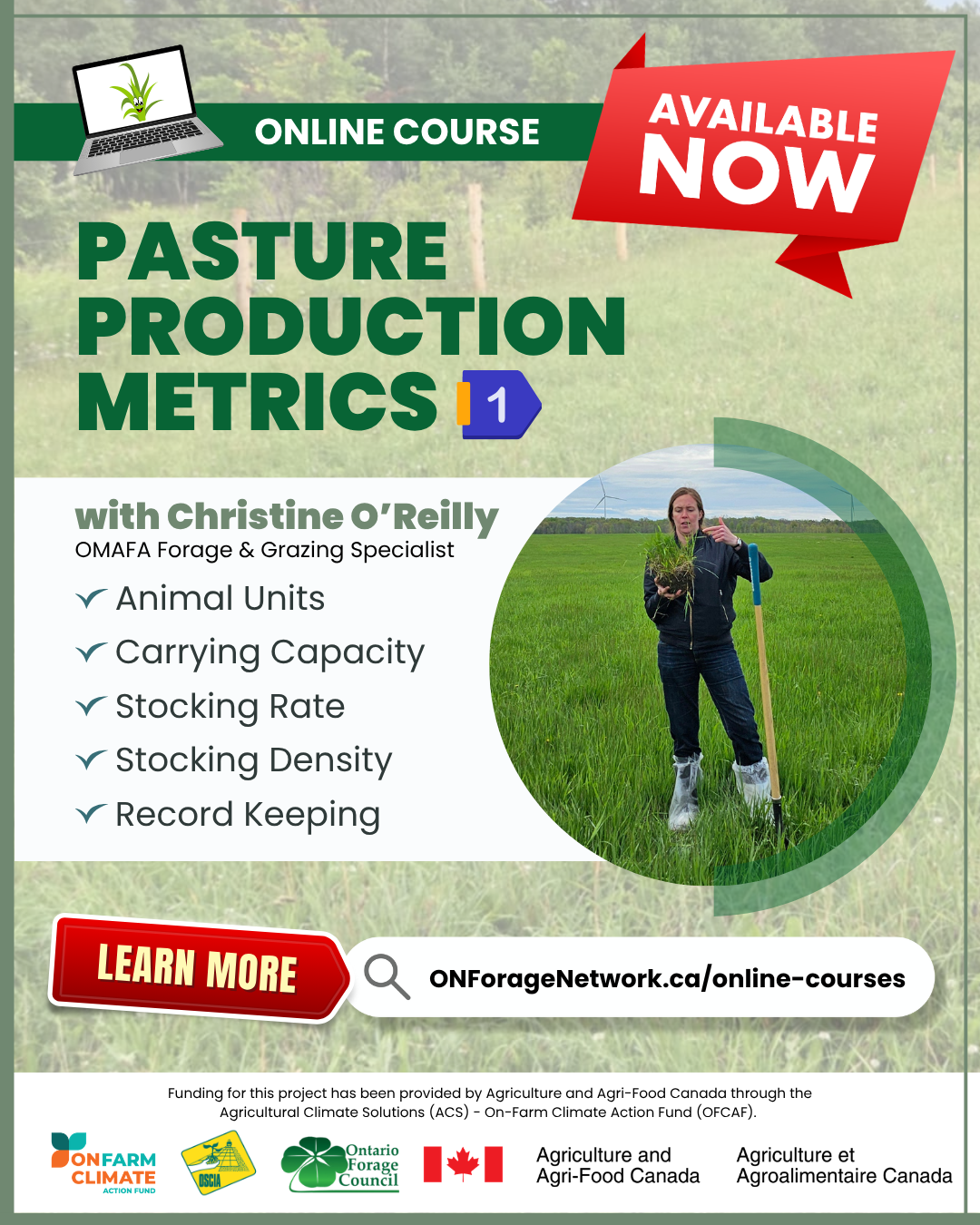
The OFC launched its new membership hub in June. All OFC individual members now have access to the OFC member community and free access to all online courses, including Pasture Productions Metrics 1, taught by Ontario Ministry of Agriculture, Food and Agribusiness (OMAFA) forage and grazing specialist Christine O’Reilly. Developing a Grazing Plan will be launched later this year.
To learn more and to sign up for a membership, visit https://onforagenetwork.ca/online-courses/.
| | |
Micro-credential badge
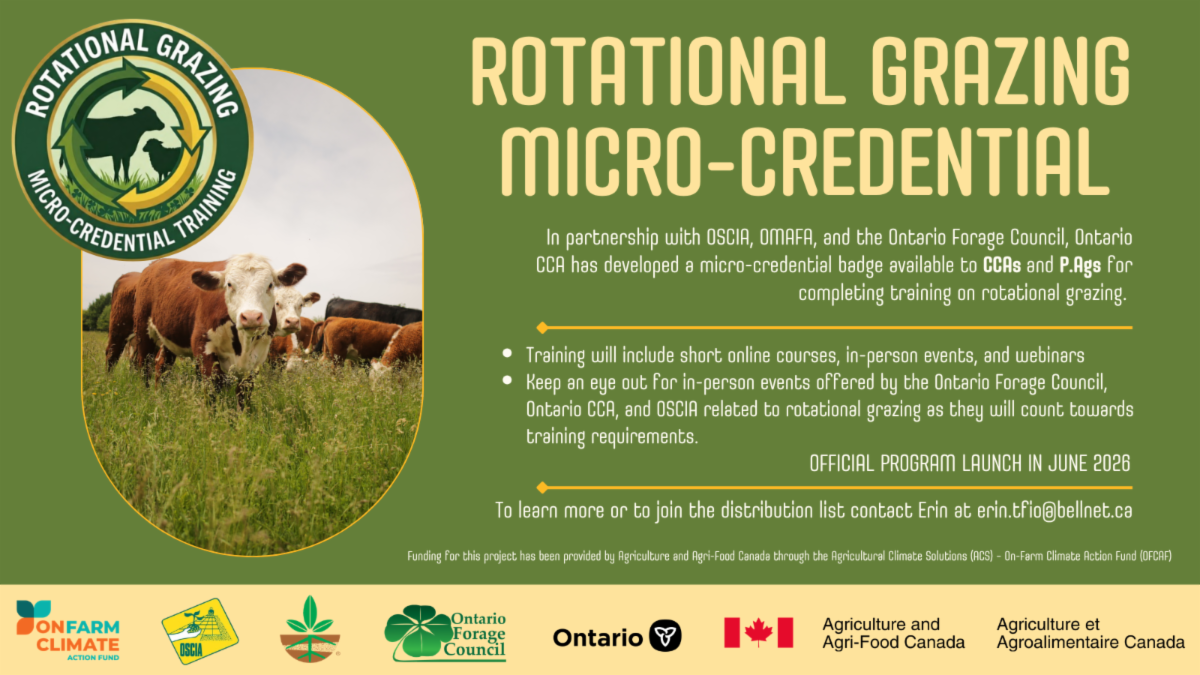
Ontario Certified Crop Advisors (CCAs) and Professional Agrologists (P.Ags) can now count OFC’s online courses and select in‑person events toward the new Rotational Grazing Micro‑Credential Badge. This badge was launched by CCA Ontario in partnership with the Ontario Soil and Crop Improvement Association (OSCIA) and OFC. To learn more contact erin.tfio@bellnet.ca.
| |
Pasture walks
Are you interested in learning about rotational grazing and the community pastures? OFC has pasture walks coming up in August, September and October. You’ll learn about projects done through the Community Pastures Initiative as well as water systems and fencing for rotational grazing. You’ll also find out more about cover crop grazing. More details coming soon! Keep an eye on OFC’s events page or subscribe to The Forage Update.
Forage Expo 2026
Forage Expo 2026 in Norwood was a huge success; even the rain couldn’t slow them down. The OFC had an excellent crowd come out to enjoy a full day of live equipment demos, hands‑on learning and good conversation across the field. The on‑site food truck kept everyone fueled and the energy never dipped thanks to their incredible sponsors and exhibitors who made the event unforgettable! Visit the OFC website to learn more about sponsors and exhibitors of the event and to see pictures from the day.
| | Provincial news: Saskatchewan | | |
RM 3 Enniskillen student field day
by Cindy Green, Saskatchewan grazing coordinator
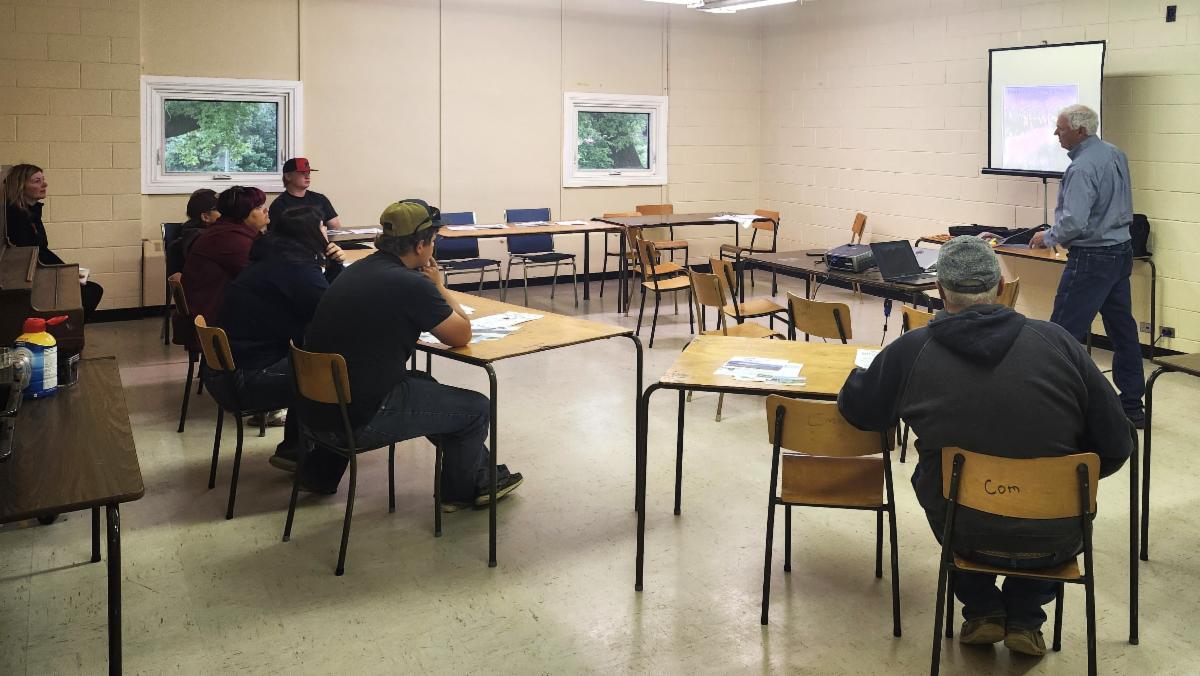
The plans were ready, the pasture was waiting and everything was set for the RM 3 Enniskillen student tour. However, the Saskatchewan weather had other ideas. A call for heavy rain had us scrambling to find a dry location and thankfully the Glen Ewen Communiplex was available. Councilor Yvonne Douglas quickly helped coordinate the last-minute changes and by 10 a.m. on Monday, June 29, the students were back in a classroom setting with CFGA mentor Ralph Corcoran leading the day.
Ralph kicked off the workshop much like he does with adult audiences, sharing an overview of his ranch, why he became involved with Holistic Management Canada and the opportunities that have come from adopting those principles. Ralph and his wife Linda recently won the 2026 The Environmental Stewardship Award (TESA) award for holistic grazing management!
From there, the students jumped into a hands-on learning activity using the Holistic Management Canada grazing chart, learning how to complete yield calculations. The students found these calculations to be straightforward and could be used to determine how many grazing days each paddock could support, an important first step in developing a grazing plan.
CFGA’s Saskatchewan grazing coordinator, Cindy Green, then took over to discuss the importance of having a grazing plan and how it benefits livestock, the land and the caretakers. Students learned why the CFGA recommends grazing paddocks for one to five days before moving livestock and how proper rest and recovery are essential to maintaining healthy, productive pastures.
Many of the students had already been introduced to these concepts through the Range Management project in their local 4-H club. Throughout the year they had been learning about grazing management with their 4-H leader and their final project was to create a grazing plan. It was exciting to build on the knowledge they had already gained through 4-H and watch them confidently apply it throughout the day.
After a quick and healthy lunch break, we were back in the classroom to learn about pasture cell design. Students were provided with aerial maps and challenged to plan out a pasture design. It was a delight to see the creativity and thought that went into their designs. We were blown away by what these young producers created and would be confident to take these plans to the pasture and build paddocks just as they had designed. It was rewarding to teach students who already have a strong connection to agriculture and are actively involved in their family’s operations. The future of Saskatchewan agriculture is certainly in good hands.
The afternoon also included a discussion on emerging technology in the livestock industry and the many projects that the CFGA takes part in. From virtual collars and GPS livestock tags to online grazing planning tools, technology is rapidly becoming an important part of grazing management. Today’s youth are naturally comfortable with technology and integrating these tools into agriculture may help encourage more young people to remain involved in farming and ranching.
Danyelle Thompson from the Lower Souris Watershed also joined the event to lead a plant identification session and showcase several of the organization’s interactive educational resources. Her presentation added another valuable hands-on learning opportunity for the students.
Shortly after 2 p.m., the final school bell rang and the students were done school for the year – finally!
| | |
Calendar of events
At the time this newsletter was distributed, all event times and locations were accurate, but please check event websites for the most current information. Some events may have been postponed or cancelled.
| | |
Aug. 1: Beveridge Ranch Pasture Tour. Maple Creek, Saskatchewan. More info.
Aug. 5: 23rd Annual Saskatchewan Pasture Tour. Canwood, Saskatchewan. More info.
Aug. 5: NBDAAF NBSCIA Cereal Plot Tour Field Day. Waterville and Williamstown, N.B. More info.
Aug. 6 : CQPF Caravane des pâturages au Lac Saint-Jean. St-Edmond-les-plaines, Quebec. More info.
Aug. 8: BCFC Intercropping Research Field Day. Lone Butte, B.C. More info.
Aug. 9 : Farm Tour & Potluck BBQ at Springer Farm. Foam Lake, Saskatchewan. More info.
Aug. 13: Kinsella Research Ranch Field Tour. Kinsella, Alberta. More info.
Aug. 13: CQPF Cohorte Pâturage : Gestion intensive des pâturages. Ste-Marie, Quebec. More info.
Aug. 13: BCFC OFCAF Field Day Chinook Meadow Farm. Radium Hot Springs, B.C. More info.
Aug. 14: NBSCIA Northwest Cover Crops and Nitrogen Management: A Sustainable and Profitable Approach to Potato Production. Drummond, N.B. More info.
Aug. 18-20: Canadian Beef Industry Conference. Winnipeg, Manitoba. More info.
Aug. 19: Legacy on the Land Field Day. Dorintosh, Saskatchewan. More info.
Aug. 20: Planned Grazing & Cover Crops Field Day. Alcurve, Alberta. More info.
Aug. 22 : BCFC Winter Bale Grazing Field Day. Horsefly, B.C. More info.
Aug. 25: CQPF Journée Provinciale des pâturages. Bolton-Est, Cowansville, Granby, Quebec. More info.
Aug. 25: SK PCAP Native Prairie Speaker Series Webinar: Woody Plant Encroachment and Forages. Online. More info.
Aug. 26: CFGA Young Ranchers Network Meeting: Managing woody encroachment and leafy spurge. Online. More info SKgrazing@canadianfga.ca.
Aug. 26 and 28 : CQPF Visite de pâturages avec Luc Delaby. Bas-Saint-Laurent and Lac-Saint-Jean, Quebec. More info.
Aug. 28: NBSCIA Moncton Soil and Crop Farm Tour and Social. Killams Mills, N.B. More info.
Sept. 2 : CQPF Forum sur les bovins laitiers au pâturage. Sherbrooke, Waterville, Quebec and online. More info.
Sept. 17 : CQPF Pâturages connectés Abitibi. Dupuy, Quebec. More info.
Sept. 23: CFGA Young Ranchers Network Meeting: Topic TBD. Online. More info SKgrazing@canadianfga.ca.
Sept. 29. BCFC Intercropping Research Field Day. Grindrod, B.C. More info.
Sept. 29: SK PCAP Native Prairie Speaker Series Webinar: Deep Roots: The Story of Alberta's Grasslands. Online. More info.
Oct. 6: SK PCAP Native Prairie Speaker Series Webinar: Incorporating Diverse Perspectives into the Sturgeon River Plains Bison Herd’s Stewardship. Online. More info.
Oct. 9 : CQPF Pâturages connectés. Saint-Cyrille-de-Wendover, Quebec. More info.
Oct 28: CFGA Young Ranchers Network Meeting: Topic TBD. Online. More info SKgrazing@canadianfga.ca.
Oct. 30 : CQPF Le chien de protection au cœur du système d’élevage webinaire. Online. More info.
Nov. 9-12 : CFGA 2026 annual conference. Calgary, Alberta. More info.
More event listings More event listings:
B.C. Forage Council (BCFC)
Beef Cattle Research Centre webinar series
Canadian Forage and Grassland Association (CFGA)
Conseil Québécois des plantes fourragères (CQPF)
New Brunswick Soil Crop Improvement Association (NBSCIA)
Ontario Forage Network
Saskatchewan Forage Council
Saskatchewan Prairie Conservation Action Plan (SK PCAP)
| | | | |