|
Cedric MacLeod
From the executive director's desk
| |
As we settle into the early months of 2026, I extend a warm welcome to our members, partners and supporters across Canada’s forage and grassland community. Winter is always a season of reflection and preparation and this year is no exception. The work we do together continues to strengthen the resilience, productivity and ecological integrity of Canada’s working landscapes and I’m excited for what lies ahead.
This year carries special significance as the United Nations celebrates the International Year of Rangelands and Pastoralists (IYRP). This global recognition shines a well deserved spotlight on the vital role that rangelands, and the people who steward them, play in food security, biodiversity, climate mitigation and rural livelihoods. For Canada, it’s an opportunity to elevate the importance of our grasslands and graziers on the world stage and to highlight the leadership of producers who manage these landscapes with skill, innovation and care.
In that spirit, the CFGA is planning a series of activities and events throughout 2026 to celebrate IYRP as well as to highlight the value of forage and grassland systems, share producer-driven knowledge and continue strengthening the national conversation around sustainable land management. This includes:
- Showcasing Canadian producers whose grazing and forage management practices demonstrate the power of working lands to deliver environmental and economic benefits
- Expanding our work on habitat conservation and biodiversity
- Advancing measurement, reporting and verification tools that help producers capture the full value of the ecological goods and services they provide
- Continuing our leadership in climatesmart agriculture, with a focus on soil health, carbon sequestration and adaptive grazing systems
- Strengthening national and regional networks to ensure producers have access to the resources, training and peer connections they need to thrive
We’re also preparing for the 2026 CFGA Annual Conference, where we’ll gather in the Prairies to celebrate progress, share insights and chart the next steps for our sector. This year’s event will be an important moment to reflect on the global spotlight provided by IYRP and to showcase the innovation and stewardship happening across Canada.
Keep an eye on the CFGA social media platforms, website and future newsletters for updates on IYRP and other activities the CFGA will be involved in throughout the year.
| | |
Greener horizons in action: CFGA’s national conference review
The Canadian Forage and Grassland Association (CFGA) hosted its 16th annual conference in Fredericton, New Brunswick, in November. With the theme Greener Horizons: Technological Innovations in Forage and Grassland Management, this year’s event was held in partnership with the CFGA’s provincial partner, the New Brunswick Soil and Crop Improvement Association (NBSCIA), and highlighted the cutting-edge advancements shaping the future of sustainable agriculture.
The event included:
- Two concurrent pre-conference workshops – the Grasslands Stakeholder Summit and the Advanced Grazing Mentorship Workshop
- Two full days of expert-led sessions exploring smart tech, pasture strategies and innovations in forage management systems
- An industry trade show
- Ppresentation of the CFGA’s 2025 Leadership Award
- Farm tours at three innovative family farms that showcase integrated crop and livestock systems, sustainable forage management and regionally adapted practices
- Numerous networking opportunities including a Building Bridges Social bring that brought together those who have an impact on forage, pasture and grasslands to network and build stronger connections.
Check out the CFGA blog for conference recaps. Online access to recordings of all the conference sessions are available free to those who registered for the conference. They will also be available for purchase soon.
Email info@canadianfga.ca for more information.
| | |
2025 Leadership Award winner
The winner of the 2025 CFGA Leadership Award is the Nappan Research Station, commonly known as the Nappan Research Farm, that is located in Nappan, Noa Scotia. It is a satellite location of the Kentville Research and Development Centre (Kentville RDC) which was established in 1911 in Kentville, Nova Scotia and is one of Agriculture and Agri-Food Canada’s (AAFC) network of 20 research and development centres. Research at the Nappan Research Station focuses on forage production and livestock management with work being led by the core team of Dr. Yousef Papadopoulos, Dr. Kathleen Glover and John Duynisveld.
The Nappan Research Farm team exemplifies excellence in agricultural research, innovation and knowledge transfer, advancing sustainable forage and livestock systems across the Maritimes and Canada. Their collaborative work has significantly improved pasture resilience, forage quality, and environmental stewardship, positioning the Nappan Research Farm as a national leader in forage-based research.
Read the full media release here.
| | Actualités du congrès de l’ACPF | | |
Des horizons plus verts en action : retour sur le congrès national de l’ACPF
L’Association canadienne pour les plantes fourragères (ACPF) a tenu son 16e congrès annuel à Fredericton, au Nouveau-Brunswick, en novembre. Sous le thème Des horizons plus verts : Innovations technologiques dans la gestion des fourrages et des pâturages, l’événement de cette année a été organisé conjointement avec notre partenaire provincial, l’Association pour l’amélioration des sols et des cultures (AASCNB) et a permis de mettre en lumière les avancées de pointe qui façonnent l’avenir de l’agriculture durable.
L’événement comprenait :
- deux ateliers précongrès simultanés – le Sommet des parties prenantes sur les prairies et l’atelier sur le mentorat en matière de pâturage avancé
- deux journées complètes de sessions animées par des experts explorant les technologies intelligentes, les stratégies de pâturage et les innovations dans les systèmes de gestion du fourrage
- un salon professionnel
- la remise du prix du leadership 2025 de l’ACPF
- la visite de trois fermes familiales innovantes qui présentent des systèmes intégrés de culture et d’élevage, une gestion durable du fourrage et des pratiques adaptées à la région
- de nombreuses occasions de réseautage, notamment l’activité sociale « Construire des ponts » qui a réuni des personnes ayant une influence sur le fourrage, les pâturages et les prairies afin de créer des liens et de renforcer les relations.
Consultez le blogue de l’ACPF pour les résumés du congrès. L’accès en ligne aux enregistrements de toutes les sessions du congrès est gratuit pour les personnes qui se sont inscrites au congrès, mais il est également possible de se les procurer en les achetant. Pour plus d’informations, écrivez à info@canadianfga.ca.
| | |
Récipiendaire du prix du leadership 2025
Le gagnant du prix du leadership 2025 de l’ACPF est la station de recherche de Nappan, communément appelée la ferme de recherche de Nappan, située à Nappan, en Nouvelle-Écosse. Il s’agit d’un site satellite du Centre de recherche et de développement de Kentville (Kentville RDC), créé en 1911 à Kentville, en Nouvelle-Écosse, et qui fait partie du réseau de 20 centres de recherche et développement d’Agriculture et Agroalimentaire Canada (AAC). Les recherches menées à la station de recherche de Nappan sont axées sur la production fourragère et la gestion du bétail. Elles sont dirigées par une équipe composée du Dr Yousef Papadopoulos, du Dr Kathleen Glover et de John Duynisveld.
L’équipe de la ferme de recherche de Nappan incarne l’excellence en matière de recherche agricole, d’innovation et de transfert de connaissances, et contribue à l’avancement des systèmes fourragers et d’élevage durables dans les Maritimes et ailleurs au Canada. Leur travail collaboratif a considérablement amélioré la résilience des pâturages, la qualité du fourrage et la gestion environnementale, positionnant la ferme de recherche de Nappan comme un leader national dans la recherche sur le fourrage.
Lisez le communiqué de presse complet ici.
| | |
OFCAF producer information sessions to take place Feb. 6 and March 6
The CFGA opened the 2026 intake for the On-Farm Climate Action Fund (OFCAF) on Feb. 1. In anticipation of high demand for OFCAF, the CFGA encourages producers to familiarize themselves with the Advanced Grazing Systems learning resources the CFGA offers and to complete their grazing plan in preparation for their project submissions. 2026 intake closes March 15, 2026 at 11:59 p.m. Pacific.
Producer Information Sessions are available for potential applicants to ask questions.
- Friday, Feb. 6: English with French support (bilingual) – 10 a.m. Pacific/11 a.m. Mountain/12 p.m. Central/1 p.m. Eastern
- Friday, March 6: French with English support (bilingual) – 10 a.m. Pacific/11 a.m. Moun tain/12 p.m. Central/1 p.m. Eastern
Register here
Agriculture and Agri-Food Canada (AAFC) announced the extension of the OFCAF program for three years in January 2025 with the CFGA administering up to $16.1 million to continue to support farmers in British Columbia, Alberta, Saskatchewan and Quebec in planning and implementing short-term rotational grazing practices.
Grazing plan development
You can find more background, the grazing plan template and grazing plan checklist here. We also encourage you to talk to your provincial partner bout graze days and rest days specific to your location.
Mentor training and support
If you are interested in becoming an Advanced Grazing Systems Mentor, you will find more details here or contact Emma Brooks at learning@canadianfga.ca. Part of the pre-work is completing the Advanced Grazing Systems course for Mentors. This includes a walkt hrough of how to complete the grazing plan template so it is a valuable, free resource to get potential mentors started towards helping other people with the process.
The CFGA also offers support for field days, information sessions, mentor training opportunities and bursaries and virtual sessions. Reach out to your provincial partner for more information!
More information about OFCAF.
| |
|
Séances d’information sur le FAFC à l’intention des producteurs : 6 février et 6 mars
L’ACPF acceptera les demandes dans le cadre du Fonds d’action à la ferme pour le climat (FAFC) à compter du 1er février. En prévision d’une forte demande pour le FAFC, l’ACPF encourage les producteurs à commencer dès maintenant à se préparer à déposer leur demande en consultant le cours Gestion avant-gardiste des pâturages et en élaborant un plan de paissance. La période de dépôt des demandes pour 2026 se terminera le 15 mars 2026 à 23 h 59, heure du Pacifique.
Des séances d’information destinées aux producteurs sont organisées pour permettre aux candidats potentiels de poser leurs questions.
- Vendredi 6 février : anglais avec soutien en français (bilingue) – 10 h (Pacifique)/11 h (Rocheuses)/12 h (Centre)/13 h (Est)
- Vendredi 6 mars : français avec soutien en anglais (bilingue) – 10 h (Pacifique)/11 h (Rocheuses)/12 h (Centre)/13 h (Est)
Inscrivez-vous ici
En janvier 2025, Agriculture et Agroalimentaire Canada (AAC) a annoncé la prolongation du FAFC pour trois ans. Ainsi, l’ACPF bénéficie d’un financement pouvant atteindre 16,1 millions $ pour continuer à aider les agriculteurs de la Colombie-Britannique, de l’Alberta, de la Saskatchewan et du Québec à planifier et à mettre en œuvre des pratiques liées au pâturage en rotation.
Élaboration d’un plan de paissance
Vous trouverez plus d’informations, le modèle de plan de paissance et un guide pour la réalisation d’un plan de paissance ici. Nous vous encourageons également à discuter avec votre partenaire provincial afin de déterminer les périodes de paissance et de repos propres à votre région.
Formation et soutien des mentors
Si vous souhaitez devenir un mentor en matière de pâturage en rotation, consultez la page suivante ou communiquez avec Emma Brooks au learning@canadianfga.ca. Une partie du travail préparatoire consiste à suivre le cours Gestion avant-gardiste des pâturages pour les mentors. Cette ressource précieuse, offerte gratuitement, présente la démarche à suivre pour remplir le modèle de plan de paissance. Elle permet aussi d’outiller les mentors afin qu’ils soient en mesure d’aider d’autres personnes dans le cadre du processus.
L’ACPF offre également un soutien pour les journées sur le terrain, les séances d’information, les offres de formation pour les mentors, les bourses et les séances virtuelles. Communiquez avec votre partenaire provincial pour obtenir plus d’informations!
Plus d’informations sur le FAFC.
| | |
Let’s celebrate International Year of Rangelands and Pastoralists
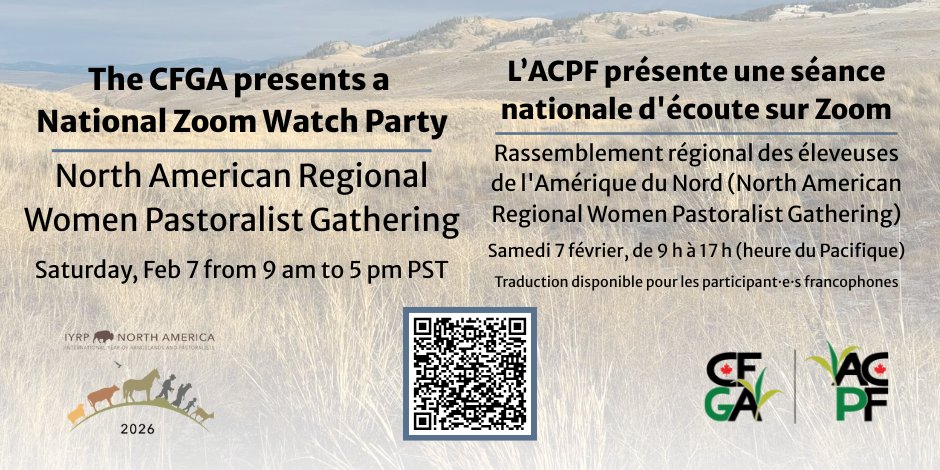
It’s International Year of Rangelands and Pastoralists, a United Nationsdesignated global initiative for 2026 that highlights the importance of rangelands and the pastoralist communities who depend on them. To launch its series of IYRP-themed activities, the CFGA is hosting a Canadian Zoom watch party of the North American Women’s Pastoralist Gathering on Feb. 7. If you’re a pastoralist or rancher woman in Canada, the CFGA invites you join this welcoming, come-as-you-are, virtual event. Learn more, and register, here.
Join us
Are you or your organization involved in IYRP initiatives and events? The CFGA is hosting bi-weekly Zoom meetings to bring together people and organizations interested in doing activities to celebrate IYRP. If you would like to join the meetings, please email info@canadianfga.ca.
| | |
Grassland Learning and Knowledge Hub update
The CFGA is excited to be working with the University of Alberta, Ducks Unlimited Canada and the Restore Assert Defend (RAD) Network on the Grassland Learning and Knowledge Hub (GLKH).
Working alongside these partners, the CFGA contributes its national expertise in forage and grassland management to help address the economic, social and policy dimensions of grassland conservation across Alberta, Saskatchewan and Manitoba. Its involvement supports collaborative engagement with diverse communities and helps ensure that the hub’s research, outreach and knowledge-sharing efforts are grounded in practical industry experience and the needs of grassland stewards across Prairie Canada.
Upcoming podcast
The GLKH Learning and Knowledge Transfer (LKT) working group is proud to announce the launch of a multi-season podcast in March 2026, dedicated to amplifying perspectives from across Canada’s grasslands. This series will bring together a diverse range of voices – including land stewards, graziers, biologists, researchers and program leaders – offering insights from both practice and science.
Each episode will feature a facilitated dialogue that explores pressing issues and emerging opportunities for those committed to sustaining and caring for Canada’s grasslands. By engaging viewpoints from across the sector, the podcast aims to foster deeper understanding, spark collaboration and highlight the shared responsibility of stewardship.
Stay tuned for more details and watch upcoming newsletters for the official subscribe button to ensure you don’t miss this important conversation series shaping the future of Canada’s grasslands.
| | |
CFGA represents Canada at 2025 World Alfalfa Congress
Kaylee Healy, CFGA communications and KTT logistics manager
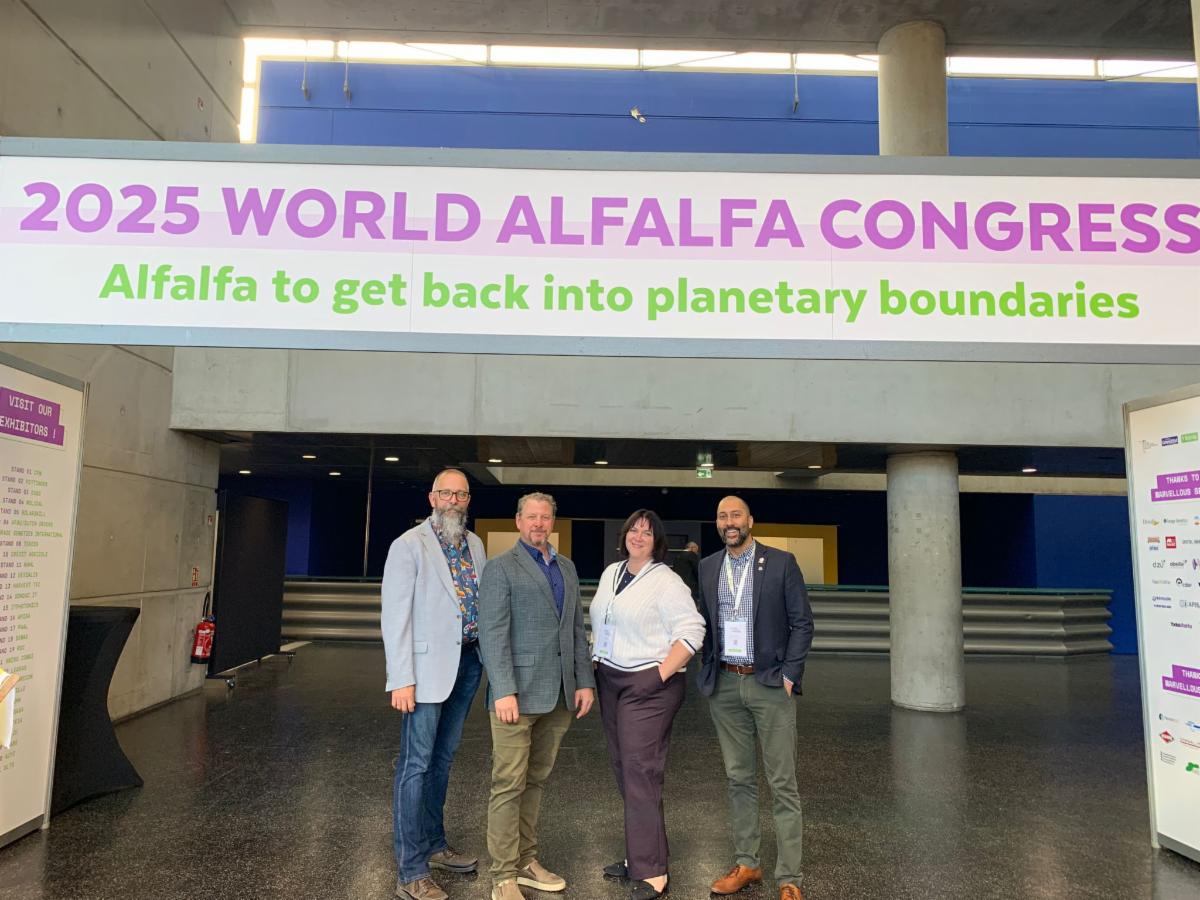
In November 2025, delegates from the CFGA attended the 2025 World Alfalfa Congress in Reims, France. This event, held every three years, brought together global leaders to explore the year’s theme of how alfalfa can help agriculture operate within planetary boundaries.
With sessions spanning genetics, agronomy, climate resilience and international markets, the Congress highlights alfalfa’s role in low‑carbon cropping systems and farm economic stability. Canada plays an important part in this global conversation: Canadian researchers contribute to advances in forage science and our export‑oriented alfalfa sector aligns closely with the Congress’s focus on sustainable production and evolving global demand.
Representing Canadian impact to the future of alfalfa, several delegates were active contributors to the conversations taking place on the Congress stage. Cedric MacLeod, CFGA executive director, joined an international panel exploring the relationship between livestock systems and alfalfa, emphasizing how well-managed forage stands contribute to soil health, biodiversity and resilient grazing operations. His perspective as a longtime advocate for Canada’s forage sector highlighted the practicality that makes alfalfa a cornerstone of sustainable livestock production.
Duane Vandenberg, CFGA board member and a respected voice in Canada’s hay and forage industry, contributed a dedicated presentation on Canada’s alfalfa market, outlining trends in both domestic demand and international trade. Drawing on decades of experience supporting hay growers, he illustrated how Canada’s high quality alfalfa products are positioned to meet evolving needs at home and in key export regions. Together, their contributions underscored Canada’s strong and growing role in the global alfalfa landscape.
Finally, the post-Congress field tour offered delegates a close look at France’s cooperative drying model, beginning with a visit to Sun Dezy in Francheville, one of several regional drying coops. Staff there typically begin harvest operations in April, once alfalfa reaches about 40 centimetres in height. With three production lines and three dryers, Sun Dezy can process multiple crops simultaneously, including alfalfa and sugar beet, while maintaining consistent quality.
The tour continued to Luzeal, another major drying cooperative located about 30 minutes away. Both facilities rely on a mix of low-temperature and high-temperature dryers, powered almost entirely by renewable energy, with roughly 95 per cent of heat sourced from wood chips in Sun Dezy’s case. Incoming alfalfa varies significantly year to year, with 2025 averaging 50 per cent dry matter compared to 38 per cent in 2024, requiring flexible processing approaches.
Each coop produces a range of end products for domestic and international markets, including baled and pelleted alfalfa, and both also contribute renewable heat back into their communities using excess dryer heat for water and building heating and, in Luzeal’s case, supplying heat to the nearby city as part of a local energy network.
The Congress not only showcased Canada’s leadership in the global alfalfa sector, but also strengthened the CFGA’s international relationships and knowledge base, ensuring Canadian producers are well positioned for the opportunities ahead.
| | Provincial member news: Conseil québécois des plantes fourragères (CQPF) | | |
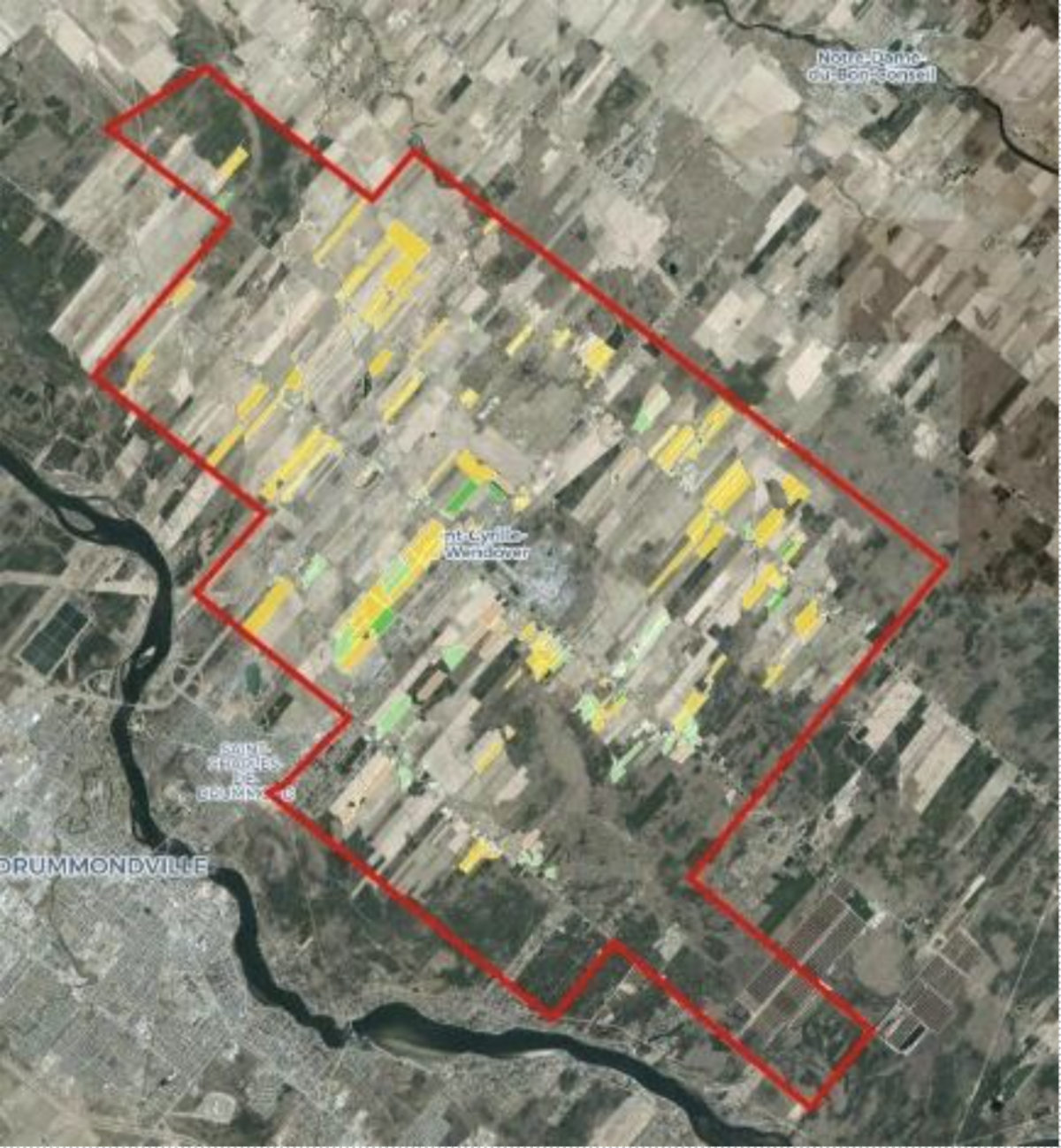
Faire progresser la cartographie des superficies fourragères dans l’Est du Canada : enseignements tirés du Québec
Marie-Pier Beaulieu, chargée de projet
Le Conseil québécois des plantes fourragères (CQPF) est heureux d’annoncer que le rapport final du projet Caractérisation des superficies en plantes fourragères au Québec a été déposé officiellement le 1er décembre 2025. Ce projet marque une étape importante dans l’amélioration des méthodes permettant d’identifier, de quantifier et de suivre l’évolution des superficies en prairies et en cultures fourragères à l’aide d’outils de télédétection.
Tout au long du projet, le CQPF et ses partenaires ont travaillé à l’élaboration et à la mise à l’essai d’une approche méthodologique basée sur l’analyse d’images satellitaires, visant à mieux reconnaître les superficies en plantes fourragères dans des paysages agricoles variés. Plutôt que de s’appuyer uniquement sur des classifications statiques de l’occupation du sol, le projet s’est concentré sur le développement d’un modèle capable d’identifier les cultures fourragères à partir de la variation de la biomasse dans le temps. En suivant les patrons de croissance saisonniers et les variations de vigueur végétative, le modèle permet de distinguer plus finement les systèmes fourragers annuels et pérennes des autres types de cultures.
Cette approche s’appuie sur un principe fondamental de la production fourragère : les systèmes fourragers sont dynamiques et leur signature s’exprime à travers les cycles de croissance, les périodes de défoliation et les capacités de repousse. L’intégration de la variation de la biomasse dans l’analyse des images permet ainsi de dépasser une vision statique du territoire et d’aller vers une compréhension plus fonctionnelle de la présence des fourrages sur le paysage.
Le CQPF considère ce projet comme une base pour de futures collaborations, des travaux de raffinement et une mise à l’échelle des outils développés. En améliorant la caractérisation des superficies fourragères, on renforce la capacité collective à soutenir les producteurs, à éclairer les décisions publiques et à mieux reconnaître la valeur des prairies au Canada. À cet égard, la méthodologie développée au Québec, fondée sur l’analyse de la variation de la biomasse dans le temps, offre une perspective complémentaire au National Grassland Inventory, particulièrement adaptée aux régions où les superficies fourragères sont réparties en parcelles de petite taille et soumises à des changements fréquents liés à la gestion.
| | |
Advancing Forage Mapping in Eastern Canada: Lessons from Quebec
Marie-Pier Beaulieu, Project Manager
The Conseil Québécois des Plantes Fourragères (CQPF) is pleased to share that the final report for the Caractérisation des superficies en plantes fourragères au Québec project was officially submitted on Dec. 1, 2025. This initiative marks an important step forward in improving how forage and grassland areas can be identified, quantified, and monitored using remote sensing tools.
Throughout the project, the CQPF and its partners worked to develop and test a methodological approach based on satellite image analysis, with the objective of better recognizing forage and grassland areas across diverse agricultural landscapes. Rather than relying solely on static land-use classifications, the project focused on developing a model capable of identifying forage crops by analyzing biomass variation over time. By tracking seasonal growth patterns and changes in vegetative vigor, the model allows for a more refined distinction between annual and perennial forage systems and other crop types.
This approach builds on a fundamental principle of forage production: forage systems are dynamic, and their signature is expressed through growth cycles, defoliation events, and regrowth capacity. Integrating biomass variation into image analysis makes it possible to move beyond a static snapshot of the landscape toward a more functional understanding of forage presence.
The CQPF views this project as a foundation for future collaboration, refinement, and scaling. By improving how forage areas are characterized, we strengthen our collective ability to support producers, inform policy, and better recognize the value of grasslands across Canada. In this context, the methodology developed in Quebec, based on the analysis of biomass variation over time, offers a complementary perspective to the National Grassland Inventory, particularly well suited to regions where forage areas are divided into smaller parcels and subject to frequent management-driven changes.
| | Provincial member news: New Brunswick Soil and Crop Improvement Association (NBSCIA) | | |
NBSCIA 47th annual general meeting and technical workshop
Preparation for the New Brunswick Soil and Crop Improvement Association’s (NBSCIA) AGM is in the works and is scheduled for March 12 and 13, 2026 at the Crown Plaza Hotel in Moncton, New Brunswick. This year’s theme is Envisioning New Brunswick's Agri-Food Sector in 2050. A draft agenda is available on the NBSCIA website AGM page. Registration is now open for the event on Eventbrite here. The hotel has a block of rooms available for the event at a reduced rate until Feb. 11. If you plan to attend, book your hotel using this link to get the reduced rate. Keep an eye on the NBSCIA website page for future details on other upcoming events.
On Farm Climate Action Fund update for N.B.
OFCAF funding supports New Brunswick’s producers in their ongoing progress, adopting beneficial management practices (BMPs) that reduce greenhouse gases (GHGs) and store carbon.
OFCAF funds are available for the COURSE and CONFERENCE EDUCATION PROGRAM. This program will support agriculture producers, agrologists (P.Ag) and certified crop advisors (CCA) who wish to participate in conferences, workshops and training events outside the Province of New Brunswick that support the reduction of greenhouse gas emissions, embracing new technology for improved nitrogen management, cover cropping and rotational grazing.
Plan your next summer’s OFCAF project now, as the NBSCIA is accepting applications from Jan. 1, 2026, closing when funding is fully allocated, for projects funded in the fiscal year ending March 31, 2027. Detailed program guidelines and the application process are available on the NBSCIA website.
For assistance with the application process contact a your local NBSCIA coordinator or the OFCAF program administration team: Stephen London (506) 392-0408 ofcaf.facf@nbscia.ca; David Walker (506) 461-6046 research@nbscia.ca; David Good (506) 391-9424 drgood449@gmail.com; Ray Carmichael (506) 276-3311 ofcafadmin@nbscia.ca.
Support for these activities has been provided by Agriculture and Agri-Food Canada through the Agricultural Climate Solutions – On-Farm Climate Action Fund
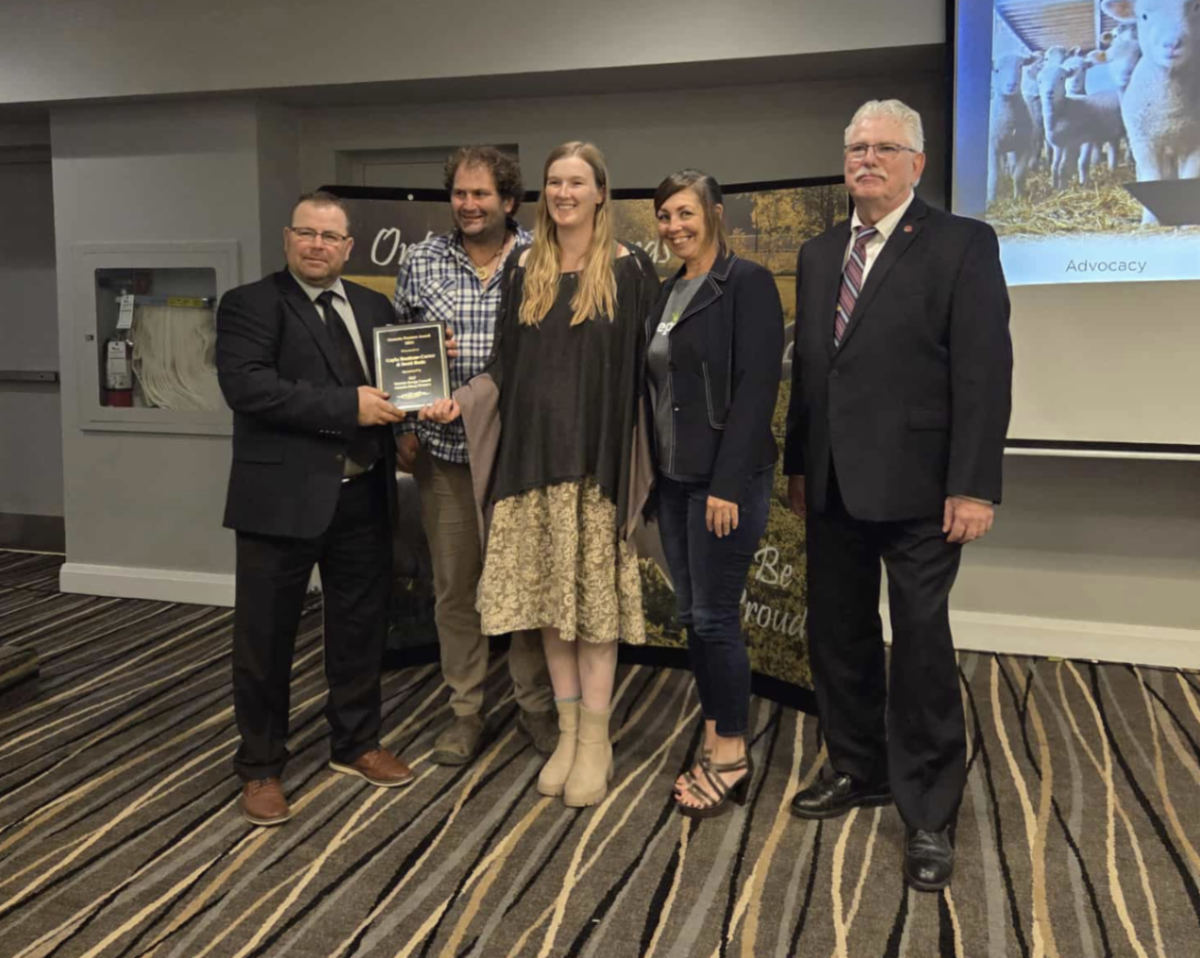
| | Provincial member news: Ontario Forage Council | | From left to right: Scott Fisher from DLF, DLF Pasture Award recipients Scott Bade and Gayla Bonham-Carter from Foootflats Farm, Patricia Ellingwood from Ontario Forage Council, Art Alblas from Ontario Sheep Farmers | | |
Amherst Island family receives 2025 DLF Sheep Pasture Award
Gayla Bonham-Carter and Scott Bade of Footflats Farm on Amherst Island are the recipient of the 2025 DLF Sheep Pasture Award. The award, sponsored by DLF, the Ontario Forage Council and the Ontario Sheep Farmers, was presented at the Ontario Sheep Farmers annual general meeting and Lamb Banquet in Cambridge. For their exceptional pasture management, Footflats Farm received a cash award of $250 and a bag of forage seed from DLF.
Gayla and Scott took over Footflats Farm from Gayla’s grandparents, Mark Ritchie and Cherry Allen, four years ago. In addition to the 180 acres at the home farm, they lease several other pastures. Amherst Island, near Kingston, has a lot of marginal land with heavy clay soil, which means a lot of pasture land for those willing to fence it. Pastures are fenced in four-wire electric and rotated through with the ewes and lambs.
Their flock of 1,200 ewes is now entirely New Zealand Coopworth and Gayla notes that they chose the Coopworth for their strong maternal instincts out on pasture with minimal inputs. They target the light lamb market at around 70 pounds. The Coopworths are a medium-sized sheep, which is a good size for great feed conversion.
Ewes are wintered outside and there is a feedlot at the home farm to finish lambs on. Gayla attributes part of their success to their Prattley mobile handling system, which can be taken out into the field to sort, drench, dock, wean and vaccinate, allowing them to handle the sheep wherever they are and provide more grazing opportunities. Looking towards the future, they have started incorporating cattle into their grazing system to rotate with the sheep, helping to keep the parasite load down and freshen the feed up for the lambs.
Read the full media release here.
| | Provincial news: Saskatchewan | | |
January grazing plan workshops connect producers across Saskatchewan
Cindy Green, CFGA – Saskatchewan grazing coordinator
January in Saskatchewan kicked off with one of our favorite things to do: Talking about rotational grazing with producers! The Canadian Forage and Grassland Association’s (CFGA) Saskatchewan team hosted grazing plan workshops in Stenen and Killdeer early in the month and both had great turnouts.
Stenen really tipped the scales with 35 producers in attendance and we are guessing the incredible hospitality at Rawhides Bistro had something to do with that. Rawhides Bistro is a well-known local spot with amazing food, great staff and a beautiful setting.
In Killdeer, we were lucky to gather at the community hall, where local volunteers treated us to delicious homemade soup and sandwiches. Smalltown hospitality truly shines in moments like these. That being said, the best part would have been our grazing plan workshops and networking. What better way to spend a January day filled with great food, meaningful conversation and learning more about rotational grazing.
Both groups were eager to learn and had a great teacher at the front of the room leading us with conversation and years of experience in the pasture. We are so grateful for Ralph Corcoran from Holistic Management Canada for once again sharing his time and expertise. Ralph does a great job walking producers through where he started with rotational grazing and the journey he's been on since. The morning kicked off with Ralph sharing his operation and how the switch to holistic management and rotational grazing has benefited his land, his cows and, most importantly, his family. He talks about improvements to soil health and grass, financial gains and overall cattle health, all things that producers are keen to learn about.
From there, we switch gears and dove into the funding available through the CFGA On Farm Climate Action Fund (OFCAF). The floor then opened up for questions, both about funding and rotational grazing, which always leads to great discussion. The break for lunch provided a chance to network, a key part of the day, with lots of valuable conversations happening over a meal.
After a delicious lunch when participants are full and not quite ready to jump back into heavy learning, we slowed things down and walked through the application process step by step. We want this process to be as smooth as possible and have fine-tuned our application process to reflect this. Participants leave the workshop feeling confident in their ability to build a grazing plan and apply online through the Impact website.
Ralph then jumped back in with pasture mapping and using the grazing chart. Participants drew out their pastures, making sure to have all their paddocks included, estimating how many acres are in each paddock and grading each paddock from one to 10. This helps when using the holistic management grazing chart to estimate how long livestock can stay in each paddock. While this formula itself is fairly simple, it can be tricky to wrap your head around – trust me. I've attended many of Ralph's workshops and still ask questions! Ralph takes it all in stride, spending lots of one-on-one time helping participants work through it and really understand the process. By the end of the workshop, the grazing plans and charts feel more manageable and far less intimidating.
Cold days, warm meals and good conversations made for a great start to the year. We are excited to continue these conversations and support producers as they implement rotational grazing plans.
| | |
Engaging producers, sharing knowledge: the CFGA at Agribition
Cindy Green, CFGA – Saskatchewan grazing coordinator Canadian
Western Agribition, held annually in Regina, Saskatchewan is widely known as the best beef show on the continent and we can confidently say it lives up to the name. Taking place each November, Agribition is a premier event showcasing purebred cattle, cutting-edge agriculture technology and the Maple Leaf Finals Rodeo.
In 2025, Agribition set a new record when it welcomed 151,037 visitors during the six-day event. Hats off to the organizing crew for another seamless and impressive show. With that many visitors walking the halls, the Canadian Forage and Grassland Association (CFGA) had the opportunity to connect with a range of producers and have many great conversations about rotational grazing.
We were also pleased to speak at the Indigenous Ag Summit where we made meaningful connections with participants. The CFGA has been working with producers who are rotational grazing bison and we are excited to continue to expand this work. Rotational grazing is often described as grazing the way bison did historically and when paired with the soil health benefits it provides, it is a natural fit for bison operations.
The CFGA booth wasn’t all business. We had a steady stream of families stopping by to play a round of cornhole, snap photos at our photo booth, chat about extended grazing and enter for a chance to win a sorting flag. Our grazing sticks were also a big draw, with many producers learning how to use them and leaving with their own grazing stick, excited for the grass to grow and put that knowledge to work.
Agribition is always a busy week, but it’s also a lot of fun. We are already booking hotel rooms for next year and hope to see you there!
| | |
Calendar of Events
At the time this newsletter was distributed, all event times and locations were accurate, but please check event websites for the most current information. Some events may have been postponed or cancelled.
| | | | |