|
WHAT WERE THE KEY TAKEAWAYS FROM THE MEETING?
As Texas school districts transition into a new era of real-time data reporting and accountability, it is essential that financial and administrative leaders take a proactive role in ensuring data accuracy and compliance. Recent discussions with TEA and regional leaders have emphasized that data integrity is now directly tied to funding, compliance, and accountability ratings.
This summary outlines the key takeaways from the most recent ESC RAC meeting, highlights cross-references with the Student Attendance Accounting Handbook (SAAH) and the Financial Accountability System Resource Guide (FASRG) and provides actionable steps for CFOs to strengthen district data systems.
The New Data Landscape: Live PEIMS and Six-Week Submissions
- TEA is shifting toward live PEIMS data with six-week submissions used to adjust funding allocations throughout the year.
- Each submission will be treated as critical and final, requiring careful review before certification.
- Data accuracy now impacts state funding, compliance audits, and accountability ratings.
SAAH Reference: Section 2.3.1 – Timely and accurate submission of PEIMS data.
FASRG Reference: Module 1.2 – Financial records must align with student and program data for audit integrity.
Building and Empowering Data Integrity Teams
- Districts should establish or strengthen Data Integrity Teams that include the superintendent, CFO/business manager, PEIMS coordinator, principals, and program directors (see “one pager”).
- These teams should meet every six weeks to review data before submission and ensure cross-departmental accuracy.
- In smaller districts, consider forming a “capacity team”—a cross-trained group capable of managing PEIMS, finance, and compliance responsibilities.
SAAH Reference: Section 1.5 – Local responsibility for data verification.
FASRG Reference: Module 3 – Internal control systems and segregation of duties.
Attendance Accounting and Program Accuracy
- Attendance remains the foundation of funding. Ensure compliance with official attendance-taking times and proper coding for medical absences and special program attendance.
- Verify instructional arrangement codes for Special Education, service IDs for CTE, and LPAC documentation for Bilingual/ESL programs.
- Cross-check attendance data with PEIMS submissions before certification.
SAAH Reference:
- Section 3.2.1 – Official attendance-taking time.
- Sections 4.2, 5.2, 6.2 – Program-specific attendance documentation.
FASRG Reference: Module 10 – Program cost accounting and allowable expenditures.
Documentation, Retention, and Audit Readiness
- Maintain all attendance and program documentation for five years after the school year ends.
- Ensure records are secure, accessible, and auditable for TEA desk reviews.
- Establish a clear audit trail for any data corrections, including who made the change, when, and why.
SAAH Reference:
- Section 1.4.2 – Records retention requirements.
- Section 1.2.4 – Audit trail and correction procedures.
FASRG Reference: Module 2 – Recordkeeping and documentation standards.
Student Eligibility and Funding Verification
- • Verify that all students meet eligibility criteria for state funding, including age, residency, and program participation.
- • Ensure that documentation supporting eligibility is collected and retained for audit purposes.
SAAH Reference: Section 3.3 – Eligibility requirements and documentation.
FASRG Reference: Module 10.300 – Funding eligibility and program compliance.
Reconciling Financial and Student Data
-
PEIMS and SAAH attendance data must be reconciled with your Summary of Finance reports.
- Regular comparisons between current-year and prior-year data can identify anomalies before TEA or external auditors do. (As Mr. Albritton said, look at the past and into the future).
- CFOs should ensure that financial data aligns with attendance and program data to maintain compliance and funding accuracy.
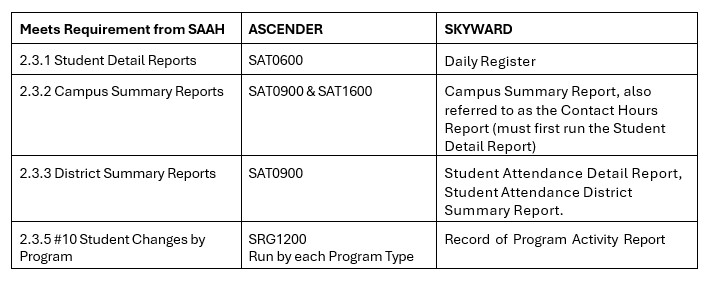
SAAH Reference: Section 2.3.2 – PEIMS and attendance data reconciliation.
FASRG Reference: Module 1.4 – Reconciliation and reporting standards.
Preparing for AI-Driven Auditing
As a side bar to the SAAH Manual and the FASRG, we discussed TEA’s ability to utilize AI to look at our PEIMS data in real-time, meaning attendance desk audits may become more frequent.
- TEA is expanding the use of AI-based audit tools capable of instantly detecting anomalies in district data.
- Accurate, consistent reporting across all systems will reduce audit risk and protect district funding.
Action Step: Ensure your teams understand how each data point in PEIMS and finance connects to funding formulas and accountability measures.
Key Takeaways for CFOs
- Districts have lost millions in unclaimed funds due to reporting errors.
- Data integrity is no longer just a compliance issue—it’s a financial management priority. Even our teacher raises are tied to it.
- Incorrect or delayed data can trigger TEA audits and funding discrepancies. The desk audits will now rely on data anomalies rather than physical reviews.
- Establish strong cross-departmental data review processes.
- Verify attendance, program participation, and eligibility documentation regularly.
- Maintain complete audit trails and records for all data changes.
- Collaborate with your ESC and TEA contacts for ongoing training and updates.
Resources for Reference
• Student Attendance Accounting Handbook (SAAH)
• TEA’s Financial Accountability System Resource Guide (FASRG) Webpage
• TEA Summary of Finance
Summary of the Data Integrity Team Discussion
Ladies and gentlemen, we have seen first-hand districts that have lost major money and or entire letter grades in accountability due to PEIMS errors. It truly does take a team to pull off PEIMS in this day and time. Please do not hamstring your people by making this a “one person job”. I remember the lady that did PEIMS at Cushing, Tammy Smith – a true miracle of a person and I cringe at what I asked of her now. Accurate data drives accurate funding AND accountability. Don’t make the Tammy’s of the world do it alone! Also, know that as TEA moves toward real-time audits and AI-driven data analysis, Superintendents and CFOs play a critical role in safeguarding district resources. By aligning your district’s practices with the SAAH and FASRG, you ensure compliance, protect funding, and strengthen public trust in financial stewardship.
Quick discussion regarding the Mandate salary raises and MOE
We have had several inquiries regarding whether federal funding can be used for the 4K / 8K raises (less for our bigger districts). In short, please know federal funds cannot be used to pay for state-mandated raises – specifically the 4K / 8K raise required under HB2. That amount must be coded to state and local funds, not federal ones.
Additionally, even though there are no new “time and effort” requirements introduced by HB2, we want to emphasize that time and effort documentation is still required for federally funded employees. In short, state-mandated raises must be funded from state and local sources, not federal funds, and “time and effort” documentation must continue to be maintained for federally funded staff.
Properly coding the 4K / 8K raise to state and local funds protects MOE compliance by ensuring that state and local spending levels are maintained and federal funds are used for only allowable purposes.
Remember, if you charge the 8K raise to federal funds, MOE won’t stand for “maintenance of effort” anymore. It will stand for “mistake on entry” – ok bad humor, but if you need MOE help, contact Beverly Beran at bberan@esc7.net.
Audit deadline extension for July 1 FY Districts
It is my understanding that TEA is moving the submission deadline for all FY 2025 audits to February 27, 2026. This extension was granted because of the development of the new audit 2.0 application in TEAL and the yet to be released 2025 OMB final compliance supplement.
Audit 2.0 will be available for submission on January 15, 2026. It is my understanding that all users MUST apply for access through TEAL beginning November 1, 2025.
Final thoughts
Everyone, you all have a tough job. It is massive and constantly changing. Please know that I am not an expert in all things finance, but if you ever need anything at all, I will do all that I can to help you. It is always a blessing to hear from any of you. I learn a lot by looking into your issues and it compounds over time. You would be surprised by how an inquiry in one district equates to a great discussion in another. So, thank you for sharing your victories and celebrations as well as your thoughts, concerns, and or frustrations as we want to both lighten your load and celebrate your successes.
Some things we learn are like pulling a diamond from the sky. My hope with this correspondence is that you go forth utilizing a data integrity team, which is one of the best practices I have heard in a while. We are going to go forward here at the ESC making connections that we hope to see in our districts. Our PEIMS staff have already made plans to collaborate with our special programs staff on an entirely different level so that we can ultimately serve you better through trainings and guidance. Each department in your district is so interconnected, and we want to do our part to make those connections stronger.
Have a great day… msd
|