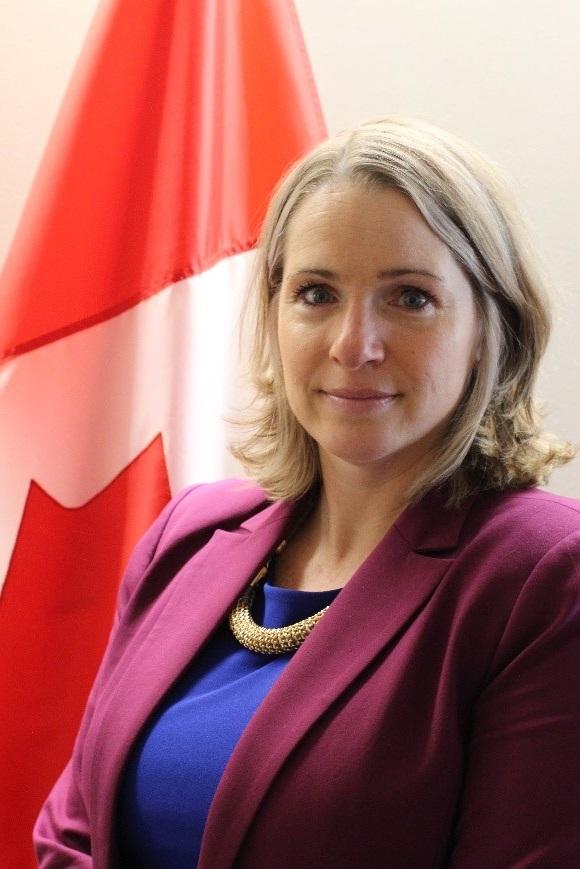
We return again to GBD’s interview last week with the Minister-Counsellor for Economic and Trade Policy at the Canadian Embassy in Washington, Nadia Bourély. Our exchange with Ms. Bourély on the subject of China was short in length but rich in substance. Save for a few minor edits, we share it here in its entirety. (On this one occasion, we shall dispense with our use of italics for quoted material.)
From the Interview
GBD: In today’s world, every trade discussion sooner or later turns to China. Canada’s relationship with China is large, important, and complex. That said, what is the current state of play on Canada’s relationship with China?
NADIA BOURÉLY: Let me start by saying Canada recognizes China’s importance in global affairs. If you look at trade, China is Canada’s third largest merchandise trade partner, behind the U.S. and the EU. Overall bilateral trade with China was about $100 billion in 2019. And, you know, we have more than 500 Canadian firms that are active in China, in a range of sectors: automotive, life sciences, financial services, ICT, clean technology. So, there are very strong trade ties there. And we have very solid and meaningful people-to-people ties as well.
Beside these meaningful ties, we have fundamental disagreements with the Chinese government. Most significantly, Canada is deeply concerned by China’s arbitrary measures against Canadian citizens, namely, the arbitrary detentions of Michael Kovrig and Michael Spavor and the arbitrary sentencing to death of Robert Schellenberg. Canada is deeply concerned that Canadian officials have not been granted consular access to Mr. Kovrig and Mr. Spavor since last January. We call for their immediate release and for clemency for Mr. Schellenberg as we do for all Canadians that face the death penalty.
Canada is grateful for all who have joined us in expressing concerns about recent Chinese actions. And I think it is not just the concerns from Canada but for all parties who seek to engage with China. We will continue to stand up for our democratic values and the rule of law, while also continuing to look for ways to work with China in line with our common interests.
And this includes expanding and enhancing our bilateral trade within a broader trade diversification agenda. Right now, as a top priority, we continue to work with China and our industry stakeholders to resolve bilateral commercial challenges and, in particular, the restoration of full market access for Canadian canola seed.
Editor’s Note. China was also part of the discussion in that portion of the interview that dealt with the WTO. Here is just a bit of that.
GBD: There are many ways to look at the problems of the WTO. Over the years, fingers have been pointed at different countries at different times for blocking progress. Today, the key question seems to be, can the WTO function cooperatively when it is home to economies that operate on, arguably, very different system, the U.S. and China being exemplars of those different systems?
NADIA BOURÉLY: That’s a big question. I’ll provide a simple answer. These are very big and serious and complex issues, but the multilateral trading system and its rules, I think, can be made to work with goodwill and flexibility. Yes, the issue, for instance, of the degree of formal and informal state control or influence, that is a very important issue, but there are also other very important issues, like how to ensure that trade disciplines support inclusive economic growth. Or, you know, how to make sure that trade disciplines promote environmental sustainability. …
While there are differences of views, it’s not true across the board, and we do see scope for progress on some issues. Not everything can be solved at the same time, but, you know, I think there is a sense that we should focus on issues of primary importance right now, such as e-commerce and fishery subsidies. Despite, again, those differences, it’s really important for members to remain engaged and continue to come forward and bring ideas and contribute in an effort to move things forward.