John Neuffer, the president and CEO of the Semiconductor Industry Association, was one of three panelists at the GBD's China trade event on June 11. The title to that session was Grading the U.S.-China Midterm, but given the situation at the time - the fact that the U.S.-China trade talks had broken off in early May - the focus of the event was more on the importance of having a deal than on the importance of what it should contain.
As organized by the event moderator, Jeremie Waterman of the U.S. Chamber of Commerce, each speaker gave a short opening statement, under five minutes. The themes of those statements were then elaborated in the panel discussion that followed. Mr. Neuffer packed a lot in his first few minutes, including a description of how semiconductors are made, the role of his industry in international trade, and the very high stakes that are in play in the current stand-off and hoped-for negotiations between the United States and China. Here are some excerpts on each of those topics.
On Supply Chains and the Making Semiconductors, Mr. Neuffer said:
We're probably the most global industry in the world, dependent on sophisticated and deep supply chains all around the world.
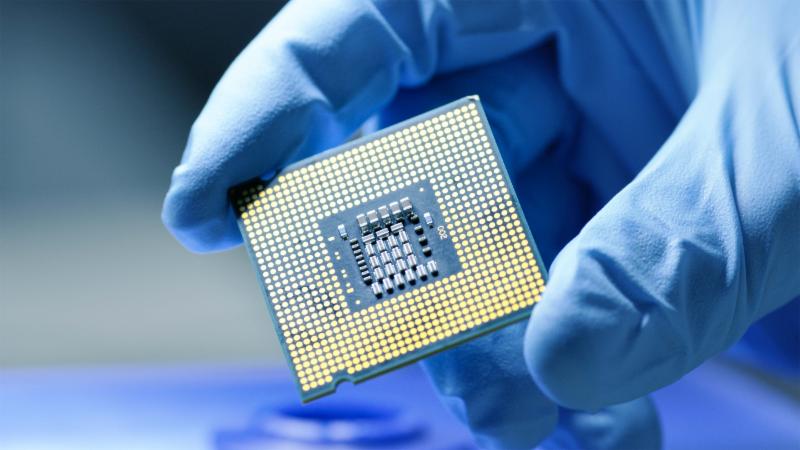 We start with sand. That gets turned into these massive silicon ingots. The Japanese produce a lot of that stuff. That gets turned into clean, blank wafers, beautiful things that look like mirrors. That gets turned into finished wafers. We put all the billions and billions of semiconductors, transistors on the wafers. That gets chopped up and sent to another country, and there is assembly, test, and packaging. And then it gets put into finished products, these semiconductors do. We start with sand. That gets turned into these massive silicon ingots. The Japanese produce a lot of that stuff. That gets turned into clean, blank wafers, beautiful things that look like mirrors. That gets turned into finished wafers. We put all the billions and billions of semiconductors, transistors on the wafers. That gets chopped up and sent to another country, and there is assembly, test, and packaging. And then it gets put into finished products, these semiconductors do.
In all of that, semiconductors, when they start out as grains of sand, end up in incredible devices like this [holding up a cellphone], travel around the world two or three times.
So anything that takes us away from a global marketplace with deep supply chains is a risk for our industry.
On Semiconductors and Trade. Today's featured quote is from this portion of his remarks. Here is what he said:
First of all, I think we really need to get a deal, some kind of deal, because the alternative is not a good one. For us, in particular, it's very important that we, as an industry, get an outcome that takes us away from all this loose talk of decoupling our economies. The U.S. semiconductor industry, 80 percent of its customers are overseas. In fact, it's a little known fact that we are the fourth largest exporter in this economy. Number 1 is planes, crude oil, refined oil, and we just jumped ahead of cars/automobiles this year. ... And China is a critical part of what we do.
Goals and Tactics. That is not to say that the semiconductor industry doesn't have issues with China. It does, and Mr. Neuffer highlighted some of them. "Getting IP [intellectual property] protection is critical," he said, and China's massive state subsidies are a matter of great concern. As Mr. Neuffer explained:
China [has] earmarked over $100 billion in state subsidies to build a stronger, indigenous semiconductor industry, and that can lead to a lot of non-market driven overcapacity, lots of distortions.
But for Mr. Neuffer and the semiconductor industry how America approaches (and solves) its problems with China is critical. On that topic, Mr. Neuffer was both graphic and clear. He said:
We strongly believe that the scalpel approach to dealing with China is much more sensible than the sledgehammer approach. There's just too much wreckage with the sledgehammer approach, and there are ways of applying the scalpel successfully. I think you target bad actors and particularly bad actors that are state entities. And when you do target bad actors - even when you do that - you apply a scalpel and not a sledgehammer. Our economies are just too dependent on each other to do otherwise.
The tariffs that the U.S. has already applied to China are a sledgehammer of a sort. Tariffs on the roughly $300 billion remaining imports from China would be an even bigger sledgehammer, and semiconductors would be part of the wreckage. As Mr. Neuffer put it:
If list four becomes real, this gets very, very real for us as an industry because that's where the consumer goods are, and they're bristling with semiconductors. So, we hope it doesn't come to that.
|