BUILDING CANADA IN THE WAKE OF GLOBAL TURBULENCE | | Insights from: Stuart McCarthy, Executive Vice-President; Janice Nicholson, Vice-President Digital; Angelo Bakoulas, Vice-President; Jordan Paquet, Vice-President; Ian Skipworth, Senior Consultant; Emily Szemethy, Senior Consultant; Greg Loerts, Senior Consultant; Manuela Boeira, Senior Consultant; and Leah Young, Consultant. | | Today in the House of Commons, Canada’s Finance Minister François-Philippe Champagne tabled the 2026 Spring Economic Update (SEU), a shift in the conventional timing for government financial reporting (from the fall) to better align with established fiscal timelines. The 178-page document, entitled, Canada Strong for All, provides an update on the country’s financial outlook and outlines the overall progress made since Prime Minister Mark Carney’s government tabled it’s first budget in November 2025. The SEU is presented as a strong endorsement of Canada’s fiscal strength vis-à-vis global players – particularly the U.S. – and a proof statement that Carney’s “Team Canada Strong,” is delivering for Canadians, despite the unpredictable and volatile world we are forced to operate within.
| | |
To that end, outside of a handful of new initiatives such as the Canada Strong Fund, announced yesterday, the SEU is very much an update, not a mini-budget. It is light on new spending with only $1.7B in new capital investments over the next five years, on top of existing baseline and Budget 2025 measures through to 2030-31. All new measures in the SEU have a net additional cost of $37.5B over six years, with more than 45 per cent of that on subsidies and support programs for Canadians through groceries, fuel tax cuts, housing initiatives and training.
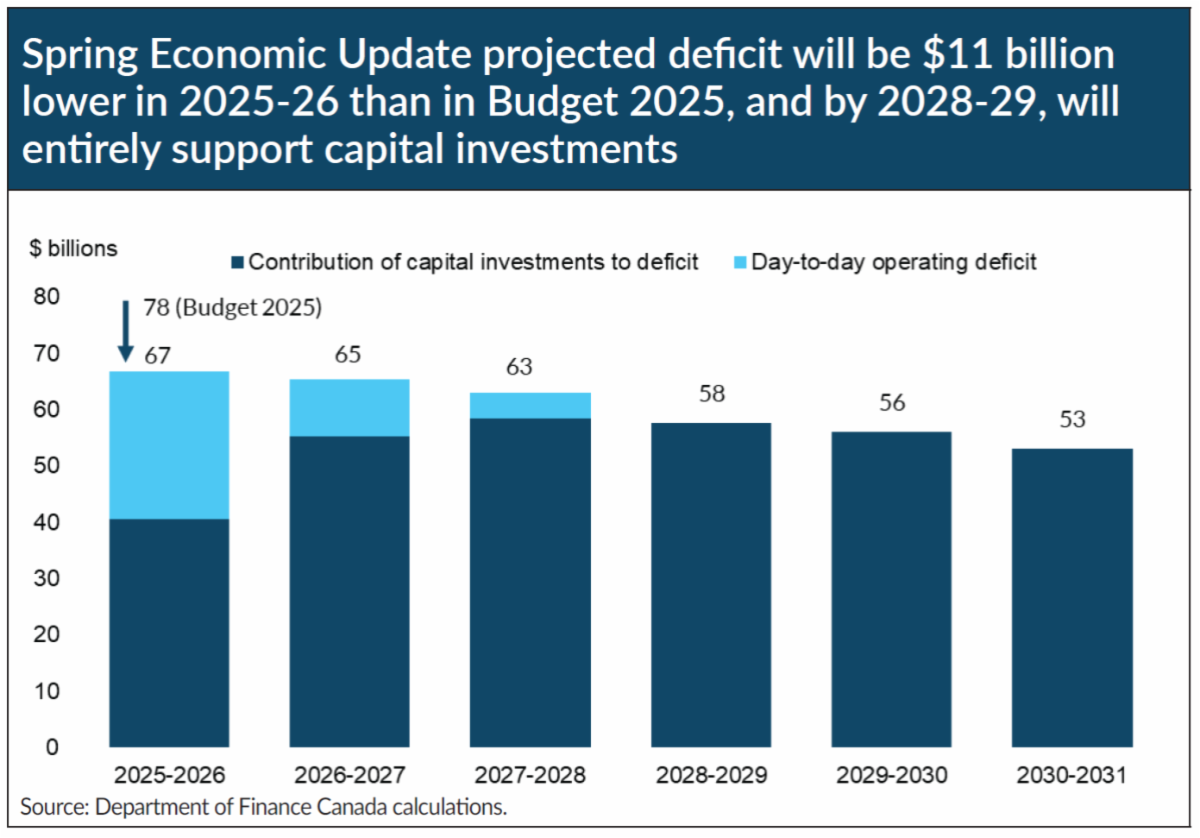
The SEU largely restates measures introduced in November’s Budget 2025 but points out that the forecasted deficit for the next year will be approximately $11.5B lower than thought five months ago, now projected to be $66.9B or 2.1 per cent of GDP. Federal debt is tracking at 41.1 per cent of GDP for 2026, rising to 41.8 per cent over the next five years.
| | |
FINANCIAL and CORPORATE MEASURES
The SEU signals a shift in the federal government’s approach, with a focus on targeted investment attraction and project delivery rather than broad-based tax relief. The central message to business is a continued emphasis on directing capital toward priority sectors and reducing barriers to investment, alongside efforts to address labour and capacity constraints.
A key development is the introduction of the Canada Strong Fund, Canada’s first sovereign wealth-style vehicle, seeded with $25B over the next three years, to invest alongside private capital in strategic projects and companies. The Fund is intended to generate commercial returns while supporting economic transformation, particularly in infrastructure, energy, and advanced manufacturing. It will operate at arm’s length and include a retail investment component, allowing Canadians to participate directly in its returns.
The SEU also places emphasis on accelerating major projects and reducing execution risk. The expansion of the Major Projects Office, combined with efforts to streamline regulatory processes and prioritize nation-building investments across government systems, points to a more coordinated federal approach to advancing large-scale projects. These measures are intended to support a significant pipeline of investment, though their impact will depend on implementation and timelines.
On tax policy, the government continues to rely on targeted incentives tied to specific sectors and outcomes. Measures include enhancements to clean economy tax credits, accelerated depreciation for low-carbon LNG, and housing-related tax supports. The Canada Revenue Agency (CRA) will also prioritize advance income tax rulings for large and nationally significant projects, which may help reduce uncertainty for investors.
Other measures are more incremental but still relevant for business. Making the Employee Ownership Trust tax exemption permanent may support succession planning, while the planned reduction in Canada Pension Plan (CPP) contributions beginning in 2027 provides modest cost relief for employers and employees.
Overall, the approach is focused and selective. Rather than lowering corporate tax rates, the government is using a mix of public capital, targeted tax measures, and regulatory changes to influence investment decisions and support project development in priority sectors.
| | |
DEFENCE
The SEU reinforces the federal government’s sustained commitment to strengthening Canada’s defence capabilities while accelerating the development of a more resilient domestic defence industrial base.
While Canada’s achievement of the NATO 2 per cent spending target and its trajectory toward 5 per cent by 2035 have already been established, the update provides important detail on how this funding will be operationalized and governed. Most notably, the government is advancing the creation of a Defence Industrial Agency (DIA) as a stand-alone departmental agency, to be enabled through amendments to the Defence Production Act. The DIA will be led by a dedicated minister and equipped with enhanced financial and transactional authorities, signalling a more centralized and strategic approach to defence procurement policy. The proposed $103.8M over five years to support the new agency further underscores Ottawa’s intent to build lasting institutional capacity to manage significantly expanded defence investments.
The SEU also highlights the growing role of domestic procurement as a core policy lever. Although still in its early implementation phase, the Buy Canadian Policy has already been applied to $3.6B in solicitations, with over $527M in contracts awarded as of mid-April. Within the defence sector, early procurements impacted by the policy include communication bridge systems, breathing apparatus maintenance, and facility management services for the Department of National Defence — illustrating how the policy is beginning to shape operational and infrastructure spending. This early uptake points to a structural shift toward prioritizing Canadian suppliers, particularly in areas linked to readiness and support services. For industry, this signals a more favourable environment for domestic firms, alongside a procurement landscape that will increasingly emphasize Canadian content, supply chain security, and long-term industrial participation. Complementing this is a targeted $250M investment over five years to expand skilled trades training capacity through the Canadian Armed Forces, aimed at addressing persistent labour shortages that continue to constrain both military readiness and defence industrial output.
| |
CANADA-U.S. RELATIONS and TRADE
While little new information is introduced in the SEU on the government’s trade approach, particularly in relation to the ongoing instability of Canada-U.S. relations, several underlying assumptions are reaffirmed for stakeholders.
First, current retaliatory tariffs on U.S. imports remain in place. Second, engagement will continue with the U.S. to advocate for the removal of remaining tariffs affecting key Canadian exports, including steel, aluminum, automotive, and forestry products. Simply, trade tensions are being managed as an ongoing policy factor rather than as a temporary crisis.
A key confirmation, the Buy Canadian Policy will continue and expand. Noting that the policy has already applied to a portfolio of solicitations valued at around $3.6 billion with $527.9 million worth of contracts awarded to date, just two months after implementation, the next phase of expansion is clarified. Later this spring, the government will launch a new Small and Medium Business Procurement Program aimed at supporting Canadian firms in accessing federal procurement opportunities through new digital tools and reduced barriers.
Taken together, these measures suggest a continued shift toward a more active use of procurement and trade policy to support domestic industry, with implications for market access, supplier competition, and alignment with broader North American trade dynamics.
| |
NATURAL RESOURCES, ENERGY and RENEWABLES
In parallel with its broader fiscal and economic priorities, the government is advancing a targeted set of measures in the energy and environmental space aimed at balancing emissions reduction with continued sector competitiveness. The Carney government is expanding incentives to accelerate lower-emissions technologies without undermining the economic viability of major energy projects, while also signalling a more active federal role in long-term system planning.
This includes upcoming engagement on electricity grid modernization, with the government set to release a discussion paper on strengthening interconnections and expanding capacity in collaboration with provinces, territories, and Indigenous partners. It is also signalling a longer-term role for firm, non-emitting power through a forthcoming Nuclear Energy Strategy that will set out a coordinated federal vision for the sector’s place in Canada’s energy mix.
Additionally, the SEU proposes expanding the Carbon Capture, Utilization and Storage investment tax credit (CCUS ITC) to include Enhanced Oil Recovery (EOR), marking a notable shift from the current framework where EOR is not an eligible use. Under the proposal, EOR projects would receive effectively half the standard credit rates, reflecting their additional revenue potential, resulting in rates of 30 per cent for direct air capture equipment, 25 per cent for other capture equipment, and 18.75 per cent for transportation, storage, and use equipment through 2035. To qualify, projects must meet strict permanence requirements, including capturing and reinjecting CO2 used in the EOR process and ensuring that at least 95 per cent is permanently stored, with ongoing compliance assessed over time. The measure would apply immediately, subject to jurisdictional approval based on regulatory sufficiency, and aligns EOR treatment across other clean economy tax credits.
The Carney government is also moving forward with an accelerated capital cost allowance for LNG facilities, available only to projects meeting a strict emissions intensity threshold of 0.20 tCO2e per tonne of LNG. Together, these measures reinforce a focus on incentivising cleaner production within existing industries.
The government is also scaling its international climate finance commitments, proposing $2.0B in additional capital for FinDev Canada and $732M to expand its concessional financing. This is intended to mobilise private investment into climate-related projects in developing markets, with a broader goal of delivering over $13B in international climate support over five years.
On critical minerals, the SEU brings minimal new information. Carney has been clear on his strategy for near-term wins: push projects via the Major Projects Office and sign “One Project, One Review” agreements with the provinces to streamline the assessment process. There is one notable omission: no new measures to support early-stage junior mining companies and prospectors. While investment has returned to Canada, the mining sector sees most of those dollars go to mid-size or mature single-asset companies; the suite of previously announced funding measures (First and Last Mile Fund, ITC expansions, and CGF/CIB funding options) and the yet-to-be-announced Critical Minerals Sovereign Fund are geared towards bringing potential deposits into production.
| |
INFRASTRUCTURE
Alongside broader infrastructure initiatives such as the previously announced Build Communities Strong Fund, the Carney government is now also placing a clear emphasis on strengthening Canada’s sport system as a form of social and community infrastructure, with a focus on participation, system integrity, and long-term asset utilization.
The “Playground to Podium” strategy proposes $755M over five years starting in 2026–27, with $118M ongoing, to modernize and expand the sport system. The majority of funding, $660M over five years and $110M ongoing, is directed toward National Sport Organizations to increase participation, particularly among children and youth, and to better leverage existing community infrastructure. An additional $50M over five years is allocated to attract major international sporting events, with funding tied to projects that deliver lasting community benefits. A further $45M over five years and $8M ongoing will support high-performance athletes, including investments in mental health and strengthened safe sport frameworks.
Overall, the package reflects a shift toward using sport investments to drive broader infrastructure outcomes, ensuring facilities and programming support both grassroots participation and elite performance while delivering sustained community value.
| |
SKILLS and LABOUR
In the context of promoting nation-building initiatives and major projects, the SEU identifies gaps in skilled labour and tradespeople and pursues measures to address those concerns.
Specifically, $2B is committed over five years, starting in 2026-27, and $262M ongoing, to fund the government’s Team Canada Strong initiative. The program aims to recruit, train, and hire 80,000 to 100,000 new Red Seal skilled trades workers by 2030-31, including through the new Build Canada Apprenticeship Service which will provide wage subsidies of up to $10,000 for their first-year salary. Additionally, the eligible temporary relocation expenses that can be deducted in a year will increase from $4,000 to $10,000 in 2026, with annual indexation thereafter, and with a modified distance rule mandating that temporary lodging must be at least 120 kilometres closer to each temporary work location than the taxpayer’s ordinary residence.
This approach reflects stakeholder calls for greater federal support to expand the skilled trades workforce, particularly through wage subsidies and mobility incentives. At the same time, the breadth of the program — both in sectoral eligibility and program design — suggests that access to supports will be competitive and likely shaped by alignment with broader “nation-building” priorities. As a result, early positioning and clear linkage to government priorities may be important for stakeholders seeking to benefit.
| |
INDIGENOUS-FOCUSED INITIATIVES
The SEU emphasizes continued federal investment in measures to aiming to continue advancing reconciliation with Indigenous communities by supporting long-term social and economic outcomes, highlighting nearly $4.3B in funding to support “healthy, thriving, Indigenous communities.” This includes funding to improve culturally relevant elementary and secondary education on reserve, sustain Indigenous-led approaches to child and family services through a number of funding announcements, and expand health benefits through programs like the Non-Insured Health Benefits Program, which sees an investment of $794M in 2026-27.
Housing and infrastructure continues to be a key emphasis. The SEU proposes realigning previous investments to better support Indigenous housing providers by reallocating $2.8B over five years, starting in 2026-27, with the goal to better align support for Indigenous housing in Canada’s current landscape. The supports are positioned as part of a more coordinated, multi-departmental approach to closing infrastructure gaps, and improving housing access for Indigenous communities.
Overall, the SEU signals continued federal attention on closing service and infrastructure gaps in Indigenous communities through targeted investments in housing, health, education, and infrastructure
| |
WHAT’S NEXT
The SEU is not something Parliament votes on. It is a fiscal update that sets out the government’s economic outlook and policy direction, but it does not have legal effect on its own. Instead, any legislative measures or amendments announced in the update must be introduced separately before they can take effect.
After it is tabled, the SEU is typically reviewed by the House of Commons Standing Committee on Finance (FINA). The committee may hear from government officials, economists, and stakeholders, providing an opportunity for scrutiny and political positioning. However, this stage does not involve any binding decisions.
The real procedural steps come afterward. New spending, tax changes, or policy measures must be implemented through legislation or the Estimates process. Bills must pass through both the House of Commons and the Senate before receiving Royal Assent, while spending requires approval through parliamentary votes. Tax measures are usually introduced through Ways and Means motions followed by legislation.
Recent changes to committee structures to better align with the new majority status of the government in the House of Commons reinforce this advantage. Adjustments to committee membership — particularly at the finance committee — will give the government more control over studies and proceedings. While procedural, these changes reduce the opposition’s ability to influence timelines or outcomes and could speed up the review of SEU-related measures.
This process is likely to move more quickly in the current context. With the majority in the House of Commons, the government has greater control over the legislative agenda and can advance its measures with fewer delays than in a minority Parliament.
| |
BLUESKY IS HERE TO ASSIST
Bluesky will continue to monitor all government announcements, legislation and engagement opportunities. Our team of experts is poised and ready to provide support, analysis and counsel to our clients and help you navigate the complexity of government. From early policy conversations and shaping future capabilities, building tailored activation and communications strategies, to engagement with senior political and departmental decision-makers, Bluesky has turned challenging opportunities into tangible wins for our clients.
| | |
For assistance, please contact:
Tim Barber, Principal, 613-241-3512 x 223 tbarber@blueskystrategygroup.com
Susan Smith, Principal, 613-241-3512 x 221 ssmith@blueskystrategygroup.com
Stuart McCarthy, Executive Vice-President, 613-241-3512 x 225 smccarthy@blueskystrategygroup.com
Raphael Brass, Vice-President, 613-241-3512 x 227 rbrass@blueskystrategygroup.com
Janice Nicholson, Vice-President Digital, 613-241-3512 x 238 jnicholson@blueskystrategygroup.com
Angelo Bakoulas, Vice-President, 613-241-3512 x 230 abakoulas@blueskystrategygroup.com
Jordan Paquet, Vice-President, 613-241-3512 x 224 jpaquet@blueskystrategygroup.com
| | | | |