WEEKLY NEWS & ANNOUNCEMENTS
January 30, 2022
Sunday Worship

The Fourth Sunday After the Epiphany

Scripture Readings for this Sunday:


Service of Holy Eucharist 
with Music, in the Sanctuary

8:00 am

Please wear a mask.


Service of Holy Eucharist 
with Music, in the Sanctuary

9:30 am

Please wear a mask.

Are you serving this Sunday? Would you be interested in reading at either service (zoom or in person)? You can sign up by emailing christmemorialkilauea@gmail.com
WELCOME TO CHRIST MEMORIAL
Welcome to Christ Memorial Episcopal Church. We are devoted to following the life and teachings of Jesus, the Christ.  

We hope your experience worshiping with us will bless and enrich your life. 

People of all faiths are welcome to worship with us on Sunday.


During pandemic time, join us at 9:30 here.
WHAT IS AN ANNUAL PARISH MEETING?
The Annual Parish Meeting is a meeting of the members of a parish. The by-laws of the parish generally require an annual parish meeting and state the qualifications to be a voting member of the parish. Diocesan canons may state requirements concerning parish meetings. The annual parish meeting typically elects vestry members, and it may elect vestry officers. Delegates to diocesan convention and representatives to other diocesan, deanery, or parish entities may also be elected by the parish meeting. The budget of the parish may be presented. The rector, vestry officers, and ministry leaders may make presentations at the annual parish meeting. The parish by-laws may allow the rector or a majority of the vestry to call a special parish meeting at any time. The by-laws may specify the requirements for a special parish meeting, including the requirements for notice to the members of the parish.

Christ Memorial's Annual Parish meeting
will be held in the Sanctuary and
will also be available by Zoom

Join us! This Sunday, January 30, 2022 at 11:00 am

If you chose to join us in the Sanctuary, please wear a mask.
TEACHING SERIES:
RE-THINKING CHURCH

What if Church is not something we have to do?

A six-week exploration of the basics.
Skepticism and criticism are essential in the search for truth:


“What is skepticism in principle but enquiry, investigation, examination? and what is criticism but separating, distinguishing, judging, determining between the true and the false, the good and the bad.”
–William Porcher DuBose

GENERAL TOPICS

The Scriptures: What in the World is God doing?
Spiritual Growth & The Church’s Life: Practical Worship and Changing Belief
Holy Baptism & The Church: God in the Here and Now
Holy Eucharist: Our Holy Common-Union
The Prayer Book Rule of Life: Day by day we bless you


JOIN US EVERY THURSDAY
at 9:00 a.m.

From the comfort of your own
computer via Zoom
POETIC REFLECTIONS
Believing in God’s Belief in Us

Leslie Scoopmire via the Episcopal Cafe

Believing in God’s Belief in Us: Jeremiah 1:4-10

Jeremiah, known sometimes as “the weeping prophet,” is believed to have written both Jeremiah and Lamentations. Jeremiah was twenty years-old when God called him.  At first Jeremiah believes that he is not up to the responsibility, but God insists that he is the right person. Jeremiah recounts his call story to bolster the legitimacy of his call in the eyes of those around him—that he did not seek out this position, but God insisted. God planned this for Jeremiah since before his birth (just as with Jesus). 

God gives Jeremiah the unpleasant task of warning the people about the destruction of Jerusalem—and worse, to make clear that this destruction will happen because the people turned their backs on God. Jeremiah became quite skilled in doom-forecasting. So much so that the term “jeremiad” refers to a long prophetic work which warns about the imminent destruction of society. Cataclysm, holocaust, the end of the world as we know it–those are heavy subjects for one so young to speak about with authority. No wonder Jeremiah feels the need to establish his bona-fides.

Jeremiah’s self-doubt contrasts with the self-assurance of Jesus that we find in the fourth chapter of Luke, to be read this Sunday. Jesus speaks with authority, unlike Jeremiah with his self-doubt and hiding behind his young age.  

Yet even Jeremiah understood that people need a glimmer of hope. That’s why even the book of his prophecies includes the section known as the “Little Book of Consolations,” which makes a decided turn from doom-saying to looking for the hope that shines out even in the darkest night. 

This gets back to the idea of God’s purpose for human life: not fear, not dread, but the assurance that God has loved us and known us from before we were even aware of that love and tenderness. That love is the source of the wondrous hymn of hope “Great is Thy Faithfulness,” derived from the third chapter of Lamentations—a reading often chosen at funerals because of the certainty with which Jeremiah lays claim to the mercy upon mercy we receive from God.

Most of us no longer believe that bad things happen to us as a punishment from God. God values us as we are—and too often we find that idea the unbelievable one. How often do we fail to believe in ourselves? How often do we fail to believe that God is calling us? This speaks of a personal relationship with God that so many of us long for. Jesus will be the fulfillment of the prophecies recorded here, just as he claimed last week. Seizing ahold of the reality of God’s love for us, as daunting as that can seem, brings all that we have been promised by God into focus, and allows us to see ourselves as we really are: beloved by God. 

How can we apply this lesson to ourselves? There have been plenty of times in most lives when we felt that we just couldn’t do something, or faced an obstacle or a sorrow that was overwhelming. There have been times I have felt this– and in the midst of prayer, I feel a calm descend upon me. God promises us that we will be strengthened for whatever challenges we need to face, even at the end of our lives. God has faith is us—how can we fail to reflect that faith in ourselves, and to be beacons of hope to a world that desperately cries out for hope?


Leslie Scoopmire is a writer, musician, and a priest in the Diocese of Missouri. She is rector of St. Martin’s Episcopal Church in Ellisville, MO. She posts prayers, meditations, and sermons at her blog Abiding In Hope, and collects spiritual writings and images at Poems, Psalms, and Prayers.
DIOCESAN COMMITMENT TO ADDRESS
THE CLIMATE CRISIS
At the 53rd annual meeting of the Convention of the Diocese of Hawaiʻi, it was resolved to urgently accelerate and expand the level of discourse on climate change within the diocese and throughout all congregations. Here are some of the things we are looking to work towards:

  • Forming a “Green Team” in every congregation (or hui of congregations) and beginning by identifying one member to act as an “Environmental Coordinator” who will serve as a liaison to the Diocesan Creation Care and Environmental Justice Task Force.

  • Congregations are urged to undertake an energy audit for all buildings in order to reduce the church’s carbon footprint, and implement actions that reduce, reuse, and recycle.

  • Prioritizing care for God’s creation through the mission, liturgy, prayer life, education, work, and budget of the Diocese and each congregation.

If you are interested in joining us in this important work, please email us at christmemorialkilauea@gmail.com

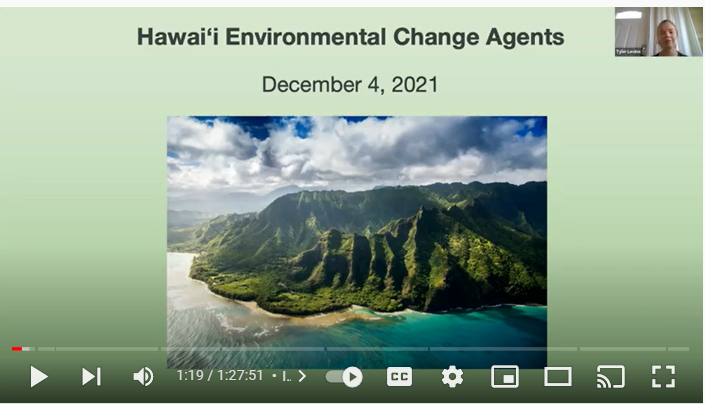
Want to know more about climate policy in Hawai'i? Click the video below to watch the Climate Action Planning Forum held on December 4, 2021. CCL Hawaii and several local environmental groups participated in this climate policy discussion.
OPENING REMARKS BY PRESIDING BISHOP MICHAEL CURRY AT THE EXECUTIVE COUNCIL
The following is a transcript of the opening remarks of Presiding Bishop Michael Curry at the Executive Council of The Episcopal Church, meeting virtually through Jan. 27. These remarks have been lightly edited for clarity.
 Executive Council
January 25, 2022
Opening Remarks

It is good to be together, I wish we were in Cleveland right now, I wish we were all together, but we will be together very soon.
I
Recently I was talking to a good friend who suggested that I needed to take a look at the reading from Nehemiah appointed for last Sunday (Nehemiah 8:1-10).

In the text, Ezra the priest reads the law of God to the people. And the text says that when he reads it and interprets it and applies it to their lives, the people wept when they heard it. Why did they weep? My friend was right. That’s simply extraordinary! God’s word was read, interpreted, and applied to their lives, and the people wept! Why in God’s name did they weep?

They had been through a long period of dislocation, disorientation, and disequilibrium. Worse than a pandemic, but related. Their world had actually fallen apart when the Babylonian armies razed the Judea countryside, breached the walls of Jerusalem, desecrated the Temple King Solomon had built, and virtually destroyed Jerusalem.
Many of the people were then carted off to Babylon, to virtual servitude, a long, long way from home. As the exile went on, they forgot what home was like. The temple of Jerusalem became a distant memory.

In time many probably forgot the faith that gave them birth. Holy days sometimes went unobserved. Teachings unlearned. Traditions left unkept. They did what they could to survive on what they had. The deep spiritual and emotional pain of this is captured in one of the psalms that they have left us, Psalm 137, which says:

“By the waters of Babylon—
we sat down and wept
and we remembered thee, O Zion,
when we remembered home.
On the willows
we hung up our harps.
For it was there that our captors
required of us a song,
tormenting us with the words,
‘Sing us one of the songs of Zion!’
But how, how shall we sing the LORD’s song
in a strange land?” (paraphrased)
And soon the very song was forgotten.
And then on that day years later in Jerusalem, Ezra read the Torah, God’s law for life; he interpreted it and applied it to them. And they remembered!
They remembered their high calling.
They remembered life that is more than mere survival.
They remembered who they were and whose they were.
The congruence of their lives with their calling, their highest and noblest aspirations, ideals gave them something exile had taken away—a deep sense of a divine purpose for living.
In God‘s law they discovered who they were. And when you know that you can face anything, you can endure anything, you can bear any burden, with a sense of direction no matter how hard life can be.
Another way to say it is they found their soul, their core, the essence, their heart. And when that happens the word of Ezra in the rest of the text becomes true –
“Go your way,” he said to them, “eat the fat and drink sweet wine and send portions of them to those for whom nothing is prepared, for this day is holy to our LORD; and do not be grieved, for the joy of the LORD is your strength.”
II
In 2005 Huston Smith, who was himself a Christian, grown up the son of Methodist missionaries in Asia but who was a scholar of world religions, wrote one of his last books. In it he spoke of the renewal of genuine Christianity in our time in a process similar to that described when Ezra read the law. Part of what he said in that book was that Christianity would be revived, renewed, and restored as it rediscovers and reclaims its soul, its origin, its essence, found in the teachings, and the life and the spirit of Jesus of Nazareth. He called his book “The Soul of Christianity: Restoring the Great Tradition.”

The wisdom here is one of the reasons I believe passionately that we in our time must reclaim the teachings, and the example, and the spirit of Jesus of Nazareth and his way of love as our way of life.
Some years later, after Huston Smith had published his book, historian Jon Meacham followed a similar trajectory to Huston Smith and to Ezra—now for American democracy and society, to reclaim the high calling and noble ideals, in a book titled, interestingly enough, “The Soul of America: The Battle for Our Better Angels.”

To find our way as a nation that is more than a collection of individual self-interest, it will be necessary for us to claim the high calling of the ideals and principles at the core, the soul of the American experiment in representational democracy.
III

Those ideals are found in such texts as the Declaration of Independence, Lincoln’s Gettysburg Address, King’s “Letter from a Birmingham Jail.” They are found, though imperfect it may be, in the Constitution of the United States, the Bill of Rights and subsequent amendments. But listen again to the words of the Preamble:

“We the People of the United States, in Order to form a more perfect Union, establish Justice, insure domestic Tranquility, provide for the common defense, promote the general Welfare, and secure the Blessings of Liberty to ourselves and our Posterity, do ordain and establish this Constitution for the United States of America.”

The ideal of democracy, while not perfectly lived out to be sure, offers the best hope yet devised for government that fosters human freedom, equal justice under law, the dignity and equality of every human being made as the Bible says in the image and likeness of God.
A cornerstone of that democratic ideal is and remains the right to vote. The right to vote is a fundamental human right grounded in the dignity and equality of human beings. I am thankful that this Executive Council previously has gone on record supporting, or advocating for the John R. Lewis Voting Rights Advancement Act, the Freedom to Vote Act, and/or other similar legislation that enhances and furthers the provisions and intention of the Voting Rights Acts of 1965.

But as you know from the news, this is not going to happen overnight, and it’s not going to happen easily. But we and other people of good will must work, we must persist, and we must labor on against the odds until the right to vote is fully protected and unencumbered by partisan self interest.

Like the story of the persistent widow that Jesus told, who would not let the judge get away with ignoring her, we must persist until justice rolls down like a mighty stream and righteousness like an ever-flowing brook.

But we must do something else. We must both advocate for these legislative remedies and also roll up our sleeves to do the hard and laborious work of nonpartisan—and please hear me when I say this; don’t anybody send me emails saying this is partisan since this is not a partisan rant—we must do the hard and laborious work of nonpartisan voter education, registration, and facilitation. And it’s hard work. And you wonder why is he saying this now? It’s January—the midterms aren’t till November. We can’t wait until November to start that work! We must start now.

The Office of Government Relations has begun an effort to do just that. It’s called Episcopal Activators. This is a practical effort to help people to vote in spite of encumbrances that may currently stand in the way for many in many of our states. We must help folks be able to cast an unencumbered ballot. We must do so in a nonpartisan way, but we must do it.

The right to vote is not merely a secular ideal. It is a fundamental human right grounded in the innate dignity and equality of every human being created, as the Bible says, in the image and likeness of God.

For this reason the passage of the foundational Voting Rights Bill of 1965 only occurred after long, protracted nonviolent struggle and protest.

It is salutary to remember that countless people were beaten and hospitalized on the successive marches in Selma. It is important to remember that on that March “Bloody Sunday,” 17 marchers were hospitalized by beatings from law enforcement. Several dozen were treated in hospitals and released.

And maybe it is most important to remember that in the Selma struggle for voting rights, four nonviolent protesters and children of God involved in voter registration were killed:

Jimmie Lee Jackson, a local Baptist deacon. The Rev. James Reeb, a Unitarian minister. Viola Liuzzo, a housewife who volunteered from Detroit. And Jonathan Myrick Daniels, an Episcopal seminarian.
They gave their lives for the right to vote. But they were martyrs who gave their lives for the cause of our God-given human right and dignity. “We hold these truths to be self-evident, that all men are created equal. That they are endowed—not by a parliament, not by a government—endowed by their Creator with certain unalienable rights.” That is not simply a secular ideal, that is an ideal born of the God who made all human beings equally imago dei, in the image of God. And we who are followers of Jesus Christ, we who are citizens of this country, we who are people of good will and human decency of any stripe or type, must not, cannot, and we will not allow their sacrifice to be in vain.
Amen.
ZOOM CLASS: REBUILD
THE INNER TEMPLE!
Dr. Matt Miller (Christ Memorial’s guitarist, reader and cross sculptor), is offering a ZOOM class in how to “go to God the Father,” because Jesus said in John 14:12, “You can do all I have done, and more, because I go to the Father.”

After twenty-five years of research and experiment, Dr. Matt can now explain the techniques used by the Egyptian desert Fathers, taught to monks in the Byzantine monasteries, and practiced among Western Christian mystics, to enter into direct experience of God. Jesus knew these techniques, and He taught them to us in a very strong and powerful way, especially in His miracles, and in the Sermon on the Mount.

If you want to come closer to direct experience of Jesus’ God of Love, sign up now to rebuild your Inner Temple. It will take two to three months to work through the material in weekly meetings, depending on how fast we learn the techniques. We will agree on a date and time that works for all the students – not on Thursday, the day of Pastor-in-Residence Edwin Wills’ Teaching Series.

Rebuild the Inner Temple! only has four seats remaining. So if you have questions, or want to sign up, e-mail Dr. Matt Miller at mahopmi@gmail.com today! 

This is a private teaching Matthew is offering. He has graciously included an invitation to Christ Memorial members who might be interested.
THIS IS MY OFFERING
A Prayer:

Magnificent Holy Father. 
I stand before you at this altar. So many have given you more.
I may not have much I can offer. Yet what I have is truly yours. 
This is my offering, dear Lord. 
This is my offering to You, God.


Your offering enables us to maintain worship, prayer and study during this time. Help us continue to provide a beautiful, flourishing, and safe "Sanctuary for the Spirit" at our historic and faithful church on Kaua'i.
​
Change to Automated Giving: Thank you to those of you who automate your giving and have a plan to support your church. Your consistent, planned generosity makes it possible for us to budget and dream responsibly. Want to change to automated giving? It makes life easy, especially if you travel.

Live off island? If you have a prayer intention or would like to pray for those on our prayer list, email our office. To be part of the church collective means we all share in the cost of being a church. We want our church to have inspiring worship; pastoral care for those in need; beautiful church grounds; programs to learn and grow; and tools to reach out to those who are seeking a closer relationship with God. See the different ways you can share your gifts, on our Giving page HERE. 
If you like to give by check, please send to:
Christ Memorial Episcopal Church,
P.O. Box 293, Kilauea, HI 96754

Or consider changing to Automated Giving. It makes life easy. Just click on the button below to make a one-time or recurring donation. 

Thank you for your love and care for our Christ Memorial community!

SUNDAY SCHOOL
Sunday school will be held at 8:00 a.m. in the Parish Hall across from Christ Memorial with beloved teachers Leona and Keana.

Masks are required.

Aloha ke akua.
THRIFT STORE IS OPEN

Shopping Hours:

Monday 2:00 pm -5:00 pm
Tuesday 2:00 pm -5:00 pm
Wednesday 9:30 am -12:30 pm
Thursday 2:00 pm -5:00 pm
Friday 2:00 pm -5:00 pm
Saturday 9:30 am -3:00 pm


Donations Accepted: 

Monday 2:00 - 5:00 pm
Wednesday 9:30 am – 12:30 pm
Saturday  12:00 pm – 3:00 pm

Please wear a mask
VOLUNTEERS NEEDED
Helen Mitsui Shared Blessings Thrift Shop in Kilauea is seeking Volunteers for 2021.

Each volunteer shift is a 2-4 hour commitment for a minimum of one day per week. Experience in Retail, Customer Service, and/or Retail a plus, but not required.

Volunteers are invaluable to serving our community. Our goal is to reuse, repurpose and recycle goods — keeping as much as possible out of landfill — while providing our community with access to reasonably priced, quality merchandise.

Here are ways you can help:
* Greeters welcome shoppers and monitor our COVID guidelines.
* Customer Care helps shoppers to ensure a pleasant shopping experience.
* Merchandisers organize departments, restock the floor and display retail goods.
* Philanthropy distributes merchandise to organizations in need.
* Donation Intakers receive, sort and process donations.

Work-from-Home volunteers help prepare merchandise for sale. We are especially looking for help in these areas:
* Games: checking games to ensure all components are intact
* Stationery: packaging up cards and envelopes
* Holidays: preparing merchandise for Christmas, Halloween, Easter, Valentines, 4th of July, and more
* School, Office, Art Craft Supplies: organizing and packaging materials for reuse
* Toys: sorting, cleaning, and packaging toys
* Hardware: sorting and packaging tools, materials, electronics and appliances

Requirements?
*Team players with a genuine interest in serving the community and contributing to the reuse movement.
* Willingness to support COVID-19 safety measures set by Shared Blessings
* Physically able to lift 50 pounds (Merchandisers and Donation Intakers only)

Benefits?
Serving the community and our environment is rewarding work. We have a lot of fun! New merchandise is donated daily, so the element of surprise and wonder is constant. Get a first peek and more!

Interested?
Click on the reply button here! Let us know 1) your interests, 2) your availability to volunteer and 3) your contact information. Mahalo!
PRAYER REQUESTS THIS WEEK
Let us pray for our own needs and those of others. We remember especially those on our prayer list. Healing of body, mind and spirit for: Janice, Marilyn, Webb, David, Linda, David, Satya, Birdi, Penny, Patrick, McKenzie, and Scott. We pray that you will bring people together in worship. Enliven your church and bless Michael our musician, our clergy and lay leadership. We pray for our sibling Episcopal congregations on Kauai: St John and St Paul, West Kauai, St Michael & All Angels, Lihue and All Saints, Kapaa; and for all churches on the North Shore. We pray for our own congregation of Christ Memorial, Kilauea for those present, online and absent - that all of us together may be united in your ministry. 
ONGOING ACTIVITIES
Thrift Store Hours :

Monday 2:00 pm -5:00 pm
Tuesday 2:00 pm -5:00 pm
Wednesday 9:30 am -12:30 pm
Thursday 2:00 pm -5:00 pm
Friday 2:00 pm -5:00 pm
Saturday 9:30 am -3:00 pm


For a safe shopping experience, we can only allow 8 shoppers in the store at any time. 

All must wear masks and use hand sanitizer.

Alcoholics Anonymous (AA)

Meets in the Parish Hall:
Monday 6:15 - 7:15 pm & 7:30 - 8:30 pm
Tuesday 10:00-11:00 am & 7:30 - 8:30 pm
Wednesday 7:30 - 8:30 pm

Go to www.kauaiaa.org for more info.
Keep up-to-date with messages from the Bishop. Click on the buttons below to view the Bishop's weekly Monday & Wednesday messages, and find links to online worship in the Diocese.
QUICKLINKS
Christ Memorial Episcopal Church
2509 Kolo Road, Kilauea, HI 96754
(808) 482-4824