|
Monthly News & Opportunities | |
| |
Leadership Turns Over on CNTR Committees | |
CNTR welcomes new members of the board and committees and a new Stakeholder Advisory Council chair. We look forward to working with all our member organization representatives in the coming year.
Board of Directors
Eileen Bulger, MD, FACS - AAST
Bellal Joseph, MD, FACS - EAST
Scientific Advisory Committee
Jonathan Meizoso, MD, MSPH, FACS - AAST
Jan Jansen, MBBS, PhD - EAST
Stakeholder Advisory Council
Chair - Colleen Trevino, PhD, FNP, AGACNP - STN
|
Proposed OMB Rules Change Undermines Scientific Integrity
The Office of Management and Budget (OMB) has proposed major changes to the Regulation for Federal Financial Assistance (OMB-2026-0034-0001) that will have a devastating effect on the conduct of scientific research funded by all agencies of the federal government.
Together, the changes in the more than 400-page document will result in transforming OMB guidance into enforceable regulation, aligning awards with current administration priorities, enabling termination of grants without cause, and adding a number of broad and vague non-scientific policy restrictions, among many other disruptions.
CNTR has prepared and submitted a formal response stressing that federal research programs should remain grounded in scientific merit, public health need, and evidence-based priority setting. CNTR’s response also addresses proposals to disallow publication costs, restrict conference participation, make journal subscriptions unallowable and impose new prior-approval requirements for professional memberships.
The deadline to submit comments is July 13, 2026.
| | Attend EAST's next Virtual Meeting on Multicenter Trials | |
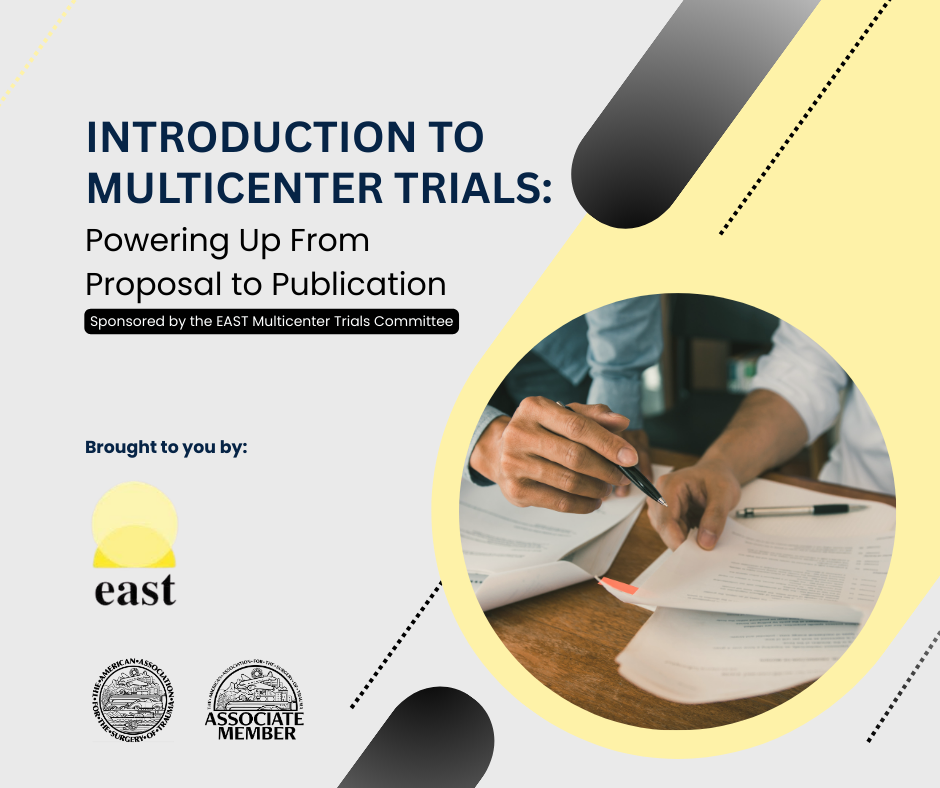
EAST's Virtual Meeting Series on Multicenter Trials continues this month with session 5: Maximizing Impact: Dissemination, Publication, Long-Term Research Success and Using CNTR Resources.
The session focuses on developing strategies for abstract and plenary submissions, developing high-impact manuscripts, structuring post-hoc analyses responsibly, and positioning results for maximum visibility within academic and professional societies.
Speakers will also address how successful trials can serve as a foundation for sustained scholarly productivity, and CNTR Executive Director, Michelle Price, will explain how to leverage CNTR resources to support study development.
Designed for young investigators, the six-part webinar series provides a structured, practical roadmap for developing, launching, managing, and publishing high-impact multicenter trials.
Recordings for the entire series will be made available following Session 6 in August.
Session: Maximizing Impact: Dissemination, Publication, Long-Term Research Success and Using CNTR Resources
Time: Wednesday, July 15, 2026 @ 3:00 p.m. (CT)
| | | CNTR Investigator Resources | | | | | Unlocking Burn and Trauma Databases: From Benchmarking to Breakthroughs | |
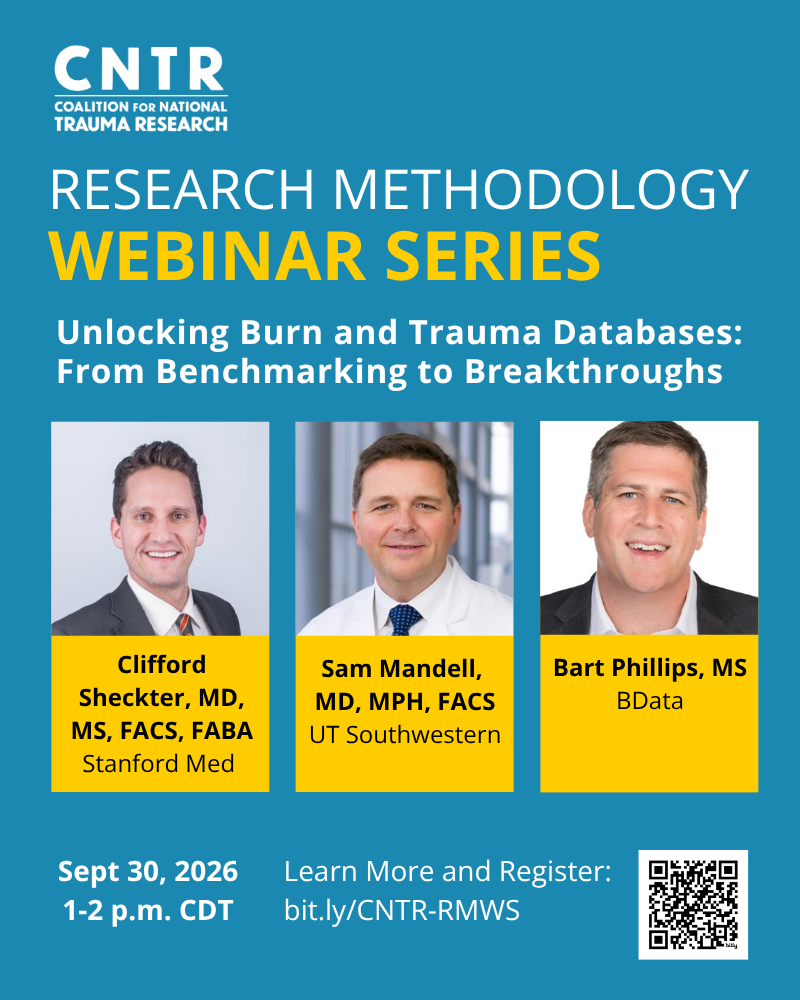
Join leading experts in burn research, Drs. Clifford Sheckter and Sam Mandell, and BData CEO Bart Phillips for an interactive webinar exploring the current landscape of burn and trauma databases and how investigators are using them to advance science, improve quality and shape future clinical trials.
You'll learn how to:
- Choose the right database for your research
- Leverage new BCQP features and resources
- Benchmark outcomes and support quality improvement
- Design more rigorous database studies
To watch recordings of past webinars, suggest topics or offer your expertise for a future session, visit the CNTR webinar page HERE.
| | |
Design for Implementation Conference Year 2 Manuscripts Published in TSACO
During the second year of the DFI conference series, the key partners in attendance tested a beta version of a clinical trauma guidance repository, heard from experts about the responsible use of AI in clinical decision making, reviewed current guidance development processes, launched an Evidence to Practice Committee at CNTR, and more.
Articles detailing conference outcomes are now available at Trauma Surgery & Acute Care Open:
- Design for Implementation: The Future of Trauma Research and Clinical Guidance (DFI) Conference Series-year 2 editorial
- Conference proceedings for the 2025 Design for Implementation: The Furue of Trauma Research and Clinical Guidance Conference Series
- Design for innovation: centering the patient voice in the development of trauma clinical guidance
- Better way: initial acceptability testing of using artificial intelligence tools to accelerate development of trauma clinical guidance
- Usability and feasibility of a mobile application for real-time trauma care guidance: considerations for user adoption
- Application of evidence into practice in trauma: the Purpose-to-Practice (P2P) approach to consensus generation
Read all the articles at TSACO
| | | |
|
National Blood Summit Returns to San Antonio
The 2026 National Blood Summit is a premier gathering of national leaders in prehospital, hospital, and military medicine focus on advancing blood research, program development, implementation strategies, and system-wide integration.
This one-day event delivers cutting-edge discussions on transfusion practices, trauma system coordination, and operational innovations that improve survival and expand blood readiness nationwide.
Speakers include John Holcomb, MD, Eric Epley, Kristan Staudenmayer, MD, Jeff Kerby, MD, Zain Hashmi, PhD, Don Jenkins, MD, and many more thought leaders in trauma systems across the country.
Date: July 21, 2026
Location: Intercontinental San Antonio Riverwalk
Cost: $275
| | | | | |
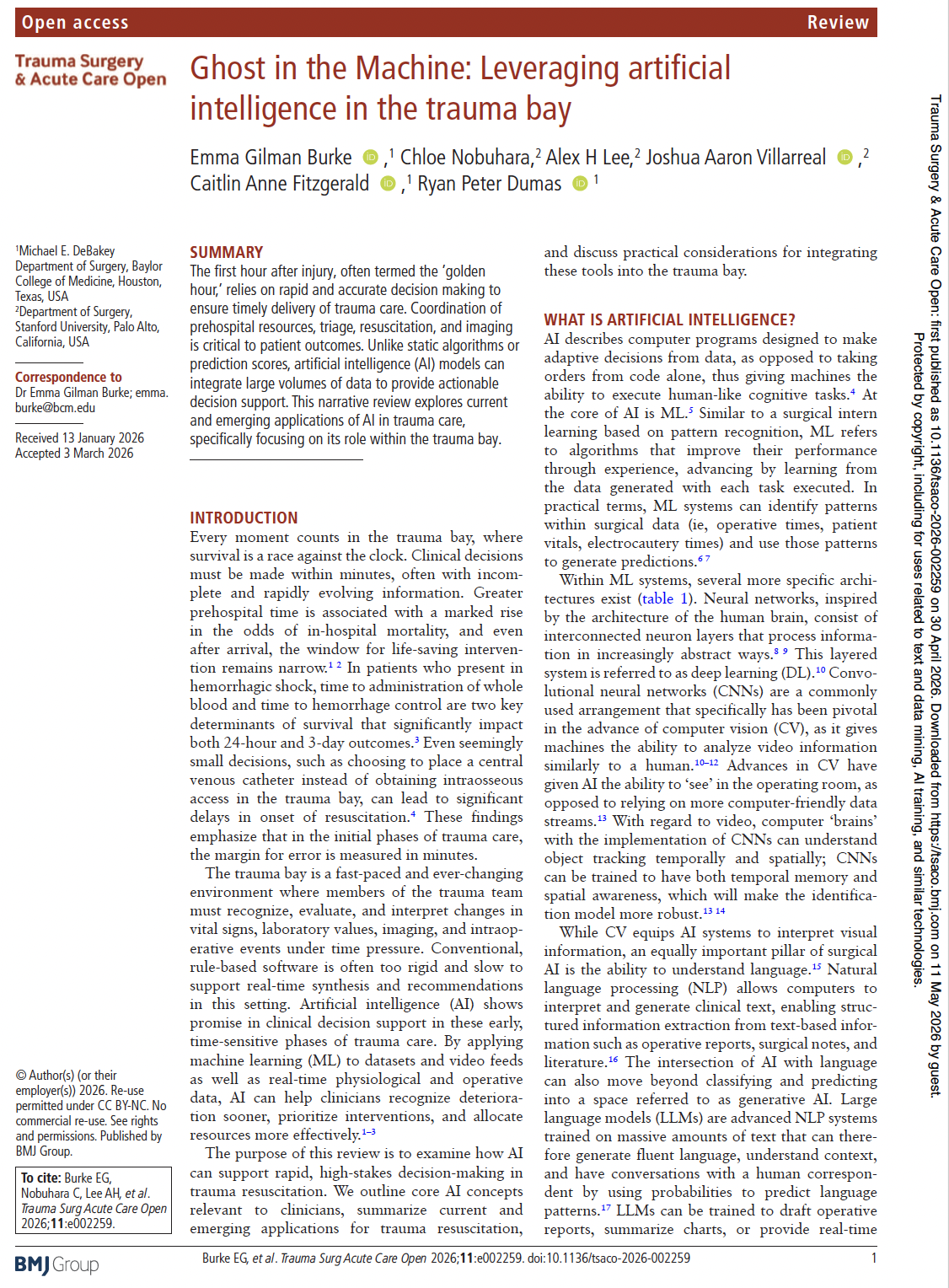
Article Explores How AI Could Change Trauma Care Forever
A new review published in Trauma Surgery & Acute Care Open explores how artificial intelligence (AI) may help trauma teams make faster, more informed decisions during the critical first hour after injury.
The manuscript, Ghost in the Machine: Leveraging Artificial Intelligence in the Trauma Bay, highlights emerging AI tools that can analyze large amounts of information in real time, including vital signs, imaging, laboratory results, and prehospital data. These technologies have the potential to help clinicians identify high-risk patients sooner, prioritize life-saving interventions, and improve coordination across the trauma system.
While many of these applications remain in development, the review outlines a future in which AI could support trauma care from the moment emergency resources are dispatched through resuscitation and definitive treatment.
Read the Article
| | | | | |