To opt out of these daily Black History emails from the Voting Rights Alliance,
please reply back to this email.
|
|
Ella Baker (1903-1986)
Corrected version
|
|
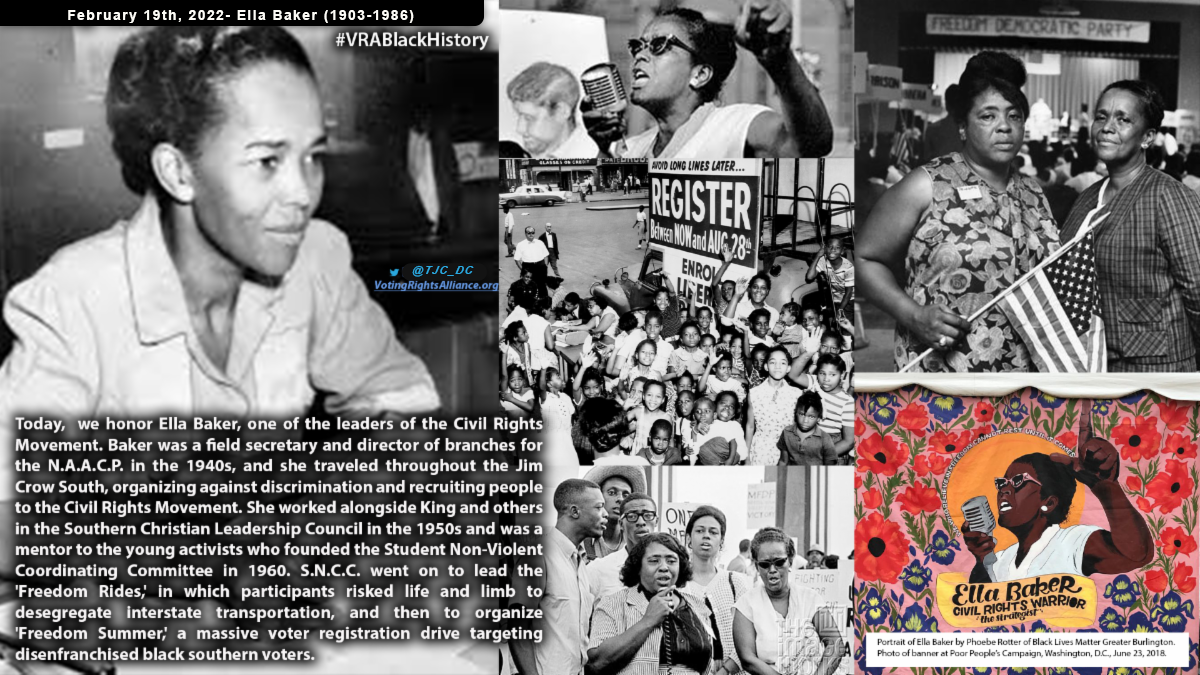
Yesterday, February 19th, 2022, we honored Ella Baker, one of the leaders of the Civil Rights Movement. The article put out yesterday incorrectly listed her year of birth and year of death incorrectly in the image and headline. We apologize for this error and thank the reader who pointed out the inconsistency.
Today's version has a corrected headline and image. The information below has also been revised to include more detail on Ella Baker's birth in 1903 and death in 1986.
Thank you.
|
|
Click the buttons below to share this article to your social networks: |
|
The Transformative Justice Coalition and the Voting Rights Alliance, in honor of Black History Month, are reviving the daily special series devoted to sharing the legacies and stories of the sheroes, heroes, and events in the fight for Black suffrage. This series was created in 2017 and will add 9 NEW articles this year. In addition to these daily newsletters all February long, this series also incorporates daily social media posts; an interactive calendar; and, website blog posts to spread the word broadly.
We encourage everyone to share this series to your networks and on social media under the hashtag #VRABlackHistory. You can also tweet us @TJC_DC to share your own facts.
|
|
"Born in Norfolk, Virginia, on 13 December 1903, Baker was raised on the same land her grandparents had worked as slaves. Baker’s childhood was marked early on by the activist spirit of her mother, a member of the local missionary association, who called on women to act as agents of social change in their communities.
[Ella Baker's] political activism began in Harlem in the 1930s. She worked with the cooperative movement during the Great Depression; supported the campaign against Italy’s invasion of Ethiopia; and opposed the racist conviction of the famed Scottsboro boys.
Baker was a field secretary and director of branches for the N.A.A.C.P. in the 1940s, and she traveled throughout the Jim Crow South, organizing against discrimination and recruiting people to the Civil Rights Movement. She worked alongside King and others in the Southern Christian Leadership Council in the 1950s and was a mentor to the young activists who founded the Student Non-Violent Coordinating Committee in 1960. S.N.C.C. went on to lead the 'Freedom Rides,' in which participants risked life and limb to desegregate interstate transportation, and then to organize 'Freedom Summer,' a massive voter registration drive targeting disenfranchised black southern voters.
In addition to continuing her involvement as an advisor to SNCC, Baker served as a consultant to the Southern Conference Education Fund throughout the mid-1960s and helped organize the Mississippi Freedom Democratic Party. She returned to New York in the late 1960s and remained active in the civil rights struggle until her death in 1986."(Ransby, B., 2020)
|
|
Fun Facts:
-
"Gov. Roy Cooper issued a proclamation declaring April 15 as Ella Baker Day in North Carolina. Previous declarations were made by the town of Littleton, Warren and Halifax counties" (Weldon, L., 2018).
- "'Fundi,' a Swhali word, was Baker's nickname, meaning a person who passes down their craft to the next generation" (Herriot, A., 2020)
Recommended Reading:
|
|
One Person, One Vote: The Legacy of SNCC and...
One Person, One Vote: the Legacy of SNCC and the Fight for Voting Rights shows how SNCC united with local people to build a grassroots movement for change.
Read more
onevotesncc.org
|
|
|
|
|
|
Did you miss any of the #VRABlackHistory series articles?
Don't forget to tell your friends!
|
|
Click the buttons below to share this article to your social networks: |
|
~References~
Ella Baker, head-and-shoulders portrait, facing slightly left. , None. [Between 1942 and 1946] [Photograph] Retrieved from the Library of Congress, https://www.loc.gov/item/94504496/
Student Nonviolent Coordinating Committee. (2020). One Person One Vote. Duke University and The SNCC (Student Nonviolent Coordinating Committee) Legacy Project. Retrieved from: http://onevotesncc.org/
|
|
|
|
|
|
|