Weekly Digest Number #4 - January 25th, 2022 |
|
CORRECTION: In the lead article reprinted below, the publication incorrectly states that the union coalition has appealed for arbitration. This is inaccurate. The CBC has appealed for mediation. See the additional articles (red buttons) below the lead article which accurately refer to the process as mediation.
|
|
(Editor's Note: This represents a major development for rail labor, as now ALL rail unions that are party to the master freight agreement are at impasse, and the opportunity for universal solidarity is at hand! It is time that the unions begin the process of preparing their members for action.) |
|
Unions Declare Impasse in Negotiations with Railroads, Will File for Arbitration |
|
The group representing rail unions in bargaining with railroad over a new general agreement says the negotiations have reached an impasse, leading them to file for arbitration.
A brief letter today (Thursday, Jan. 20) from Jeremy R. Ferguson, president of the International Association of Sheet Metal, Air, Rail and Transportation Workers-Transportation Division (SMART-TD) informed other union officials of the development. It says the Coordinated Bargaining Coalition will file for arbitration next week.
Negotiations began in February 2020 between the railroads and union coalition, which represents the American Train Dispatchers Association, Brotherhood of Locomotive Engineers and Trainmen, Brotherhood of Railroad Signalmen, International Association of Machinists, International Brotherhood of Boilermakers, National Conference of Firemen & Oilers, International Brotherhood of Electrical Workers, Transport Workers Union of America, Transportation Communications Union and SMART-TD. The industry group, the National Carriers’ Conference Committee, represents BNSF Railway, CSX Transportation, Kansas City Southern, Norfolk Southern, Union Pacific, and the U.S. railroads owned by by Canadian National.
Negotiations are held every five years and can continue as long as both sides believe progress is being made.
Crew size is a key factor in the negotiations. Before negotiations opened, railroads called for conductors to be taken off of trains to become a “ground-based” position [see “Nationwide railroad labor talks start …,” Trains News Wire, Jan. 15, 2020]. And the subject sparked a lawsuit in which SMART-TD sued the National Mediation Board after that government agency appointed an arbitrator to address the issue [see “Railroads, unions butt heads on crew size …,”News Wire, Jan. 31, 2020].
|
|
(Editor's Note: In the face of a mounting strike movement in the country and in rail labor, RWU will work in the weeks and months ahead to help prepare railroad workers for the looming confrontation.) |
|
RWU To Co-Sponsor Workshop on Railway Labor Act and Workers Rights to Strike
"Worker Rights Under the Railway Labor Act to Engage in Concerted Activity"
|
|
"Worker Rights Under the Railway Labor Act to Engage in Concerted Activity"
ALL railroad workers and allies are invited to join us for this important workshop. Railroad Workers United (RWU) has partnered with the University of Iowa Labor Center to provide this exciting event to help educate the railroad workforce about our rights under the Railway Labor Act, what the Act allows and does not allow, and how rail workers can use the law to our advantage. Please Register in advance as attendance is limited. The event is free and open to all. So please share this announcement with your fellow rail workers and encourage them to register as well. The more union members that get involved, the stronger we will be when facing off with the rail carriers!
DATE: Tuesday, February 1, 2022
TIME: 7 PM to 9 PM Central Time
FORMAT: This will be a Zoom format with a presentation by U of I Labor Center Professor Paul Iversen, to be followed by a question and answer sessions with ample time for a general discussion and strategizing session.
|
|
(Editor's Note: Roadway workers have traditionally held some of the most difficult and dangerous jobs in the rail industry. The dangers trackmen face have not been taken seriously by the rail industry, as exemplified here by the fact that all seven safety recommendations issued by NTSB five years ago remain open, five of these with unacceptable action. ) |
|
NTSB Continues to Press Worker Safety Message |
|
Five years after the Jan. 17, 2017, Edgemont, South Dakota, tragedy in which two railroad roadway workers were struck and killed by a BNSF train, the National Transportation Safety Board continues to advocate for implementation of recommendations addressing rail worker safety as a result of its investigation.
NTSB issued seven safety recommendations based on the investigation involving a westbound BNSF Railway train, traveling at 35 mph, when it struck and killed two roadway workers, including the watchman/lookout. The three-member roadway work group had been cleaning snow and ice from the track switch on the main track to prepare for the movement of a train that was to have its air brake system tested in a stationary test on the main track. The crew of the striking train sounded the train horn and bell, and both members of the train crew applied emergency braking; however, there was no response from the roadway work group, and the train was unable to stop before reaching the work location.
NTSB determined the probable cause was the improper use of train approach warning by the BNSF Railway roadway work group to provide on-track safety.
“This tragedy unfortunately exposed the many issues that still need to be addressed to protect train crews, maintenance-of-way employees, and mechanical workers from getting killed or injured,” said NTSB Board Member Thomas Chapman. “If adopted, our recommendations will help to mitigate the risks associated with this work and provide better protection to workers across all railroads.”
Of the seven safety recommendations, all remain open and five are open with unacceptable action. The recommendations issued to the Federal Railroad Administration and BNSF Railway address safety issues including improper use of train approach warning, deficient watchman/lookout equipment, and incomplete roadway worker on-track safety briefings.
|
|
Amtrak to Temporarily Reduce Service on Some Routes Due to Staffing, COVID-19 |
|
Amtrak last week announced it will temporarily reduce service on multiple routes because of staffing shortages and the spread of the omicron variant of the coronavirus.
Over the next 20 weeks, 8% of train departures will be suspended. Not only is the national intercity passenger railroad struggling to fill vacancies, but current staff have been affected by the omicron surge throughout the network, Amtrak officials said in a press release. Additionally, the railroad has noted a 25% reduction in customer demand due to the pandemic, as well as seasonal travel patterns.
Service adjustments will include:
• suspension of 8% of Northeast Regional weekly departures from Jan. 24 through March 27;
• suspension of 6% of state-supported weekly departures from Jan. 18 through March 27;
• suspension of two weekly departures on nine long distance routes from Jan. 24 through March 27, reducing weekly service from daily to five days a week. Those routes are Southwest Chief, California Zephyr, Empire Builder, Coast Starlight, Crescent, Texas Eagle, Capitol Limited, Lake Shore Limited and City of New Orleans; and ....
Amtrak offiicals anticipate that COVID-19's impact on staffing will continue to affect parts of Amtrak’s network and the availability of its fleet in the near term, said Amtrak spokesman Marc Magliari.
"As overall staffing and equipment availability levels improve, we will look for opportunities to restore service levels faster where possible," he said.
|
|
(Editor's Note: Virginia passenger rail continues to expand. Unlike many states, Virginia has advanced the process of actually purchasing right-of-way, what might be a long term solution to the problem of dealing with contrary "host" freight railroads.) |
|
Virginia Advances Plans to Return Rail to New River Valley |
|
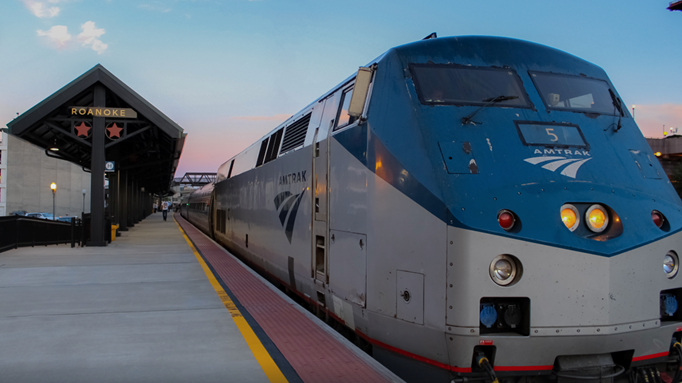
The Commonwealth of Virginia and Norfolk Southern (NS) have finalized a definitive agreement that will increase existing Amtrak service to Roanoke and expand service to the New River Valley, they reported on Jan. 13.
According to the Office of the Governor, it calls for:
• Adding a second round-trip train to Roanoke later this year. Like the current state-supported Roanoke train, the second train will serve Alexandria, Burke Centre, Manassas, Culpeper, Charlottesville, Lynchburg and Roanoke, and travel to and from Washington, D.C., and Amtrak’s Northeast Corridor. The agreement acknowledges the potential for a future station in Bedford.
• Extending service from Roanoke to Christiansburg in southwest Virginia’s New River Valley, upon completion of infrastructure improvements. It will mark the first time since 1979 that the area will have passenger rail service, which is expected to add approximately 80,000 new riders in the first year.
|
|
REMINDER: Webinar - Understanding the FRA's Expanded Grant Application Process
|
|
Join Rail Passengers Association on Wednesday, January 26th at 2pm Eastern, as we talk with the Federal Railroad Administration's Bipartisan Infrastructure Law Implementation Manager Ryan Arbuckle & Grants and Program Management Division Chief Matthew Lorah, to understand the process through which rail corridors will receive funding following the passage of the bipartisan infrastructure bill.
The Invest in Infrastructure and Jobs Act will provide $66 billion in guaranteed funding for rail over five years, with $42 billion of that flowing through the FRA in the form of competitive grants. Whether you’re a local official or a passenger-advocate, it’s important to understand the mechanics of who is eligible to apply for these funds, what that application process looks like, and the criteria the FRA will use to evaluate project submissions.
|
|
(Editor's Note: It has been nearly nine years now since the tragic train wreck that killed scores of people in this small Canadian town. Good to see the bypass plan moving forward, especially in light of CP's repurchase of the line and plans for increased train frequency in the years ahead.) |
|
Public Consultation Begins on Lac-Mégantic Bypass |
|
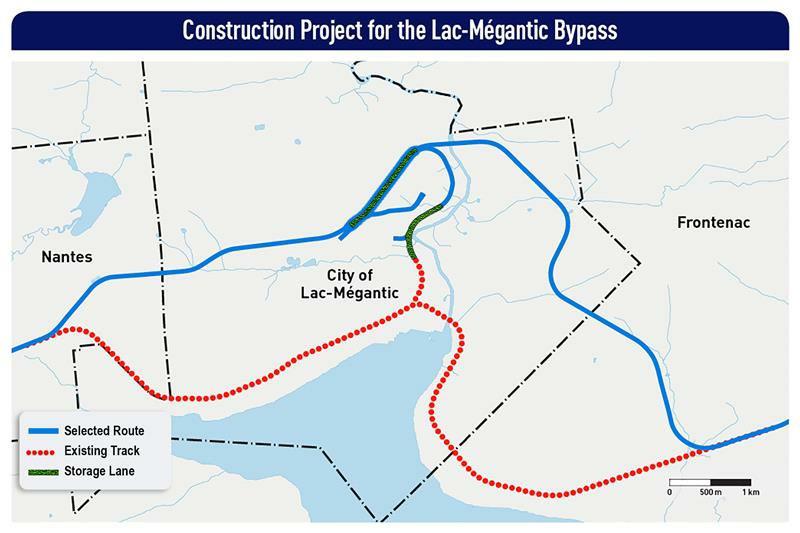
In the latest step in the process of building a new rail bypass around Lac-Mégantic and neighboring communities, Transport Canada will begin public consultation on the project as of today (Jan. 21, 2022).
Through Feb. 4, residents are invited to comment in writing on the bypass plan, including comments on “the main structures of the project, construction activities, committees, and means of communication with stakeholders and communities, and railway operations,” according to a press release.
Two online information sessions are also planned for residents on Jan. 27 to learn more about the project and ask questions — one from 1 p.m. to 3:30 p.m. and another from 6:30 p.m. to 9 p.m. More information for those interested in participating is available at this page on the Transport Canada website.
The 8-mile bypass will route Canadian Pacific’s main line around the community devastated by the 2013 Lac-Mégantic diaster. It is being funded by the governments of Canada and Quebec.
“The Lac-Mégantic bypass is a priority for the Government of Canada,” Transport Minister Omar Alghabra said in a statement. “We will continue to make every effort to carry out the project, always with the needs of the communities of Lac-Mégantic, Nantes and Frontenac in mind...."
|
|
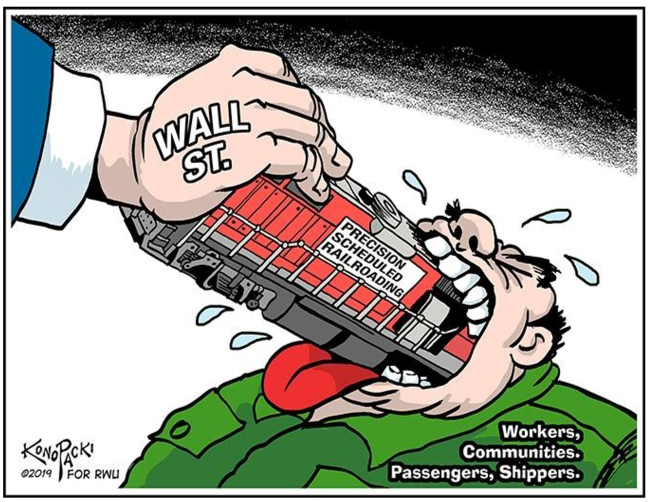
(Editor's Note: In recent years to cut costs, Union Pacific has decimated the ranks of their own "special agents" otherwise known as railroad police. Together with operating oversized and vulnerable trains, this is all part of the farce known as "Precision Scheduled Railroading." But moving to a skeletal network of police incapable of deterring trespassing, homeless encampments and theft hardly cuts costs in the long run, and does nothing for "precision" nor "scheduling", just like most other major tenants of PSR. And now because of the increase in theft, UP would like the taxpayers to pick up the policing tab while the stockholders reap the benefits of a slashed railroad police payroll.) |
|
UP Seeks Los Angeles D.A.'s Help in Stopping Cargo Thefts |
|
Union Pacific Railroad is stepping up efforts to address a spike in cargo thefts from its trains in Los Angeles.
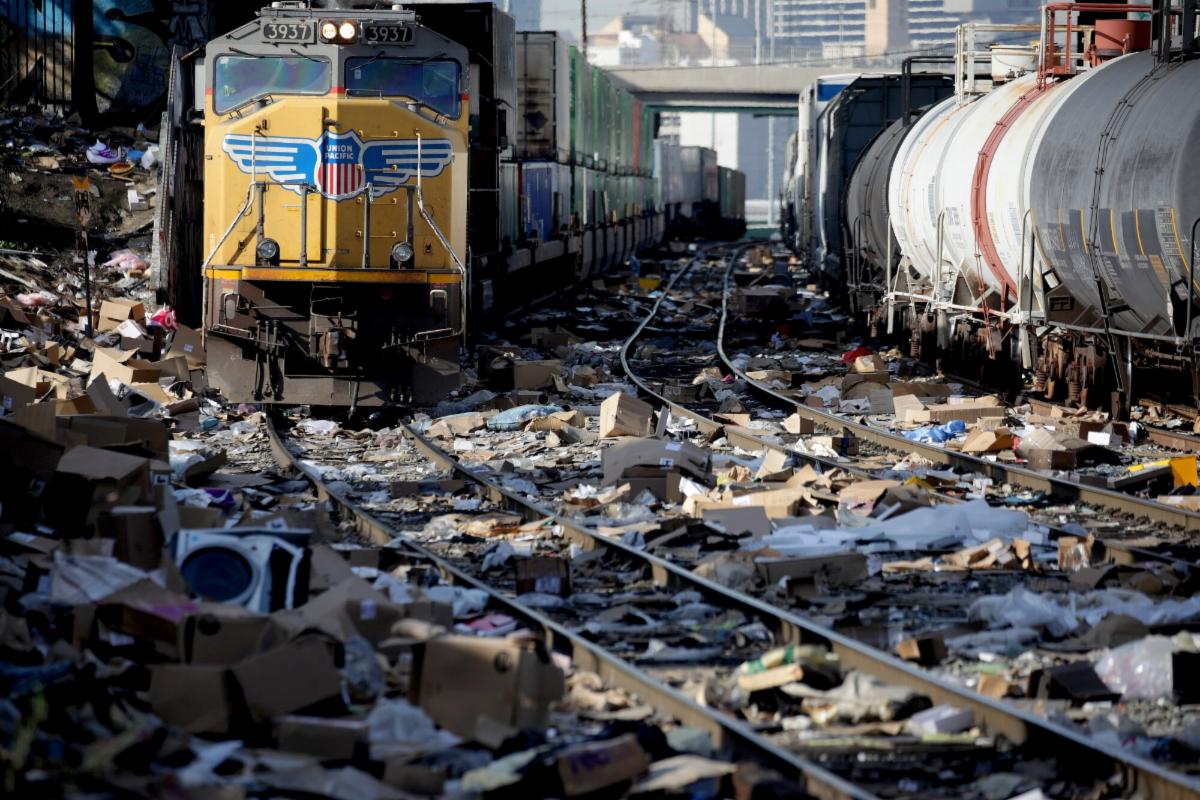
Over the past several weeks, the thefts have left UP property littered with debris, the Class I reported in its Inside Track newsletter. The incidents involve criminals climbing onto trains and breaking into containers loaded with cargo packages and merchandise destined to warehouses across the country.
UP has 1,600 employees covering 275 miles of track at its nine facilities across L.A. County. The railroad has brought in more police to protect the targeted areas and implemented drone surveillance, special fencing and trespass-detection systems.
Since December 2020, the railroad has recorded an over 160% increase in criminal theft in the county, UP General Director of Public Affairs Adrian Guerrero wrote in a letter to L.A. County District Attorney George Gascon. In October 2021 alone, criminal rail theft soared 356% compared with October 2020.
|
|
(Editor's Note: It would be helpful for STB to conduct these studies on a regular basis rather than sporadically. The striking thing about this study is that railroad rates have been increasing steadily since 2004. Simultaneously, the carloads shipped have declined. While rates are now 30% higher than they were 15 years ago, the rail industry is moving less freight than in 2006. Continuing on this trajectory is unsustainable. It is time for a new operating model.) |
|
Happy New Year! STB Releases a New Rate Study |
|
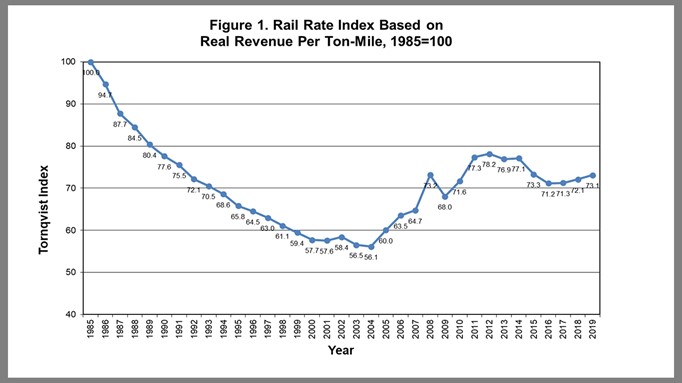
Let me provide my initial observations about what the data (all inflation adjusted numbers) show: From 2018 to 2019, rail rates rose 1.4%. Previous rate studies had shown that rates had declined for a couple decades until reversing in 2004-2005, but rates are now still lower than in 1985, 27% lower, adjusted for inflation. However, since 2004, rates have risen about 30%.
STB should study reasons for the upward rate trend since 2004. There is sure to be shipper pressure to investigate increasing rates.
I should also note that these data are based on Waybill revenue and have no associated costs. We cannot tell from the rate study whether higher rail rates mean increasing profit margins. Rates alone do not indicate increasing profits and perhaps increasing rail carrier market power.
Because higher rates might lead many to question if railroads have increasing profit margins and market power. STB should consider updating the Christensen study (A Study of Competition in the U.S. Freight Railroad Industry and Analysis of Proposals That Might Enhance Competition, Laurits R. Christensen Associates, Inc.):
|
|
(Editor's Note: The stats are seemingly going from bad to worse. Meantime, shipping costs by rail have been rising since around 2004 - see article above.) |
|
U.S. Rail Traffic Continues Downward Trend in Week 2 |
|
Total U.S. rail traffic for the week ending Jan. 15, 2022 was 493,617 carloads and intermodal units, down 6.6% from the same point last year, the Association of American Railroads (AAR) reported on Jan. 19; it is the second consecutive week that traffic has dropped.
Total carloads for week two (ending Jan. 15, 2022) came in at 233,647, up 0.5% compared with the previous-year period, while intermodal volume was 259,970 containers and trailers, down 12.2%.
|
|
(Editor's Note: As freight traffic continues to decline and freight rates climb, employment and morale plummet and employee discipline skyrockets, the nation's big Class One railroads reap record profits once again.) |
|
Union Pacific Posts Higher Revenue, Profit in Q4 |
|
The 2020 adjusted results exclude a $278 million pre-tax, non-cash impairment charge.
For Q4 2021, UP posted operating revenue of $5.7 billion, a 12% increase driven by higher fuel surcharge revenue, a positive business mix and core pricing gains, partially offset by lower volumes.
Volume, as measured by total revenue carloads, was down 4%. The Class I’s operating ratio for the quarter came in at 57.2% compared with 61% in Q4 2020.
Operating income rose 7% to $2.4 billion and the company repurchased 5.8 million shares in the quarter at an aggregate cost of $1.4 billion.
Reported net income for full-year 2021 was $6.5 billion, or $9.95 per diluted share. The full-year results compare to adjusted full-year 2020 net income of $5.6 billion, or $8.19 per diluted share, which excludes the impairment charge. The full-year operating ratio of 57.2% improved 130 basis points.
|
|
BHP Group Orders Battery-Electric Locomotives From Wabtec |
|
This is the third order to be placed by an Australian freight company for battery-electric locomotives.
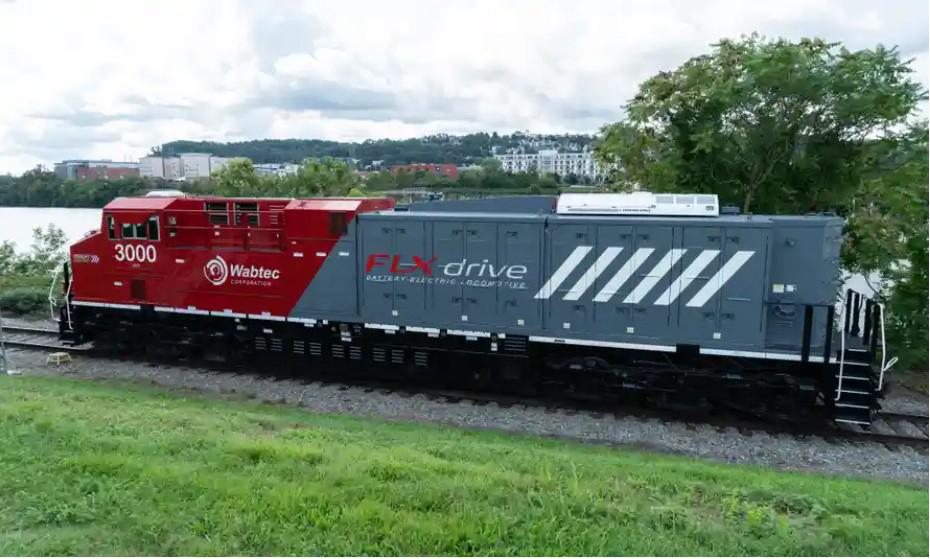
BHP subsidiary Western Australia Iron Ore (WAIO) has ordered two FLXdrive battery-electric units from Wabtec, with delivery planned for 2023.
The 7MW units, which are entirely battery-powered, are expected to reduce WAIO’s fuel costs and emissions by a double-digit percentage per train due to the topography of the Pilbara-Port Hedland route on which they will operate.
Currently, four diesel-electric locomotives in a consist are used to haul 38,000-ton trains consisting of 270 iron-ore railcars. The FLXdrive units will be formed in the consist and will recharge during the journey through regenerative braking. Wabtec’s Trip Optimizer technology will be installed on the locomotives and will determine the optimal times to discharge and recharge the batteries along the route to ensure the most fuel-efficient operation of the entire locomotive consist.
|
|
(Editor's Note: While we are saddened by this tragedy, we must ask what would make a railroad CEO take his life by jumping in front of a moving train that is operated by one of "his own" railroad employees? A decade ago, another CEO at Chicago's Metra - Philip Pagano - did the same thing on his morning commute to work May 7th, 2010 at the Crystal Lake, IL station. What does this phenomenon have to say about a railroad CEO's perspective of railroad workers?) |
|
MARTA CEO Dies by Suicide After Stepping in Front of Train |
|
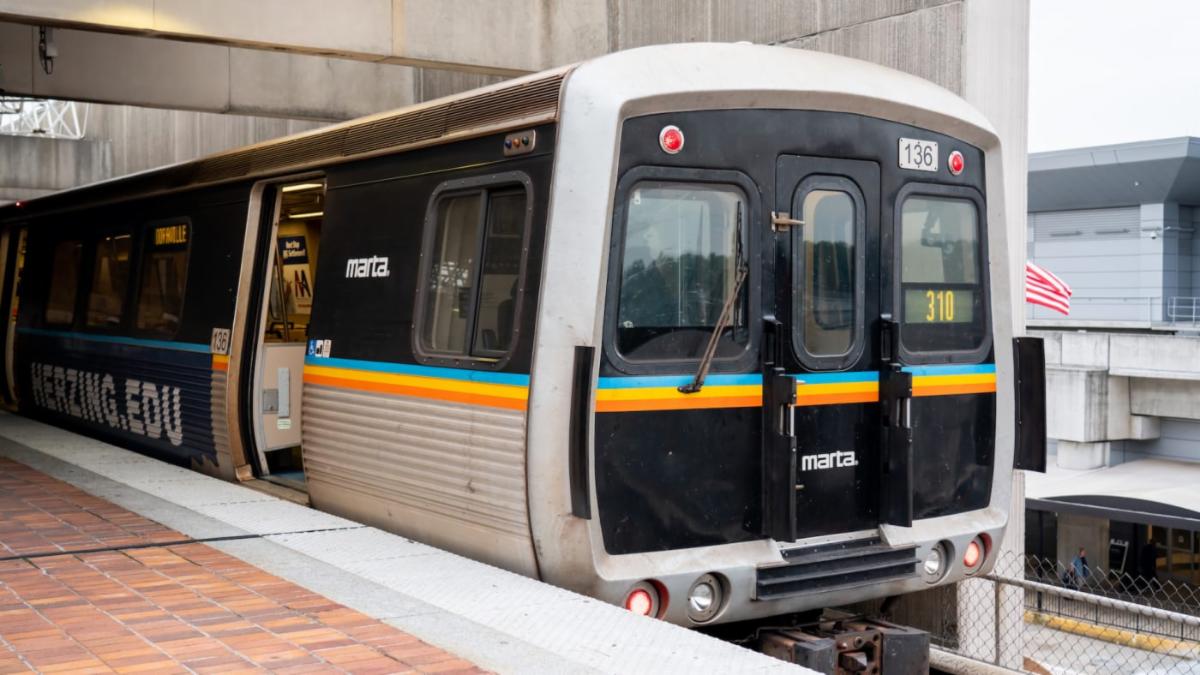
MARTA General Manager and CEO Jeffrey Parker passed away on Friday night at the age of 55, after stepping in front of an incoming train, the New York Post.
Parker oversaw the Metropolitan Atlanta Rapid Transit Authority, helping the public transportation system stay afloat as ridership plunged during the COVID-19 pandemic.
“He was an outstanding leader and steward of MARTA whose passing leaves us all heartbroken.” MARTA Chairwoman Rita Scott said in a statement. “We are devastated at this loss as we valued Jeff’s leadership and looked forward to him bringing his vision for transit to fruition. The entire metro Atlanta region owes him a debt of gratitude for his transformational efforts and we will not stop working to build on the foundation he created.”
|
|
|
|
|
|
|