For Immediate Release

October 6, 2026

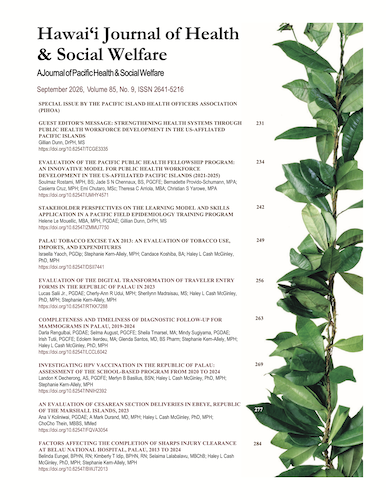
PIHOA Special Issue Highlights Strengthening Health Systems Through Public Health Workforce Development Across the

US-Affiliated Pacific Islands

Honolulu, Hawaii - The Pacific Island Health Officers Association (PIHOA) is pleased to announce the publication of a special issue of the Hawaiʻi Journal of Health & Social Welfare (September 2026, Vol. 85, No. 9), highlighting how investments in public health and epidemiology workforce development are strengthening health systems across the U.S.-Affiliated Pacific Islands (USAPIs).


The special issue features six operational research papers developed by graduates of PIHOA’s Strengthening Health Interventions in the Pacific (SHIP) Field Epidemiology Training Program (FETP), and two papers examining the broader impact of SHIP and PIHOA's Pacific Public Health Fellowship Program (PPHFP).


Key research topics explored in this issue include:


  • High Workforce Retention and Career Transitions: Demonstrating an 81% retention rate among PPHFP fellows transitioning directly into local health department roles to solve chronic staffing shortages.


  • Workplace-Based Field Epidemiology: Utilizing a "from work, at work, for work" experimental learning model to train health professionals in advanced epidemiology, health information systems, and non-communicable disease (NCD) surveillance utilizing local data.


  • Local Health Systems Strengthening and Evidence-Based Policy: Strengthening data analytics and research capacity through student-led, targeted field projects and development of interactive data dashboards to establish new and/or enhance existing evidence-based policy development and drive program/service delivery improvements.


The PIHOA Secretariat wishes to congratulate all the USAPI health agency leadership and staff who contributed as primary authors and co-authors to the publications highlighted in this special issue, and to the PIHOA Secretariat team who provided publication coordination and technical support and contribution of additional publications in the special issue. 


Read the full special issue online at: Hawai‘i Journal of Health & Social Welfare

This work is fully supported by funds made available from the U.S. Centers for Disease Control and Prevention (CDC) of the U.S. Department of Health and Human Services (HHS), through PIHOA’s Partnership Cooperative Agreement OT21-2101: Strengthening the Public Health Systems in the US-Affiliated Pacific Islands. The contents are those of the author(s) and do not necessarily represent the official views of, nor an endorsement, by CDC/HHS, or the U.S. Government.


###


About the Pacific Islands Health Officers' Association


PIHOA's mission is to improve the health and well-being of the USAPIs by providing, through consensus, a unified, credible voice on health issues of regional significance. Established in 1986, PIHOA is governed by and represents the collective interests of the USAPI health leadership from American Samoa, Federated States of Micronesia, Guam, Republic of the Marshall Islands, and the Republic of Palau. 


PIHOA’s Secretariat, comprised of executive, administrative, and technical staff and consultants, provides support to the USAPI health agencies and leadership in the following priority areas: health workforce development; epidemiology and surveillance; health systems performance improvement; laboratory services; regional health leadership and policy advocacy; Pacific health security; and partnership engagement and coordination. PIHOA has two offices in Honolulu, Hawai’i, and Hagåtña, Guam.


Media Contact


PIHOA Communications

communications@pihoa.org


Dr. Gillian Dunn, MPH, DrPH

Health Information and Management Systems and Surveillance Coordinator

gilliand@pihoa.org


Hélène Le Mouëllic, MBA, MPH, PGCFieldEpi

SHIP Program Manager

helenel@pihoa.org


Soulmaz Rostami, MPH

PPHFP Program Manager

soumazr@pihoa.org