|
Tomorrow: Benchmarks WILL
Be Hosting Our Friday Membership Webinar With Guest Dave Richard
Date: July 31, 2020
Time: 8:30 am
|
NC DSS 2020 COVID-19 Recovery Act Funds
From Linda Waite: NC DHHS recognizes that the on-going COVID-19 public health crisis has impacted families and children across our state in many ways. The daily needs of children, youth, young adults, and families have increased, and financial resources have been overburdened.
As part of the on-going effort to address these needs, the General Assembly passed Session Law 2020-4, the 2020 COVID-19 Recovery Act, which appropriated federal CARES Act funding for children receiving foster care services. County DSS access to these funds, for children in their custody, has been made available through a process described in a Directors Letter (BG-08-2020) dated June 15, 2020.
These additional funds currently consist of a supplemental payment of $100 per month for each child or youth receiving foster care services during the months of April, May, and June 2020. The funds are intended to benefit the children and youth directly. Upon receipt by the County DSS, they should be paid directly to the foster family, or residential care provider, who cared for the child or youth during this period, or to the private child placing agency that supervised the foster family who should, in turn, pay the additional funds to the foster family. Young adults in the Foster Care 18 to 21 program should receive the funds in the same manner that their board rate is received. For example, if they receive their board funds directly, they should receive the supplemental payment directly. These funds are not intended to be used in the support of case work activities or administrative costs.
If you have questions or need clarification about the 2020 COVID-19 Recovery Act funds, please contact your Regional Child Welfare Consultant or your assigned Regulatory and Licensing Program Consultant.
Thank you for your anticipated participation and cooperation in this important process and, as always, thank you for your dedication to serving children and families.
Stakeholder Updates
PRESS RELEASES
since the last update include:
UPDATED
guidance since the last update include:
UPDATED
reports since the last update include:
Re-Opening Schools-Exceptional Children Division Statement
On Tuesday, July 14, 2020, Governor Cooper announced that school buildings would re-open using the guidelines for Plan B. However, Phase 2 (Safer at Home) requirements are still in effect for the next three weeks. Under Phase 2, school buildings are closed.
As public schools prepare to re-open it is important that the EC Division (ECD) provide updated guidance regarding the provision of a free appropriate public education to children with disabilities. Guidance, issued prior to this document, was offered as a result of the sudden school closures that occurred nationally and was expressly intended to assist local education agencies (LEAs) in adapting to communication provided by the federal government, state government and the NC Department of Public Instruction during the crisis experienced in the Spring of the 2019-2020 SY.
At this time, the ECD has the opportunity to provide more clarity about how to move forward with re-opening and the implementation of individualized education programs (IEPs). Therefore, guidance issued by the ECD specifically addressing issues in the Spring of the 2019-2020 SY should not be generalized to the beginning of the 2020-2021 SY even though some circumstances may be similar.
NC Department of Information Technology
Feasibility Study Recommends Ways to Increase Access to Broadband, Telehealth Services in Western N.C.
In an effort to increase access to telehealth in western North Carolina, the N.C. Broadband Infrastructure Office and the N.C. Office of Rural Health today released a study on how to increase broadband access, adoption and use, and strengthen the implementation of telehealth services.
The
Broadband Feasibility Study for Telehealth in Western North Carolina
is the result of more than nine months of data collection and research on best practices. Although the study began before the COVID-19 pandemic hit North Carolina, telehealth has become increasingly urgent to respond to the public health crisis, especially in the most underserved parts of the state.
"In our current situation, we appreciate the value of telehealth services more than ever before," said Jeff Sural, director of the N.C. Broadband Infrastructure Office (BIO). The office is a division of the N.C. Department of Information Technology. "Telehealth services provide access to care for our most vulnerable citizens across the state when leaving home is a challenge or even risky. Understanding those challenges so that we can build strategies and programs to increase telehealth opportunities is critical."
In February 2019, the Appalachian Regional Commission (ARC) awarded NCDIT, BIO and the N.C. Department of Health and Human Services (DHHS) Office of Rural Health (ORH) a $98,000 Partnerships for Opportunity and Workforce and Economic Recovery (POWER) grant. The purpose of the POWER grant was to study and make recommendations to increase broadband access, adoption and use, and strengthen the implementation of telehealth services.
"The N.C. DHHS Office of Rural Health is proud to partner with NCDIT in this effort. The need for broadband access and the ability to access healthcare, education and employment resources has been amplified by the COVID-19 pandemic." Maggie Sauer, director of the ORH, said. "The POWER grant afforded our teams, the opportunity to work collaboratively across state government, geography and community stakeholders to complete the study. Targeting our efforts to reduce the gaps in broadband access has far-reaching impact."
Through the study, the project team identified the broadband, health care and telehealth assets and gaps in the 20 coal-impacted counties in the Appalachian region in order to design pilot programs that leverage technology to provide appropriate clinical interventions, improve the local population's health, increase local workforce participation and ultimately improve local economies.
The study includes two dashboards with data visualizations designed to illustrate the region's capacity to improve both access to and adoption of broadband services and expanded telehealth use. The Broadband Adoption Potential Index is based on U.S. Census information collected from communities in the ARC region and examines broadband access, subscription data and computer ownership. The Internet Access and SafetyNet Sites in North Carolina's ARC region shows the distribution of SafetyNet Sites, community anchor institutions, and, where available, households without internet access in those counties.
In addition to the study, BIO released the
North Carolina Broadband Survey
last week. Information gathered in the survey will be used to provide context to the state's broadband picture, informing Gov. Roy Cooper's initiatives on expanding broadband access, guiding funding opportunities through North Carolina's Growing Rural Economies with Access to Technology (GREAT) grant program, shaping research and policy recommendations, and supporting strategic targeting of additional funding channels to ensure all North Carolinians have access to affordable high-speed internet.
|
Details on Delayed Implementation for New Information Required in Applications for Individual Providers
Below is a list of the communications that have been published regarding these system changes. This delayed implementation date will apply to all of the changes detailed in these communications:
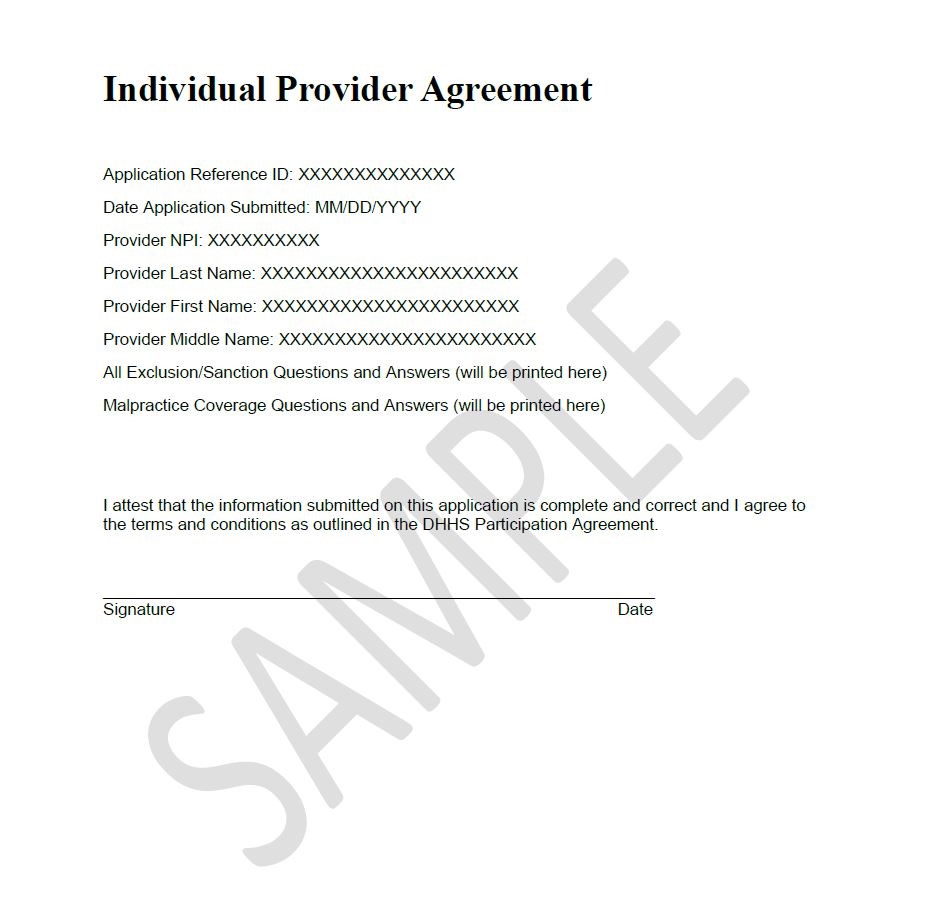
In addition, the two new sanction questions (L and M) and the Individual Provider Agreement shown below previously detailed in these communications will no longer be required in any applications as part of this update. Only the new Provider Supplemental Information page will be required. All website references to these items are in the process of being removed to avoid confusion.
- L. Does the enrolling provider have any medical, chemical dependency or psychiatric conditions that might adversely affect your ability to practice medicine or surgery or to perform the essential functions of your position?
- M. Has the enrolling provider had any malpractice judgements or settlements in the past five years?
New Clinical Coverage Policies Bulletin
The NC Division of Health Benefits (DHB) has recently published a new Medicaid Bulletin, Clinical Coverage Policies. This bulletin details new or amended clinical coverage policies.
View updated policies
July Pharmacy Newsletter Now Available
The latest Medicaid Pharmacy Newsletter, dated July 2020, is now available on the N.C. Medicaid website. In addition to the Aug. 2020 checkwrite schedule, this edition of the newsletter includes the article Preferred Brands with Non-Preferred Generics on the Preferred Drug List (PDL). The PDL is current as of July 22, 2020.
|
Referred to as a form of "modern-day slavery," human trafficking occurs in every state and is not limited by the size of a community. Health services are one of the most common points of access to a lifeline for those actively being trafficked, giving healthcare professionals an advantage to help victims escape. A rural hospital CEO, a SORH director, a Sexual Assault Nurse Examiner, and a Safe Harbor Regional Navigator share how they combat human trafficking through training and raising awareness...
Rural Healthcare Surge Readiness
Developed by the COVID-19 Healthcare Resilience Working Group, this new tool provides critical resources for rural healthcare facilities to prepare for and respond to a COVID-19 surge.
|
2020 KIDS COUNT Data Book
2020 State Trends in Child Well-Being
Summary
The 31st edition of the Annie E. Casey Foundation's KIDS COUNT® Data Book describes how children across the United States were faring before the coronavirus pandemic began.
This year's publication continues to deliver the Foundation's annual state rankings and the latest available data on child well-being. It also identifies multi-year trends - comparing statistics from 2010 to 2018. As always, policymakers, researchers and advocates can continue using this information to help shape their work and build a stronger future for children, families and communities.
|
e-News for Small Business Issue 13
Temporary suspension of limits on charitable contributions
The CARES act suspended limits on charitable contributions for individuals and corporations. Individuals may deduct qualified charitable contributions up to 100 percent of their adjusted gross income. A corporation may deduct qualified charitable contributions up to 25 percent of its taxable income.
Both individuals and corporations can carry over to the next year contributions that exceed the AGI limitation. To qualify, the contribution must be:
- a cash contribution;
- made to a qualifying organization;
- made during the calendar year 2020
Temporary increase in limits on contributions of food inventory
The CARES act created a special rule allowing greater deductions by businesses for contributions of food inventory for the care of the ill, needy or infants. Businesses that contribute food inventory in 2020 may deduct up to 25 percent of their net income or taxable income. Additional information is available on IRS.gov.
IRS tax help available for those who filed an extension
The deadline for taxpayers who requested an extension to file their 2019 federal tax returns is October 15, 2020. Those who have not yet filed can find many helpful resources on IRS.gov:
- IRS Free File: Taxpayers who earned $69,000 or less in 2019 can file using free brand-name tax software.
- Interactive Tax Assistant: This online tool provides answers to tax law questions.
- Directory of Tax Return Preparers: For taxpayers who want help with their taxes, this tool can help them find a tax professional in their area.
- Where's My Refund? Taxpayers can check the status of their refund within 24 hours after the IRS has received their e-filed return.##
IRS advice for those who didn't file an extension
The IRS cautions taxpayers who missed the July 15 tax deadline and didn't request an extension, to file as soon as possible to reduce potential penalties. e-Filing returns can help expedite the process.
An extension to file is not an extension to pay; penalties and interest will apply to taxes owed after July 15. A taxpayer will usually qualify for relief if they have filed and paid timely for the past three years and meet other requirements. More information is on the first-time penalty abatement page on IRS.gov.
Businesses filing cash transaction reports have e-file option
The IRS reminds businesses required to file reports of large cash transactions that e-filing is a fast, easy and secure option for filing their reports. Now, businesses can batch-file their reports, which is helpful when required to file many forms.
Although businesses have the option of filing Form 8300, Report of Cash Payments Over $10,000, on paper, many have found the free and secure e-filing system is a more convenient and cost-effective way to meet the reporting deadline. The form is due 15 days after a transaction and there's no charge for the e-file option.
For more information, see the fact sheet on reporting cash transactions.
IRS Form 7200 fax line
Employers use Form 7200 to request an advance payment of the tax credits for qualified sick and qualified family leave wages and the employee retention credit. The employer tax credits for qualified sick leave wages and qualified family leave wages apply to those wages paid from April 1, 2020, to December 31, 2020.
Businesses should fax the completed form to 855-248-0552.
Due to scheduled maintenance, the 7200 fax line will be unavailable from August 7 at 10 p.m. to August 8 at 7 a.m. ET.
IRS Freedom of Information Library
The IRS Freedom of Information Act (FOIA) Library , provides a comprehensive list of documents and other information available electronically on IRS.gov. The library has links to many records that may be of interest to small business tax professionals and managers, such as:
- Frequently Requested Documents like Active Enrolled Agents Listing, Return Preparer Tax Identification Number (PTIN) Listing, and External Customer Data Store (ECDS) Extracts.
- Published Tax Guidance including Final, Temporary, and Proposed Regulations, as well as IRS Publications and Notices.
- Admin Manuals and Instructions such as Chief Counsel Notices and Internal Revenue Manuals.
|
Today we are excited to launch a fully redesigned FEMA.gov that is easy to navigate, focused on the user and accessible by all. This is a big step towards reducing the complexity of FEMA, one of the three main strategic goals for the agency.
Over the past two years, FEMA.gov has been visited over 80 million times, making it our most important communication tool to provide disaster survivors, emergency managers, government and private sector officials, and first responders with the information and assistance they need before, during and after disaster. Today we are excited to launch a fully redesigned FEMA.gov that is easy to navigate, focused on the user and accessible by all. This is a big step towards
reducing the complexity of FEMA, one of the three main strategic goals for the agency.
This redesign is an opportunity to start fresh. We've upgraded our content management system and fully implemented the
U.S. Web Design System for greater accessibility and mobile-friendly user experiences. Our team worked across the entire agency with program experts to rewrite thousands of pages in plain language and reorganize the information to make it easier for people to find what they are looking for.
|
Thursday: July 30, 2020
If you are 5-10 years away from retirement, join
Retirement: Are You Ready?
Time: 2:00 pm thru 3:30 pm
|
Thursday: July 30, 2020
Human Service Provision in High Stress Environments, Skills and Strategies for Provider Self-Care
Time: 2:00 pm thru 3:30 pm
|
Friday: July 31, 2020
Benchmarks' Friday Membership Call Featuring
Dave Richard & Karen McLeod
Time: 8:30 am thru 9:30 am
|
Tuesday: August 4, 2020
Addressing the Intersection of Substance Use and Suicide: Strategies for Prevention, Intervention, and Treatment
Time: 2:00 pm thru 3:30 pm
|
Wednesday: August 5, 2020
Parents Can We Talk: IEP & Disability Rights (ONLY FOR NC FAMILIES)
Time: 10:00 am thru 11:30 am
|
New: Wednesday: August 5, 2020
Rethinking Employment Services and Supports in the COVID-19 Era
Time: 2:00 pm thru 3:30 pm
|
Please click on each of the following links to view details sent out from each LME/MCO.
Benchmarks' wants to be sure to make the following list handy for our members to visit and suggests a peek at least once per week to find information that may be pertinent to your agency and contracts.
|
|
|
|
|
|