|
Benchmarks' Friday Special
Report & Written Update
|
| Benchmarks Special Report
October 16, 2020 |
Cases Hospitalized: 1,096
NC Deaths: 3874
Positive Tests: 7 day average was 5.9 %
$20 Billion in New Phase 3 Provider Relief Federal Funding
The U.S. Department of Health and Human Services (HHS), through the Health Resources and Services Administration (HRSA), is announcing $20 billion in new funding for providers on the frontlines of the coronavirus pandemic. Under this Phase 3 General Distribution allocation, providers that have already received Provider Relief Fund payments will be invited to apply for additional funding that considers financial losses and changes in operating expenses caused by the coronavirus. Previously ineligible providers, such as those who began practicing in 2020 will also be invited to apply, and an expanded group of behavioral health providers confronting the emergence of increased mental health and substance use issues exacerbated by the pandemic will also be eligible for relief payments.
Providers can begin applying for funds on Monday, October 5, 2020.
HHS has already issued over $100 billion in relief funding to providers through prior distributions. Still, HHS recognizes that many providers continue to struggle financially from COVID-19's impact. For eligible providers, the new Phase 3 General Distribution is designed to balance an equitable payment of 2 percent of annual revenue from patient care for all applicants plus an add-on payment to account for revenue losses and expenses attributable to COVID-19.
Further, HHS recognizes constraints such as the stay-at-home orders and social isolation have been particularly difficult for many Americans. A recent Centers for Disease Control and Prevention (CDC) report found the prevalence of symptoms of anxiety disorder in the second quarter of 2020 was approximately three times those that reported in the second quarter of 2019 (25.5% versus 8.1%); and the prevalence of depressive disorder was approximately four times that reported in the second quarter of 2019 (24.3% versus 6.5%). Our behavioral health providers have shouldered the burden of responding and confronting this expanded challenge triggered by the pandemic. When traditional face-to-face counseling was restricted and new telehealth flexibilities were put in place in response to the pandemic, many behavioral health providers invested in and adopted - PDF telehealth technologies to continue providing patient care. While some Medicare or Medicaid behavioral health providers have already received prior General Distribution payments, others have not. Working with the Substance Abuse and Mental Health Services Administration (SAMHSA), HRSA developed a list of the nation's behavioral health providers now eligible for funding, which includes, for example, addiction counseling centers, mental health counselors, and psychiatrists.
Eligibility
HHS is making a large number of providers eligible for Phase 3 General Distribution funding, including:
Providers who previously received, rejected or accepted a General Distribution Provider Relief Fund payment. Providers that have already received payments of approximately 2% of annual revenue from patient care may submit more information to become eligible for an additional payment.
Behavioral Health providers, including those that previously received funding and new providers.
Healthcare providers that began practicing January 1, 2020 through March 31, 2020. This includes Medicare, Medicaid, CHIP, dentists, assisted living facilities and behavioral health providers.
Payment Methodology - Apply Early
All eligible providers will be considered for payment against the below criteria.
All provider submissions will be reviewed to confirm they have received a Provider Relief Fund payment equal to approximately 2 percent of patient care revenue from prior general distributions. Applicants that have not yet received Relief Fund payments of 2 percent of patient revenue will receive a payment that, when combined with prior payments (if any), equals 2 percent of patient care revenue.
With the remaining balance of the $20 billion budget, HRSA will then calculate an equitable add-on payment that considers the following:
- A provider's change in operating revenues from patient care
- A provider's change in operating expenses from patient care, including expenses incurred related to coronavirus
- Payments already received through prior Provider Relief Fund distributions.
We know providers want to receive payments shortly after submitting their information. However, this distribution requires cooperation on the part of all applicants. Again, HHS is urging all eligible providers to apply early; do not wait until the last day or week of the application period. Applying early will help to expedite HHS's review process and payment calculations, and ultimately accelerate the distribution of all payments.
All payment recipients will be required to attest to receiving the Phase 3 General Distribution payment and accept the associated Terms and Conditions.
Application Deadline
Providers will have from October 5, 2020 through November 6, 2020 to apply for Phase 3 General Distribution funding. HHS's top priority is ensuring as many providers possible have an opportunity to apply. HHS will continue to host webinars to assist providers through the application process and the call center is also available to address questions.
HHS recognizes the multifaceted challenges of this pandemic cannot be won without frontline healthcare providers focused on containing the virus and delivering holistic care. Funding for this Phase 3 General Distribution was made possible through the bipartisan CARES Act and the Paycheck Protection Program and Health Care Enhancement Act, which allocated $175 billion in relief funds to hospitals and other healthcare providers.
Uninsured Payment Portal
North Carolina Department of Health and Human Services (DHHS) developed a program to reimburse primary care providers (PCP) with federal funds for providing care for COVID-19 related services (e.g. follow-up care) to uninsured North Carolina residents.
An NCTracks Portal to submit claims is scheduled to go live late October and claims will be retroactively reimbursed to Sept. 1, 2020. A payment of $150 per eligible encounter enables providers to recoup costs for COVID-19 related services provided for uninsured patients. $7.8M is available to support this program through Dec. 30, 2020, or until the funds are depleted, whichever occurs first. Reimbursement will be made on a first-come first-served basis.
Medicaid Expansion
WNCT NEWS, 10/12/20
Members of the North Carolina House of Representatives stood together (although, at six-feet apart) in Thomas Foreman Park to push their health care plan. They say their number one priority this election season is expanding Medicaid, a health insurance program covered by the federal government for low-income people. N.C. House Minority Leader Darren Jackson, D-Wake, says their only challenge expanding Medicaid are Republicans in the State House "stonewalling" legislation. "Back in 2011 they passed a law, Speaker Thom Tillis said we couldn't expand Medicaid, Governor Purdue vetoed that bill, then McCrory was elected Governor in 2012 he immediately passed another one in 2013, again under Speaker Thom Tillis. We need to repeal that law and submit our application to Medicaid," Jackson said.
Democrats say that expanding Medicaid in North Carolina will come at no cost to voters. That's because hospitals and healthcare providers have agreed to pick up the 10 percent fee that comes with the application. North Carolinians are already paying for Medicaid in other states, and even in D.C. According to the U.S. Census Bureau, North Carolina ranks among the ten states with the least amount of insured residents. The number of residents without access are rising due to pandemic related job loss. Brian Farkas, Candidate for N.C. House of Representatives in District 9 says that expanding Medicaid could do much more than ensure citizens.
Atrium Health
Hannah Smoot, THE CHARLOTTE OBSERVER, 10/09/20
In a major change for healthcare and education in the Charlotte region, Atrium Health announced Friday it has officially combined with Wake Forest Baptist Health, including the Wake Forest School of Medicine. The partnership will bring a medical school to Charlotte, which is the largest city in the U.S. without a four-year medical school, according to Atrium. It's part of an ambitious move to "create a 'Silicon Valley' for healthcare innovation, spanning from Winston-Salem to Charlotte," Atrium CEO Gene Woods said in a news conference Friday.
The partnership was first announced in April 2019. The combined health system will have over 70,000 employees, 42 hospitals and more than 1,500 care locations, according to Atrium. Atrium gave a first look at renderings of the future Charlotte medical school in August. The medical school could launch with 3,200 students across 100 programs and 1,600 faculty members, Woods said at the time. Woods hasn't said when the medical school in Charlotte could open. The official combination announcement had to wait for approval from the Federal Trade Commission. That approval came last week, Woods said.
The announcement also comes just days after rival hospital system Novant Health landed a critical vote in a $5 billion deal to buy a Wilmington hospital, expanding into southeastern N.C. Novant could have more than 36,000 employees after that deal goes through state regulatory review. Both deals follow a trend toward hospital consolidation across the country. But some critics of consolidation warn it can mean rising prices for patients.
Some of the details of the Atrium and Wake Forest Baptist combination are still unclear. But if the two systems plan to negotiate with insurance companies as one entity, "Patients, frankly, can expect higher prices and expect higher insurance premiums," said Barak Richman, a Duke Law School professor with expertise in health care policy. "That's a prediction that is borne out very thoroughly."
In a statement, Atrium spokesman Dan Fogleman said all current agreements with insurance companies will remain in place, adding, "We will be approaching future contracts with a shared services approach when and where it makes sense." The health systems will combine under the name Atrium Health. Based on an independent economic analysis, the immediate direct and indirect annual economic and employment impact from the combined enterprise exceeds $32 billion and 180,000 jobs, according to Atrium.
IRS Issues Final Rules For ABLE Accounts
by Michelle Diament
Federal officials are firming up rules for a relatively new type of account that allows people with disabilities to save money without jeopardizing their government benefits.
The Internal Revenue Service issued final regulations this month spelling out details about how ABLE accounts should operate.
The accounts, which were established by the 2014 ABLE Act, allow individuals with disabilities to accrue up to $100,000 without risking eligibility for Social Security and other government benefits. Medicaid can be retained no matter how much money is saved in the accounts.
The rules released this month stem from when the accounts were originally created as well as tweaks to the law that came in 2017 tax-cut legislation. Many of the changes have already been in effect, but the IRS said the final regulations clarify specifics and address comments the agency received in response to previous proposals about how the law would be applied.
Annual deposits to ABLE accounts are capped at the value of the gift tax exclusion for any given year, currently $15,000 annually.
However, under the final rules, people with disabilities who are employed can deposit their earnings in ABLE accounts, above and beyond the existing contribution cap for the year. These individuals can save whatever money they earn in their ABLE account up to the value of the poverty line in the state where they live.
The IRS said that workers with disabilities who have ABLE accounts can also qualify for a Saver's Credit, which can reduce their federal tax bill.
Separately, money saved in a traditional 529 college savings plan for an individual with a disability or a family member can be rolled over into an ABLE account up to the maximum annual contribution limit. The rules indicate that this option is available until Jan. 1, 2026.
The regulations also offer guidance on the record-keeping and reporting requirements of ABLE programs as well as other specifics about the mechanics of the accounts.
ABLE accounts are open to people with disabilities that onset prior to age 26. Money saved in the accounts can be used for education, housing, transportation, employment training and support, assistive technology, personal support services and other "qualified disability expenses."
Currently, 42 states and Washington, D.C. have active ABLE programs, many of which are open to people with disabilities nationwide, according to the ABLE National Resource Center.
As of June, data from ISS Market Intelligence shows that there are nearly 71,000 ABLE accounts open nationally with $469.4 million in assets.
DSS Hearing
Colin Campbell, THE INSIDER, 10/14/20
State legislators grilled Buncombe County's social services director for hours Tuesday about a child welfare case there. The Joint Legislative Oversight Committee on Health and Human Services subpoenaed Buncombe County Health and Human Services Director Talmadge "Stoney" Blevins over an incident in which police say DSS told them to leave a 9-year-old girl with a stranger in a hotel room that contained more than 100 hypodermic needles. Blevins answered some questions about the incident and his department's policies, but he said confidentiality laws prevent him from releasing more details about the case. Rep. Donny Lambeth, R-Forsyth and chairman of the committee, said at the start of the meeting that the subpoena wasn't ultimately necessary and that Blevins was appearing voluntarily, but Blevins told the committee that he believes he was under subpoena.
Blevins said that if he wasn't bound by confidentiality laws, "I think we could put the miscommunication and misunderstandings at rest in 10 minutes tops," but the rules were put in place to protect children. Only a judge could order the public release of further details in the case, he said, but he stressed that at his department, "no staff member has ever given the advice to a police officer to leave a child in a room with a stranger with 100-200 needles."
But police in Black Mountain have said DSS refused to pick up the child, according to the Asheville Citizen-Times, and instructed them to leave her in the room. Blevins said the incident prompted his agency to formalize its cooperative agreements with law enforcement, and now social workers are required to respond to the scene of similar incidents. "The only breakdown I can see is a break in communication," he said of the circumstances of the March incident. "That's why we implemented a policy to go on-site, which we don't have to do, but it would eliminate a situation like that from happening."
Republican legislators on the committee weren't happy with Blevins' unwillingness to provide further details. Sen. Ralph Hise, R-Mitchell, said that legislative oversight committees have subpoena powers to gather information about the activities of state government, and they shouldn't "have to seek permission from the judicial branch to do our job." Rep. Larry Potts, R-Davidson, complained that "it seems like we spent 50 minutes here doing a lecture on confidentiality." Sen. Chuck Edwards, R-Henderson, who brought the matter before the committee, said he's heard about similar incidents in other counties. "What took place really puts a spotlight on a couple of broader issues," he said. Asked what changes are needed to improve the child welfare system at a broader level, Blevins cited a number of studies conducted in recent years. "We have a broken child welfare system that we refuse to invest in, and then we seem surprised when it fails," he said.
|
|
Call For Proposals One Community in Recovery Conference
The planning committee for the NC "One Community in Recovery" Conference is excited to announce the dates for our 12th annual program. As we chose our theme for this year, "Inclusion, Justice, and Reflection: The Hindsight of 2020," we talked about how the COVID-19 pandemic has worsened existing health disparities and brought new light to the need for racial and social justice and inclusion. We alsotalked about how this has been a time of reflection.
We are actively seeking proposals that will explore diverse topics and disseminate new concepts about recovery and resiliency throughout our state.
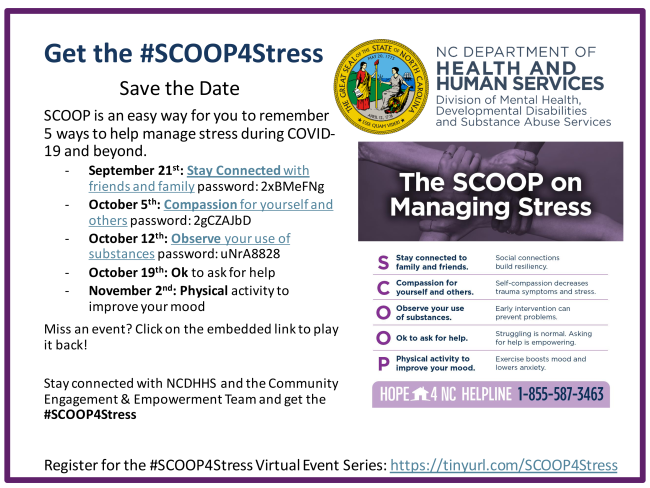
Access Recordings of Past SCOOP Webinars on Managing Stress and Register for Upcoming Webinars (Thank you, Leslie Kellenberger!!!!)
|
Grants to develop and expand experiential training opportunities, such as field placements and internships, to improve the distribution and supply of the behavioral health workforce. The program emphasizes relationships with community-based partners to increase access to quality behavioral health services across the lifespan in high need and high demand areas. Special focus is placed on demonstrating knowledge and understanding of the specific concerns for children, adolescents, and transitional-aged youth who are at risk for behavioral health disorders.
Geographic coverage: Nationwide
Application Deadline: Jan 21, 2021
Sponsors: Bureau of Health Workforce, Health Resources and Services Administration, U.S. Department of Health and Human Services
Provides a national-level overview of geographic disparities in life expectancy at mid-adulthood, as well as changes to life expectancy between 1980 and 2014. Discusses gender, racial, and rural differences in life expectancy. Presents nine strategies to address the geographic disparities.
Sponsoring organization: AARP
In a separate brief, the CDC reports that, between 2009 and 2018, the rate of overdose deaths involving cocaine rose significantly across all age groups, gender identities, and racial/ethnic categories. The overdose death rate in 2018 involving cocaine with concurrent use of opioids was triple the rate of those without any concurrent opioid use. Among all regions of the country-Northeast, Midwest, South, and West-rates were significantly lower in rural counties than in urban counties; however, the rate in Northeastern rural counties was about triple the rates of Midwestern, Southern, and Western rural counties.
Find all funding and frequently asked questions for programs administered by the Health Resources and Services Administration (HRSA).
The Centers for Medicare & Medicaid Services (CMS) hosts recurring online sessions to share information related to COVID-19. These sessions are open to members of the health care community and are intended to provide updates, share best practices among peers, and offer attendees an opportunity to ask questions of CMS and other subject matter experts.
The Addiction Technology Transfer Center (ATTC) Network was established in 1993 by the Substance Abuse and Mental Health Services Administration. The online catalog of COVID-related resources includes regularly-updated guidance and trainings for professionals in the field.
Read More The Substance Abuse and Mental Health Services Administration (SAMHSA) created this list of resources, tools, and trainings.
|
|
PETITION FOR RULEMAKING
Pursuant to N. C. Gen. Stat. §§ 150B-20 and 150B-21.1A, the undersigned Petitioners, Episcopal Farmworker Ministry, North Carolina State AFL-CIO, NC Raise Up/ Fight for $15 and a Union, the Hispanic Liaison of Chatham County/ El Vinculo Hispano, Western North Carolina Workers' Center and the North Carolina State Conference of the NAACP, petition and request that the North Carolina Department of Labor (hereafter "NCDOL" or "Department") adopt the proposed Rule attached to this petition as Exhibit A; or, in the alternative, the Department grant the Petition for Rulemaking and initiate rule-making proceedings, as allowed by N. C. Gen. Stat. § 150B-20(c).
Workers throughout North Carolina, from all industries, age groups, and across racial and ethnic lines, are not safe at work because of the lack of enforceable COVID-19 workplace requirements. As of September 20, 2020, NCDOL has closed nearly 1,000 formal workplace health and safety complaints related to COVID-19, from employees who did not think their employers were taking adequate steps to protect them1 . Of that total, NCDOL only opened investigations on six occasions - in each case because there was an NCDOL regulation implicated in addition to the COVID-19 related concerns2 . For all other cases, NCDOL simply wrote to the employer to notify them of the complaint and encourage them to comply....
|
Feds kick in nearly $22 million to bring high-speed internet to rural Pender
PENDER COUNTY - U.S. Secretary of Agriculture Sonny Perdue arrived at the Pender Commerce Park on Friday morning for the announcement of a $21.6-million grant to roll out high-speed fiber optic internet to more than 6,853 homes in Pender County - covering more than half of Pender County's roughly 930 square miles.
The grant was awarded to Shallotte-based cooperative Atlantic Telephone Membership Corporation (ATMC), which began conducting preliminary engineering assessments needed to apply for the grant as early as last December. As part of the agreement, the state's largest communications cooperative will contribute a quarter of the federal funds, roughly $7.3 million, to bring the project total to about $28.9 million....
From nursing students to rural health pros: ECU program takes aim at NC's rural provider shortage
A new scholarship program at the East Carolina University School of Nursing has taken aim at that knowledge gap, training up to 21 advanced practice nursing students a year. Through conversations with farmers, visits to rural counties and courses that tackle issues such as pesticide exposure on farms and other topics unique to rural areas, Dr. Pamela Reis, who created the program, hopes to demystify rural health for these students... Applications open for $32M in special GREAT grant funding to expand internet in rural areas
RALEIGH - Internet service providers and electric membership cooperatives can now apply for $32 million in pandemic relief grant funding to help bring high-speed internet access to rural North Carolina.
Governor Roy Cooper signed House Bill 1105 into law, allocating more than $32 million for rural broadband expansion from the Coronavirus Relief Fund created by the Coronavirus Aid, Relief, and Economic Security (CARES) Act of 2020. The North Carolina Department of Information Technology's (NCDIT) Broadband Infrastructure Office (BIO) will review applications and assign the funding through the Growing Rural Economies with Access to Technology (GREAT) Grant program... USDA invests more than $2 Million in high-speed broadband in rural N.C.Funding to connect 1,302 rural households to high-speed broadband
WASHINGTON - The Trump Administration today announced that the United States Department of Agriculture (USDA) is investing more than $2 million to provide broadband service in unserved and underserved rural areas in North Carolina. This investment is part of the $100 million Congress allocated to the ReConnect Program through the CARES Act."The need for rural broadband has never been more apparent than it is now - as our nation manages the coronavirus national emergency. Access to telehealth services, remote learning for school children, and remote business operations all require access to broadband," said U.S. Secretary of Agriculture Sonny Perdue. "I am so proud of our rural communities who have been working day in and day out, just like they always do, producing the food and fiber America depends on. We need them more than ever during these trying times, and expanding access to this critical infrastructure will help ensure rural America prospers for years to come."
In rural North Carolina, Randolph Telephone Membership Corporation will use a $2.3 million grant to deploy a fiber-to-the-premises (FTTP) network to connect 3,333 people, 17 farms, 26 businesses and nine educational facilities to high-speed broadband internet in Moore County.
|
|
HHS Awards Nearly $500 million to Support Primary Health Care Workforce Nationwide
Today, the U.S. Department of Health and Human Services' (HHS) Health Resources and Services Administration (HRSA) announced nearly $500 million in awards to support, recruit and retain qualified health professionals and students through its National Health Service Corps (NHSC) and Nurse Corps programs.
"National Health Service and Nurse Corps clinicians have been heroic frontline providers in high-need rural, urban and tribal communities for decades, and their service has proven only more essential during the COVID-19 pandemic," said HHS Secretary Alex Azar. "This year's nearly half a billion dollars in awards will help Corps clinicians continue their work as part of HHS's efforts to address health disparities, tackle substance abuse, and expand access to care for vulnerable Americans."
HRSA Releases 2019-2020 Report on Health Equity: Special Feature on Housing and Health Inequalities
The Health Resources and Services Administration, through the agency's Office of Health Equity, today released the HRSA 2019-2020 Health Equity Report: Special Feature on Housing and Health Inequalities. The report indicates substantial progress has been made nationally for all Americans in vital indicators including life expectancy, cardiovascular disease, cancer, diabetes, and influenza and pneumonia; while health inequities between population groups and geographic areas persist.
The report will help HRSA and others build upon the agency's mission to improve health outcomes and address health disparities through access to quality services, a skilled health workforce and innovative, high-value programs.
"This remarkably comprehensive report captures a vast range of data on a wide array of health indicators which will help scholars and policy makers track and gauge our nation's progress to improve the health and well-being of all Americans," said HRSA Administrator Tom Engels. "HRSA is committed to continuing this research in order to build upon its efforts to build a healthier and more equitable future for all."
Moving Upstream: The Urgency of Transforming Systems HRSA's Warren Pens Blog Post for the Administration for Children and Families (ACF) The latest issue of the Administration for Children and Families' blog features a post by MCHB Associate Administrator Michael D. Warren, MD, MPH, FAAP, on the importance of preventing disease and harm before it happens.
The piece discusses how MCHB programs incorporate this primary prevention approach to support healthy child development and avoid child maltreatment. Programs highlighted include the Maternal, Infant and Early Childhood Home Visiting (MIECHV) Program, the Infant-Toddler Court Program (PDF - 259 KB) and Early Childhood Comprehensive Systems (ECCS).
|
|
Funding streams for child welfare agencies
The Coronavirus Aid, Relief, and Economic Security (CARES) Act provided over $6.3 billion in funding to the Administration for Children and Families. Additional flexibilities and guidance have been provided to allow reallocation of certain federal funds to more directly address COVID-19 response efforts for child welfare agencies.
This issue brief summarizes COVID-19 funding pathways available for child welfare agencies and are arranged by program, funding stream, or federal agency.
A Historic Opportunity to Reform the Child Welfare System: Youth & Alumni Priorities on Special Populations
The National Foster Care Youth & Alumni Policy Council
Youth involved in, or at risk of entering, the child welfare system often face bureaucratic and legal obstacles that hinder family preservation and reunification efforts. Data shows that system-involved youth are at a greater risk of poor life outcomes such as homelessness and 1 incarceration . Improving positive outcomes for all youth, especially those who are in "Special 2 Populations" that are typically underserved within the foster care system, are of the utmost importance. These youth have unique needs and challenges that increase their vulnerability. The priority in this statement includes an emphasis on best practices to support youth who fall within these categories.
The Family First Prevention Services Act (Family First Act) includes key provisions to address systemic barriers for youth who fall under what we consider 'Special Populations'. The purpose of this brief is to discuss policy changes in the Family First Act that could support Special Populations; to examine relevant considerations for these populations, and to provide guidance on how the Family First Act can be leveraged most effectively to support these groups, increase their rates of reunification and improve positive long-term outcomes.
Human Trafficking Guidance for Medical and Mental Health Professionals During and After COVID 19
International Centre for Missing & Exploited Children The COVID-19 pandemic has led to widespread public health mandates in many countries. Governments have imposed policies requiring varying levels of social isolation, which has resulted in closures of schools and non-essential businesses, marked increases in unemployment and concerns of a major global recession. While confirmatory data is sparse at this early stage and formal peer-reviewed studies are needed, there are major concerns that the effects of the COVID pandemic will exacerbate many of the risk factors for human trafficking, leading to a rise in rates of commercial sexual and labor exploitation. The impact of COVID may increase risk in the following ways...
It Is Not a Broken System, It Is a System That Needs to Be Broken: The upEND Movement to Abolish the Child Welfare System
Journal of Public Child Welfare
ABSTRACT
The child welfare system disproportionately harms Black children and families through systemic over-surveillance, over-involvement, and the resulting adverse outcomes associated with foster care. Ending this harm will only be achieved when the forcible surveillance and separation of children from their parents is no longer viewed as an acceptable form of intervention. This paper describes the upEND movement, a collaborative movement aimed at abolishing the child welfare system as we know it and reimagining how we as a society support child, family, and community safety and well-being.
Whether you're a parent, child welfare professional, educator, or other professional working with children and youth, you can help them feel prepared to support a friend-or get help for themselves-by sharing this new resource.
Hear how a common goal brought two states together to combine resources to develop more than 60 free online courses designed for home visiting professionals. Two members of the Institute for the Advancement of Family Support Professionals share how its competency framework enables supervisors to customize learning plans that ensure staff build skills-instead of merely passing tests-in prevention and family strengthening efforts.
Understand the state laws about advertising and facilitators in private or independent adoptions by both prospective adoptive parents and birth parents. Summaries of laws for all states and U.S. territories are included.
Find family support resources and programs in this updated web section. All families can benefit from these community-based services, which may be comprehensive, focus on a particular goal, or target specific populations.
Explore almost two dozen new and updated pages with resources on a wide range of topics, including the opioid crisis and collaboration between mental health, substance use, child welfare, and other systems.
Find resources on this webpage to help support youth and teens aging out of care to develop the life skills they need to become self-sufficient adults.
This edition of CBX focuses on building awareness of an unprecedented effort to transform child welfare in the United States. Core national partners are committed to a long-term, unified effort to partner with families, communities, and jurisdictions in new ways that are driven by the lived expertise of parents and young people. This edition includes articles from a variety of organizations and federal partners as well as the four jurisdictions participating in tier one of the Thriving Families effort-Colorado, California/Los Angeles County, Nebraska, and South Carolina.
Prevention-Focused E-Learning From CWVE 2020
More than 2,400 child welfare professionals came together for the Child Welfare Virtual Expo 2020: Strengthening Families Through Prevention and Collaboration on September 24, 2020. Explore the center's newly released Child Welfare Virtual Expo 2020 learning experience to view session recordings and reflect on how your agency can build a prevention-focused system. NC: Foster Care numbers in Cabarrus County have risen since COVID-19 shutdowns, expert says
Independent Tribune - October 14, 2020
Members of the public had a lot of good things to say at the Board of Education's regular meeting Monday, but one quote in particular is very hard to forget: "We are getting an increased number of parents bringing their children to DHS and leaving them. Hear me say that - they are leaving them." COVID-19 has affected every level of society in the United States since the virus was declared a global pandemic by the World Health Organization on March 11.
|
|
Justice Department Announces $29 Million To Support Justice And Mental Health Programs
The Department of Justice today announced awards totaling more than $29 million to support adult and juvenile justice initiatives designed to reduce crime and recidivism associated with mental illness and co-occurring disorders.
"More and more people with mental illness are coming into contact with the criminal justice system, straining law enforcement resources and placing exceptional demands on our jails and prisons," said Office of Justice Programs (OJP) Principal Deputy Assistant Attorney General Katharine T. Sullivan. "By supporting partnerships between justice system professionals and treatment providers, we are making substantial investments in addressing the link between mental health and public safety." Through OJP's Bureau of Justice Assistance (BJA), the Justice and Mental Health Collaboration Program is providing $18.6 million to support innovative cross-system collaboration for individuals with mental illnesses or co-occurring mental health and substance abuse disorders who come into contact with the justice system. The program funds collaborative projects between criminal justice and mental health partners to plan, implement or expand a justice and mental health program....
Department of Justice Announces More Than $341 Million in Grants to Combat America's Addiction Crisis
The Department of Justice today announced grant awards totaling more than $341 million to help fight America's addiction crisis. Office of Justice Programs (OJP) Principal Deputy Assistant Attorney General Katharine T. Sullivan discussed this year's grant awards during a roundtable discussion of mental health and addiction issues led by Second Lady Karen Pence.
"The addiction crisis has taken an enormous toll on America's families and communities, eroding public health, threatening public safety and claiming tens of thousands of lives year after year," said Attorney General William P. Barr. "Through comprehensive measures taken by this administration, we have been able to curtail the opioid epidemic, but new and powerful drugs are presenting exceptional challenges that we must be prepared to meet. The Justice Department's substantial investments in enforcement, response, and treatment will help us overcome these challenges and work towards freeing Americans from abuse and addiction." "If we hope to defeat an enemy as powerful, persistent and adaptable as illicit drugs, we must be at least as determined and versatile, focusing our ingenuity and resources on curbing abuse and fighting addiction," said OJP's Principal Deputy Assistant Attorney Katharine T. Sullivan. "It was a privilege to join the Second Lady in announcing these investments, which will enable criminal justice officials and substance abuse, mental health and other medical professionals to pool their assets and bring the full weight of our public safety and treatment systems down on this epidemic that has already caused so much harm.".... Remarks by Katharine T. Sullivan, Principal Deputy Assistant Attorney General of the Office of Justice Programs, at the Pennsylvania Roundtable on Mental Health and Addiction
Thank you. It's wonderful to be here today, and it's such a privilege to join the Second Lady for this conversation.
I want to thank my colleagues in the administration and all of the experts taking part in today's discussion. And most of all, my thanks to the survivors who were brave enough to tell their stories. Our attorney general would have been very proud to hear how each of you has fought to overcome your addiction. I saw this battle play out many times during my days as a judge, when I ran a drug court, and I know how tough a fight it is. You are all warriors in every sense of the word, and we are all pulling for you.
There are many, many people across our country struggling with addiction and abuse, and too many - far too many, sadly - have lost the fight. Over 700,000 Americans have died of a drug overdose in the last two decades. Attorney General Barr understands the enormity of this crisis. Countless families, and communities of all sizes, have suffered. Bill Barr sees this not just as a public health and public safety emergency - which it certainly is - but as a national tragedy, which is why he is willing to do whatever it takes, to deploy whatever resources are necessary, to bring this tragedy to an end....
|
|
Trump Administration Drives Telehealth Services in Medicaid and Medicare
On October 14, CMS expanded the list of telehealth services that Medicare Fee-for-Service will pay for during the COVID-19 Public Health Emergency (PHE). CMS is also providing additional support to state Medicaid and Children's Health Insurance Program (CHIP) agencies in their efforts to expand access to telehealth. The actions reinforce President Trump's Executive Order on Improving Rural Health and Telehealth Access to improve the health of all Americans by increasing access to better care.
"Responding to President Trump's Executive Order, CMS is taking action to increase telehealth adoption across the country," said CMS Administrator Seema Verma. "Medicaid patients should not be forgotten, and today's announcement promotes telehealth for them as well. This revolutionary method of improving access to care is transforming health care delivery in America. President Trump will not let the genie go back into the bottle."
Expanding Medicare Telehealth Services:
For the first time using a new expedited process, CMS added 11 new services to the Medicare telehealth services list since the publication of the May 1 COVID-19 Interim Final Rule with comment period (IFC). Medicare will begin paying eligible practitioners who furnish these newly added telehealth services effective immediately and for the duration of the PHE. These new telehealth services include certain neurostimulator analysis and programming services, and cardiac and pulmonary rehabilitation services. The list of these newly added services is available on the List of Telehealth Services webpage.
In the May 1 COVID-19 IFC, CMS modified the process for adding or deleting services from the Medicare telehealth services list to allow for expedited consideration of additional telehealth services during the PHE outside of rulemaking. This update to the Medicare telehealth services list builds on the efforts CMS has already taken to increase Medicare beneficiaries' access to telehealth services during the COVID-19 PHE.
Since the beginning of the PHE, CMS added over 135 services to the Medicare telehealth services list - such as emergency department visits, initial inpatient and nursing facility visits, and discharge day management services. With this action, Medicare will pay for 144 services performed via telehealth. Between mid-March and mid-August, over 12.1 million Medicare beneficiaries - over 36% - of people with Medicare Fee-for-Service received a telemedicine service.
Preliminary Medicaid and CHIP Data Snapshot on Telehealth Utilization and Medicaid & CHIP Telehealth Toolkit Supplement:
In an effort to provide greater transparency on telehealth access in Medicaid and CHIP, CMS released, for the first time, a preliminary Medicaid and CHIP data snapshot on telehealth utilization during the PHE. This snapshot shows, among other things, that there have been more than 34.5 million services delivered via telehealth to Medicaid and CHIP beneficiaries between March and June of this year, representing an increase of more than 2,600% when compared to the same period from the prior year. The data also shows that adults ages 19-64 received the most services delivered via telehealth, although there was substantial variance across both age groups and states.
It also helps states identify services that can be accessed through telehealth, which providers may deliver those services, the ways providers may use in order to deliver services through telehealth, as well as the circumstances under which telehealth can be reimbursed once the PHE expires.
The toolkit includes approaches and tools states can use to communicate with providers on utilizing telehealth for patient care. It updates and consolidates in one place the FAQs and resources for states to consider as they begin planning beyond the temporary flexibilities provided in response to the pandemic.
View the Medicaid and CHIP data snapshot on telehealth utilization during the PHE.
Enforcement Discretion Relating to Certain Pharmacy Billing
The Centers for Medicare & Medicaid Services ("CMS") appreciates its long-standing partnership with immunizers, including pharmacies, to facilitate the efficient administration of vaccinations, particularly for vulnerable populations in long-term care facilities and other congregate care settings across America. Leveraging immunizers' capabilities and expertise will play an important role in the Department's ability to broadly distribute and administer COVID-19 vaccinations, including Medicare beneficiaries.
America is facing an unprecedented challenge. Quickly, safely, and effectively vaccinating our most vulnerable citizens in settings that have accounted for about 30 percent of U.S. COVID-19 deaths is a top-priority mission for the Trump Administration. Unfortunately, many long-term care facilities may not have sufficient capacity to receive, store, and administer vaccines. And some long-term care facility residents cannot safely leave the facility to receive vaccinations.
Outside immunizers can help fill that urgent need and provide onsite vaccinations at skilled nursing facilities ("SNFs"). But to do so during this global emergency, Medicare-enrolled vaccinators must be able to bill directly and receive direct reimbursement from the Medicare program. However, the Social Security Act requires SNFs to bill for certain services, including vaccine administration, even when SNFs rely on an outside vendor to perform the service. See Social Security Act §§ 1862(a)(18), 1842(b)(6)(E).
Therefore, in order to facilitate the efficient administration of COVID-19 vaccines to SNF residents, CMS will exercise enforcement discretion with respect to these statutory provisions as well as any associated statutory references and implementing regulations, including as interpreted in pertinent guidance (collectively, "SNF Consolidated Billing Provisions"). Through the exercise of that discretion, CMS will allow Medicare-enrolled immunizers, including but not limited to pharmacies working with the United States, to bill directly and receive direct reimbursement from the Medicare program for vaccinating Medicare SNF residents.
CMS will exercise such discretion (1) during the emergency period defined in paragraph (1)(B) of section 1135(g) of the Social Security Act (42 U.S.C. § 1320b-5(g)) and ending on the last day of the calendar quarter in which the last day of such emergency period occurs; or (2) so long as CMS determines that there is a public health need for mass COVID-19 vaccinations in congregate care settings-whichever is later. While CMS exercises this enforcement discretion, compliance with SNF Consolidated Billing Provisions is not material to CMS' decision to reimburse for COVID-19 vaccine administration. If CMS decides in the future to cease exercising this enforcement discretion, CMS will provide public notice in advance and allow at least 60 days for affected outside immunizers to modify their business practices.
Trump Administration Announces Historically Low Premiums and New Insulin Benefit as Medicare Open Enrollment Begins
Today, the Centers for Medicare & Medicaid Services (CMS) announced that 2021 Medicare Open Enrollment is officially open and will run through December 7, 2020. More than 60 million people with Medicare can review health and drug plans, and make changes to their healthcare coverage for next year, based on their financial and medical needs, from the comfort of their homes.
With Medicare Advantage (or private Medicare health plans) and Part D prescription drug plan premiums at historic lows - and hundreds of healthcare plans now offering $35 monthly co-pays for insulin - there are plenty of reasons to compare coverage options. As part of this year's open enrollment, CMS also reminds people with Medicare to get their flu shot, beware of open enrollment scams, and seek virtual assistance if they need it to enroll in a plan amid the coronavirus disease 2019 (COVID-19) pandemic.
"I hope everyone with Medicare takes time over the next few weeks to review their health and drug coverage for next year," said CMS Administrator Seema Verma. "There are more plans than ever to choose from, many new benefits, and historically low plan premiums. You may well find a plan that's a better fit for you and save yourself some money in the process. Shopping for plans is easy with Medicare Plan Finder."
During Open Enrollment, Medicare beneficiaries can compare coverage options like Original Medicare and Medicare Advantage, and choose health and prescription drug plans for 2021. Medicare health and drug plan costs and covered benefits can change from year-to-year. CMS urges Medicare beneficiaries to review their coverage choices and decide on the options that best meet their health needs. Over the past three years, CMS has made it easier for seniors to compare and enroll in Medicare coverage. The redesigned Medicare Plan Finder makes it easier for beneficiaries to:
- Compare pricing between Original Medicare, Medicare prescription drug plans, Medicare Advantage plans, and Medicare Supplement Insurance (Medigap) policies;
- Compare coverage options on their smartphones and tablets;
- Compare up to three drug plans or three Medicare Advantage plans side-by-side;
- Get plan costs and benefits, including which Medicare Advantage plans offer extra benefits;
- Build a personal drug list and find Medicare Part D prescription drug coverage that best meets their needs.
Highlights for 2021 Open Enrollment include:
- A 34 percent decrease in average monthly premiums for Medicare Advantage plans since 2017. This is the lowest average monthly premium since 2007. Beneficiaries in some states, including Alabama, Nevada, Michigan, and Kentucky, will see decreases of up to 50 percent in average Medicare Advantage premiums. More than 4,800 Medicare Advantage plans are offered for 2021, compared to about 2,700 in 2017. Similarly, more Medicare Part D plans are available, and the average basic Part D premium has dropped 12 percent since 2017.
- Medicare beneficiaries can join a prescription drug plan that will offer many types of insulin at a maximum copayment of $35 for a 30-day supply. More than 1,600 Medicare Advantage and Part D prescription drug plans are participating in the Part D Senior Savings Model for 2021. People who enroll in a participating plan could save up to an estimated $446 a year in out-of-pocket costs on insulin. CMS has added a new "Insulin Savings" filter on Medicare Plan Finder to display plans that will offer the capped out-of-pocket costs for insulin. Beneficiaries can use the Medicare Plan Finder to view plan options and look for a participating plan in their area that covers their insulin at no more than a $35 monthly copay.
- Free, personalized counseling on Medicare options is also available through the nonprofit State Health Insurance Assistance Program, or calling 1-800-MEDICARE (1-800-633-4227). TTY users can call 1-877-486-2048.
Finally, CMS urges people with Medicare to practice safety measures to guard against identity theft during open enrollment. Beneficiaries should not give their Medicare card or Medicare number to anyone except their doctor or people they know should have it.
CMS removed Social Security numbers from all Medicare cards last year to reduce fraud and protect beneficiaries from identity theft. Even with this change, people with Medicare should guard their Medicare card like they would a credit card. They should also check their Medicare claim summaries for errors and questionable bills and report fraud to Medicare's toll-free customer service center at 1-800-MEDICARE or online.
|
|
FinCEN Issues Supplemental Advisory on Identifying and Reporting Human Trafficking and Related Activity
Human traffickers and their facilitators exploit the innocent and most vulnerable of our society for financial gain, employing an evolving range of money laundering tactics to evade detection, hide their proceeds, and grow their criminal enterprise.
The Financial Crimes Enforcement Network (FinCEN) is issuing this advisory to help save lives, and to protect the most vulnerable in our society from predators and cowards who prey on the innocent and defenseless for money and greed. This advisory supplements the 2014 FinCEN Guidance on Recognizing Activity that May be Associated with Human Smuggling and Human Trafficking - Financial Red Flags ("2014 Advisory").
|
|
SSI, Social Security Benefits Will Increase In 2021
People with disabilities receiving Supplemental Security Income and other Social Security benefits will soon see their payments rise.
The Social Security Administration said this week that benefits will increase 1.3 percent in 2021.
The change comes as a result of an annual automatic cost-of-living adjustment, known as COLA, that's tied to inflation. By law, Social Security benefits go up when there is an increase in the Consumer Price Index from the U.S. Department of Labor's Bureau of Labor Statistics.
|
|
| |
SBA Releases Long-Awaited Guidance on M&A Rules for Paycheck Protection Program Borrowers
The Small Business Administration (SBA) recently released a procedural notice concerning when a borrower of a Paycheck Protection Program (PPP) loan may forgo SBA approval in connection with a merger or acquisition. The notice clarifies previous uncertainty regarding when a PPP borrower may be required to obtain SBA approval.
As discussed more below, in order to forgo SBA approval in connection with a "change of ownership" transaction, a PPP borrower must: (1) provide proper notice to their PPP lender and receive the lender's approval and (2) place the principal amount of the PPP funds into an escrow account in accordance with certain SBA restrictions.
What Constitutes a "Change of Ownership"?
SBA guidance for its 7(a) loan program (on which the PPP is based) provided that a change of ownership of a borrower within 12 months of a loan being issued is prohibited unless the lender obtains the SBA's prior written approval. However, it was not clear what transactions would constitute a change of ownership. For example, there was doubt whether a sale of a minority stake of a borrower's equity or a sale of its assets would constitute a change of ownership (although the SBA had indicated informally that it would view a sale of all or substantially all of a borrower's assets as a change of ownership). It was also not clear if these rules would apply to the PPP, which, despite technically being a part of the 7(a) loan program, has substantial differences.
The new notice clarifies this by specifically addressing the PPP and defining a change of ownership based on certain thresholds.
|
Upcoming Events
|
Monday: October 19, 2020
Get the SCOOP on Ok to ASK for Help
Time: 11:30 am thru 12:30 pm
|
Monday: October 19, 2020
COVID-19 and Mental Health in the Workplace: Solutions for Employers and Employees
Time: 1:00 pm thru 2:00 pm
|
Wednesday: October 21, 2020
NIMH Livestream Event: Managing Attention-Deficit/Hyperactivity Disorder in Children and Adolescents
Time: 1:00 pm thru 1:30 pm
|
Wednesday: October 21, 2020
A Building Accessible for All: Equity and Inclusion Principles that Assure Participation and Positive Outcomes for Everyone in the Community
Time: 11:00 am thru 12:15 pm
|
Wednesday: October 21, 2020
Telehealth Hack - Telehealth Technology Trends
Time: 2:00 pm
|
Thursday: October 22, 2020
Benchmarks FAR Meeting-Legislative Agenda Planning
Time: 8:00 am thru 10:00 am
|
Thursday: October 22, 2020
Management of Alcohol Use Disorder
The HRSA-funded National Clinician Consultation Center presents an interactive webinar for health center clinicians. Unhealthy alcohol use remains a growing public health issue in the U.S., contributing significantly to the global burden of disease and posing challenges to the everyday practice of primary care. In this webinar, speakers will define the spectrum of unhealthy alcohol use and compare therapeutic approaches, focusing on pharmacological treatment options. They will also provide strategies for managing withdrawal, an especially important issue during COVID-19. Participants will be able to more confidently assess and care for patients with unhealthy alcohol use.
Time: 1:00 pm thru 2:00 pm
|
Thursday: October 22, 2020
COVID-19 Q&A Webinar for Behavioral Health Care
Time: 1:30 pm thru 3:00 pm
|
Thursday: October 22, 2020
New Certificates of Achievement: Professional Development Plans for DSPs and Other Staff in IDD Organizations
|
Thursday: October 22, 2020
Mental Health First Aid: A Primer for Public Health Professional and Communities
|
Monday: October 26, 2020
Triangle: Regional Policy Institutes
Time: 9:00 am thru 11:30 am
Keynotes: Youth Transition Program Director, NC Families United - Lacy Flintall
MomsRising - Sheila Arias
Advocacy 101: Beth Messersmith, MomsRising
Legislative Panelists:
Senator Valerie Foushee - Chatham/Orange
Senator Natalie Murdock - Durham
Representative Verla Insko - Orange
Counties Include: Wake, Johnston, Chatham, Orange, Durham, Franklin, Granville
|
Monday: October 26, 2020
Telehealth Hack - Building Accessible Telehealth for Patients with Disabilities from the Ground Up
Time: 2:00 pm
|
Tuesday: October 27, 2020
Incorporating Youth Leadership into Treatment
|
Tuesday: October 27, 2020
Provider Recruitment and Retention Training for Health Centers
Staffing-related shortages are a common barrier identified by health centers-especially in light of the pandemic. Join a session featuring HRSA, HRSA-funded NTTAPs (Community Health Center, Inc., and the Association of Clinicians for the Underserved), and a health center. Speakers will discuss recruitment and retention promising practices and provide resources.
Time: 3:00 pm thru 4:30 pm
Call-in: 888-323-9689
Passcode: 7945934
|
Wednesday: October 28, 2020
Independent Living Initiative
Time: 10:00 am thru 12:00 pm
|
Wednesday: October 28, 2020
A Building of Warmth and Light: Strategies to Support Rural Leaders Facing Challenging Conditions
Time: 11:00 am thru 12:15 pm
|
Wednesday: October 28, 2020
Time: 12:00 pm thru 5:00 pm
|
New: Wednesday: October 28, 2020
North Carolina's TBI Pilot Waiver
Time: 4:00 pm thru 5:00 pm
|
Thursday: October 29, 2020
Benchmarks' Medicaid Forum-Legislative Agenda Development
Time: 8:00 am thru 9:30 am
|
Thursday: October 29, 2020
Continuing Medicaid & CHIP Outreach During COVID-19 to Keep Kids Covered
Time: 2:00 pm thru 3:00 pm
|
Monday: November 2, 2020
Time: 11:30 am thru 12:30 pm
|
Friday: November 6, 2020
NC AHEC Annual Rural Nursing Conference
Time: 8:30 am thru 12:30 pm
There is a small fee of $25 to attend that includes 3.0 Nursing Contact Hours/3.0 Contact Hours/.3 CEUS
|
Monday: November 9, 2020
Bridging the Gap: Behavioral Health and Oral Health in Public Housing
The National Network for Oral Health Access (NNOHA) will join the National Center for Health in Public Housing (both HRSA-funded NTTAPs) to host a webinar to review behavioral health data and resources from a recent survey of residents of public housing. Speakers will highlight how a health center dental program located in public housing integrates behavioral health screenings and referrals into oral health care. 1.0 Continuing Dental Education (CDE) credit will be offered.
Time: 1:00 pm thru 2:00 pm
|
Tuesday: November 10, 2020
A Virtual Discussion on New Jersey's Direct Care Workforce
Time: 11:00 am thru 12:30 pm
|
Tuesday: November 10, 2020
When IDD Co-Occurs with Mental Illness Training
Time: 1:30 pm thru 4:30 pm
|
New: Tuesday: November 17, 2020
Social Determinants of Health in Rural Populations
Time: 1:00 pm
|
Please click on each of the following links to view details sent out from each LME/MCO.
Benchmarks' wants to be sure to make the following list handy for our members to visit and suggests a peek at least once per week to find information that may be pertinent to your agency and contracts.
|
|
|
|
|
|