|
Special Benchmarks'
Friday Membership Webinar
Recording and Written Update
September 4, 2020
|
| Benchmarks Membership Webinar
September 4, 2020 |
NC Cases: 172,209
Cases Hospitalized: 858
NC Deaths: 2,803
Reopening Plan
Gyms, museums, bowling alleys, and aquariums will be allowed to open Friday, Gov. Roy Cooper announced Tuesday. Museums and aquariums will be allowed to open at half capacity, and gyms will be able to open at 30% capacity, Cooper said in a press conference. The changes take effect Friday. Playgrounds will also be allowed to open. The news of loosened restrictions on businesses, which Cooper called Phase 2.5, comes a week ahead of schedule. Cooper said on August 5 that existing regulations would be in place until at least Sept. 11. "We've continued to see our statewide numbers stabilize," Cooper said. "We're encouraged but cautious."
The new executive order is scheduled to remain in effect through Oct. 2, but could be ended earlier or extended. "We know that some businesses are still closed and that people are hurting," Cooper said. "And the more we can do to slow the spread of this virus, the faster we can turn this dimmer switch and let everything open. The problem is if people don't do things to slow the spread like wearing a mask and social distancing." In recent weeks, the state has seen key coronavirus trends, like hospitalizations and percentage of positive tests, stabilize or decrease, Cooper said Tuesday. "We're encouraged, but cautious," he said. "Stability isn't victory."
Earlier Tuesday, the state Department of Health and Human Services reported the highest daily total of new COVID-19 cases in four weeks. Dr. Mandy Cohen, head of the state health agency, said that cases, hospitalizations, and other metrics are stabilizing. "As we are going to take some steps forward today, it's important to remember that moving forward does not mean letting up," she said. Cohen said that just because restrictions are easing on gyms, it doesn't mean that going is the right choice for everyone. People should use their own best judgment, she said.
In addition, NCDHHS Secretary Mandy Cohen issued a Secretarial Order allowing for outdoor visitation at nursing homes or skilled nursing facilities. To participate, nursing homes must meet several requirements, including not having a current outbreak, having a testing plan and updated written Infection Control or Preparedness plan for COVID-19, and having adequate personal protective equipment.
Children's COVID Illness
ADAM WAGNER, THE NEWS & OBSERVER, 8/31/20
North Carolina has reported 25 cases of multisystem inflammatory syndrome in children, a severe condition that some children develop as much as a month after being diagnosed with COVID-19. During a meeting Monday of the N.C. Child Fatality Task Force, Kelly Kimple, the head of the N.C. Department of Health and Human Services' Women's and Children's Health Section, said two additional cases of MIS-C were diagnosed in the last week. Abdominal pain and vomiting were the most frequent symptoms of multisystem inflammatory syndrome, followed closely by skin rash and diarrhea, according to the Centers for Disease Control and Prevention.
Not every child will have the same symptoms, the CDC cautioned, and parents should seek medical care immediately if their children show any symptoms. Neck pain, red eyes and unusual fatigue are also associated with the syndrome. The condition seems to develop two weeks to a month after the onset of COVID-19 symptoms, according to the CDC. According to a CDC report about the 570 patients diagnosed with MIS-C between March and July, 364, or 64%, spent time in the intensive care unit. The median hospital stay for someone diagnosed with the syndrome was six days.
In North Carolina, there have been 18,358 confirmed COVID-19 cases in children, according to the N.C. Department of Health and Human Services. One North Carolina child, an 8-year-old Durham girl, has died from COVID-19. While children account for a relatively small 11% of cases statewide, Kimple said, "That does not mean that there's not a great impact to the children throughout our state and nation." Kimple also said that because many children show mild or no symptoms, there may have been an undercount of cases among young people in the state.
Unemployment Claims
RICHARD CRAVER, WINSTON-SALEM JOURNAL, 8/31/20
North Carolina is exiting August on a down trend for initial unemployment-insurance claims, with Saturday having the second lowest total for any day since the COVID-19 pandemic began in mid-March. The N.C. Division of Employment Security said Monday there were 2,857 initial jobless claims on Saturday, along with 4,157 on Friday and 5,658 on Sunday. The pandemic low in daily claims has been 2,648 claims on Aug. 15. The highest total of claims during August has been 9,191 on Aug. 17. North Carolina is nearing the $7.2 billion threshold in paid state and federal unemployment insurance benefits.
How much larger the benefit total gets depends largely on two issues:
When eligible North Carolinians receive three $300 payments from the federal Lost Wages initiative. The state Commerce Department projects North Carolina would receive up to $321 million from the program.
Whether the Republican-controlled state legislature is willing to expand one of the nation's most limited UI programs during the next session, which begins at noon Wednesday.
Commerce spokesperson Kerry McComber said Monday it appears the first $300 Lost Wages benefit could be made this week. The latest DES report has $1.64 billion of the $7.17 billion in UI benefits coming from state resources. The state had $3.85 billion in the state UI Trust Fund when the brunt of the pandemic began to be felt in mid-March. The bulk of payments, at $4.71 billion, came from the $600 federal weekly UI supplement contained in the pandemic unemployment compensation program. That program began in early April and ran until Congress allowed it to expire July 26 for most recipients.
School Meals
T. KEUNG HUI, THE NEWS & OBSERVER, 8/31/20
The federal government will continue to allow all public school students, including those in North Carolina, to get free school meals even if they don't normally qualify for the benefit. Public schools can normally only serve free meals to lower-income students, but that restriction was lifted during the ongoing coronavirus pandemic. The waiver was set to expire Monday, but the U.S. Department of Agriculture says it's extending the free meal flexibility until federal funding runs out, which currently could be late as Dec. 31. "As our nation reopens and people return to work, it remains critical our children continue to receive safe, healthy, and nutritious food," Agriculture Secretary Sonny Perdue said in a news release Monday. "During the COVID-19 pandemic, USDA has provided an unprecedented amount of flexibilities to help schools feed kids through the school meal programs, and today, we are also extending summer meal program flexibilities for as long as we can, legally and financially."
Perdue said students would be eligible regardless of whether they're attending classes on campus or virtually. More than 70% of North Carolina's 1.5 million public school students started the school year using remote instruction instead of in-person classes. School districts across the country set up emergency feeding programs when schools were closed in the spring due to COVID-19 concerns. Schools were given federal flexibility on where and when meals could be served as well as expanding who could be served. But with the federal waiver set to expire at the end of August, school districts like Wake County have been warning families they'd have to begin paying this week if they didn't qualify for free-or-reduced-price meals. Wake will still charge for meals this week while it waits to get the waiver details, according to a district spokeswoman on Monday. Some other North Carolina school districts said they'll continue with the universal free meals. Others said they're waiting for more details first from the state Department of Public Instruction.
Contact Tracing
CLAIRE DONNELLY, WFAE RADIO, 8/31/20
A company in the Hickory area helped develop a technology that could make social distancing and coronavirus contact tracing easier. VOLT Wearable Tech, a division of the Supreme Corp., normally makes high-tech yarns that are used to make things like heat-resistant fabrics. When the pandemic hit, VOLT and two other companies came together to design a new wearable technology. "People were working 20 hours a day, around the clock," said Matthew Kolmes, the head of Supreme. "Doing circuit board design, getting prototypes made, working on firmware, developing software. It was tough."
The result is AlertTrace, a black plastic device about the size of a quarter. "It can be worn on your wrist. It can be worn on your belt. It can be worn hanging from your ID tag or your lanyard," Kolmes said. The device hit the market in June. The Republican National Convention was among AlertTrace's first customers: About 500 delegates and staff at the RNC event in Charlotte on Aug. 24 wore the fobs around their necks. AlertTrace uses Bluetooth technology. The device is programmed to look for Bluetooth signals within six feet, i.e., other AlertTrace devices. So if two people wearing AlertTrace devices get too close to each other, each device records the other's ID number along with the amount of time those people were in close contact. The information is uploaded to a cloud-based software, which Kolmes said administrators can use to monitor how well people at an organization are social distancing.
According to Kolmes, AlertTrace could also simplify the coronavirus contact tracing process. When someone tests positive for the virus, he said, an organization could use a person's AlertTrace ID to digitally generate a list of their recent close contacts and ask those people to quarantine or get tested, as opposed to manually tracking down each contact.
School Plan
T. KEUNG HUI, THE NEWS & OBSERVER, 9/01/20
A North Carolina judge has approved a plan that calls for spending $427 million this year to improve the state's public education system. But it's questionable whether the money will be provided. The $427 million action plan developed by the State Board of Education and Democratic Gov. Roy Cooper's administration includes pay raises for teachers, increasing funding for at-risk students and expanding early childhood education programs. Superior Court Judge David Lee said at a court hearing Tuesday he'd sign a consent order carrying out the plan intended to help the state meet its constitutional obligation to provide students a sound basic education. "We are constitutionally mandated to move these issues forward, and I'm as committed as ever to complying with that constitutional mandate without anybody getting in the way," said Lee, who is in charge of overseeing the long-running Leandro school funding lawsuit. But Lee and other participants at the online court hearing also acknowledged that the plan needs money from the Republican-led General Assembly. Lee said he's hoping to get feedback from state lawmakers on the plan.
"We can do the plan, we can formulate it," said Amar Majmundar, senior NC deputy attorney general. "There are obviously going to be some external forces that impact the viability of any plan."
Senate Republican leaders criticized Lee on Tuesday, saying he had declined their invitation to speak with them before signing the consent order. Republicans also pointed to an interview that Judge Howard Manning, who was in charge of the Leandro case before he retired, recently gave to WRAL. "Judge Manning had it exactly right when he blasted the focus on money instead of quality," Sen. Deanna Ballard, R-Watauga, co-chairwoman of the Senate Education Committee, said in a news release.
College Coronavirus
BRYAN ANDERSON, THE ASSOCIATED PRESS, 9/01/20
At least 3,000 college students in North Carolina have tested positive for the coronavirus since campuses reopened last month for in-person classes, with an overwhelming number of cases coming from just three campuses, an Associated Press analysis shows. The University of North Carolina at Chapel Hill has seen 895 students test positive for the virus since classes began Aug. 10, while North Carolina State University has reported 788 cases among students over the same time period. East Carolina University, which started classes Aug. 10, has had 756 students test positive since Aug. 9. The 13 remaining public colleges within the University of North Carolina System and the group of 36 independent universities in the state have reported about 550 cases, combined.
In the week before classes, 2.8% of coronavirus tests came back positive at UNC. But in the three weeks since classes reopened, 26.2% of tests came back positive, which is much higher than the state average that held steady between 6% and 8% throughout August. The spike in cases prompted UNC, N.C. State and ECU to halt undergraduate in-person classes and move students out of their dorms as classes go fully online. While a handful of private universities began the academic year with online-only instruction, the vast majority of campuses remain undeterred in their efforts to have classes at least partially in person.
Adding to the uncertainty is the tremendous disparity in transparency universities are displaying. Some colleges do not provide the public with any information about COVID-19 cases, while others offer weekly updates with minimal details. Shaw University said it is working to develop a coronavirus dashboard with statistics on cases, but confirmed there have been no positive student cases since fall classes began. High Point University lists the number of active cases on its website, but a spokesperson declined to provide additional information about the number of positive cases among students since classes resumed. Several other private colleges did not immediately respond to requests for such information. East Carolina University and Duke University publicly release comprehensive information about testing and caseloads, but do so on a weekly basis.
At UNC-Asheville, case counts do not distinguish between students and employees. North Carolina Central University makes the distinction but only discloses a cumulative number of positive cases going back to July 1 instead of the start of the school year. The state's top public health official, Mandy Cohen, said in an Aug. 19 news conference that the Department of Health and Human Services has worked behind the scenes with chancellors to draft plans on how to keep campus communities safe in the middle of a pandemic. Still, she is limited on what she can require of public and private colleges.
NC General Assembly COVID Relief Bill
DAWN BAUMGARTNER VAUGHAN, THE NEWS & OBSERVER, 9/02/20
The North Carolina Senate passed a nearly $1 billion spending bill on Wednesday that would use the rest of the state's share of federal COVID-19 relief money. The House was expected to vote on it Thursday. The current version of the Coronavirus Relief Act 3.0 would give all North Carolina households with parents of children 17 and younger a $335 stimulus check to help offset costs associated with remote learning at schools. The proposal would spend about $440 million of the $903 million of federal CARES Act money that must be spent by Dec. 30. The Senate passed the bill 44-5, with five Democrats voting against it.
Senate leader Phil Berger, R-Rockingham, said parents are at "their wit's end." The checks, which are being called "extra credit grants," would be given to parents who filed taxes. For those who didn't file, they would be able to apply for the grant, which is a flat amount regardless of how many children are in the household. Checks would be issued by Dec. 15.
"Every parent in the state of North Carolina is a teacher," Berger told reporters at a news conference Wednesday where he and House Speaker Tim Moore laid out their plans for the session. They want to pass the COVID-19 bill as one package. Final votes were expected on Thursday to send the bill to the governor before lawmakers adjourn what could be just a two-day session. Berger said he knows the $335 amount isn't enough to pay off a mortgage but could pay for a babysitter and a dinner out for parents along with other costs.
Part of the proposed bill also includes raising income-eligibility caps for opportunity scholarships, which are vouchers for private school. Republican leaders have said private schools opening for all-in-person learning this school year are an important school choice for parents. The state reopened in Plan B, which allows local school systems to decide how to operate with remote or a mix of remote and in-person learning with restrictions.
Democratic Gov. Roy Cooper's proposed budget calls for eliminating the remaining general budget funds for opportunity scholarships. Lt. Gov. Dan Forest presided over the Senate on Wednesday and recognized opportunity scholarship families in the Senate gallery above as the afternoon session started.
At about the same time, the North Carolina Association of Educators and others were outside the Legislative Building in support of priorities including student food and housing programs, holding public school funding harmless for COVID-19-related enrollment declines and funding personal protective equipment for students and educators. "The General Assembly likes to talk about saving for a rainy day, and we need to make it clear that for public school educators and parents, it's been raining for months," Tamika Walker Kelly, president of the NCAE, said in an emailed statement.
Adult Care Home and Child Care Deregulation Provisions
Colin Campbell, THE INSIDER, 9/03/20
Senators killed a controversial provision that would ease some regulations on adult care homes, giving a rare win for a Democratic-sponsored amendment to the coronavirus relief bill that passed the Senate on Wednesday. Buried on page 41 of the bill, the provision didn't relate to coronavirus funding and would have allowed adult care homes facing a license suspension to keep operating while filing an appeal.
Sen. Mike Woodard, D-Durham, argued that the provision needed more vetting and was inappropriate to insert in a coronavirus funding bill. "A two-day emergency session around the pandemic is not the time to have this conversation," he said. Sen. Joyce Waddell, D-Mecklenburg, won near-unanimous support for an amendment deleting the entire provision. Only Sen. Ralph Hise, R-Mitchell, voted against the Waddell amendment.
Another Democratic defense of regulations failed along partisan lines. The bill makes it easier for community groups and others to offer childcare services, and Sen. Terry Van Duyn, D-Buncombe, sought to include some existing safety rules for childcare to the new offerings. That would include requiring criminal background checks for staff, first aid and CPR certifications for at least one staffer and notifications for parents if someone tests positive for COVID-19. Without the amendment, "we're literally taking away protections for children that have taken decades to develop," Van Duyn said. "These are just common-sense amendments that continue to provide the flexibility that we're looking for."
But Republicans argued that the regulations would reduce the options available for childcare, particularly in rural areas, and parents would choose the take any risk involved in sending their kids to a temporary facility. "This legislation is an attempt to help these parents in communities that don't have other options," said Sen. Jim Perry, R-Lenoir.
- Provider Relief Fund. $20,000,000 to the Department of Health and Human Services (Department) to establish the North Carolina COVID-19 Provider Relief Fund (Fund). The Department shall allocate the monies in the Fund to reimburse providers enrolled in the North Carolina Medicaid program for costs incurred in providing COVID-19 related treatment to uninsured patients in North Carolina during the COVID-19 pandemic. The Department shall reimburse these providers for COVID-19 related treatment expenses incurred on or after March 10, 2020, through December 30, 2020. However, the Department shall not reimburse expenses pursuant to this subdivision that exceed Medicare reimbursement rates.
- $6,500,000 (increased from $1.5 million previously allocated) to the Department of Health and Human Services to provide a grant to NC MedAssist, a nonprofit corporation, to offset increased costs for providing prescription assistance services during the COVID-19 pandemic to individuals who are indigent or uninsured.
- $38,000,000 to the Department of Health and Human Services, Division of Mental Health, Developmental Disabilities, and Substance Abuse Services (DMH/DD/SAS), to be distributed to local management entities/managed care organizations (LME/MCOs) as additional lump sum single-stream allocations. LME/MCOs shall not use these funds for any purpose other than to provide eligible individuals direct services associated with the COVID-19 pandemic. The DMH/DD/SAS shall distribute these funds among the LME/MCOs as follows:
- a. $5,899,330 to Alliance Behavioral Healthcare.
- b. $9,166,016 to Cardinal Innovations Healthcare.
- c. $4,027,152 to Eastpointe.
- d. $4,375,407 to Partners Behavioral Health Management.
- e. $4,631,095 to Sandhills Center.
- f. $5,292,267 to Trillium Health Resources.
- g. $4,608,733 to Vaya Health.
- Enhanced rate for licensed facilities through State-County Special Assistance. $20,000,000 to the Department of Health and Human Services, Division of Social Services (DSS), for facilities licensed to accept State-County Special Assistance. These funds shall be used to provide temporary financial assistance in the form of a monthly payment to these facilities to offset the increased costs of serving residents who are recipients of State-County Special Assistance during the COVID-19 emergency. For the period commencing August 1, 2020, and ending December 30, 2020, the amount of the monthly payment authorized by this subdivision shall be equal to two hundred fifty dollars ($250.00) per month for each resident of the facility as of the first day of the month who is a recipient of State-County Special Assistance. The DSS shall terminate all monthly payments pursuant to this subdivision on the earlier of December 30, 2020, or when the funds allocated under this subdivision are depleted.
- Funds to DPI to serve Exceptional Children. $22,000,000 (increased from $5million previously allocated) to the Department of Public Instruction to hold in reserve and to award as grants, in the discretion of the Department, to public school units that apply for funds to provide access to services for exceptional children who have lost critical services as a result of school closures related to COVID-19. Of these funds, the Department is encouraged to use at least seventeen million dollars ($17,000,000) for in-person services for qualifying children.
- Regulatory Flexibility. Reauthorizes state agencies to exercise regulatory flexibility during the coronavirus in order.
- Delay the renewal dates of permits, licenses, and other similar certifications, registrations, and authorizations issued by the agency pursuant to its statutes.
- Delay or modify any educational or examination requirements implemented by the agency pursuant to its statutes.
State agencies may adopt emergency rules for the implementation of this section. Emergency rule adopted pursuant to this section shall expire 30 days after Executive Order No. 116 is rescinded or March 31, 2021, whichever is earlier.
- Food Bank Funds. $12,000,000 to the Department of Health and Human Services to allocate equally among each of the six food banks in this State. The food banks are encouraged to use the funds allocated in this subdivision to purchase food from North Carolina-based farmers and vendors.
- Increase in Foster Care Reimbursement. $4,350,000 (increased from $3,550,000 previously allocated) to the Department of Health and Human Services, Division of Social Services, to assist in serving children in foster care during the COVID-19 emergency. These funds shall be used for monthly supplemental payments in the amount of one hundred dollars ($100.00) for each child receiving foster care assistance payments beginning with the month of April 2020 and continuing until funds are exhausted.
- Student Health Collaborative Pilot. $300,000 to the Division of Social Services, shall establish a student health collaborative pilot program allowing a local education agency (LEA) to collaborate with the county department of social services to assist students with their mental and physical well-being while in a public school setting in response to the COVID-19 pandemic. The Division of Social Services, in collaboration with the State Board of Education and the Department of Public Instruction, shall select at least one LEA to participate in the pilot program upon providing the required local match to funds allocated in this act for the collaborative pilot.
- Funds to Offset Licensed Child Care Providers. $35,000,000 to the Department of Health and Human Services, Division of Child Development and Early Education (Division), to provide operational grants to licensed child care providers.
- Funds to YMCAs for Child Care. $19,850,000 to YMCA of the Triangle Area, Inc., (YMCA) for the North Carolina Alliance of YMCAs (Alliance) which shall develop and administer a grant program to facilitate remote learning opportunities during the COVID-19 pandemic.
- PPE for Child Care settings. Allocates $6M to DHHS to purchase PPE and sanitizing supplies for prevention efforts to combat COVID-19 in child care settings regulated by the State.
- Funds for DPI to Increase Internet Connectivity for Students. $21,000,000 (increased from 11 million previously allocated) to the Department of Public Instruction to improve Internet connectivity for students, in response to COVID-19, by providing community and home mobile Internet access points. These funds shall be used only for the purchase of devices and not for subscription services.
- Additional funds for GREAT Fund to increase Broadband Availability. $30,000,000 to the Department of Information Technology to use for the Growing Rural Economies with Access to Technology Fund to provide funding for a special supplementary GREAT Act grant process. (Expansion of broadband availability in rural areas.)
- Virtual Charter Expansion. Permits two virtual charter schools to increase student enrollment by 3,800, as allotted to each school, for the 2020-2021 school year only. North Carolina Cyber Academy shall be permitted to increase its enrollment by 1,000 students and North Carolina Virtual Academy shall be permitted to increase its enrollment by 2,800 students.
- Cap Lifted and Eligibility Expanded for Private School Scholarships. Modified the Opportunity Scholarship Grant Program to (i) no longer cap the amount of funds that could be used for students entering kindergarten and first grade and (ii) change the income eligibility threshold to broaden who may participate in the program.
- CDC Compliance Funds for DPI. DPI for CDC- and federal guidance compliant-PPE in public schools to facilitate in person instruction, is increased from $7M to $27M. These funds may also be used for COVID-19 testing.
- Extra Credit Grant Program - $335 per Family. The intent is to help families with qualifying children in North Carolina by providing economic support to assist with virtual schooling and child-care costs during the COVID-19 pandemic. The only criteria for receiving a grant is that the family filed a 2019 tax return on or before October 15th, indicated they were State residents for all of 2019, and reported they had at least one child eligible for the federal child tax credit. The amount of the grant is $335 per family. To distribute the money quickly, the Department will administer the grant program using a query of 2019 tax data. Families that did not have to file a 2019 tax return because their income fell below the filing threshold may apply for a grant on or before October 15th. 1.2 million families, with almost 2 million children, are expected to qualify for the grant. The grant is part of federal, but not State, taxable income.
- Increase Weekly Unemployment Rate. Creates a $50/week increased benefit amount for individuals receiving State unemployment assistance. The increased benefit amount is payable for weeks beginning on or after September 5, 2020. It expires immediately following the week that fully expends the $87M or the week beginning December 26th, whichever occurs first.
|
NCDHHS Launches New Public Campaign, Urging North Carolinians to "Get Behind the Mask"
RALEIGH: The "Whatever Your Reason" campaign, a new statewide public campaign to encourage every North Carolinian to wear a mask in our collective fight against COVID-19, is being launched today by the North Carolina Department of Health and Human Services (NCDHHS). This distinctly North Carolina campaign features real North Carolina people and places and focuses on the personal reasons North Carolinians across the state are choosing, every day, to do their part to stop the spread of COVID-19.
"Wearing a mask is a simple, effective way to care for our communities and help our economy. I wear a mask to protect my family and loved ones, and because I know my actions contribute to our state's effort to slow the spread of this virus," said Governor Roy Cooper.
The first public service announcement, called "Whatever Your Reason, Get Behind the Mask", was informed by recent research conducted by the University of North Carolina at Chapel Hill and statewide online focus groups, which showed that North Carolinians have personal reasons for wearing a mask, including: avoiding the spread COVID-19 (77%), wanting to protect their community (72%) and families (71%), and feeling a sense of responsibility (72%). The campaign highlights many of the deeply personal, yet distinctly familiar, reasons people from across North Carolina are choosing to get behind the mask.
"We all have a reason to fight the spread of COVID-19," said NCDHHS Secretary Mandy Cohen, M.D. "We are excited to launch the 'Whatever Your Reason' campaign to remind every North Carolinian that there is a reason behind every decision to wear a mask. For me, I wear my mask to protect my family and out of respect for every North Carolinian working hard to do the same. So, whether it's getting back to work and school or protecting our loved ones, whatever your reason, get behind the mask."
To date, 172,209 people in North Carolina have tested positive for COVID-19, with a disproportionate number of those cases occurring in the Latinx/Hispanic, Black/African American, and American Indian communities. NCDHHS is committed to ensuring that the "Whatever Your Reason" campaign's prevention message reaches people across the state, with an intentional focus on reaching historically marginalized communities most impacted by the pandemic. To support this goal, NCDHHS has committed approximately $3.9 million dollars of CARES Act funding to the campaign.
The "Whatever Your Reason" campaign will feature a series of television and radio public service announcements and social media advertisements that will play across North Carolina throughout the fall. The critical message on prevention will include additional community promotions such as print publications, online display ads, and displays at gas stations, convenience stores, bus stations, and on buses.
The "Whatever Your Reason" campaign works with North Carolina photographers to photograph real North Carolina people, places, and lives, reflecting the strength and diversity of North Carolina. The campaign will run in Spanish and English language media.
NCDHHS encourages community and business organizations to help get the word out about the 3Ws (Wear. Wait. Wash.) and ask community members, customers, and employees to "Get Behind the Mask". Together, we will stop this virus.
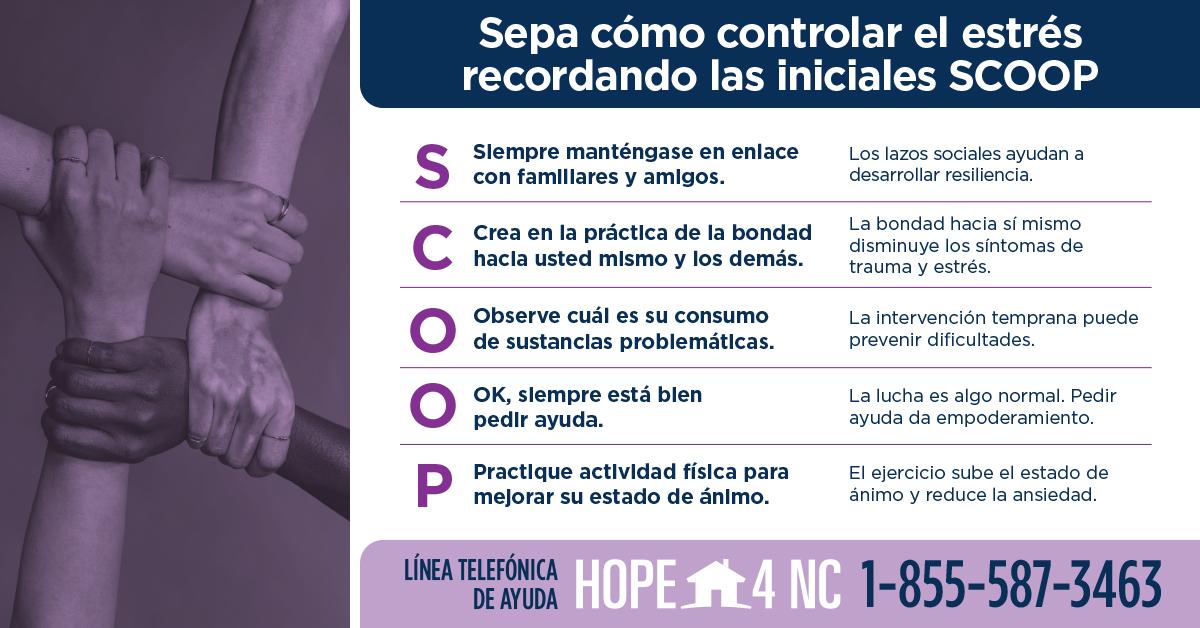
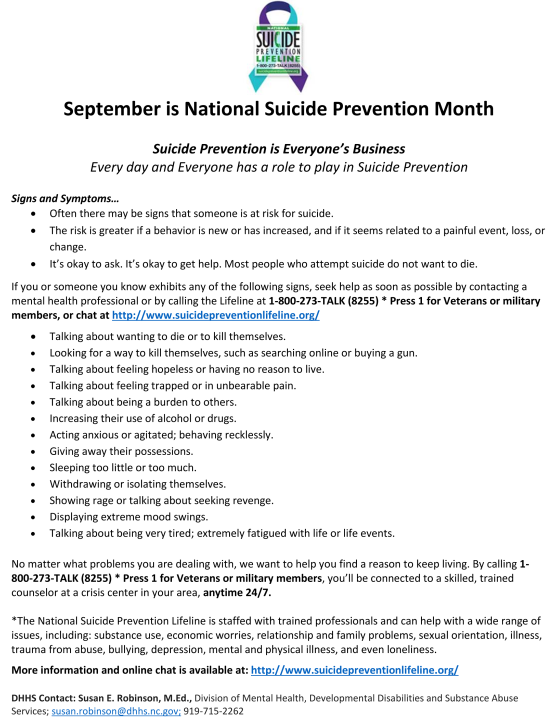
September is Suicide Prevention Month
Download Documents Here:
Recording from LME/MCO & DHHS Joint Listening Session with Residential Providers: September 3, 2020
|
| |
LME/MCO & DHHS Residential Listening Session
|
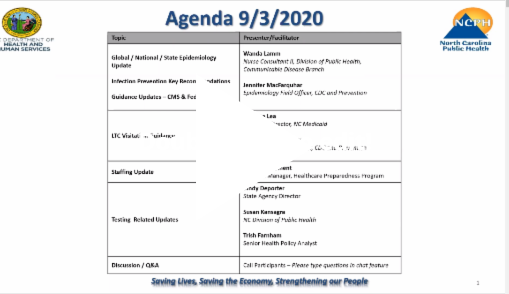
DHHS/NC AHEC: COVID-19 Update for Long Term Care Settings Recording: September 3, 2020
|
Dear Director Letter: VIRTUAL TIPS-MAPP PRE-SERVICE AND REQUIRED TRAINING
The Children's Alliance of Kansas owns all rights to the TIPS-MAPP program, which includes TIPS-Deciding Together and Caring For Our Own. In April 2020, amid the COVID-19 public health crisis, The Children's Alliance did not allow agencies to facilitate TIPS-MAPP virtually but did permit the NC Division of Social Services (NC DSS) to offer a virtual TIPS-Deciding Together certification to our public and private licensing agencies so they could use virtual TIPS-Deciding Together to license foster families.
Due to the ongoing pandemic, the Children's Alliance changed course and has designed a training to teach currently certified TIPS-MAPP Leaders how to deliver the program to prospective foster families virtually. NC DSS has been granted permission to offer that virtual training to certified TIPS-MAPP Leaders in North Carolina. The Staff Development Team will develop a new course for currently certified TIPS-MAPP Leaders titled TIPS-MAPP Virtual Update. Once the virtual classroom design is complete, the course will be available on www.ncswlearn.org and TIPS-MAPP Leaders will be able to register. The TIPS-MAPP Virtual Update will be available by November. This training will be required before a TIPS-MAPP leader may train TIPS-MAPP virtually.
We are aware of the burden this pandemic has put on supervising agencies and the frustration that many are experiencing due to the inability to access the 8-day TIPS-MAPP certification. Unfortunately, NCDSS remains unable to certify new TIPS-MAPP Leaders. The Children's Alliance is developing a virtual TIPS-MAPP Leader Certification course to certify new leaders and plan to have it available towards the end of the year. NCDSS will offer that certification to agencies as soon as possible, hopefully in the Winter/Spring of 2021.
In summary:
- Agencies will be allowed to do virtual TIPS-MAPP with prospective foster parent groups as preservice training for licensure.
- Before current leaders are allowed to deliver TIPS-MAPP virtually an update to the TIPS-MAPP Leader certification is required.
- Licensing agencies are not allowed to deliver TIPS-MAPP virtually until they have completed the course TIPS-MAPP Virtual Update.
- NC DSS is unable to certify new TIPS-MAPP Leaders at this time but hope to offer it next year.
If you have any questions about the TIPS-MAPP program please contact the Interim Program Manager of the Staff Development Team, Tammy Shook at tammy.shook@dhhs.nc.gov .
We appreciate your patience as we work together to continue to address on-going areas of concern and need during this difficult time. As always, thank you for your dedication to serving children and families.
Help protect your family and neighbors from COVID-19. Know the 3 Ws. Wear. Wait. Wash. #StayStrongNC and get the latest at nc.gov/covid19.
|
What's New: September 3, 2020
HHS Coronavirus Data Hub. The U.S. Department of Health & Human Services (HHS) launched a website in July with data on the COVID-19 response at federal, state, and local levels. The hub includes estimated and reported hospital capacity by state, with numbers updated daily.
SAMHSA Training and Technical Assistance Related to COVID-19. The Substance Abuse and Mental Health Services Administration (SAMHSA) created this list of resources, tools, and trainings.
|
New Medicaid Bulletin Available As of Sept. 1, 2020
The NC Division of Health Benefits (DHB) has recently published a new Medicaid Bulletin article dated Sept. 1, 2020:
|
DSS official acknowledged problems after 9-year-old found in hotel with 150 used needles
Citizen Times - September 03, 2020
A Buncombe County Department of Social Services official acknowledged mistakes in how the department responds to law enforcement child welfare calls after a DSS staffer told police a 9-year-old girl could stay at a hotel room with 150 used hypodermic needles with a man she barely knew. But a state senator said the acknowledgement and a new DSS law enforcement response protocol, sent out June 24, was not enough and that he will continue to seek legislative action including subpoenaing Buncombe Health and Human Services Director Talmadge "Stoney" Blevins.
|
Survey Request
Fostering Health NC is a program of the North Carolina Pediatric Society. The program's goal is to improve the health and well-being of children in DSS custody throughout North Carolina. Part of their work includes providing training and resources regarding the health needs of children in foster care.
As part of their Private Agency Workgroup (which is always looking for more members), they have created a survey to learn more about the experiences of staff working at private agencies (congregate care, residential treatment, family foster care, and therapeutic foster care). This survey will then inform the work that we do moving forward.
The survey is meant for case managers, program managers/supervisors, and residential staff and should only take about 10 minutes to complete. The survey can be accessed here: Fostering Health Private Agency Survey.
|
FLOTUS Participates in the "Recovery at Work" Roundtable Includes Powerful Testimony by
Larry Kudlow
|
| Recovery at Work: Celebrating Connections,
a White House Roundtable Event |
|
Human Trafficking News & Information
The Department of Justice is committed to a collaborative approach, and relies extensively on its robust partnerships across the government and with non-governmental organizations.
DOJ participates in the President's Interagency Task Force to Combat Human Trafficking and Senior Policy Operating Group, interagency coordination bodies created by the TVPA and chaired by the State Department's Office to Monitory and Combat Trafficking in Persons. Read about the many federal government agencies working to combat human trafficking.
|
New: Tuesday: September 8, 2020
Unpacking the COVID19 Community Partner Testing Toolkit
Time: 11:00 am thru 12:00 pm
|
New: Tuesday: September 8, 2020
Child & Family Teams in the Time of COVID-19
Time: 11:30 am thru 12:30 pm
|
Tuesday: September 8, 2020
Navigating Special Education in Light of COVID-19
(Cost $25.00)
Time: 12:30 pm thru 1:30 pm
|
Wednesday: September 9, 2020
Partners Quarterly Provider Webinar
Time: 1:00 pm
|
Wednesday: September 9, 2020
Responding to the Opioid Overdose Epidemic
Time: 2:00 pm thru 3:00 pm
|
Wednesday: September 9, 2020
Reduction of Stigma in our Communities
Time: 3:00 pm thru 4:00 pm
|
Reminder: Thursday: September 10, 2020
Benchmarks' Child Welfare Webinar feat: Karen McLeod & Lisa Cauley
Time: 8:00 am thru 9:00 am
|
New: Thursday: September 10, 2020
Resource Parent Curriculum (RPC) Staff Facilitator Opportunity
Time: 9:00 am thru 10:00 am
|
New: Thursday: September 10, 2020
Know the Signs - Suicide Awareness & Prevention among Older Adults Presented by Serena Turpin and Susan Baggett
Time: 11:00 am thru 12:00 pm & 3:00 pm thru 4:00 pm
|
Thursday: September 10, 2020
Protecting Our Children: COVID-19's Impact on Early Childhood and ACEs
Time: 1:00 pm thru 2:00 pm
|
Thursday: September 10, 2020
Time: 3:00 pm thru 4:00 pm
|
Thursday: September 10, 2020
Join us for NAMI's Ask the Expert Webinar: Eating for Better Mental Health
Time: 4:00 pm thru 5:30 pm
|
New: Friday: September 11, 2020
Friday Open House for Providers
Time: 12:30 pm thru 1:30 pm
|
Sunday: September 13, 2020
|
Monday: September 14, 2020
Western NC: Regional Policy Institutes
Time: 9:00 am thru 11:30 am
Deputy Secretary Juvenile Justice, Billy Lassiter
Advocacy 101: Adam Sotak, NC Child Legislative Panelists:
Terry Van Duyn - Buncombe
Representative Sarah Stevens -Alleghany/Surrey/Wilkes Counties Include:
Cherokee, Graham, Clay, Macon, Jackson, Swain, Haywood, Transylvania, Madison, Buncombe, Henderson, Polk, Yancey, McDowell, Rutheford, Cleveland, Lincoln, Burke, Caldwell, Mitchell, Avery, Watagua, Ashe, Alleghany, Surry, Wilkes, Yancey, Catawba, Alexander, Iredell, Yadkin, Davie, Stokes, Forsyth
|
Tuesday: September 15, 2020
Health Care Industry - Credentials, Skills, Competencies discussion
Time: 10:00 am thru 11:30 am
See NC Workforce Credentials Overview Here |
New: Tuesday: September 15, 2020
Understanding Clinical Quality Measures: How CMS is Modernizing its Approach to Digital Measurement
Time: 2:00 pm thru 3:00 pm
|
New: Thursday: September 17, 2020
PRESCRIPTION DRUG MISUSE IN
OLDER ADULTS
Time: 11:00 thru 12:00 pm & 3:00 pm thru 4:00 pm
|
Thursday: September 17, 2020
QTRP Accreditation with The Joint Commission
Time: 1:00 pm thru 2:00 pm EST
|
Thursday: September 17, 2020
Partners Mental Health/Substance Use Provider Information Session
Time: 4:00 pm
|
Thursday: September 18, 2020
MEDICAL CARE ADVISORY COMMITTEE (MCAC) TELECONFERENCE MEETING
Time: 10:30 am thru 12:30 pm
Call: 866-390-1828
Access Code: 4586030
|
New: Monday: September 21, 2020
Coping with Stress, the Triple P Positive Parenting Way!
Time: 10:00 am thru 11:00 am & 3:00 pm thru 4:00 pm
|
Monday: September 21, 2020
Addressing FFPSA Requirements: Tools for Selection and Sustainable Implementation of Evidence-Supported Programs Webinar
Time: 1:00 pm thru 2:00 pm EST
|
Tuesday: September 22, 2020
Partners Innovations-I/DD Provider Information Session
Time: 4:00 pm
|
Tuesday: September 23-September 24, 2020
Family Focused Treatment Association's (FFTA) 34th Annual Conference on Treatment Family Care
There is a cost associated with this event. $$$
Time: 10:00 am (Events are scheduled throughout the two days)
|
Thursday: September 24, 2020
Time: 3:00 pm thru 4:00 pm
|
Friday: September 25, 2020
Western NC: Regional Policy Institutes
Time: 9:30 am
|
Friday: September 25, 2020
NCDHHS Supported Living Level 2 & 3
STAKEHOLDERS MEETING
Time: 1:00 pm thru 3:00 pm
PARTICIPATE ONE OF TWO WAYS:
- Meeting ID: 973 1973 1182
- Passcode: 329118 (No registration necessary but you must enter this passcode to be admitted to the meeting.)
2) Attend by Phone:
855-880-1246 (US Toll-free)
Meeting ID: 973 1973 1182
|
Monday: September 28, 2020
Central NC: Regional Policy Institutes
Time: 9:00 am thru 11:30 am
Keynotes: Deputy Director, Child Welfare Services Lisa Cauley
NC Child Welfare Family Advisory Council - Gina Brown
Advocacy 101: Melea Rose-Waters, Prevent Child Abuse NC
Counties Include: Gaston, Mecklenburg, Union, Rowan, Rockingham, Caswell, Person, Guilford, Davidson, Randolph, Montgomery, Cabarrus, Stanly, Alamance, Lee, Moore, Anson, Richmond
|
Tuesday: September 29, 2020
The Value of Youth Peers Serving on Community Boards
Time: 2:00 pm
|
New: Tuesday: September 29, 2020
NC AHEC and CCNC Navigating COVID-19 Webinar Series
Time: 6:00 pm thru 7:00 pm
|
Wednesday: September 30, 2020
Save the Date! National Adoption Month Webinar "Engage Youth: Listen and Learn"
Time: 2:00 pm thru 3:30 pm
|
Thursday: October 1, 2020
Time: 1:00 pm thru 2:00 pm
|
Tuesday: October 6, 2020
Eastern NC: Regional Policy Institutes
Time: 9:00 am thru 11:30 am
Keynotes: Deputy Secretary, Behavioral Health & Intellectual and Developmental Disabilities - Kody Kinsley
Associate Director, NC Families United - Stacy Justiss
Advocacy 101: i2i Center for Integrative Health
Legislative Panelists:
Senator Don Davis - Greene/Pitt
Representative Donna White - Johnston
Counties Include: Vance, Warren, Halifax, Northampton, Nash, Edgecombe, Wilson, Harnett, Cumberland, Hoke, Scotland, Robeson, Bladen, Harnett, Sampson, Duplin, Wayne, Pender, New Hanover, Brunswick, Columbus, Onslow, Jones, Lenoir, Greene, Pitt, Carteret, Beaufort, Craven, Pamlico, Hyde, Dare, Washington, Martin, Bertie, Currituck, Perquimans, Pasquotank, Gates, Hertford, Camden, Chowan, Tyrell
|
Saturday: October 10, 2020
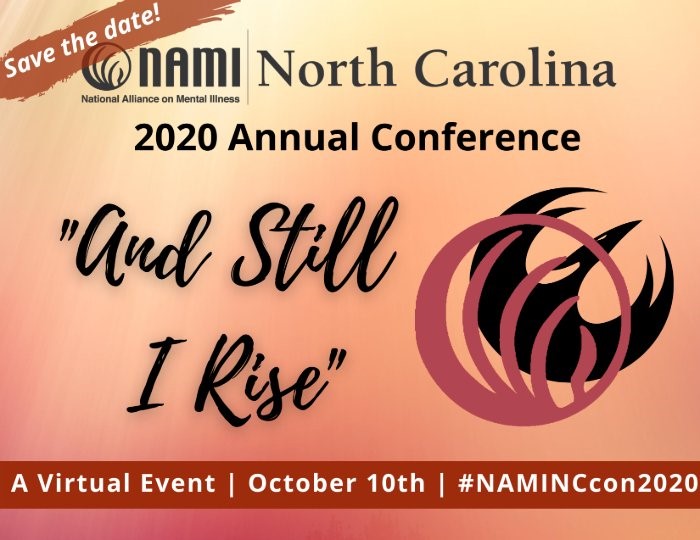
Save The Date: NAMI's 2020 Annual Conference
Virtual and Free
|
Monday: October 26, 2020
Triangle: Regional Policy Institutes
Time: 9:00 am thru 11:30 am
Keynotes: Youth Transition Program Director, NC Families United - Lacy Flintall
MomsRising - Sheila Arias
Advocacy 101: Beth Messersmith, MomsRising
Legislative Panelists:
Senator Valerie Foushee - Chatham/Orange
Senator Natalie Murdock - Durham
Representative Verla Insko - Orange
Counties Include: Wake, Johnston, Chatham, Orange, Durham, Franklin, Granville
|
Please click on each of the following links to view details sent out from each LME/MCO.
Benchmarks' wants to be sure to make the following list handy for our members to visit and suggests a peek at least once per week to find information that may be pertinent to your agency and contracts.
|
|
|
|
|
|