NC Cases:
25,639
NC Cases Hospitalized:
708
NC Deaths:
866
Increase in COVID-19 Cases and Hospitalizations
With North Carolina in its first week of Phase Two and the state's coronavirus update showed troubling numbers on Thursday.
The number of deaths attributed to COVID-19 increased by 33 to 827 and hospitalizations established a new single-day high of 708.
The state has reported 83 deaths since Sunday. Reported hospitalizations have jumped 20.6% from 587 to 708 over that same time.
The average number of positive cases tested rose to 8% this week as well.
Access To COVID-19 Testing
Many providers with residential facilities have been struggling to identify companies that will come out to the facility to test clients for COVID-19 when needed. There have also been challenges in finding companies to test staff as well. Many agencies found that when they did identify a company to do the testing, the cost was too high and many weren't willing to bill Medicaid or Medicare for the agency.
We reached out to DHHS to see if they had lists of companies that would come on site AND would be willing to bill Medicaid directly. They provided us a list of companies that are providing the tests -to see them click here. Of the companies on the list, DHHS confirmed that LabCorp, Mako, and Quest are billing Medicaid for the tests. There may be other companies on the list that are billing Medicaid, but those are the only ones that DHHS had confirmed as billing Medicaid. Mako will also do testing of uninsured patients and will bill HRSA (Health Resources Services Administration) on behalf of the uninsured patient.
For agencies that need staff tested (with and without insurance), they recommend reaching out to your local FQHC (Federally Qualified Health Center). Some of them have the capacity to bring teams out to the facility to do testing, but all can provide testing at their center. FQHCs can bill Medicaid and private insurance. They can also provide testing to your staff without insurance as they have funding to be reimbursed for those tests. To find a an FQHC near you go to their
locator website here
.
Faces of the Frontline
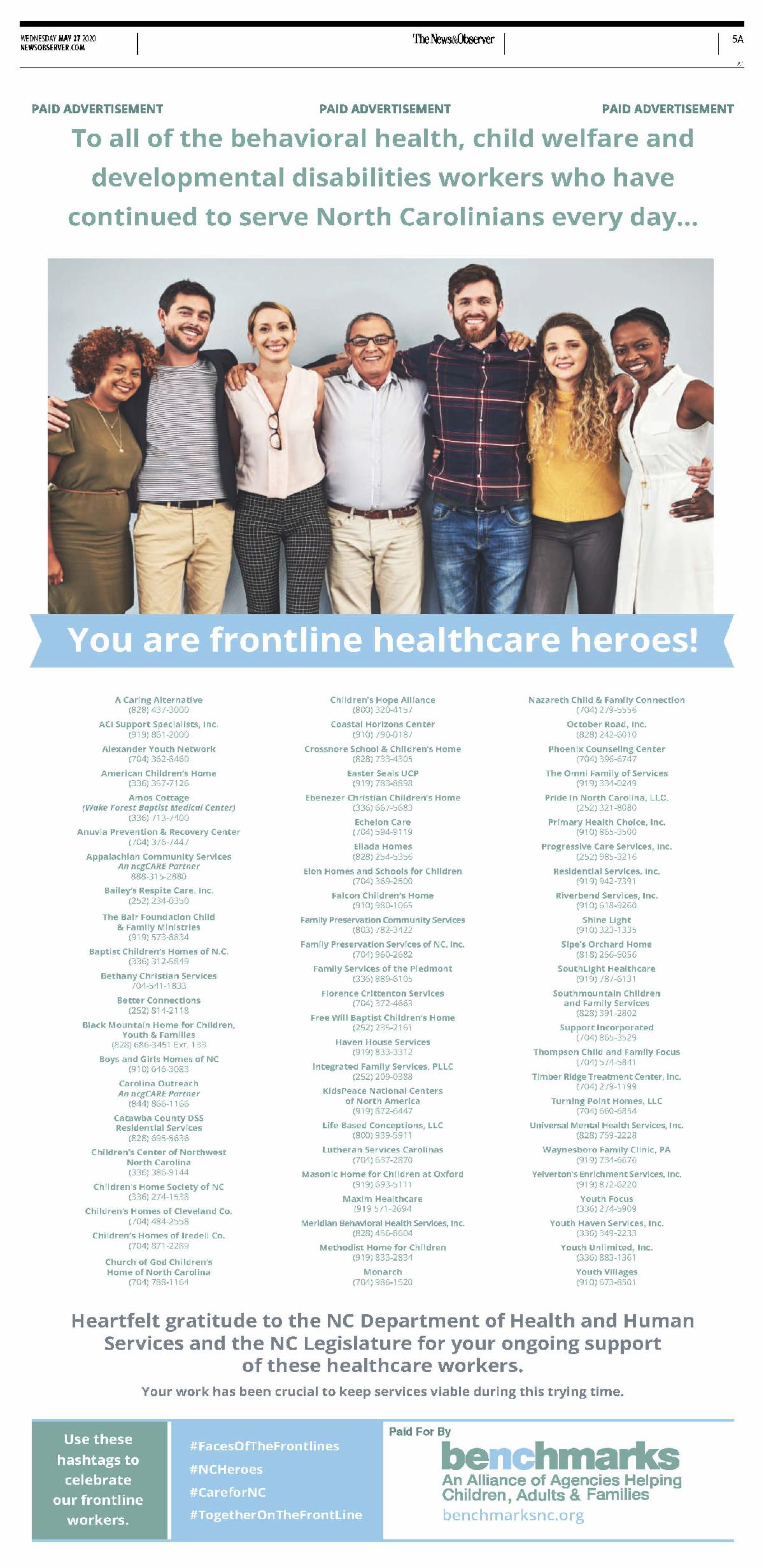
Thank you to all our member agencies that supported our social media blast, tied to our full page ad in the News and Observer, that recognized and thanked the frontline child welfare and MH/DD/SA workers as well as DHHS and the NC GA for their support during COVID-19. Please keep the media blasts coming and don't forget to hashtag your social media posts with:
#FacesoftheFrontlines
#NCHeroes
#CareforNC
#TogetherOnTheFrontLine
I/DD Group Homes
There is growing confusion over family visitation, work allowance, home visits, etc. in response to the COVID-19 restrictions aimed at reducing outbreaks in group homes. While DHHS has released guidance on eliminating all outside visitors and other significant restrictions, calls they have hosted for families have provided other guidance such as allowing visits outside the home, allowing residents to return to work and yet not allow family members in their home. All of these types of mixed messaging has created a tremendous amount of confusion for both providers and families.
DHHS has a workgroup putting together new guidance for providers as restrictions are loosening. The guidance should be out by next week and we hear that much of the decision-making will be left up to the provider based on the clientele and type of facility. While flexibility in these types of settings can be a good thing, it also means increased liability for providers for the decisions they make. We are hoping for guidance that will offer a balance. DHHS welcomes any and all suggestions so please send any recommendations you have to
lmartin@benchmarksnc.org
so that we can submit them to DHHS for consideration.
Child Welfare Update
The number of children coming into care has dropped over the last two months because the places that most frequently report abuse and neglect, schools and daycare centers, have been closed. Currently there are 11,639 children were in foster care statewide as of March 31. It is expected that there will be a surge of abuse and neglect reports in the fall when schools open and as daycare centers resume providing services.
Legislation was passed May 5th to allow background checks of foster families using name-based rather than fingerprint checks, however, NC DSS still has not provided guidance on how to move forward. According to NC DSS, the process has been stalled by concerns raised by the FBI to the NC SBI that the legislation does not include all the language necessary to override the fingerprint checks. NC DSS is still attempting to find a work-around to the problem.
Once Phase One began, many of the county DSS agencies began pressing for family, site and home visits and this has only been accelerated under Phase Two. Benchmarks has pressed hard on NC DSS to provide guidance and protocol to the counties on ways to safely and thoughtfully move toward resuming some of these face-to-face visits. NC DSS, the Division of Public Health (DPH) and 5 county DSS Directors came together to work on some draft protocol for the counties. That protocol is expected out next week.
It will be stressing to the counties that all visits should be determined on a case-by-case basis based on safety. They provide protocol on the visits. They recommend that now, and in the future, if you have concerns about the safety of a visit that is being requested and the county DSS agency continues to insist moving forward, that you refuse and request they take it to the Director level or contact Linda Waite to address the issue.
We have given them feedback that under no circumstances should any visit take place without all parties wearing masks and heath checks being conducted. We have also advised them against allowing any day or multiday home visits taking place for children in residential Children's Homes due to the transmission risk being too great for the agency staff and clients.
Second Request of Appendix K Approved
The second request under Appendix K was approved on Wednesday, May 27th. The Division of Health and Human Services will be sending out a bulletin next week with information about the approval. To see what all was included under the second request of Appendix K see below.
Innovations:
TBI:
Unemployment Rate
North Carolina's unemployment rate nearly tripled from 4.3% in March to 12.2% in April, a stark reflection of the COVID-19 pandemic's impact on the state's economy. By comparison, the state unemployment rate reached a 33-year peak of 10.9% in 2010 as the state and national economies began their slow recoveries from the Great Recession.
Economists forecast that as many as 2.5 million North Carolinians may be at high- or moderate-risk for a layoff or reductions in wages, tips and work hours, or for furloughs. The private sector experienced a 14.3% decline from March to April, representing a loss of 545,700 jobs, while the government sector had a 3.5% decline representing 26,000 jobs. As expected, the state's leisure and hospitality sector took the brunt of the job losses and furloughs with a 48.8% decline in its workforce, down 249,800 to 262,300
Revenue Forecast
Top state government fiscal researchers predicted Friday that North Carolina will collect $4 billion less in revenues over a two-year period than previously due to COVID-19. The General Assembly's Fiscal Research Division and the executive branch Office of State Budget and Management jointly estimated that state collections for the current fiscal year will fall $1.6 billion short of a pre-pandemic forecast. And for the 2020-21 fiscal year, the group predicted that revenue will fall short of the previous forecast by nearly $2.6 billion.
The group did note that because the current pandemic is unprecedented, their forecast reflects more uncertainty than normal. They also noted that delays in state tax deadlines for individuals and businesses also clouded the picture.
Legislative Session Update
Appropriations committees in the House and Senate are working on budget bills, but this will not be a normal budget bill process. Both chambers are creating spending bills for individual programs. This is how they plan to address all the 2020-2021 fiscal year's most pressing funding needs.
Asked if avoiding a single omnibus budget bill is a strategy to avoid a veto from Gov. Roy Cooper, Brown said "pretty much." The House appears to be taking a similar approach, with a committee agenda featuring separate spending bills for law enforcement communications upgrades and funding for housing funds. A blank budget bill on the agenda titled "omnibus" will become an area-specific bill, according to budget writer Rep. Jason Saine, R-Lincoln. Brown said many funding requests won't make the cut this year. "We're having to say no to a lot of people," he said.
Some of these appropriation "omnibus" bills are placeholders without funding as they wait for guidance from the federal government as to whether they can use the CARES Act funding for budget holes and have a clear picture of just how significant the deficit will be.
The legislature is also dealing with an additional unexpected budget loss due to a $467 million hole in Medicaid rebase due to increased physical health COVID-19 costs.
Bill Highlights
Below are some bill highlights but to see all the bills that Benchmarks is tracking:
H 728 Increase Innovation Waiver Slots
Would create up to an additional 500 waiver slots. Not likely to move forward in the current budget environment.
H 1187 - Raise the Age Funding
Provides about $10.5 million for Raise the Age. Very likely to move forward if at all fiscally possible in this current environment.
H 1196 - Funds/COVID-19 Test & PPE For Congregate Living
Allocates $12 million in non-recurring money for testing and PPE supplies. The sponsors are Democrats so not sure the likelihood of this being included as a budget item, although Republican House and Senate members have acknowledged the need to fund more of this.
H 1214 - Dept of HHS Svcs Revisions
This is a DHHS bill that addresses a number technical, conforming and other changes they want, not all COVID-19 related.
- Eliminates the rule-making process to implement a co-payment schedule for MH/DD/SA services.
- Changes to expand First Exams for Involuntary Commitment
- DHHS authority to adjust single stream funding allocations for LME/MCOs
- LME/MCO utilization of standardized out-of-network agreements for MH/DD and for youth in foster care or independent foster care adolescent.
S 708/H1048 CPS Intake Screening/PED Recommendations
This bill came from a Program Evaluation Division of the NCGA. It makes recommendations to improve the consistency of county abuse and neglect screen-in/ screen-out reports.
- Doesn't allow more stringent screen in process than state policy
- Requires state to set up a consultation call center for counties to contact if unsure about a correct screening decision, assessment track or response time frame of a specific case.
- Requires DHHS to periodically assess county DSS workers and supervisors' comprehension and correct implementation of State policy. Assess their training needs for screening and respond to meet those needs.
- Requires DHHS to revise the structured intake form.
- Requires DHHS to implement statistically valid program monitory for county intake screening procedures, as well as establish measurable performance benchmarks for all counties.
S 476 - School Based Mental Health
Danielle Battaglia, THE INSIDER, 5/28/20
Sen. Don Davis told senators Wednesday afternoon that suicide is the 11th ranked cause of death in North Carolina. His statement came minutes before a bill passed the Senate that aims to help high school and middle school students struggling with mental health. The bill is now awaiting approval by Gov. Roy Cooper.
Sen. Deanna Ballard, R-Watauga, introduced the conference report in the Senate Education Committee meeting Wednesday morning and then to the Senate during the afternoon session. "This is a bill that directs the State Board of Education to adopt a school-based mental health policy..." Ballard said. She added that various stakeholders including Davis, D-Pitt, and Sen. Joyce Krawiec, R-Forsyth, were involved. The required mental health policies will include training for school staff on mental health issues, including how to identify suicide risk among students. Other provisions in previous versions of the bill, which addressed teaching assessments and teen dating violence, were dropped from the final conference report that passed the House and Senate on Wednesday.
The education committee's concern about the bill was whether funding for the initiative would fall on the individual school boards. They were assured that there was already funding available as well as partnership agencies willing to step up and help.
"This bill is indeed designed to help provide a life jacket to reach out to these kids," Davis said, adding that it was years in the making and would go a long way to help other people. Davis said students today are dealing with things the senators never had dealt with. "To get a child to the point in their life that they're in a dark place that they feel hopeless and the only thing they feel that they have left that they can do is to take their own lives in their hand," Davis said. "I must believe that is a place we don't want to see our kids."