Are you looking for online training?   Take moment to see what Benchmarks' Online Training Library  has to offer!  

Any questions at all, please reach out to Paige Wiggs , Benchmarks' Online Training Guru!


Take care of each other and stay safe and healthy!

The Benchmarks' Team


Benchmarks' Friday Membership Update &
 Webinar Recording
May 8, 2020

Benchmarks' Membership Webinar: May 8, 2020
Benchmarks' Membership Webinar
 May 8, 2020

NC Cases:  13,397
NC Cases Hospitalized:  514
NC Deaths:  507
 
 
Faces of the Frontlines Campaign
Most of you recall the work we did in partnership with the 7 LME/MCOs and the Providers Council to create a shared media platform that we titled CareForNC. We continue to #CareForNC in our social media posts and hope that you will continue to do the same as well.
 
The CareForNC is launching a COVID-19 campaign during May and June to recognize and honor the MH/DD/SA, child welfare and juvenile justice front line workers who have placed themselves, and their families, at-risk to continue serving their clients during the pandemic. Unfortunately, most people don't recognize the behavioral health, I/DD, Substance Use Disorder and child welfare work as "frontline workers" and it is important to change that perception. We work amongst healthcare warriors every day in our field and we are asking you to send in photos and short videos we can share to help our state and communities see the many faces of frontline workers!
 
These images will be used in our CareForNC COVID-19 Campaign: #FacesOfTheFrontline. The focus of this campaign is to tell our story - that our providers are on the front lines as well as physical health providers during this pandemic. The photos and videos submitted will be put together by a group of the LME/MCO public relations staff and posted on our CareForNC Facebook and Twitter site. We strongly encourage all your agencies to repost on your individual sites the CareForNC posts AND structure similar posts on your own website showing the many #FacesOfTheFrontline!!! Be sure to use one or all the hashtags listed below on your agency posts.
  • #FacesoftheFrontlines
  • #NCHeroes
  • #CareforNC
  • #TogetherOnTheFrontLine
 
To make it easier for you, we have created a Google Drive site with guidance and a submission form for uploading your photos and videos.:  https://forms.gle/7ZFx1DCnsqKs7vvq8
 
If you do not have a google account to use the Google drive, you can email your pictures and videos to carefornc@gmail.com.

Many video attachments may be too large to send via email. In that case, please upload your videos to YouTube privately, Dropbox, or use WeTransfer and send a link to the CareForNC email so we can download the file. Be sure to include:
  • Your Name
  • Organization name
  • County or counties you serve
  • Email
  • Description of Content
  • Any additional information

Below are some links to provide you additional information to help you create your own #FacesOfTheFronline posts and for video and picture submissions to CareForNC.

 
Brand/Technical Guidance:   Google Doc        
Provider Guide/Directives:   Google Doc  
 
Thank Legislators for their Support
Please let legislators know how much you appreciate the COVID-19 liability protections extended to our members as well as the money for MH/DD/SA and foster care in the $1.57 billion budget passed on Monday. It is REALLY important they receive this positive feedback to understand the importance this funding has for you, and will influence their decision making when they take up the remaining $1.93 billion of federal COVID-19 relief funds. They plan to release the second COVID-19 bill at the end of May or early June. We have provided some draft language (depending on what type of service you provide you can choose what language to include) and ask that you please take just a minute to send a quick email to the legislators listed below. Please make this letter your own and include the different parts of the budget that impact you so that it is personalized.
 
Rep White - Donna.White@ncleg.net            
Rep Potts - Larry.Potts@ncleg.net
Rep Dobson - Josh.Dobson@ncleg.net
Sen Hise- Ralph.Hise@ncleg.net                    
Sen Krawiec - Joyce.Krawiec@ncleg.net
 
Dear Representative (Senator) _______,

Thank you so much for providing COVID-19 liability protections for (fill in what type of service you provide i.e. mental health, I/DD, SUD, child welfare). Every day our frontline staff work tirelessly to protect the health and safety of our clients, while placing themselves and their families at risk of the coronavirus. Information around testing, treatment, symptoms, etc are evolving weekly around COVID-19 and we are adapting quickly which makes the liability protections paramount to safeguard our agency.

We also want you to know how much we appreciate ( options to choose from below)
  • the $20 million enhanced behavioral health capacity that was provided in the budget. This funding will help keep our clients stabilized in the community, rather than in a hospital when we need to keep as many hospital beds available as possible. There has been so much disruption to the utilization of behavioral health services from COVID-19 that every single dollar counts and this allocation is greatly needed.
  • The $19 million to DHHS that includes support for residential settings due to the additional costs of COVID-19. The costs for hazard pay, cleaning supplies, personal protection equipment, staff training, additional cleaning procedures, etc are taking a financial toll on our budgets as we strive to provide healthy, quality and safe residential services.
  • The $100 supplement payments for each child receiving foster care assistance payments. This funding is critical to avoid disruption for our children in care and help offset the increased costs from COVID-19.
 
As you prepare to allocate the remaining federal COVID-19 funding, we would greatly appreciate if you would continue to provide support for ( fill in what type of service you provide). As a result of the stressors from the pandemic and the economic challenges that individuals and families are facing, we expect to see a significant increase in the number of referrals for care over the next few months. We desperately need financial assistance to help keep our network of services viable to provide the support needed to maintain healthy communities.
 
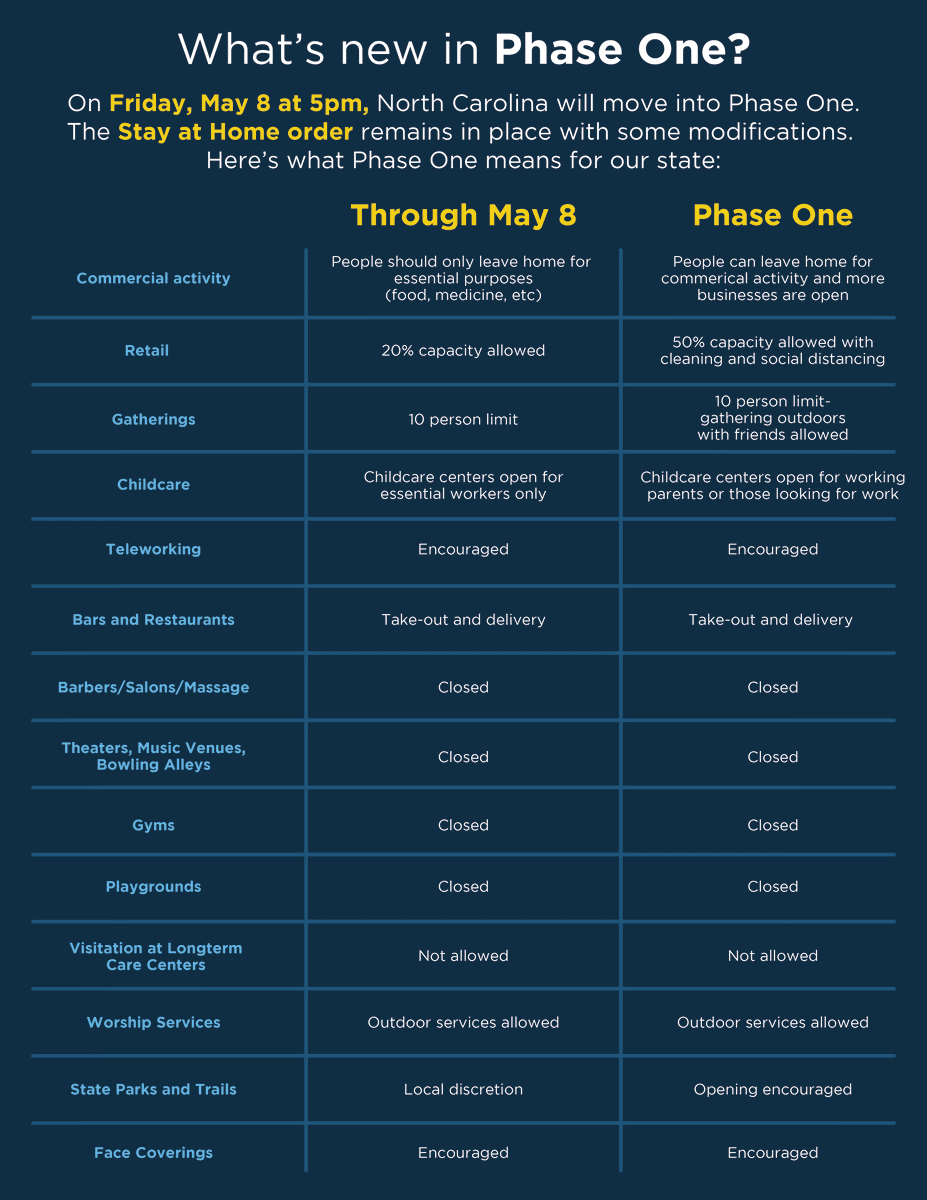
NC Moves Into Phase 1 of COVID-19 Response
Governor Roy modified North Carolina's Stay At Home order and transition to Phase 1 of slowly easing certain COVID-19 restrictions effective Friday, May 8 at 5 pm. Certain businesses remain closed as the state continues battling COVID-19. 

"COVID-19 is still a serious threat to our state, and Phase 1 is designed to be a limited easing of restrictions that can boost parts of our economy while keeping important safety rules in place," said Governor Cooper. "This is a careful and deliberate first step, guided by the data, and North Carolinians still must use caution while this virus is circulating."

"We must continue to protect our families and neighbors as we take this cautious step forward. When you leave your home, follow the three W's: Wear a face covering, wash your hands, and wait six feet apart," said Dr. Mandy Cohen, Secretary of the NC Department of Health and Human Services.  

Today's Order removes the distinction between essential and non-essential businesses. Retail businesses are allowed to open at 50% capacity and will be required to direct customers to stand 6 feet apart, perform frequent cleanings, provide hand sanitizer when available, screen workers for symptoms and more. The Order allows people to leave their homes for commercial activity at any business that is open.
 
Certain businesses remain closed, including bars, personal care businesses, entertainment venues, and gyms. Restaurants may only continue to serve customers for drive-through, take out and delivery. 
All workers at retail and other businesses are recommended to wear cloth face coverings. Teleworking is still encouraged for businesses that can practice it.

Though small outdoor gatherings will be allowed in Phase 1, gatherings of more than 10 people generally are still prohibited. The Order encourages cloth face coverings to be worn when outside the home and in contact with others. Everyone who uses a face covering should adhere to this guidance without fear of profiling or bias.
During Phase 1, childcare facilities will be open to serve families of parents who are working or looking for work. These centers will be required to follow strict cleaning protocols. Summer day camps can operate in compliance with NC DHHS guidelines.  
 

Upcoming State Cuts in Response to COVID-19 Economic Hit
The negative impact to county and state revenue due to COVID-19 is estimated to create between a $3.5 to $4 billion budget shortfall. Governor Cooper has already noted that we will have to have fiscal cuts to Divisions in our next state budget to make a balanced budget as required by our state constitution. The state's rainy day fund of $1.2 billion won't be enough to offset the shortfall. While we don't know how much DHHS and other divisions will be asked to cut out of their budget at this point, we know other states have already notified their health and human service divisions to find cuts upward of 20 - 35%.
 
DMV Renewals
One of the NC legislative coronavirus relief bills Gov. Roy Cooper signed into law Monday adds five months to the expiration date of any license, permit, registration or other credential issued by DMV and waives all fees, fines or penalties for not complying with the old date. Motor vehicle tax payments and inspection deadlines are also delayed to match the new expiration dates. The extension applies to any DMV credential that expires on or after March 1 and before Aug. 1.
 
Unemployment Claims
North Carolina has surpassed the 1 million threshold for individual unemployment insurance benefit claims this week. There have been just under 1.01 million applications filed since March 15. As of Monday morning, 20.3% of the 4.97 million North Carolinians listed in the state's workforce as of mid-March have filed a unemployment claim. The Division of Employment Security has paid out $1.27 billion in state and federal unemployment insurance.
North Carolina is the fifth-hardest hit state for unemployment since the pandemic began. NC saw claims increase 3,833% for April 2020 compared to April 2019.
 
School Start
The coronavirus pandemic closed North Carolina schools and forced students to online learning for the remainder of the school year. To help offset some of the lost school days, the NC legislative COVID-19 relief bills passed this week changed the school calendar so that the next school year will start on Aug. 17, a week earlier than normal, and end no later than June 11, 2021.
 
Virus Data
NC DHHS will receive $25 million to expand COVID-19 testing in the legislative budget but that funding comes with strings attached. To receive the money, DHHS will need to begin tracking and then release the following data:
  • The number of positive and negative COVID-19 tests.
  • Information about vendors providing those tests, including the cost of a test.
  • Recovery rates.
  • Hospital discharges, including the underlying conditions of COVID-19 patients.
  • "Comprehensive reporting" on deaths, including percentage of patients diagnosed with severe conditions prior to contracting the virus, as well as what conditions deaths were attributed to.
Session Plans
Dawn Baumgartner Vaughan, THE NEWS & OBSERVER, and THE INSIDER, 5/02/20
House Speaker Tim Moore said that over the next two weeks, the House COVID-19 committee would continue to meet and that the House would return on May 18 for a "normal" session. He said proxy voting would end, which means more House members would be in the chamber at once. Moore said rules about access to the Legislative Building would be reassessed at that point. Last week, only lawmakers, staff and credentialed press were allowed inside. Moore told reporters on Thursday that during the time lawmakers are gone, they'll see how things go with the state reopening and people going back to work.
Moore said action on May 18 will be largely coronavirus-related, and even with in-person meetings, some social distancing may continue. "We'll probably need to spread out," he said. "We have some very large committee rooms that we can use if we need to. We can even use this chamber as a committee room." Moore also reassured Rep. Yvonne Holley, D-Wake, that lawmakers will be allowed to wear masks if they choose
 
Reopening Malls
THE ASSOCIATED PRESS, 5/02/20
Several major shopping malls in North Carolina are expected to reopen on the same day Gov. Roy Cooper's COVID-19 stay-at-home order is scheduled to end. The News & Observer reports that Simon Property Group announced that it plans to reopen the SouthPark and Concord Mills malls and Charlotte Premium Outlets on May 8. Simon is the largest mall operator in the U.S. Its other North Carolina property, Carolina Premium Outlets in Smithfield, is also set to open May 8. The planned reopenings are based on "current state and/or local stay-at-home or closure orders, which are subject to change," according to a statement on Simon's website.
The mall operator said all employees will be required to wear masks and take hand-washing breaks. The malls will also limit entrances, hours and the number of people in the buildings. Chairs in dining areas will be removed, and drinking fountains and play areas will be closed. Shoppers will be encouraged to wear masks or facial coverings while shopping, and to frequently wash or sanitize their hands
 
Visitor Restrictions
Sarah Ovaska, NC HEALTH NEWS, 5/06/20
Several disability rights groups in the state argue that hospitals' visitor restrictions violate basic civil rights provisions that should allow people with intellectual or developmental disabilities access to their caregivers, even during the COVID-19 pandemic. Spokespeople for Wake Forest Baptist indicated that they could not comment on specific cases but the hospital does "make exceptions for a number of different circumstances" and staff is committed to providing compassionate care.

The COVID-19 pandemic has upended much of how the state's health care systems operate, initially delaying everything but the most essential surgeries as health care providers responded to the spread of the dangerous and highly contagious pathogen. Hospitals in North Carolina and elsewhere have enacted visitor restrictions to try to prevent the spread of the disease. That means more patients are alone, although access has been given to those deemed essential such as parents or guardians for pediatric patients, as well as allowing the birth partner of a woman in labor to be by her side.

But pushed aside in some instances have been the caregivers of those with disabilities, both adults and children, said John Nash, executive director of the Arc of North Carolina, an advocacy group for those with intellectual disabilities. He has heard of four instances of caregivers in different parts of the state being denied access to their disabled loved ones in North Carolina hospitals and believes there are many more instances that he and other advocates haven't heard about. He believes this violates long-held principles outlined in the landmark 1990 Americans with Disabilities Act and other federal laws including the CARES Act, the recently passed COVID-19 stimulus bill. "This is not just a request," Nash said. "This is a part of a person's civil rights."
 
NCCARE360 Network
Vidant Health, the Greenville-based nonprofit health care system that serves 1.4 million people across 29 counties in Eastern North Carolina, is now a part of NCCARE360 network. Vidant joins Greensboro-based Cone Health and Raleigh-based WakeMed Health & Hospitals on the statewide web-based platform that is attempting to eliminate barriers to the delivery of social support services like housing, food and medical care. Vidant Health is integrating its electronic health records system, Epic, with NCCARE360's database of social service providers so clinicians, case managers and other staff are able to connect patients directly to the community resources they need. 

NCCARE360 has also recruited 19 additional counties to its platform, bringing the total number of counties on board to 69 as of Tuesday. The newest counties are Avery, Burke, Cabarrus, Caldwell, Caswell, Duplin, Greene, Harnett, Jones, Lee, Lenoir, McDowell, Mitchell, Onslow, Polk, Rutherford, Surry, Wayne and Yancey



Benchmarks' Child Welfare Webinar Recording
May 7, 2020

Benchmarks' Child Welfare Webinar: May 7, 2020
Benchmarks' Child Welfare Webinar
 May 7, 2020

Monday:  May 11, 2020 (Innovations & I/DD)
Provider Information Sessions

Time:  10:00 am
Monday:  May 11, 2020 
TF-CBT Information Call

Time:  11:00 am
Monday:  May 11, 2020 
Statewide Developmental Disabilities Council Launches Virtual Road Tour to "Meet" Communities

Times:  
  • 12:30 pm to 2:00 pm 
  • 6:30 pm to 8:00 pm 
Monday:  May 11, 2020 (Each Monday until May 26, 2020)
Joint DMHDDSAS and DHB (NC Medicaid) COVID-19 Update CallFor BH/IDD Consumers, Family Members and Community Stakeholders

Time:  2:00 pm to 3:00 pm

Toll-Free:   844-291-5495 Access Code: 1279313
Monday:  May 11, 2020 
COVID-19 Q&A Webinar for Behavioral Health Care

Time:   1:30 pm to 2:30 pm 

Tuesday:  May 12, 2020 
N.C. START (Systemic Therapeutic Assessment Resources Treatment) will offer training on effective interventions for individuals with intellectual disability/autism spectrum disorder (ID-ASD) and behavioral challenges.

Time:   1:30 pm to 2:30 pm 

Thursday:  May 12, 2020 (Mental Health/Substance Use)
Provider Information Sessions

Time:  3:30 pm
Tuesday:  May 12, 2020 (Each Tuesday)
Weekly Q&A Sessions for Trillium Providers

Times: 
10 a.m. - 11 a.m. Crisis Providers, Adult and Child MH/SUD Providers  
11 a.m. - 12 p.m. Adult/Child IDD, TBI, and Residential Providers
 
Tuesday:  May 12, 2020 
Cracked Up: The Evolving Conversation (Ep.2)
The link between childhood trauma and suicide.

Time:  5:00 pm
 
Thursday:  May 14, 2020 (Innovations & I/DD)
Provider Information Sessions

Time:  2:00 pm
Thursday:  May 14, 2020 
Who Ya Gonna Call?

Time:  2:00 pm to 3:00 pm
 
No really, do you know who to call to access supports and services for Substance Use, Mental Health and/or Intellectual and Developmental Disabilities?

The Who Ya Gonna Call webinar and NCDHHS staff are here to help!

Join us and learn more!
* How to access Behavioral Health and IDD Services
* Learn about the role of the Customer Service and Community Rights Team
* Find community-based resources to assist with services like housing, finance and healthcare

Thursday:  May 14, 2020

Time:  2:30 pm thru 3:30 

Has it been challenging to find the right resources to support you during this time of uncertainty? We've scoured our network and the web to find the best information to support you, your staff, your program, and your participants as you continue to drive your mission.
 
Attend this webinar for resources on staying connected with your community, managing and accelerating your programs, taking advantage of immediate funding streams, and more.
Friday:  May 15, 2020 (Each Friday)
Benchmarks' Friday Membership Webinar

Time:  8:30 am

Friday:  May 15, 2020
Trillium Call with Day Service Providers for I/DD: Reopening Requirements

Time:  10:00 am to 11:30 am

Friday:  May 15, 2020 (Each Friday)
WEEKLY Q&A WEBINAR FOR VAYA NETWORK PROVIDERS

Time:  11:00 am

Monday:  May 18, 2020 
Statewide Developmental Disabilities Council Launches Virtual Road Tour to "Meet" Communities

Times:  
  • 12:30 pm to 2:00 pm 
  • 6:30 pm to 8:00 pm 
Monday:  May 18, 2020 (Each Monday until May 26, 2020)
Joint DMHDDSAS and DHB (NC Medicaid) COVID-19 Update CallFor BH/IDD Consumers, Family Members and Community Stakeholders

Time:  2:00 pm to 3:00 pm

Toll-Free:   844-291-5495 Access Code: 1279313
Wednesday:  May 20, 2020 (All Providers)
Provider Information Sessions

Time:  2:30 pm
Thursday:  May 21, 2020 
SPARCS Information Call

Time:  12:30 pm
 
Meeting number: 473 235 227
Password: HQmtXJmy445

Wednesday:  May 21, 2020 (All Providers)
Monday:  May 25, 2020 (Each Monday until May 26, 2020)
Joint DMHDDSAS and DHB (NC Medicaid) COVID-19 Update CallFor BH/IDD Consumers, Family Members and Community Stakeholders

Time:  2:00 pm to 3:00 pm

Toll-Free:   844-291-5495 Access Code: 1279313
Wednesday:  May 27, 2020 (Each Friday)
QUESTION, PERSUADE, REFER (QPR) - SUICIDE PREVENTION WEB-BASED TRAINING

Time:  2:00 to 4:00 pm (7 Slots Available)

Thursday:  May 28, 2020
Let's Talk w Dave Hingsburger; Human Trafficking and People with an Intellectual Disability-Staying 'As Safe As Possible'

Time:  2:00 pm

Friday:  May 29, 2020 
COVID-19 Q&A Webinar for Behavioral Health Care

Time:   1:30 pm to 2:30 pm 

Monday:  June 1, 2020 
Statewide Developmental Disabilities Council Launches Virtual Road Tour to "Meet" Communities

Times:  
  • 12:30 pm to 2:00 pm 
  • 6:30 pm to 8:00 pm 
Monday:  July 20, 2020 
PCIT Information Calls

Time:  10:00 am
 
Meeting number: 730 385 489
You can also dial 173.243.2.68 and enter your meeting number. Or, join by phone: 1-650-479-3207 Access code: 730 385 489 
Thursday:  July 23, 2020 
PCIT Information Calls

Time:  10:00 am
 
Meeting number: 730 385 489
You can also dial 173.243.2.68 and enter your meeting number. Or, join by phone: 1-650-479-3207 Access code: 730 385 489 

Recordings for Calls and Webinars

You will find at the bottom of this page the location of the Provider Webinar and the Consumer Call recordings.   Please feel free to share this information with others.

NC HealthConnex COVID-19 Special Update
Our thoughts are with the health care community and our fellow North Carolinians who are adjusting their lives on a daily basis to address this pandemic. During these challenging and uncertain times, the NC HIEA/NC HealthConnex is doing our part to provide uninterrupted data exchange during the COVID-19 outbreak. We are working with our health information exchange participants, numerous stakeholders, including DHHS, AHEC and others, to provide near, real-time information to support important patient and public health monitoring and care coordination. 

We understand that many of your health care organizations are on the front line of this public health crisis and with changes happening daily, the team at NC HealthConnex is here to help. Supporting communities with real-time patient data during an emergency is a proven use case of HIEs like NC HealthConnex. We are fully operational, but our team is now working remotely to accommodate social distancing guidelines. 

COVID-19 Recovery Act Provides Relief to HIE Act June 1 Deadline
In response to the COVID-19 pandemic, the  COVID-19 Recovery Act (NCSL 2020-3) was signed into law by Governor Roy Cooper on Monday, May 4. Section 3E.1.(a) addresses the connection requirement to the state-designated HIE Network - NC HealthConnex, extending the June 1, 2020, connection deadline to October 1, 2021. In addition, all providers who have shown a good faith effort to connect to NC HealthConnex and have a valid Participation Agreement on file will also have the extended deadline of October 1, 2021. This extension of time will allow the large queue of health care providers who are in active onboarding to complete the connection process. Connecting to NC HealthConnex can take up 12 months, depending on your EHR software.  

Please note: If you were mandated to connect by June 1, 2020, your new deadline is October 1, 2021. Providers who have signed a Participation Agreement do not need to take further action. The NC HealthConnex technical team will reach out when technical discussions are to begin with your practice. 
1. What is P-EBT?

Pandemic Electronic Benefits (P-EBT) provides a benefit on an EBT card to North Carolina families whose children have access to free and reduced lunch at school. The P-EBT program is a collaboration between the North Carolina Department of Health and Human Services and the North Carolina Department of Public Instruction and is intended to help families during school closures.

2. Who is eligible for P-EBT?
All families with one or more children, under age 18, in their household who normally have access to free and reduced lunch at school are eligible for P-EBT benefits. Due to school closures caused by COVID-19 pandemic, these households are now eligible to receive a benefit on an EBT card to help them buy food for their children.

3. Does legal status of the child affect eligibility for P-EBT? Will school aged children who are undocumented non-citizens enrolled in a free/reduced lunch school program receive the P-EBT benefits?
North Carolina Department of Health and Human Services is utilizing data from the Department of Public Instruction for free and reduced lunch only. Eligibility will be determined based on the enrollment of a child in that program. Any child that receives free/reduced lunch qualifies. There are no other filtered criteria.

4. How to apply for P-EBT
There is no application for P-EBT benefits. P-EBT eligibility information comes from the Department of Public Instruction based off enrollment in free and reduced-price meals. Families should contact their local schools for more information about eligibility for free and reduced-price meals.

5. What about children who enrolled in free and reduced lunch programs after the report was run for P-EBT eligibility?
The North Carolina Department of Health and Human Services is working with the Department of Public Instruction to work through how these will be reported and possibilities for inclusion for P-EBT benefits.


A reminder that the below telephonic codes were active thru April 30, 2020. Alliance is awaiting guidance to determine if these codes will continue past April 30. Please continue to monitor provider news for ongoing updates.
98966 CR
98967 CR
98968 CR
99446 CR
99447 CR
99448 CR
99449 CR

Infosource
Updated: Provider Monitoring Notice
Cardinal Innovations will continue to suspend provider monitoring during the new coronavirus (COVID-19) pandemic. Read more.
 
Facility-Based Opioid Treatment and COVID-19
The N.C. Department of Health and Human Service (NC DHHS) has provided additional guidance for Facility Based Opioid Treatment as outlined in NC Medicaid Special Bulletin #46 to assist providers as they continue to serve our members during the COVID-19 pandemic. Read more. 
 
Substance Use Disorder Treatment Flexibility and COVID-19
The N.C. Department of Health and Human Service has provided guidance on substance use disorder (SUD) service flexibilities as outlined in NC Medicaid Special Bulletin #46  to assist providers during the COVID-19 pandemic. Cardinal Innovations Healthcare offers additional information on using these flexibilities. Read more.
 
Adult Mental Health Services Flexibility and COVID-19
The N.C. Department of Health and Human Service has provided guidance on mental health (MH) service flexibilities as outlined in NC Medicaid Special Bulletin #46 to assist providers during the COVID-19 pandemic. Cardinal Innovations Healthcare offers additional information on using these MH flexibilities. Read more.
 

2020 Listserve Announcements
2020.05.01-COVID 19 - #75 Telehealth and Virtual Patient Communications
2020.05.01-New Frequently Asked Questions on EMTALA
2020.05.04-COVID-19 Provider Update #25 Guidance for Limiting the Spread of COVID-19
2020.05.04-HHS Begins Distribution of Payments
2020.05.05-Attn - Peer Support Specialists and Peer Support Providers
2020.05.05-CMS COVID-19 FAQs for State Medicaid Agencies
2020.05.06-CMS NEWS ALERT May 5, 2020 (COVID-19)
2020.05.06-NC Moving to Phase One- Easing restrictions- May 8
2020.05.06-Weekly Joint NC DMHDDSAS and NC Medicaid COVID19 Virtual Briefing NC Providers
2020.05.07-ADA and RA Protections during the COVID-19 Pandemic
2020.05.07-CMS Interim Final Rule with Commit Period (COVID-19)
2020.05.07-COVID-19 Update #26 Guidance on Appendix K Flexibility for Retainer Payments
2020.05.07-COVID-19 Update #27 Phase 1 Reopening
2020.05.07-JCB 364
2020.05.07-Summary of Recent CMS Actions Taken in Response to COVID -19
2020.05.08-May Community Engagement & Empowerment Update
2020.05.08-Provider Webinar and the Consumer Call recordings
2020.05.08-Share your story with #FacesoftheFrontlines


CareForNC: #FacesOfTheFrontlines
CareForNC is launching a mini campaign during May to honor providers, practitioners and others who work with our most vulnerable citizens. We are asking you to provide photos and short videos of the great work you are doing during what is certainly a very challenging time.


We have not found anything new to report.

New: Network Providers Application Form for Participation in the COVID-19 Cell Phone Program
To support Vaya Health members most in need of telephonic and telehealth services during the COVID-19 pandemic, Vaya purchased a limited supply of cell phones that may be requested by our network providers for distribution to eligible members. The primary purpose of this time-limited cell phone program is for providers to deliver MH/SUD/IDD services to our members who are currently unable to access services due to lack of a reliable communication device. To learn more, access the  Network Providers Application Form for Participation in the COVID-19 Cell Phone Program.

 
N.C. DHHS: COVID-19 EMS Healthcare Resource Request Form
State leadership, including N.C. DHHS and the N.C. Department of Public Safety, has created a process for fulfilling requests from first responders and healthcare organizations for personal protective equipment (PPE). Read the  Full Guidelines for Allocation of Personal Protective Equipment  and complete the   COVID-19 North Carolina EMS Healthcare Resource Request Form.  

COVID-19 Appendix K Retainer Payment Request Form
The federal Centers for Medicare & Medicaid Services has approved the Appendix K Emergency Preparedness and Response Waiver Request submitted by N.C. DHHS. One of the temporary flexibilities permitted by CMS allows Vaya to provide retainer payments to provider agencies for direct care workers to address emergency-related issues. If you think you meet the Appendix K requirements to request a retainer payment for your direct care worker, please complete the   COVID-19 Appendix K Retainer Payment Request Form.


Summary of How N.C. Governor's Latest Executive Order Impacts Businesses
On Tuesday, North Carolina Governor Roy Cooper issued Executive Order 138, which eases some restrictions on travel, business operations, and mass gatherings. The order goes into effect at 5 p.m. on Friday and remains in place through 5:00 pm on May 22, 2020. Governor Cooper has indicated that this is the first of three phases to "re-open" North Carolina's economy. Unlike previous orders that defined which businesses could operate, all businesses that are not specifically mentioned may operate. Some businesses must operate under restrictions, as stated in the order, but most businesses will be able to operate in some form. The order sets forth specific instructions for the operation of retail businesses. In order for a retail establishment to be open during this phase, it must adhere to specific restrictions.  Read More

Federal Government Expands Eligibility for Main Street Lending Program and Updates Guidance
On April 30, the Federal Reserve announced it is expanding the scope of the Main Street Lending Program and the number of businesses eligible for it. The Fed also updated the program's initial term sheets issued on April 9 and provided additional details.  The updates to the program and the initial term sheets were developed based on input the Fed and Treasury Department received during a public comment period that ended on April 16. While not yet operational, the federal government is working to create the infrastructure to make the program available for eligible lenders and borrowers. Click here to read our breakdown of notable changes to the program.

This month's issue of CBX features National Foster Care Month, which again emphasizes the importance of foster care as a support to families and not a substitute for parents. Read a message from Jerry Milner, Associate Commissioner of the Children's Bureau, and David Kelly, special assistant to the Associate Commissioner, about how parents with children in care need supportive relationships and connections to help them mitigate the challenges often associated with removal and expedite reunification. We also highlight a recently released Information Memorandum featuring guidance from the Children's Bureau on how to make foster care a support to families. Also included are the latest guidance from the Children's Bureau regarding the COVID-19 pandemic as well as research, tools, and publications on foster care.

Read a letter from Jerry Milner, Associate Commissioner of the Children's Bureau, thanking the child welfare workforce for their tireless efforts during this challenging time and a webpage on the Children's Bureau's response to the COVID-19 pandemic, including guidance on how to continue to support families during a time of social distancing and the latest information from the Centers for Disease Control and Prevention. Also included are what's new for this year's National Foster Care Month initiative, information on a new initiative from the U.S. Department of Housing and Urban Development aimed at preventing youth homelessness, a podcast featuring Jerry Milner that emphasizes the need to support families and the importance of community-based collaboration, and a brief list of the latest updates to the Children's Bureau website.

We highlight a study that looks at strategies for preventing reentry into care for infants and teens involved with child welfare and recommendations for an online clearinghouse for states to share information on how they are improving educational stability for children in foster care.
This section of CBX provides a quick list of interesting resources, such as websites, videos, journals, funding or scholarship opportunities, or other materials that can be used in the field or with families.