|
|
Benchmarks' Friday Membership Update: July 24, 2020
|
Benchmarks' Membership Webinar: July 24, 2020
NC Cases Hospitalized: 1,188
NC Deaths: 1,749
White House Document Shows 18 States in Covid-19 "red zone"
North Carolina on the list
A document prepared for the White House Coronavirus Task Force but not publicized suggests more than a dozen states should revert to more stringent protective measures, limiting social gatherings to 10 people or fewer, closing bars and gyms and asking residents to wear masks at all times.
The document, dated July 14 and obtained by the Center for Public Integrity, says 18 states are in the "red zone" for COVID-19 cases, meaning they had more than 100 new cases per 100,000 population in the week preceding the report. Eleven states are in the "red zone" for test positivity, meaning more than 10 percent of diagnostic test results came back positive.
It includes county-level data and reflects the insistence of the Trump administration that states and counties should take the lead in responding to the coronavirus. The document has been shared within the federal government but does not appear to be posted publicly.
Dr. Deborah Birx, a leader of the task force,
referenced an earlier version of what appears to be the same report - which she said was updated weekly and sent to governors - in a press conference July 8 in which Vice President Mike Pence urged local leaders to open schools in the fall. She said
Arizona, California, Florida and Texas were among the states the task force was monitoring carefully and that "a series of other states" were also in the red zone and should It's clear some states are not following the task force's advice. For instance, the document recommends that Georgia, in the red zone for both cases and test positivity, "mandate statewide wearing of cloth face coverings outside the home." But Gov. Brian Kemp
signed an executive order Wednesday banning localities from requiringmasks.
The White House document noted that "efforts to reduce transmission in the Hispanic community are key to reducing the impact of the coronavirus pandemic in North Carolina, that includes efforts to "investigate and work aggressively to control outbreaks in meatpacking plants." The document also suggested pooling tests from 2-3 people in order to conserve testing supplies and speed up test turnaround times.
The 18 states that are included in the red zone for cases in the document are: Alabama, Arkansas, Arizona, California, Florida, Georgia, Idaho, Iowa, Kansas, Louisiana, Mississippi, North Carolina, Nevada, Oklahoma, South Carolina, Tennessee, Texas and Utah.
Unemployment Rate
Gary D. Robertson, THE ASSOCIATED PRESS, 7/17/20
North Carolina's jobless rate declined dramatically in June, the state announced on Friday, as restaurants, hotels and retailers bounced back since Gov. Roy Cooper's COVID-19 restrictions were eased. The state's seasonally adjusted unemployment fell from 12.8% in May to 7.6% for June, as the number of people on the job grew by 227,500 to more than 4.4 million people overall.
Still, the rate was twice the percentage reported before the pandemic began, and total employment remained 444,000 below the state's June 2019 figure. The state rate reached 12.9% for April, now the highest for North Carolina since 1976 when the federal government began keeping records in the manner it currently does. The national unemployment rate for June, announced two weeks ago, was 11.1%, a drop of two-plus percentage points compared to May.
Friday's improved state economic figures contrast with yet another record high for hospitalized coronavirus patients in North Carolina at 1,180, according to state health data. COVID-19-related deaths during the pandemic have now exceeded over 1,600. About 95,500 cumulative positive cases have been recorded. The unemployment percentages are based on employment activity in mid-June, three weeks after Cooper lifted the order and allowed most businesses to reopen at partial capacity, including restaurants for in-person patrons. Personal service providers, like hair and nail salons, also could reopen.
So it's not surprising that the leisure and hospitality industry led the way in employment growth, restoring almost 69,000 jobs for a 22% uptick compared to May. Still, the raw total of the industry's employment is more than 136,000 below the June 2019 total. The category that includes retail and transportation also saw over 22,000 more people employed in June. All other broad industry categories saw some increased employment except for two that were flat: information services and publishing, and mining and logging.
The unemployment rate decline comes even as daily jobless benefit claims filed with the state still exceed the average weekly total received before the pandemic. More than 8,500 claims were filed on Thursday, according to the Division of Employment Security, bringing the total since mid-March to more than 1.94 million. Nearly 1.17 million individuals have filed for claims during that time, but the growth of that number has slowed. More than $5.8 billion in state and federal benefits have been paid.
Coronavirus Economy
Cullen Browder, WRAL NEWS, 7/20/20
The coronavirus pandemic has wreaked havoc on North Carolina's economy:
The state unemployment rate jumped to 12.9 percent in April as businesses were ordered closed to limit the spread of the virus. As restrictions have eased, the jobless rate fell back to 7.6 percent in June, but that is still double what it was before the pandemic.
More than 800,000 people statewide have received about $6.1 billion in unemployment benefits, with about two-thirds of that coming from federal benefits that are set to expire at the end of the week.
More than 1,600 North Carolina companies also obtained anywhere from $150,000 to $10 million through the federal Paycheck Protection Program - another 105,000 received lesser amounts - to keep workers on their payrolls.
WRAL Investigates found that those investments have paid off on at least one front so far - personal bankruptcies are down in North Carolina. But that safety net could soon run out. "We're seeing a big uptick in Chapter 11 filings, the corporate reorganizations," said Ciara Rogers with Campbell University's Norman Adrian Wiggins School of Law. Rogers, who studies bankruptcy trends in North Carolina, said many of those companies were already on shaky ground before the coronavirus. Big brands like GNC, Brooks Brothers and Chuck E. Cheese recently filed for bankruptcy protection. Small businesses are also feeling pinched, she said. "Some restaurants have started to file," she said.
Despite the struggling economy, there hasn't been a spike in consumer bankruptcy cases yet. WRAL Investigates went through bankruptcy cases across North Carolina from mid-March, when restaurants were first shut down, to the end of June. During that time, there were 2,612 bankruptcy filings in North Carolina, compared with 3,683 during the same period last year. "A lot of that has to do with the various federal, state and local government programs that are still helping people get through," Rogers said.
Those programs include the federal mortgage protection program, the Paycheck Protection Program, extended unemployment benefits and the extra $600 a week in unemployment that is set to on Saturday. Rogers predicted personal bankruptcies could explode later this year if some of those programs aren't extended.
Federal Assistance
Colin Campbell, THE INSIDER, 7/20/20
Gov. Roy Cooper and three other Council of State Democrats outlined the state's priorities for a new federal coronavirus relief package in letters to members of Congress sent Friday.
Cooper's letter included some dire financial numbers for state and local governments. "Combined with COVID-driven losses in the recently concluded FY 2019-20, the total local and state general revenue decline in North Carolina is in excess of $5 billion, with losses in dedicated transportation related revenues driving the combined total above $6 billion," he wrote. "Current projections indicate that even assuming the eradication of COVID-19 in the near future, we are unlikely to return to previously expected 2020 revenue levels until at least 2023."
Cooper called on Congress to send money directly to all levels of government, rather than its previous approach of allowing state and county officials to determine funding for municipalities. "Congress can and should prevent pitting local leaders against one another in managing the fiscal consequences of the pandemic," Cooper said. The governor also asked federal leaders to extend the temporary increase in unemployment benefits, fund more protective and safety equipment for reopening schools and colleges, fund 1,500-2,000 more AmeriCorps service members in North Carolina, and increase the Federal Medical Assistance Percentage for more healthcare funding. "We also continue to need your support to keep our state on the leading edge of pandemic response with testing supplies and PPE to keep our frontline workers, healthcare providers, and people safe and healthy," Cooper wrote.
Vaccine Trial
Claire Donnelly, WFAE RADIO, 7/17/20
Charlotte's Tryon Medical Partners is one of about 90 locations across the U.S. that will participate in the Phase 3 trial of a COVID-19 vaccine manufactured by the company Moderna. The trial will take place at Tryon's SouthPark location and will begin screening and enrolling participants as early as July 27. It plans to enroll at least 350 people and is not limited to existing Tryon patients. Some will receive the vaccine while others will receive a placebo.
The Moderna vaccine, called mRNA-1273, was developed with researchers at the National Institute of Allergy and Infectious Diseases. It was the first to be tested in humans. According to a preliminary report published in the New England Journal of Medicine on Tuesday, the vaccine appeared safe and produced a promising immune response in the first 45 people who received it. Other North Carolina study locations listed for the vaccine trial are the University of North Carolina at Chapel Hill, the Carolina Institute for Clinical Research in Fayetteville, M3 Wake Research in Raleigh, Trial Management Associates in Wilmington and Wake Forest University Health Sciences.
Undocumented Tests
Hannah Critchfield, NC HEALTH NEWS, 7/20/20
Businesses such as CVS and Walgreens have opened their doors to expand free testing in at-risk communities. But there's a catch; for an uninsured person to receive a test, they must provide either a social security number or a state-issued identification card - neither of which undocumented people have. Migrant advocates worry the policy has had a chilling effect on testing within the undocumented community.
The state of North Carolina wants immigrants without documented status to know that isn't the case for their new, free testing sites. COVID-19 has disproportionately impacted the Black and Latino community in North Carolina. Almost half of the confirmed cases are among Latinx people, who comprise about 10 percent of the state's population. Last week, the North Carolina Department of Health and Human Services (DHHS) announced it was launching 300 no-cost testing sites specifically for historically marginalized communities in the state. Called the Community Testing in High-priority and Marginalized Populations (CHAMP) Initiative, it targets areas that currently have limited testing sites and aims to make testing available to 2.2 million Black, Latinx and American Indian people within the state. And the state wants people to know that if an uninsured person can't provide an ID, that's okay. "People are not required to have any form of state or federal ID at the CHAMP testing sites," said Dr. Shannon Dowler, the chief medical officer with North Carolina Medicaid.
Remote Learning
Chloe Leshner, WCNC NEWS, 7/22/20
In less than a month, students across the area will begin a new school year. The coronavirus pandemic has forced many districts to take learning online, but there are concerns it creates inequities. It's a problem educators have always known about but the pandemic has highlighted it. There are major imbalances in the education system and now there are worries remote learning will widen the gap even more.
Title 1 schools are largely low performing and have the highest concentrations of students living in poverty. Data shows online learning didn't work for those students. Joel Ford, former State Senator and a CMS parent, thinks the way CMS is moving forward this upcoming school year will set some students up for failure. He said if businesses have been able to safely operate throughout the pandemic, schools should too for those who need it most. "Safety is a priority, but learning has to be alongside of that. For those families where virtual learning does not work, my opinion is that we have to provide those families with an option," said Ford. He believes an in-person learning experience should be given for families to choose.
Lawrence Brinson with the Charlotte Mecklenburg Association of Educators said some students don't have the devices they need, or enough of them in the house for the number of kids.
"Especially now, people don't have the hours when it comes to working, so some people may not even have access to the internet at the moment," said Brinson. He said a lot of the work falls to the state legislature and funding. E2D, Eliminate the Digital Divide, is a local non-profit working to close the gap. Working alongside CMS, it gives students in title 1 schools who qualify for free and reduced lunch the technology they need to succeed. "There are ways that we can help rebalance society to make things more equitable. To me, helping students and families get access to computers is the ultimate win, win, win. There's no downside for us to help folks get online and become prosperous in 2020 Charlotte," said Pat Millen, the co-founder and president of E2D.
They've already helped more than 12,000 families in the area bridge the digital divide, but Millen said there is still a long way to go. They'll be distributing more laptops and technology before the start of this upcoming school year to the families who need it most.
Medicaid Transformation Plans
Legislation that passed this session requires that Medicaid Transformation begin implementation by July 2021. NC DHHS has begun work in preparation to meet the deadline. Benchmarks will have Deputy Secretary Dave Richard participating on our Friday July 31 member zoom call to provide the most recent update available on Medicaid Transformation. Below are some of the steps being taken that were identified by DHHS at the last MCAC meeting:
- Update all stakeholder materials, websites, smart phone apps and technical systems across multiple platforms (Enrollment Broker, health plans, NCTRACKS)
- Formulate capitation rates and submit to CMS for approval
- Re-review and resubmit to CMS for approval several health plans' contractual policies and procedures deliverables (annual compliance plans, call scripts, member marketing, value added service materials, and clinical coverage policies)
- Upgrade the Consolidated Provider Directory (NC DHHS, Enrollment Broker, health plans)
- Test Primary Care Provider Auto Assignment between NCFAST, NCTRACKS, health plans and providers
- Complete key testing activities to finalize data, analytics, reporting functionality including Transition of Care (NC FAST, Enrollment Broker, NC TRACKS, health plans, LME-MCOs, UM Vendors & CCNC) and Data Warehouse
- Re-review and re-validate Enrollment Broker readiness including call center staff and scripting once rehired
- Re-evaluate internal Division of Health Benefit staff readiness
- Complete provider contracting (health plans and providers)
New Federal Deadline to Apply for Federal Provider Relief Funds
There is a new federal deadline of Aug. 3, 2020 for Medicaid providers to apply for federal Provider Relief Funds. This funding is aimed at Medicaid and CHIP providers that have not yet received an allocation from the CARES Act.
The Centers for Medicare & Medicaid Services has observed that there have been low levels of applications from eligible providers due to confusion in different CARES funding streams, challenges in submitting required information amidst the public health emergency, and lack of clarity about this funding deadline. We encourage providers to apply if they think they might be eligible.
The U.S. Department of Health & Human Services detailed
FAQs
Broadband and Key Legislators
In our weekly membership call this Friday, a question was raised about which legislators would be good to contact about the need to expand internet broadband coverage in rural areas. While this was an issue at the general assembly that was usually only discussed in IT committees, it has become a regular topic of conversation now in both Health and Human Services and Education legislative committees.
Below are a list of legislative leaders from key committees that have an interest in expanding broadband. Congress is working on the next round of federal COVID-19 funds for states.
Reaching out to the legislators listed below about the need to support internet connectivity across North Carolina with some of those potential new federal funds would be helpful.
Chairman:
Larry Potts
Donna White
Vice Chairman:
Bill Brisson
Josh Dobson
Donny Lambeth
Chairman:
Hugh Blackwell
Jeffrey Elmore
John Fraley
Craig Horn
Pat Hurley
John Sauls
Chairman:
Kyle Hall
Brenden Jones
Vice Chairman:
Jason Saine
Chairman:
Dean Arp
John Szoka
Vice Chairman:
Brenden Jones
Senate:
Chairman:
Deanna Ballard
Chairman:
Joyce Krawiec
Chairman:
John Alexander
|
|
Updates and Announcements
|
Upcoming NCTracks System Changes Delayed
The previously announced upcoming system changes in NCTracks originally scheduled to implement July 26, 2020 have been delayed and are now scheduled to go into implementation August 9, 2020. Please see the summary of affected system changes below:
More details will be provided as they are available.
August 2020 Provider Training Schedule
The training class for Submitting an NEMT Claim has been moved to August 26, 2020; the following schedule has been updated to reflect the current August Provider Training schedule as of July 23, 2020.
Registration is open for the August 2020 instructor-led provider training courses listed below. Slots are limited. WebEx courses can be attended remotely from any location with a telephone, computer and internet connection. Please note that as of January 1, 2020, the WebEx information has changed. See the Training Enrollment Instructions below for details.
Provider Web Portal Applications (WebEx)
Monday, August 10, 2020, 1:00 p.m. - 4:00 p.m.
This course will guide the authorized user through an overview of the following processes:
- Enrollment
- Re-enrollment
- Re-verification
- Abbreviated Manage Change Request
- Manage Change Request
- Maintain Eligibility
- Required Fingerprinting application processes.
Provider Re-Credentialing/Re-verification (WebEx)
Tuesday, August 11, 2020, 1:00 p.m. - 2:30 p.m.
This course serves as a refresher for the steps taken by the provider for re-verifying their credentials and qualifications through NCTracks. At the end of training, the authorized user will be able to:
- Explain why provider Re-Verification is requested and what the process entails.
- Complete the Re-Verification process in NCTracks.
- Update Owners and Managing Relationships, if necessary, while completing the Re-Verification application process.
Prior Approval Institutional (WebEx)
Thursday, August 13, 2020, 9:30 a.m. - 12:00 p.m.
This course will provide instructions regarding how authorized users can submit Institutional Prior Approval requests in NCTracks. At the end of this training, the authorized user will be able to:
- Submit an Institutional Prior Approval Request
- Inquire about Institutional Prior Approval Requests
Submitting an Institutional claim (WebEx)
Thursday, August 13, 2020, 1:00 p.m. - 4:00 p.m.
This course will provide instructions for authorized users to submit institutional claims electronically in NCTracks. At the end of this training, the authorized user will be able to:
- Create an institutional claim via the NCTracks web portal
- Save a claim draft
- Submit a claim
- Search claim status
- Review claim status
- Copy a claim
- Void or replace a previous claim
Submitting a Professional Claim (WebEx)
Friday, August 14, 2020, 1:00 p.m. - 4:00 p.m.
This course will provide instructions for authorized users to submit Professional claims electronically in NCTracks. At the end of this training, the authorized user will be able to:
- Create a professional claim via the NCTracks web portal
- Save a claim draft
- Submit a claim
- Search claim status
- Review claim status
- Copy a claim
- Void or replace a previous claim
Provider Web Portal Applications (WebEx)
Tuesday, August 25, 2020, 1:00 p.m. - 4:00 p.m.
This course will guide the authorized user through an overview of the following processes:
- Enrollment
- Re-enrollment
- Re-verification
- Abbreviated Manage Change Request
- Manage Change Request
- Maintain Eligibility
- Required fingerprinting application processes.
Submitting an NEMT Claim (WebEx)
Wednesday, August 26, 2020, 9:00 a.m. - 12:00 p.m.
At the end of training, authorized users will be able to perform all aspects of submitting a professional claim via the NCTracks web portal, including:
- Understanding claims terminology
- Understanding the payment authorization process
- Creating an initial claim
- Saving a claim draft
- Using the claims draft search tool
- Submitting a claim
- Viewing the results of a claim submission
- Performing a claim status search
- Copying a claim
- Resubmitting a claim
- Voiding and replacing claims
- Understanding Your Remittance Advice
- Submitting a prior authorization inquiry
Training Enrollment Instructions
Providers can register for these courses in SkillPort, the NCTracks Learning Management System. Log onto the secure NCTracks Provider Portal and click Provider Training to access SkillPort. Open the folder labeled Provider Computer-Based Training (CBT) and Instructor Led Training (ILT). The courses can be found in the sub-folder labeled ILTs: Remote via WebEx.
To access WebEx online training sessions:
If this is your first time using the new GDIT Web Meeting, it is suggested that you begin the process 15 minutes prior to the start of the call. This will allow you sufficient time to download the required software to access the Web Meeting. To hear the audio portion of the class, dial 1-866-523-9994. Enter Access code 711 563 557.
Refer to the Provider Training page of the public Provider Portal for specific instructions on how to use SkillPort. The Provider Training page also includes a quick reference regarding Java, which is required for the use of SkillPort.
SPECIAL BULLETIN COVID-19 #115 and #116 Now Available
SPECIAL BULLETIN COVID-19 #116: New Webinar to Support Medicaid Providers Applying for Federal Relief Funds
The U.S. Department of Health and Human Services (HHS) will conduct an informational webcast for Medicaid providers applying for Provider Relief Funds (PRF). Medicaid providers interested in learning about the application process for the PRF may register and join the webcast on Monday July 27, 2020, from 3 to 4 p.m. ET.
SPECIAL BULLETIN COVID-19 #115: Targeted Rate Increase and Associated Requirements for Swing Bed Services
NC Medicaid is implementing time-limited, targeted, enhanced swing bed reimbursement rates to provide additional financial support to hospitals that provide post-acute care services to COVID-19 positive ("COVID+") Medicaid beneficiaries and non-COVID+ Medicaid beneficiaries transferred from other acute care hospitals as part of a surge response.
Two-tiered enhanced rate structure and more details
|
ACL Focus Group Participants Needed
ACL is looking for volunteers to participate in focus groups to help learn more about the experiences and needs of individuals who are supporting older adults or people with disabilities of any age. The focus groups are part of the efforts of the Family Caregiving Advisory Council and will help ACL learn more about ways to better support people and families who provide assistance to others.
Caregiver Qualification
Sometimes an individual might need caregiving help from a family member or friend. They might need help with rides to doctor appointments, other care and treatment, medication, preparing meals, and providing support, supervision and personal care such as bathing or dressing and more. When older adults or people of any age with long-term support needs, or parents of children of any age with unique healthcare needs or a disability require assistance, it often falls to family members, friends or others to provide that assistance.
People who help in this way are sometimes called "family caregivers" because they are assisting someone at no cost to the person receiving the care. An Informal Caregiver could be someone who is caring for an aging spouse or parent who needs help with personal care such as bathing and dressing, or who requires supervision due to Alzheimer's disease. They can also be parents caring for young children with disabilities, or assisting an adult of any age, with health care needs or disabilities.
The dates and times for the focus groups are noted below.
ACL is looking for:
* Someone who is currently (or has previously) provided assistance to an older family member or close friend
-July 28th, 29th, and 30th, and August 4th, 7:00 - 8:00 pm ET
* Parents who are currently supporting a young child or an adult child with a unique health care need or a disability
-August 5th and 6th 7:00 - 8:00 pm ET
What does volunteering to participate involve?
Using web-based communication technologies, participants will respond to a series of questions posed by staff from UMass, Boston, and Community Catalyst and discuss their caregiving experiences, needs and recommendations for ways to strengthen support to families and family caregivers.
All participants will receive compensation of $100 at the conclusion of the discussion.
IF YOU ARE INTERESTED, please call the number below and ask for study number 19086
Phone Number: 310-306-6866, Study #: 19086
|
International Survey - Impact of COVID-19 on People with IDD and Caregivers
We just wanted to let you know that as a member of Comparative Policies and Practice Special Interest Group affiliated with IASSID, We've been part of an international group of 25 researchers who have collaborated a survey of family members and paid staff (over 18 years) to find out what their experiences, and those of the people they support (of any age), have been during the COVID-19 pandemic.
The study has received ethical approval and the protocol is now published and peer reviewed. The project has been funded by the Irish Health Research Board where the Principal Investigator, Christine Linehan, is based at the University College Dublin. The responses will be anonymous and will be uploaded to an open source platform that researchers around the world will have access to. The first article on the global findings will be completed by the end of the year. The survey has been translated into a variety of languages including Spanish. The survey will include demographic characteristics of respondents, policies and practices implemented during the pandemic, access to information and training, personal experiences, and emotional and health impacts.
The link to the survey will be sent out in a couple of weeks. At that point we would like to make it available to national IDD organizations and encourage you to share it with your members and constituents. They should also be encouraged to share it with others as well. We
need your support to ensure that the survey reaches as many eligible family and staff participants as possible and I'm hoping that you can help. Clearly your support would make a significant difference to our participation rates.
This has been an incredibly disruptive period for people with IDD, their families, and their staff. We need to understand the policy and practice ramifications of their experiences in order to armor ourselves going forward. Being able to compare our experiences with other countries will give us a sense of what worked during these months and what didn't work.
|
In response to the COVID-19 pandemic, the Department of Health and Human Services (HHS) is creating a new department-wide system of records called the Records Used for Surveillance and Study of Epidemics, Preventable Diseases and Problems, which will replace the existing Centers for Disease Control and Prevention's Epidemic Investigation Case Records system. This allows all parts of HHS to report and maintain epidemiological and surveillance records to support the HHS response to the pandemic.
Medicare and Medicaid Programs; CY 2021 Home Health Prospective Payment System Rate Update; Home Health Quality Reporting Requirements; and Home Infusion Therapy Services Requirements
|
Early Impact Of CMS Expansion Of Medicare Telehealth During COVID-19
Blog post from Seema Verma, Administrator for the Centers for Medicare and Medicaid Services (CMS), shares data highlighting the impact of telehealth on beneficiary access and discusses how this information will be used to determine whether current expanded policies should remain in place beyond the COVID-19 pandemic. Describes specific CMS actions to expand Medicare telemedicine before and during COVID-19 and explains how telehealth is an important source of care, especially in rural areas.
|
America at a glance: COVID-19 and disability in rural areas
Summarizes results of a survey exploring rural and urban differences in COVID-19 health risks, adherence to public health recommendations, and trust in different information sources among individuals with disabilities. Includes recommendations for how to better communicate health information to at-risk populations.
|
Guidance and resources from the CDC to help rural communities respond during the COVID-19 pandemic. Includes information for public health professionals, rural healthcare systems and providers, community-based organizations, rural residents, and businesses. Also addresses risk to COVID-19 in rural communities related to rural health disparities, healthcare infrastructure issues, and the presence of agricultural and food processing industries.
Natural Disasters, Severe Weather, and COVID-19
Overview of how the COVID-19 pandemic can affect disaster preparedness and recovery. Addresses hurricane preparation, lowering risk of COVID-19 in public disaster shelters, and more.
The Importance of Reopening America's Schools this Fall
As families and policymakers make decisions about their children returning to school, it is important to consider the full spectrum of benefits and risks of both in-person and virtual learning options. Parents are understandably concerned about the safety of their children at school in the wake of COVID-19. The best available evidence indicates if children become infected, they are far less likely to suffer severe symptoms.
[1],[2],[3] Death rates among school-aged children are much lower than among adults. At the same time, the harms attributed to closed schools on the social, emotional, and behavioral health, economic well-being, and academic achievement of children, in both the short- and long-term, are well-known and significant. Further, the lack of in-person educational options disproportionately harms low-income and minority children and those living with disabilities. These students are far less likely to have access to private instruction and care and far more likely to rely on key school-supported resources like food programs, special education services, counseling, and after-school programs to meet basic developmental needs.
[4]
Aside from a child's home, no other setting has more influence on a child's health and well-being than their school. The in-person school environment does the following:
- provides educational instruction;
- supports the development of social and emotional skills;
- creates a safe environment for learning;
- addresses nutritional needs; and
- facilitates physical activity.
|
HHS Protect Public Data Hub
The whole-of-America response to the COVID-19 pandemic demands data sharing in near-real time. At HHS, four principles drive this work: transparency, sharing, privacy, and security.
The HHS Protect Public Data Hub provides high-quality, accessible, and timely information for entrepreneurs, researchers, and policy makers to help drive insights and better health outcomes for all. This site augments Healthdata.gov - the home of HHS open data - with non-government datasets from academia, non-profit organizations, industry, hospitals, and facilities reporting from all 50 states and territories.
This tool provides access to data on the healthcare system from a wide range of sources to support data-driven COVID-19 response. Brings together information from federal, state, and local governments and the healthcare industry. Shares hospital capacity data at the national and state level, including inpatient beds occupied, inpatient beds occupied by COVID-19 patients, and ICU beds occupied.
|
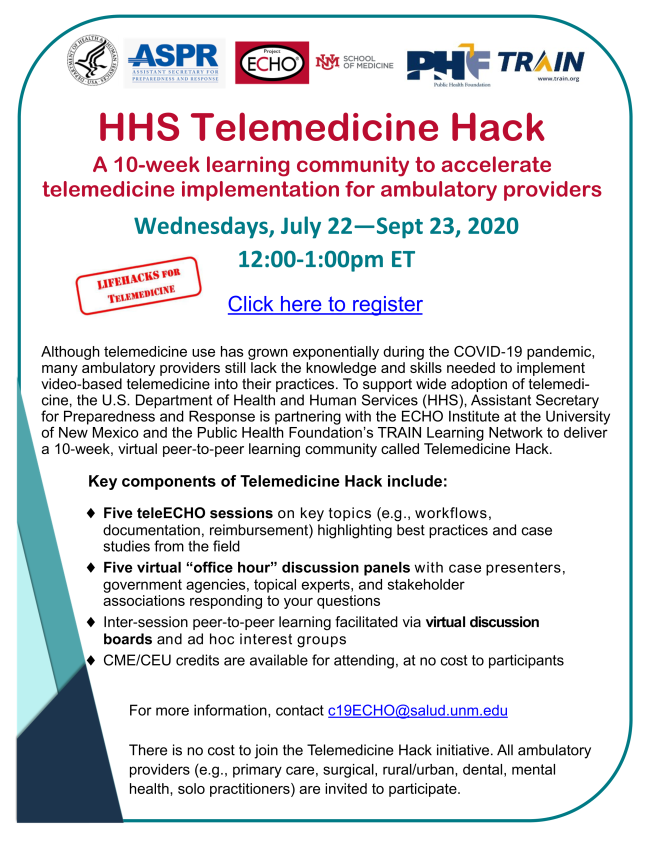
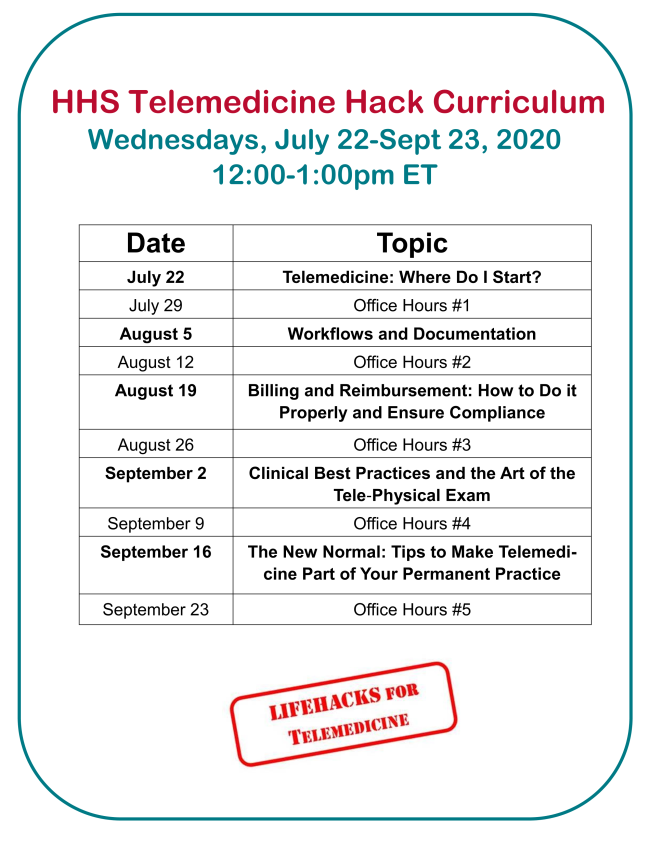
Offers weekly virtual peer-to-peer teleECHO sessions highlighting telemedicine best practices and case studies on key topics including workflow, documentation, and reimbursement. Virtual office hours provide discussion panels managed by experts responding to questions and learning is further facilitated by peer-to-peer discussion groups. CME/CEU credits are available for attending the sessions.
There is no cost to join the Telemedicine Hack initiative. All ambulatory providers (e.g., primary care, surgical, rural/urban, dental, mental health, solo practitioners) are invited to participate.
Sponsoring organizations: Project ECHO, TRAIN Learning Network, U.S. Department of Health and Human Services, University of New Mexico School of Medicine
|
Coronavirus Makes for Unique Congressional Internship for Foster Youth
Chronicle of Social Change - July 22, 2020
The coronavirus pandemic has added urgency to the work of this year's class of congressional interns with expertise in foster care - the history of their own lives. The fallout of COVID-19 has hit more than 400,000 children and youth in foster care like few other groups of Americans as yet another trauma in their lives, and none more so than young people approaching independence.
So this year's dozen former foster youth paired with policymakers by the Congressional Coalition on Adoption Institute had some legislative proposals they say are desperately needed: amending the Higher Education Act, establishing grant funding for technology needs and creating a trust fund for young adults raised by the government.
Ethical Casework Practice
Caseworkers should be prepared to address a number of ethical dilemmas that may occur when working with children, youth, and families. The following resources can help them assess the context in which moral and ethical issues may arise and how to address those issues effectively.
Every child or youth, birth family member, and adoptive family has the right to ethical adoption practice focused on the best interests of the child or youth. All parties to the adoption have the right to honest and complete information about the adoption. All actions and payments by parties to the adoption must be legal and ethical.
To ensure ethical practice, the following principles should guide all adoptions-including those made by agencies and those arranged independently...
Working With Diverse Populations in Adoption
Culturally competent casework practice is critical in our multicultural society. Cultural competence is an ability to interact effectively with people of different cultures while being aware of one's own cultural worldview. Culturally competent practice involves respect for people of all cultures, languages, classes, races, ethnic backgrounds, sexual orientations, and other diversity factors.
Find resources in this section on preparing families to adopt and emerging practices for working with children and youth.
13 Activities to Make the Most Out of Video Chats With Kids
Video chat is a perfect antidote to the isolation many families are feeling now due to shelter-in-place rules. Like all of us, babies and toddlers thrive when they have a chance to connect with the people who both love them and - more importantly - "get" them. Using technology to make this magic happen when we all need a little extra love? That's an expert-level parent hack.
Using Media Effectively with Young Children and Virtual Visitation
While in-person visitation is the best way to support families, it isn't always possible during this emergency. Now more than ever, it is critically important that birth and foster parents partner together to ensure that children experience continuity of relationships and can maintain contact with the people they love.
In the second installment of our new webinar series COVID-19: The New Normal, Dr. Rachel Barr shares research and practical tips on how virtual communication can be effectively utilized to maintain and strengthen relationships for children ages 0-5. One of the world's leading experts in the area of media and small children, Dr. Barr has worked extensively with separated families and has over 20 years of experience doing research in this area. The information included highlights some of the key takeaways from the discussion and provides tips to help parents make the most of virtual visitation with young children.
|
Explores rural and urban mental health access during the COVID-19 pandemic. Discusses the expanded use of telehealth, the lack of broadband access, and mental health provider shortages in rural areas.
|
Let's Extend National DSP Recognition Week by 51 Weeks
National Direct Support Professional (DSP) Recognition Week is an annual celebration that highlights the life-changing contributions of the direct support professional workforce. Throughout one week in September, human service organizations across the country take positive steps to acknowledge DSPs. Some examples include award ceremonies, catered lunches, prize giveaways, and more.
These are wonderful programs that organizations put in place to make sure that DSPs feel appreciated. National DSP Recognition Week is a great way to set aside time that is specifically devoted to the essential work of DSPs and say "thank you."
In the past, NADSP and CQL have collected and shared individual stories of excellence in direct support. We have posted articles and videos showcasing extraordinary DSPs who are embodying the most ethical standards and/or supporting people with disabilities to achieve their personally-defined outcomes.
This year, we're going to try something different.
Deep-Rooted DSP Recognition
For 2020 National DSP Recognition Week, we want to learn about specific organization-wide initiatives that lift up and bolster DSPs throughout the entire year. This includes significant, long-lasting, and meaningful actions that have far-reaching effects on DSPs.
We want to share organizational efforts that provide solutions to these types of questions:
- What platform or methods do you use to recognize DSPs throughout the entire year?
- How are DSPs involved in 'big-picture' decision-making at your organization?
- What specific programs do you have in place to help DSPs advance in their career?
- How do you offer staff development opportunities for DSPs?
- What platform or methods do you use to collect DSP questions, concerns, and suggestions?
- How have you transformed systems and practices to be responsive to the needs of DSPs?
During National DSP Recognition Week from September 13 - 19, 2020, NADSP and CQL will post these initiatives on our websites and social media accounts to help spread best practices and improve the standing of DSPs nationwide. While we'll also offer our gratitude for DSPs during National DSP Recognition Week, this campaign has the potential to make a world of difference in the lives of thousands of DSPs.
By sharing these initiatives, other human service providers can both learn about and replicate your efforts to build up the DSP workforce. This is also an opportunity to highlight the programs your organization has developed to strengthen DSPs.
Submit Your DSP Initiative
After clicking the 'GET STARTED' button below, you will be directed to a SurveyMonkey page to submit your organization-wide initiative that positively impacts DSPs. You are welcome to submit multiple entries, but please only submit one initiative per survey.
Before submitting your initiative, please be sure that you can answer "Yes" to the following questions:
- Is this a specific program or initiative? (vs. a mission/vision statement)
- Does your initiative/program have a long-lasting impact?
- Has there been a positive effect on the lives/work of DSPs?
- Are you able to provide DSP testimonials/quotes about that impact?
- Could other organizations replicate your efforts?
|
Friday: July 24, 2020
Parents as Changemakers: Effective Policy Advocacy
Time: 3:00 pm thru 4:30 pm
|
New: Monday: July 27, 2020
Joint DMHDDSAS and DHB (NC Medicaid) COVID-19 Update Call
For BH/IDD Consumers, Family Members and Community Stakeholders
(After this meeting, it will continue once per month, on the 4th Monday of each month)
Time: 2:00 pm thru 3:00 pm
|
New: Monday: July 27, 2020
New Webinar to Support Medicaid Providers Applying for Federal Relief Funds
Time: 3:00 pm
|
Tuesday: July 28, 2020
On the Frontline: Promoting Self-Care Practices and Psychological Well-Being During a Crisis
Time: 9:00 am thru 10:00 am
|
Tuesday: July 28, 2020
An Introduction to Youth Problem Gambling
Time: 10:00 am thu 2:30 pm
|
Wednesday: July 29, 2020
Human Service Provision in High Stress Environments, Skills and Strategies for Provider Self-Care
Time: 10:00 am thu 11:30 am
|
Wednesday: July 29, 2020
On the Frontline: How to Manage Anxiety and Worry During a Crisis (New Time)
Time: 10:00 am thu 11:00
|
Wednesday: July 29, 2020
Adverse Childhood Experiences and Resilience-Focused Skills Lab
Time: 10:00 am thu 2:30 pm
|
Wednesday: July 29, 2020
Time: 12:00 pm thru 1:00 pm
|
Wednesday: July 29, 2020
A to Zs of COVID-19 for Families and Individuals
with I-DD
Time: 12:00 pm to 1:00 pm
|
Wednesday: July 29, 2020
Series: Hurricane Season and COVID-19: How Families of Children and Youth with Special Health Care Needs Can Be Prepared
Part 3:
Recovery, Resources, and Questions Answered about Preparing during COVID-19
Time: 1:00 pm thru 2:00 pm EST
|
Wednesday: July 29, 2020
Accreditation for the Changing Face of Addiction Treatment
Time: 1:00 pm thru 2:00 pm EST
|
New: Thursday: July 30, 2020
If you are 5-10 years away from retirement, join
Retirement: Are You Ready?
Time: 2:00 pm thru 3:30 pm
|
Thursday: July 30, 2020
Human Service Provision in High Stress Environments, Skills and Strategies for Provider Self-Care
Time: 2:00 pm thru 3:30 pm
|
New: Friday: July 31, 2020
Benchmarks' Friday Membership Call Featuring
Dave Richard & Karen McLeod
Time: 8:30 am thru 9:30 am
|
Tuesday: August 4, 2020
Addressing the Intersection of Substance Use and Suicide: Strategies for Prevention, Intervention, and Treatment
Time: 2:00 pm thru 3:30 pm
|
New: Wednesday: August 5, 2020
Parents Can We Talk: IEP & Disability Rights (ONLY FOR NC FAMILIES)
Time: 10:00 am thru 11:30 am
|
Please click on each of the following links to view details sent out from each LME/MCO.
Benchmarks' wants to be sure to make the following list handy for our members to visit and suggests a peek at least once per week to find information that may be pertinent to your agency and contracts.
|
|
|
|
|
|