|
Benchmarks' Friday Membership Webinar
& Written Update
|
| Benchmarks Membership Webinar:
August 21, 2020 |
NC Cases: 148,967
Cases Hospitalized: 1,006
NC Deaths: 2,487
Revenue Projections
Colin Campbell, THE INSIDER, 8/18/20
The legislature's top economists had hoped that July's delayed income tax filing deadlines would result in a clearer state revenue forecast this month, but they said last week that the forecast will now have to wait until late September. That means state legislators likely won't have detailed information during the scheduled early September session to determine if budget adjustments are needed.
"Unfortunately, we are still facing significant economic uncertainty along with new uncertainty about federal policy and the Fiscal Research Division does not expect to have the information necessary to issue a revised, line-item forecast until late September," division leaders Barry Boardman and Emma Turner wrote in an email to legislators last week. "This will allow for us to have August revenue collection data, some clarity on the rules to implement the president's executive order issued over the weekend (on unemployment benefits), and an answer on whether Congress will or will not appropriate any additional relief packages."
"This means we are operating with as much uncertainty as we were back in May," Boardman and Turner wrote. "While our current economic forecast assumes some federal relief, without the extension of federal assistance many forecasters are projecting a 'double dip' recession, which would negatively impact the revenue forecast we currently have."
The email concludes that it's also possible that the next revenue forecast could get delayed even further. "We do caution that if by the end of September the pandemic has not subsided in some measurable amount to where we can sort out the economic effects on the state, we could be delayed again," Boardman and Turner wrote.
"We are in a very unpredictable circumstance with respect to assessing economic activity." The legislature is set to return on Sept. 2 to handle appropriations of federal funding and appointments. Pat Ryan, a spokesman for Senate leader Phil Berger, said Monday that the session "will move forward as planned" even if there's no action from Congress.
House COVID-19 Healthcare Committee
Danielle Battaglia, THE INSIDER, 8/21/20
When lawmakers come back to Raleigh in September, they plan to pass legislation to further help with COVID-19 relief. On Thursday morning, the House Select Committee on COVID-19 Health Care working group went through a list of 40 items that need funding and put them into categories of urgency. Thursday's discussion provided a tentative roadmap for the legislature's Sept. 2 session.
The committee's chairman, Rep. Donny Lambeth, D-Forsyth, told the group that the appropriations chairs will take the requests from the House committees and meet with the Senate next week to come up with a plan to use all of the federal money they "have in hand" for COVID-19 relief. Lambeth said the Senate will come with its own list of funding requests and try to reach an agreement before lawmakers meet on Sept. 2 to discuss a bill on the topic.
The group postponed action on education until the House COVID-19 committee on education meets Tuesday to see if any of the topics overlap. In the meantime, Lambeth and the group divided up the rest of the 40 items into what needed to be funded immediately and what could be funded later, likely when Congress approves a second coronavirus relief package. "Once we know more about the federal allotment we'll have to come back and make those same priority settings and negotiations with the Senate on how that second CARES Act will be spent," Lambeth said.
Legislative Fiscal Analyst Mark Collins said the list lawmakers reviewed Thursday were funding requests received since the enactment of House Bill 1043, the COVID-19 Recovery Act. Collins warned the members that some of the items were several months old, and some of the issues may have already been addressed.
One of the state's biggest needs throughout the pandemic response has been personal protective equipment. "OSBM has sent the initial payments to all of the groups that were allotted their own selection of PPE," said Jessica Meed, a legislative analyst. "We have not received information about whether or not they have been able to purchase the PPE yet." Lambeth suggested they supply some of the funding in the September sessions and then put funding for more PPE needs under the Tier 2 group that would be reexamined at a later date. "This will be through December, and they may not need all that so we'll come back and reexamine that," Lambeth said.
The group tabled discussions on a rate increase for Medicaid. Earlier in the meeting, Health and Human Services Secretary Mandy Cohen lobbied for Medicaid expansion, which she said would have a large impact on the state's healthcare needs. Right now the Division of Health Benefits has increased rates to 6.2% to almost every provider during the pandemic through federal matching funds. The increases expire when the national public health emergency ends. A required rate increase of 5% expires at the end of the national emergency, the end of the state emergency or on March 31, 2021. Providers have been told the full rate increase will last at least through Sept. 30. But Lambeth and his work group wanted clarification about some of the Medicaid asks before moving forward. They plan to discuss that next week.
"We do need to put some funding in for testing," Lambeth said. The group discussed COVID-19 testing, which currently has allocated $125 million from the Coronavirus Relief Fund and other funding from a CDC grant. That money is being used to support testing of people who have symptoms or have been exposed to the virus. Other funds pay for staff surveillance testing at nursing facilities every two weeks.
Lambeth said the governor is requesting $2 million for the Duke Human Vaccine Institute to develop a rapid, sensitive and inexpensive test for active COVID-19. He said he's hoping the governor will release his request next week. But the rest of the items need to be decided. UNC-Charlotte has requested $5 million to test wastewater and public transportation systems at the university and in Charlotte as another way to monitor, detect and offer early warning signs of the virus. Committee members agreed to put that funding into Tier 1.
Lambeth suggested offering financially distressed medical practices half of their $50 million ask and consider the rest later. Lambeth suggested moving the $100 million asks for hospitals who didn't receive federal money to Tier 2 to be reviewed later. The committee members ran out of time but agreed to meet again Tuesday to discuss the budget further.
White Paper on State Funded Services Under Tailored Plans
The department released a memo regarding the white paper from 2019 on their intent to provide state funded services under Tailored Plans. They are planning on moving away from the significant variance we have seen with the LME/MCOs and move toward more consistent standardized services utilizing the state funds. Please see the announcement that came from Deputy Secretary Dave Richard below:
Good afternoon, Medicaid Associations:
A memo regarding North Carolina's Design for State-Funded Services Under Behavioral Health and Intellectual/Developmental Disability Tailored Plans white paper has been released.
DHHS appreciates the stakeholder feedback received. Based on that feedback, this memo includes updates to eligibility for State-funded Services, the set of core and non-core State-funded Services that will be offered within available funding limits following Behavioral Health I/DD Tailored Plan launch, the eligibility for State-funded care management for recipients with I/DD and TBI, and considerations for maximizing the impact of limited state funds available to support these services.
Thank you for your dedication and commitment to ensure our North Carolina Medicaid beneficiaries receive the services and treatment they need during the COVID-19 pandemic.
-- Dave
Jail Populations
Danielle Battaglia, THE INSIDER, 8/19/20
The Task Force on Racial Equity in Criminal Justice needed a moment to compose themselves after hearing statistics on the North Carolina prison population. "These are extraordinary presentations," said Henderson Hill, senior counsel for the ACLU's Capital Punishment Project. "Breathtaking in fact." Ben Finholt, staff attorney at the N.C. Prisoner Legal Services, had just finished a presentation for a portion of the task force that showed that the number of Black people incarcerated is greatly disproportional to the Black population in North Carolina's communities.
According to 2019 Census projections, North Carolina's Black and White populations are 21.5% and 62.4% respectively. But since 1972, the prison populations were 45% Black and 44% white. But Finholt broke that down further. In the prison system, 56% of the population serving 20 years or more are Black. Black people made up 60% of the prison population serving more than 60 years or serving life without parole. For disciplinary infractions, only 29% involve white inmates, while 65% involve Black inmates.
But it was the juvenile and habitual felon populations that really caught Finholt's attention. About 75% of juveniles serving life sentences with parole are Black, 84% of inmates serving life sentences for being a habitual felon are Black, and 91% of inmates serving life without parole are black. "The last one to me, I almost couldn't believe it when I ran the data," Finholt said.
The task force members came away from the discussion with three key recommendations. The members want to recommend giving explicit bias training to all court staff, bolstering the governor's ability to grant clemency, and rethinking how North Carolina does parole. The work group plans to bring these matters up at the next Task Force meeting on Aug. 28.
Primary Care
Rose Hoban, NC HEALTH NEWS, 8/19/20
How individual offices have been able to adapt in recent months offers a glimpse into a primary care ecosystem with deep vulnerabilities for the little guys in the smaller independent private practices that rely heavily on hands-on face-to-face encounters. Some that already were preparing to offer virtual visits through telehealth models have been more nimble and able to adapt. Others are testing new financial systems that no longer count so heavily on the fee-for-service model, shifts that could offer a guide to the future as individual practices try to stave off consolidations that might offer economies of scale without bringing higher quality care.
According to a survey conducted by the North Carolina Academy of Family Physicians and the North Carolina Pediatric Society, 87 percent of practices reported being under "significant or extreme financial pressure." For physician-owned practices that number goes up to 92 percent. According to the survey, practices have tried many different ways to stay afloat, from temporary closures to reducing hours. Physician practice owners reduced pay for themselves and their workers, furloughed staff. They applied for loans, sought help from the Paycheck Protection Program, tried to open new lines of credit or refinance their mortgages. Doctors did all this, even as they pivoted their practices to telehealth and comprehensively changed the way they operated.
Despite those pivots, the survey found that about one in 10 primary care physicians has considered selling the private practice or closing up shop completely. "The rural independent practices have probably been hurt the worst," said Greg Griggs, head of the NCAFP. He noted that those practices have a mix of payers that lean heavily on Medicare and Medicaid, government programs that reimburse for care at lower rates than commercial payers such as Blue Cross Blue Shield of North Carolina.
Broadband Expansion
DAWN BAUMGARTNER VAUGHAN AND LYNN BONNER, THE NEWS & OBSERVER, 8/19/20
At Wednesday's news conference, Gov. Roy Cooper announced a $12 million fund to expand internet access. More than half of the state's K-12 public school students are starting the year working remotely, and the lack of broadband has been a concern. Cooper said the money would make broadband available to 8,000 additional families and 250 businesses, farms and community institutions in 11 counties, including Orange County in the Triangle. "Now that we're living in a socially distanced world, reliable internet is more important than ever, particularly for students learning remotely and people working from home," Cooper said.
States Pressured To Remove Disability Bias From Medical Care Guidelines
by Shaun Heasley | August 21, 2020
In what's being called a national precedent, yet another state is agreeing to change its approach to providing medical care during the pandemic in order to prevent disability discrimination.
The U.S Department of Health and Human Services' Office for Civil Rights said Thursday that it has reached a resolution with the state of Utah to revise its crisis standards of care guidelines.
At issue is the state's plan to ration care in the event that ventilators or other resources are in short supply, an issue that's come to the fore amid the coronavirus pandemic. Disability advocacy groups have filed complaints against nearly a dozen states alleging that such plans discriminate against people with disabilities.
In the case of Utah, the state has altered its plan so that medical providers must conduct an individual assessment rather than making decisions based on age, disability or functional impairment. Language allowing a person's long-term life expectancy to be factored has been removed and providers can no longer consider resource intensity or duration of need as criteria for a person to receive medical resources. In addition, under the updated policy, hospitals should not reallocate personal ventilators that people with disabilities have brought with them.
Most significantly, advocates noted that Utah will not allow blanket "do not resuscitate" policies if resources are scarce and the state is including protections to keep providers from steering people into decisions to withhold life-sustaining treatment.
"We've been pleased by the cooperation of states we have approached with civil rights concerns regarding their policies and Utah's plan is the best yet," said Roger Severino, director of the HHS Office for Civil Rights. "Older persons and persons with disabilities have equal worth and dignity and should not be deprioritized for health care based on stereotypes and other impermissible factors."
The HHS Office for Civil Rights previously resolved complaints against Tennessee, Pennsylvania and Alabama regarding crisis standards of care guidelines.
"Today's resolution sends a clear message during a dire time: people with disabilities must have equal access to life-saving treatment during the COVID-19 pandemic," said Alison Barkoff, director of advocacy at the Center for Public Representation, one of the groups that brought the complaints against Utah and other states. "Many states' medical rationing plans have discriminatory provisions similar to those in Utah. We urge states across the country to heed this warning and revise their plans now to comply with federal disability laws."
|
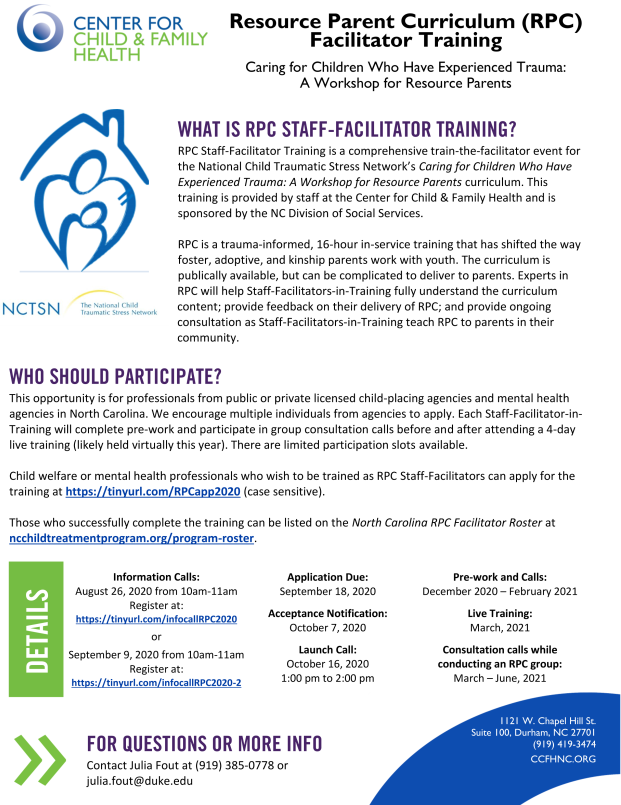
DCDL Resource Parent Curriculum (RPC) Staff Facilitator Opportunity
The NC Division of Social Services (NC DSS) is committed to building a traumainformed child welfare system that supports wellbeing and permanency goals for children, youth, and families. When the trauma needs of children and youth in foster care are addressed, they have improved permanency outcomes.
To that end, we are pleased to offer a comprehensive facilitator training for the National Child Traumatic Stress Network (NCTSN) in-service training for foster, adoptive, kinship, and therapeutic parents called Caring for Children Who Have Experienced Trauma: A Workshop for Resource Parents (RPC). RPC is a trauma-informed 16-hour in-service training that has shifted the way North Carolina parents are working with youth.
Download Associated Documents:
|
#RuralHealthChat: Preparing Rural Healthcare Systems for COVID-19 Surge
On August 26 at 1:00 p.m., we are hosting a Twitter Chat, Preparing Rural Healthcare Systems for COVID-19 Surge.
Join special guests from the Health Resources and Services Administration, National Organization of State Offices of Rural Health, National Association of Rural Health Clinics, and more! Please use #RuralHealthChat and #RuralHealthReady to participate.
Rural Data Explorer
Select from a wide range of data on health disparities, health workforce, demographics, and more. Explore how metropolitan and nonmetro counties compare, nationwide and by state.
|
Trump Administration Issues Joint Informational Bulletin Intended to Improve Health and Housing Outcomes for Older Adults and People with a Disability in Rural America
August 19, 2020, the Centers for Medicare & Medicaid Services (CMS) issued a Joint Informational Bulletin with the U.S. Department of Housing and Urban Development (HUD), the U.S. Department of Agriculture (USDA), and three other U.S. Department of Health and Human Services (HHS) agencies-the Administration for Community Living (ACL), the Centers for Disease Control and Prevention (CDC), and the Health Resources and Services Administration (HRSA).
The Bulletin provides state Medicaid agencies, state and local housing agencies, state and local public health agencies, and other health and housing entities with information on existing federal resources available to help improve health and housing outcomes for older adults and those with disabilities in rural America. The Bulletin discusses a wide variety of federal resources that can be used to help reduce physical environmental barriers in the home, increase safety, minimize the risk of falls, and support a person's ability and desire to remain in their own home.
The Bulletin also supports the HHS Rural Health Task Force, an HHS-wide effort on improving health care and access for rural America. This includes the efforts by CMS, ACL, the CDC, and HRSA to improve health care in rural America.
To view the Joint Informational Bulletin,visit
|
HHS Releases Healthy People 2030 with National Disease Prevention and Health Promotion Objectives for the Next Decade
August 18, 2020 the U.S. Department of Health and Human Services released Healthy People 2030, the nation's 10-year plan for addressing our most critical public health priorities and challenges. Since 1980, HHS's Office of Disease Prevention and Health Promotion has set measurable objectives and targets to improve the health and well-being of the nation.
This decade, Healthy People 2030 features 355 core - or measurable - objectives with 10-year targets, new objectives related to opioid use disorder and youth e-cigarette use, and resources for adapting Healthy People 2030 to emerging public health threats like COVID-19. For the first time, Healthy People 2030 also sets 10-year targets for objectives related to social determinants of health.
"Healthy People was the first national effort to lay out a set of data-driven priorities for health improvement," said HHS Secretary Alex Azar. "Healthy People 2030 adopts a more focused set of objectives and more rigorous data standards to help the federal government and all of our partners deliver results on these important goals over the next decade."
Healthy People has led the nation with its focus on social determinants of health, and continues to prioritize economic stability, education access and quality, health care access and quality, neighborhood and built environment, and social and community context as factors that influence health. Healthy People 2030 also continues to prioritize health disparities, health equity, and health literacy.
"Now more than ever, we need programs like Healthy People that set a shared vision for a healthier nation, where all people can achieve their full potential for health and well-being across the lifespan," said ADM Brett P. Giroir, MD, Assistant Secretary for Health. "COVID-19 has brought the importance of public health to the forefront of our national dialogue. Achieving Healthy People 2030's vision would help the United States become more resilient to public health threats like COVID-19."
Healthy People 2030 emphasizes collaboration, with objectives and targets that span multiple sectors. A federal advisory committee of 13 external thought leaders and a workgroup of subject matter experts from more than 20 federal agencies contributed to Healthy People 2030, along with public comments received throughout the development process.
The HHS Office of Disease Prevention and Health Promotion leads Healthy People in partnership with the National Center for Health Statistics at the Centers for Disease Control and Prevention, which oversees data in support of the initiative.
|
Health Professional Shortage Area Scoring Criteria Request for Information (RFI)
The Health Resources and Services Administration (HRSA) is seeking public and stakeholder feedback to inform policy related to scoring criteria for Health Professional Shortage Areas (HPSAs). Feedback is requested by September 18, 2020.
Scoring criteria specific to Mental Health HPSAs- Population-to-Full-Time-Equivalent-Provider Ratio
The FTE count of psychiatrists is required in all mental health HPSA applications, while the FTE count of other core mental health professionals is optional. Other core mental health professionals include: clinical psychologists, clinical social workers, marriage and family therapists, and psychiatric nurse specialists. Depending upon the data reported, the current HPSA scoring point scales utilize a population-to-psychiatrist ratio or a population-to-core mental health provider ratio. HRSA seeks input on whether these two scales should be maintained, or whether the FTE count of all core mental health professionals should be mandatory for scoring all mental health HPSAs. - Youth Ratio
The youth ratio is defined as the ratio of the number of children under age 18 to the number of adults of ages 18 to 64.
HRSA is seeking recommendations on whether this factor should be maintained. If so, HRSA seeks recommendations on the point scale to be applied. - Elderly Ratio
The elderly ratio is defined as the ratio of the number of persons aged 65 and older to the number of adults of ages 18 to 64.
HRSA is seeking recommendations on whether this factor should be maintained. If so, HRSA seeks recommendations on the point scale to be applied. - Substance Use Disorder Prevalence
A single point is awarded if an area's rate is in the worst quartile for the nation, region, or state.
HRSA is seeking recommendations on whether this factor should be maintained. If so, HRSA seeks recommendations on the point scale to be applied. - Alcohol Use Disorder Prevalence
A single point is awarded if an area's rate is in the worst quartile for the nation, region, or state.
HRSA is seeking recommendations on whether this factor should be maintained. If so, HRSA seeks recommendations on the point scale to be applied.
|
Children and COVID-19: State-Level Data Report
State-level reports are the best publicly available data on child COVID-19 cases in the United States. The American Academy of Pediatrics and the Children's Hospital Association are collaborating to collect and share all publicly available data from states on child COVID-19 cases (definition of "child" case is based on varying age ranges reported across states; see report Appendix for details and links to all data sources).
On August 13, the age distribution of reported COVID-19 cases was provided on the health department websites of 49 states, New York City, the District of Columbia, Puerto Rico, and Guam. While children represented only 9.1% of all cases in states reporting cases by age, over 406,000 children have tested positive for COVID-19 since the onset of the pandemic.
A smaller subset of states reported on hospitalizations and mortality by age, but the available data indicated that COVID-19-associated hospitalization and death is uncommon in children.
At this time, it appears that severe illness due to COVID-19 is rare among children. However, states should continue to provide detailed reports on COVID-19 cases, testing, hospitalizations, and mortality by age so that the effects of COVID-19 on children's health can be documented and monitored.
|
Race, Ethnicity and Disability: The Financial Impact of Systemic Inequality and Intersectionality
The brief offers a historical context for understanding intersectionality, the financial impacts on Black, Indigenous and People of Color with disabilities and presents data, conclusions and recommendations. The NDI notes that the most financially vulnerable population in America is the group of individuals that live at the intersection of disability, race and ethnicity.
|
People with IDD and those who serve them are experiencing trauma due to the effects of COVID-19. Relias' latest e-book, Creating a Trauma-Informed System of Care, will give your organization more understanding of the trauma-informed framework and how to care for your staff and the people you serve as you navigate these difficult times.
|
ICYMI: Oral Health & Behavioral Health: Models of Coordinated and Integrated Care
|
Monday August 24, 2020
Joint DMHDDSAS and DHB (NC Medicaid) COVID-19 Update Call For BH/IDD Consumers, Family Members and Community Stakeholders
Time: 2:00 pm
|
Tuesday: August 25, 2020
Project AWARE: A Spectrum of Opportunity in School Based Mental Health Service Provision
Time: 11:30 thru 12:30 pm
|
Tuesday: August 25, 2020
Addressing Emotional Health Needs of People with IDD During a Pandemic: A Model Demonstration Project to Promote Engagement and Comfort During a Crisis
Time: 2:00 pm thru 3:00 pm
|
Tuesday: August 25, 2020
Webinar: Successful Approaches to Creatively Engage with Older Adults during COVID-19
Time: 3:00 pm
|
Wednesday: August 26, 2020
QuitlineNC: Supporting Patients to Become Tobacco Free During COVID-19
Time: 12:00 pm thru 1:00 pm
|
Wednesday: August 26, 2020
Time: 2:00 pm thru 3:00 pm
|
Wednesday: August 26, 2020
Rural Development Hubs Webinar
Time: 2:00 pm thru 4:00 pm
|
Thursday: August 27, 2020
Fetal Alcohol Spectrum Disorders Webinar Series
4 Part Series (Aug. 27, Sept. 3, Sept. 10, Sept. 17)
Includes CEOs & Contact Hours-Free of Charge
Time: 9:00 am thru 4:45 pm
|
Thursday: August 27, 2020
INDIVIDUAL AND COMMUNITY RESILIENCE IN TIMES OF CRISIS
Time: 10:00 am thru 11:00 am
|
Thursday: August 27, 2020
Complimentary Webinar: COVID-19 Q&A Webinar for Behavioral Health Care Accreditation
Time: 1:30 pm thru 3:00 pm EST
|
Thursday: August 27, 2020
Compassionate Approaches to Crisis Webinar Series
Time: 2:00 pm
|
Thursday: August 27, 2020
Time: 2:00 pm thru 3:00 pm
|
Friday: August 28, 2020
Partners' Provider Council
Time: 9:30 am
|
Tuesday: September 1, 2020
Community Support Safeguards During the COVID-19 Pandemic
Time: 8:00 am thru 9:00 am
|
Wednesday: September 9, 2020
Partners Quarterly Provider Webinar
Time: 1:00 pm
|
Wednesday: September 9, 2020
Reduction of Stigma in our Communities
Time: 3:00 pm thru 4:00 pm
|
Thursday: September 10, 2020
Benchmarks' Child Welfare Webinar feat: Karen McLeod & Lisa Cauley
Time: 8:00 am thru 9:00 am
|
Monday: September 14, 2020
Western NC: Regional Policy Institutes
Time: 9:00 am thru 11:30 am
Deputy Secretary Juvenile Justice, Billy Lassiter
Advocacy 101: Adam Sotak, NC Child Legislative Panelists:
Terry Van Duyn - Buncombe
Representative Sarah Stevens -Alleghany/Surrey/Wilkes Counties Include:
Cherokee, Graham, Clay, Macon, Jackson, Swain, Haywood, Transylvania, Madison, Buncombe, Henderson, Polk, Yancey, McDowell, Rutheford, Cleveland, Lincoln, Burke, Caldwell, Mitchell, Avery, Watagua, Ashe, Alleghany, Surry, Wilkes, Yancey, Catawba, Alexander, Iredell, Yadkin, Davie, Stokes, Forsyth
|
Thursday: September 17, 2020
Partners Mental Health/Substance Use Provider Information Session
Time: 4:00 pm
|
Thursday: September 18, 2020
MEDICAL CARE ADVISORY COMMITTEE (MCAC) TELECONFERENCE MEETING
Time: 10:30 am thru 12:30 pm
Call: 866-390-1828
Access Code: 4586030
|
Tuesday: September 22, 2020
Partners Innovations-I/DD Provider Information Session
Time: 4:00 pm
|
Friday: September 25, 2020
Western NC: Regional Policy Institutes
Time: 9:30 am
|
Monday: September 28, 2020
Central NC: Regional Policy Institutes
Time: 9:00 am thru 11:30 am
Keynotes: Deputy Director, Child Welfare Services Lisa Cauley
NC Child Welfare Family Advisory Council - Gina Brown
Advocacy 101: Melea Rose-Waters, Prevent Child Abuse NC
Counties Include: Gaston, Mecklenburg, Union, Rowan, Rockingham, Caswell, Person, Guilford, Davidson, Randolph, Montgomery, Cabarrus, Stanly, Alamance, Lee, Moore, Anson, Richmond
|
Tuesday: October 6, 2020
Eastern NC: Regional Policy Institutes
Time: 9:00 am thru 11:30 am
Keynotes: Deputy Secretary, Behavioral Health & Intellectual and Developmental Disabilities - Kody Kinsley
Associate Director, NC Families United - Stacy Justiss
Advocacy 101: i2i Center for Integrative Health
Legislative Panelists:
Senator Don Davis - Greene/Pitt
Representative Donna White - Johnston
Counties Include: Vance, Warren, Halifax, Northampton, Nash, Edgecombe, Wilson, Harnett, Cumberland, Hoke, Scotland, Robeson, Bladen, Harnett, Sampson, Duplin, Wayne, Pender, New Hanover, Brunswick, Columbus, Onslow, Jones, Lenoir, Greene, Pitt, Carteret, Beaufort, Craven, Pamlico, Hyde, Dare, Washington, Martin, Bertie, Currituck, Perquimans, Pasquotank, Gates, Hertford, Camden, Chowan, Tyrell
|
Saturday: October 10, 2020
Save The Date: NAMI's 2020 Annual Conference
Virtual and Free
|
Monday: October 26, 2020
Triangle: Regional Policy Institutes
Time: 9:00 am thru 11:30 am
Keynotes: Youth Transition Program Director, NC Families United - Lacy Flintall
MomsRising - Sheila Arias
Advocacy 101: Beth Messersmith, MomsRising
Legislative Panelists:
Senator Valerie Foushee - Chatham/Orange
Senator Natalie Murdock - Durham
Representative Verla Insko - Orange
Counties Include: Wake, Johnston, Chatham, Orange, Durham, Franklin, Granville
|
Please click on each of the following links to view details sent out from each LME/MCO.
Benchmarks' wants to be sure to make the following list handy for our members to visit and suggests a peek at least once per week to find information that may be pertinent to your agency and contracts.
|
|
|
|
|
|