Distance Learning
T. KEUNG HUI, THE NEWS & OBSERVER, 7/25/20
The majority of North Carolina public school students will start next school year continuing to learn from home instead of going back to school for face-to-face classes. At least 46 school districts and 30 charter schools have decided over the past week to use remote instruction when classes resume in August, according to totals compiled by The News & Observer. Those schools represent 788,491 students, accounting for 51.7% of the state's K-12 public school enrollment.
Fears of returning for in-person instruction during the coronavirus pandemic have been a major theme at school board meetings across the state. "We can always fix the academics of the kids," Cumberland County school board member Joseph Sorce said before this week's vote to start students with six weeks of online classes. "But we can't fix somebody that passes away from this terrible disease."
But some board members think it's a mistake to delay bringing students back to school, even if it's only for a few days a week or alternating weeks. The state's 1.5 million students haven't been in school for face-to-face classes since mid-March. "At the end of the day, our job as a board is to provide the best education that we can for the kids of Cabarrus County and to make sure that we're providing them with a quality education, and right now we're not," Cabarrus County school board member Laura Blackwell said before the board voted Thursday to start the year with remote instruction.
Gov. Roy Cooper has announced he's reopening K-12 public schools in August under a "moderate social distancing" plan that limits how many students can be in schools and on buses. This plan, known as Plan B, also mandates daily temperature checks and health screenings, increases school cleanings and says face coverings must be worn by all students and school employees.
Plan B requires schools to limit capacity so that they can maintain 6 feet of social distancing between people in classrooms. It also requires schools to limit buses to one child per seat unless they are family members. But Cooper also gave school districts the option to use Plan C, which only has remote instruction. He's not permitting schools to reopen for full-time, in-person instruction, which is Plan A.
School Reopening
Anna Pogarcic, EDUCATION NC, 7/25/20
Following Gov. Roy Cooper's announcement on schools reopening this fall, the State Board of Education heard an update on guidance issued since June 11 from DHHS Chief Deputy Secretary Susan Gale Perry. Davis emphasized that plan B, which allows in-person instruction with social distancing and other guidelines, provides consistent expectations that are based on science. Schools can also choose to go fully remote under plan C, which some already have. He said he knows these choices haven't been easy but recognizes that they were made with "thoughtful care and concern."
Two important changes that Perry highlighted for the Board were the wording of the guidance on when to wear masks and when children can return to school after a positive test:
- The guidance now says face coverings are required for all K-12 students and staff at all times when on school grounds and while traveling, not just when within six feet of another person.
- Students may return to school if they are asymptomatic for 24 hours. DHHS decreased this from the original 72 hours in response to guidance from the CDC, according to DHHS Senior Early Childhood Policy Advisor Rebecca Planchard.
Davis said if a student doesn't comply with the face mask requirement, they will be offered remote instruction. The Board spent some time discussing how to make it easier for young students to wear masks. DHHS staff said they've explored different options, such as allowing students to decorate their masks. In addition to these changes, Perry said DHHS removed a requirement that schools adopt a 50% reduction in capacity and is instead just recommending that six feet of distance is maintained.
State Treasurer Dale Folwell asked if there's a waiver process for districts or charter schools that feel they can operate safely under Plan A, the least restrictive model that allows for in-person instruction. Perry clarified that there is no waiver process, but generally speaking, their hope is that the risks to students and staff are being taken seriously.
Education Federal Funding
MARTHA QUILLIN, THE NEWS & OBSERVER, 7/29/20
North Carolina will get more than $17.6 million in federal funds for efforts to help K-12 students get through the disruption caused by COVID-19, U.S. Secretary of Education Betsy DeVos announced Wednesday while traveling in the state. North Carolina is one of 11 states to receive the new grants, which will total more than $180 million. According to a release from the U.S. Department of Education, the money is from the Rethink K-12 Education Models Grant program and is to be used to created new ways for students to continue learning in ways that meet their needs. Awards range from $6 million to $20 million.
In North Carolina, the grant will fund a three-year initiative called "Light the Way," which will combine remote and in-person learning, according to a statement. It will be aimed at stabilizing or improving student achievement during disruptions to regular school, to better prepare teachers for digital-age instruction and to strengthen preparedness by schools and communities for events that may interrupt student learning, such as the pandemic. The effort will have statewide components but focus primarily on 45 of the state's most rural and economically disadvantaged communities. It will provide training for teachers, and resources for students and parents.
Food Insecurity
Marco Quiroz Gutierrez, NC LOCAL NEWS INTERN CORPS, 7/24/20
Organizers from the NC Second Chance Alliance and Justice Served NC have been doing weekly food donations for the Raleigh community since the COVID-19 pandemic began. The help is opportune, because according to Feeding America, the nation's largest domestic hunger-relief organization, 1 in 6 Americans could face hunger during the pandemic and more people than ever visit food banks across the country.
Inter-Faith Food Shuttle, a Feeding America food bank that operates in central North Carolina, said it has seen a 200% increase in people coming to its mobile markets, where it directly distributes food to the public, said Communications and Media Manager Laura Rice. With such an increase in demand, Inter-Faith was worried about being able to get enough food to match the increased need. Rice said, thankfully, from April to the end of June, Inter-Faith received 300,000 more pounds of food than last year during that period. The additional amount of people seeking food from food banks could be due to a variety of reasons, Rice said, including higher unemployment during the pandemic and because children are out of school.
Court Orders
NEWS RELEASE, 7/29/20
N.C. Supreme Court Chief Justice Cheri Beasley has extended several existing emergency directives in response to the COVID-19 pandemic. The directives continue to allow increased use of technology and seek to limit foot traffic in courthouses. The orders entered Wednesday by Beasley extend the effect of Emergency Directives 2-8. By law, emergency directives issued by the chief justice in response to a catastrophe expire every 30 days unless they are renewed.
The emergency directives extended Wednesday include:
- Require clerks of superior court to post notice at the courthouse to restrict entry by anyone likely exposed to COVID-19
- Allow increased use of teleconferencing for remote court hearings
- Limit public presence in courthouses to those with business to be conducted
- Waive notary requirements for court filings
- Allow certain documents to be served on another party or attorney by email
- Direct clerks of superior court not to enter or report nonpayment of money owed in criminal or infraction cases until after July 31
- Require that magistrates continue to perform marriages
Juvenile Detention Virus
Mark Schultz, THE NEWS & OBSERVER, 7/24/20
State officials announced the first confirmed case of coronavirus in a youth institution Friday. The juvenile at Pitt Juvenile Detention Center in Greenville entered the secure-custody facility already infected with the virus that causes COVID-19, state officials said in a news release. "It is important to note this juvenile was infected not at the facility, but in the community before they came to us," said William Lassiter, deputy secretary for Juvenile Justice, in the release.
"Because the Juvenile Justice Section has taken the proactive step of testing all juveniles upon entry into our facilities, we can effectively prevent the spread of the virus to other juveniles we house," he continued. This is the first positive test for COVID-19 of a juvenile being held in a secure custody facility operated by the state Juvenile Justice section of the Department of Public Safety, the release stated.
New NC utility cutoff rules explained
By Travis Fain, WRAL statehouse reporter
The rules on utility cutoffs got more complicated this week with the expiration of a state order forbidding power companies, water providers and other utilities from disconnecting customers who haven't paid.
For-profit companies, like Duke Energy, are now bound by
a new order
from the North Carolina Utilities Commission, which extends the coronavirus pandemic shutoff moratorium until September and requires them to give customers 12 months to pay off overdue balances.
But that doesn't apply to municipal-owned utilities or to co-operatives that are much smaller than the big for-profit companies but together provide water and electricity to millions of North Carolinians.
The moratorium on those shutoffs ends this week, though an executive order on the issue from Gov. Roy Cooper says these utilities have to offer people six-month payment plans to make up what they owe.
"If somebody is offered a six-month repayment plan and they comply with the plan and resume making their regular payments, then, yes, they cannot shut anyone off during that time period," Al Ripley, a consumer protection advocate at the North Carolina Justice Center, said Thursday.
"If someone does not keep up with their payments, then they can shut someone off like they normally do," Ripley said.
Providers can't charge fees, penalties or interest on late payments that accrued during the shutdown moratorium orders. They can include bad check fees, though.
The co-ops and municipal owned systems don't have the financial cushion of larger utility companies like Duke, which serves gas or electricity customers in seven states and had $3.5 billion in net income last year. That's why local officials, as well as State Treasurer Dale Folwell,
pushed for an end
to the governor's moratorium on shutoffs.
Folwell, in particular, argued that continuing the moratorium could cause smaller utility operations to fail.
The Utilities Commission, which regulates providers, said earlier this month that utilities reported more than $257 million in customer arrearages as of June 30. Nearly 60 percent of that was attributed to the three largest investor-owned utilities in the state: Duke Energy Carolinas, Duke Energy Progress and Dominion Energy.
All three remain under the shutoff moratorium.
Cooper said this week that he expects to announce a plan soon to help people pay their bills. The administration hopes to use federal money for the program, and officials are waiting on more guidance from the government.
The Justice Center has asked for a number of changes, including an extension of the shutoff moratorium for co-op and municipal customers, something the governor hasn't been willing to do.
Reipley said he fears people won't be able to cover their past-due bills, even over six months. He said that, not only will they get shut off - potentially during one of the hottest parts of the year - but utilities won't be able to collect what they're owed.
"It's going to be the worst of both worlds," he said
Competing House and Senate Covid-19 Recovery Bills
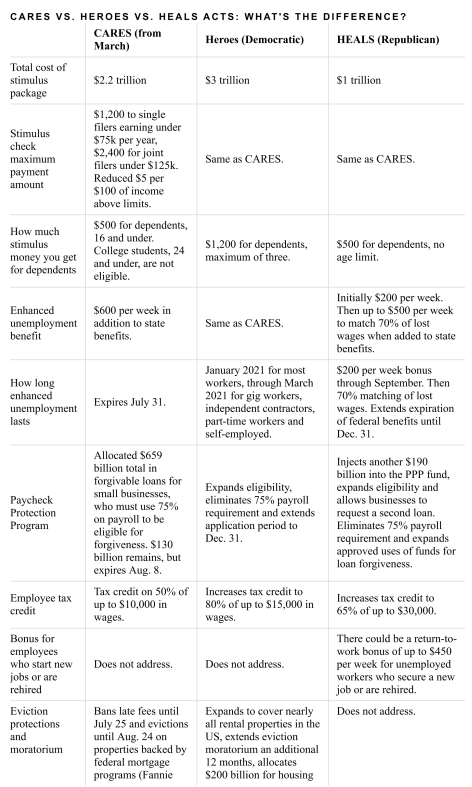
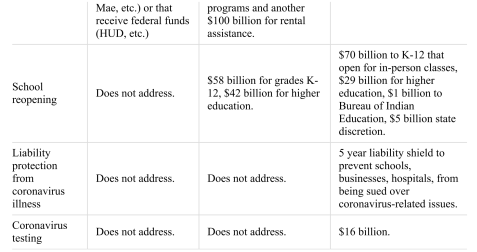
The Democratic-led House approved the HEROES Act in May. The Republican-led Senate introduced the HEALS Act July 27. Besides the competing acronyms, the two bills offer competing visions of what it will take to keep the staggering American economy from landing on the canvas during the ongoing coronavirus pandemic.
HEROES stands for Health and Economic Recovery Omnibus Emergency Solutions.
HEALS stands for Health, Economic Assistance, Liability and Schools.
What's next for the HEALS Act
With the Republicans having launched their HEALS Act on Monday 27 July, they now have until 7 August, when Congress goes into recess, to turn the proposal into legislation that will get past both the Senate and the House and onto President Donald Trump's desk for signing. And to do that, the Republicans are going to have to negotiate with the Democrats to get the votes they need (a significant amount of Republican senators are going to vote against another stimulus package no matter what, so the HEALS Act will likely need some Democratic support in the Senate, and will definitely need it in the Dems-dominated House).
That means a week and a half of fierce debate and public posturing, to try and thrash out a final package that's acceptable to both sides. The Dems will be pushing hard to expand the stimulus check coverage to somewhere near their HEROES proposal, while the Republicans, desperate not to see the budget for the legislation balloon, will hope to limit any expansion to the measure. Of course, what happens to the stimulus checks will depend on who gives way on additional unemployment benefits and a whole range of other items in the proposal.
For a more comprehensive look by the Alliance for Strong Families and Communities:
Here's what some of what the HEROES Act does:
- Makes an additional $1,200 payment to all residents; amends the CARES (Coronavirus Aid, Relief, and Economic Security) Act to provide payments for dependents over age 16 and taxpayers with a taxpayer ID number, allowing many immigrants and their families to be included.
- Ensures $600 weekly federal unemployment benefit payments through next January. It will also allow workers that had been traditionally ineligible for unemployment benefits to continue accessing them through next January.
- Continues the moratorium on evictions and foreclosures for all properties, gives protections to prevent utility and internet shutoffs, and a $100 billion rental assistance fund.
- Places a moratorium on small business debt collection, increases eligible tax credits, and provides additional grants and loans to nonprofits and small businesses.
- Hikes SNAP benefits by 15 percent. (SNAP stands for the Supplemental Nutrition Assistance Program).
- Pandemic Premium Pay - $200 billion for essential workers on the frontlines of the pandemic. Each worker would receive a pay raise equal to $13 per hour performed from Jan. 27, 2020 until 60 days after the final day of the public health emergency. Employees earning less than $200,000 per year can collect up to $10,000 in essential worker pay, while employees earning more than $200,000 per year can collect up to $5,000 in additional pay.
- State Fiscal Relief - $500 billion to assist state government with fiscal impacts from the emergency
- Local Fiscal Relief - $375 billion in funding to assist local government with fiscal impacts from the emergency
- Child Abuse Prevention and Treatment Act (CAPTA) Title I Grants to States - $20 million
- Child Abuse Prevention and Treatment Act (CAPTA) Title II - Community Based Child Abuse Prevention Grants - $20 million for necessary expenses for the prevention of child abuse and neglect
- Chafee - $50 million.
- Social Services Block Grant - $850 million set aside to fund child and family care for essential workers. $9.6 billion appropriated directly to states for emergency aid to low-income households.
- SAMHSA - $10 million for the National Child Traumatic Stress Network. $265 million for emergency response grants to address immediate behavioral health needs as a result of COVID-19.
- Federal Medical Assistance Parentages (FMAP) - New increase to 14 percent temporarily (July 1, 2020- June 30, 2021) and then back down to 6.2 percent.
- Substance Abuse Prevention and Treatment Block Grant - $1.5 billion
- Community Mental Health Services Block Grant - $1 billion
- Emergency Rental Assistance - $100 billion to help low-income renters at risk of homelessness avoid eviction.
- Cancels $10,000 in student debt for economically distressed borrowers of both publicly and privately-held loans and suspends the collection on all consumer debt.
- Provides help for states, counties, cities and school districts, most of which have balanced-budget mandates, and the U.S. Postal Service.
- Provides $4 billion for election security measures and expanded mail-voting.
Here's what the HEALS Act
does:
- Carries over the $1,200 payment from the CARES Act.
- Provides $64 million to the National Institute on Minority Health and Health Disparities
- Provides SAMHSA $4.5 billion for health surveillance and program support with $1.5 billion of that in grants for substance abuse prevention and treatment block grant o $2 billion for grants for community mental health services block grants
- Provides $50 mill for suicide prevention
- COVID-19 testing - $16 billion
- Provider Relief Funds - $25 billion
- Community Health Centers - $7.6 billion
- Rural Health Clinics - $225 million
- Low-Income Home Energy Assistance Program (LIHEAP) $1.5 billion
- Family Violence Prevention And Services grants (FVPAS) - $65 million including $2 million for the National Domestic Violence Hotline
- Child Welfare Services (Title IV Part B) - $75 million
- Community-Based Grants for Prevention of Child Abuse and Neglect (CAPTA, Title II) - $50 million
- $50 million for John H. Chafee Foster Care Program for Successful Transition to Adulthood o Suspends work and education requirements for education and training vouchers and waives limit on percent of Chafee funds that can be used for housing assistance
- Dislocated worker grants to states - $500 million
- $150 million to grants for states for youth workforce activities
- $150 million for adult workforce activities
- $150 million for dislocated worker national reserve
- Allows $100 billion in long-term, low-cost loans for what the bill calls "seasonal businesses and businesses located in low-income communities," capped at $10 million per loan.
- The "L" in HEALS, liability, gives a five-year shield against coronavirus-related lawsuits against businesses.