|
This Week: Benchmarks
WILL
Hold Our
Thursday Child Welfare Webinar! Whoo Hoo!
Date: Thursday: August 6, 2020
Time: 8:00 am thru 9:00 am
Note: We will
NOT be holding our Friday Membership Webinar next week.
|
NCDHHS announced two Request for Applications to support communities being hard hit by COVID-19
Community Engagement Grants
NCDHHS issued a Request for Applications for community engagement grants to organizations to assist our efforts in prevention and controlling the spread of COVID-19 in the African American community.
North Carolina continues to see a sustained increase in its confirmed cases of COVID-19 among the general population, and a disproportionately high percentage of cases statewide are among historically marginalized populations. Our state's African American residents are 21% of the North Carolina population, but represent 24% of the cases and 32% of the deaths where race and ethnicity are known. Health disparities among African Americans in North Carolina are historic and persistent. African Americans are disproportionately at risk for more severe illness from COVID-19 including chronic kidney disease, obesity; serious heart conditions, such as heart failure, coronary artery disease, or cardiomyopathies; sickle cell disease, Type 2 diabetes mellitus, asthma, cerebrovascular disease, hypertension, HIV, liver disease, and smoking.
The African American Community Engagement grants will be used to fund organizations to build awareness and support for DHHS prevention, testing, contact tracing, and isolation supports initiatives in regions of the state disproportionately impacted by COVID-19.
COVID-19 Support Service Program
NCDHHS is seeking regional partner organizations to administer an innovative new program to support individuals in targeted counties who need supports like food and transportation to successfully quarantine or isolate due to COVID-19.
In the Isolation Supports program, people in target counties who are directed to quarantine or isolate due to COVID-19 may apply to receive one or more of five social supports to help them do so: nutrition assistance such as home-delivered meals or groceries; a relief payment to offset temporary loss of income or ability to look for work; transportation; medication delivery; and COVID-related supplies such as a mask or cleaning supplies.
DHHS is releasing this RFA today in order to select regional partners who will administer the program in their area, including directly providing or contracting with local organizations that can collectively provide the full array of support services, handling invoicing, reimbursement, and reporting functions related to the delivery of support services, and working closely with local health care professionals who will be referring and coordinating services. DHHS is prioritizing areas of the state with high per capita COVID-19 case rates for this program, with final target counties selected based on the applications received. This program is temporary and is expected to run until late 2020.
RFI for IRIS
The purpose of this Request for Information (RFI) is to survey the market for information and recommendations from the technology vendor community regarding the functionality and estimated cost of procuring an Incident Reporting and Improvement System (IRIS) Replacement Solution for the Division of Mental Health, Developmental Disabilities, and Substance Abuse Services (DMH/DD/SAS).
See Executive Summary below for additional details.
North Carolina Broadband Survey
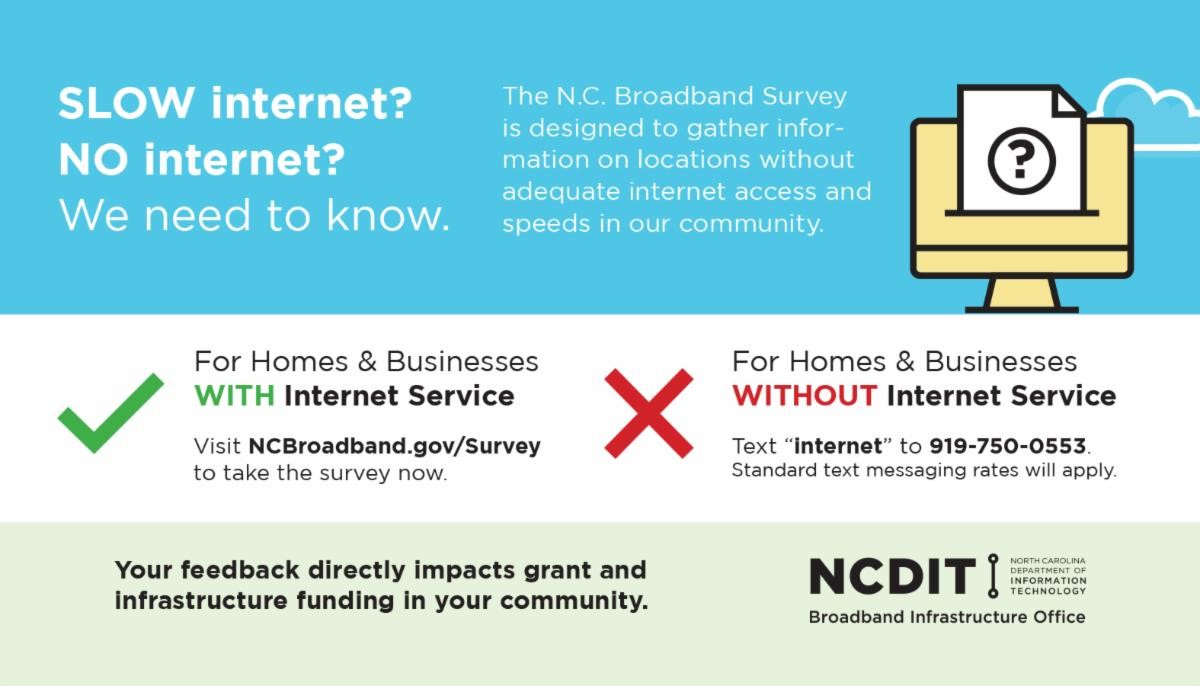
The North Carolina Broadband Survey is designed to gather information on locations in the state without adequate internet access and speeds.
The information gathered from the survey will:
- Provide clear data to guide investment of funds through the state's Growing Rural Economies with Access to Technology grant program
- Inform research and policy recommendations
- Support strategic targeting of additional funding streams
Taking the Survey
The survey takes about 5 minutes to complete and is available in both English and Spanish. Participants are encouraged to also take the optional internet speed test to connect survey data with broadband speed information.
For Homes & Businesses With Internet Service
For Homes & Businesses Without Internet Service
To report locations without internet service, participants can take the survey by phone. Residents without internet service but with phones capable of text messaging can text "internet" to 919-750-0553. Standard text messaging rates will apply.
Can't Text?
Residents with landlines or cellphones that do not have texting capability may place a voice call to 919-750-0553. An interactive voice response system will guide them through a series of short questions to obtain the caller's address and register it in the database as having no internet capability at all.
Other Ways to Take Action
Find out more about how you, your community group or your organization can help promote the North Carolina Broadband Survey by filling out the
Broadband Survey Community Action form.
Someone will contact you with more information on how to help.
Or check out some
outreach materials
to help get you started.
|
Additional Extension: CARES Act Provider Relief Fund for Medicaid, CHIP, and Dental Providers
The U.S. Department of Health and Human Services (HHS), through the Provider Relief Fund, is distributing $15 billion to eligible Medicaid, Medicaid managed care, Children's Health Insurance Program (CHIP), and dental providers that have been impacted by the coronavirus disease 2019 (COVID-19). Eligible providers may receive up to 2 percent of reported revenue from patient care.
The application deadline has been further extended to offer providers additional opportunity to apply for funding. You must act by Friday, Aug. 28, 2020 at 11:59 p.m. ET to be considered for payment from this distribution. Read more about the extension here.
Action Required
In order to apply, you must submit your Taxpayer Identification Number (TIN) for validation through the Enhanced Provider Relief Fund Payment Portal by Aug. 28, 2020. If you receive the results of that validation after Aug. 28, you will still be able to complete and submit your application.
If you have already begun or completed the process above, thank you.
Additional Information
For additional information, please call the provider support line at (866) 569-3522; for TTY, dial 711. Hours of operation are 7 a.m. to 10 p.m. Central Time, Monday through Friday. Service staff members are available to provide real-time technical assistance, as well as service and payment support.
|
As clinical trials continue across the world for a COVID-19 vaccine, many employers are asking whether they will be able to require employees to take the vaccine when it becomes available in the United States. Like with so many questions surrounding COVID-19, the answer is not entirely clear. In general, employers can require vaccination as a term and condition of employment, but such practice is not without limitations or always recommended....
|
From First Lady, Melania Trump: 'Be Best' is Advocating that Every Child Find a Loving, Safe and Forever Family
America's kids need us now more than ever. The disruptions caused by the COVID-19 pandemic have had a serious impact on America's children and those who care for them, from parents and teachers to child welfare workers and foster families.
The Trump administration is committed to ensuring that children benefit from the care and support of loving, permanent families, preferably in their own homes whenever possible. We are doing all we can to establish commonsense solutions that best serve our children in the welfare system.
As part of my Be Best campaign, I have made foster care a top priority. It remains our generation's responsibility to help our children overcome the many issues they face today, which may include their social, emotional and physical well-being.
Right now, there are over 400,000 children and youth in the foster care system and 124,000 of them are awaiting permanent placement with a forever family. It is our time to be the voice for these thousands of children waiting for a forever family - and it is our time to decide on how we proceed so we can do the most for children in need.
The executive order is the next great step towards our goal of creating long-term solutions for America's most vulnerable. And with this great momentum, I'm working with the Administration for Children and Families at the U.S. Department of Health and Human Services to continue our journey towards helping children waiting in the foster care system find loving, safe and forever families.
In supporting this priority, I recently held a virtual roundtable and heard from foster care advocates, parents, governors and their spouses, as well as youth who have aged out of the system without a forever family.
I was incredibly touched to hear personal stories from those who have spent most of their lives in foster care. A story in particular that touched my heart came from two young people who shared their struggle of being apart from their siblings when they entered the foster care system. We believe that no child should be out on the streets due to their birth date and no child should have to grow up without their siblings.
It is so important that we use these voices to create policies and deliver resources for children and families so that no child has to go through the experiences that these children and adults have experienced.
As my husband, President Donald Trump said, "The best foster care system is one that is not needed in the first place." If we address our child welfare system with the lens of "primary prevention," we can have the ability to support children and families long before they ever need to enter the system in the first place.
Still, we understand that prevention efforts will not completely eliminate the need for foster care services to ensure the safety and well-being of some children. When that is required, it is our responsibility to make sure that children and youth do not leave our foster care system without a forever family.
To support children in the foster care system, Administration for Children and Families Assistant Secretary Lynn Johnson is leading an important initiative aimed at achieving permanency for the 124,000 children waiting for placement with forever families. In November, the Department of Health and Human Services launched the Assistant Secretary's "All-In" Foster Adoption Challenge.
Federal officials have been hard at work engaging directly with governors, human services leaders, philanthropic organizations and faith-based organizations to improve the lives of vulnerable children and families.
As we talk to governors and state leaders, we are asking them to extend the foster care age from 18 to 21, host roundtables with partners and foster youth, work with the courts to expedite quality hearings, develop additional resources for older foster youth and adoptive parents, and identify laws or barriers that stand in the way of helping our children.
But we cannot do this alone. We need the engagement of our youth who have experienced the best and the worst of the child welfare system.
We need these strong voices to bring awareness to circumstances, issues and policies that can be changed. We also need everyone's involvement - from families to governors to churches and nonprofits.
This is a team effort to help America's children. We are taking bold actions, and we will stop at nothing to help our children find safe and loving families that they can call their own forever.
|
New Standards, Old Challenges: The Outlook For Child Welfare Organizations
We recently covered the Joint Commission's release of new and revised standards for child welfare provider organizations. The new standards focus largely on using evidence-based practices (EBPs) and providing trauma-informed care across the service system-intake, assessment, reunification, trauma-informed care, and case closing. The standards go into effect quickly, on September 13, for the 200 accredited organizations and include 74 new and 12 revised elements of performance.
This is happening at time of great change in children's services. Substance use by parents is leading to increased rates of child abuse and neglect, as well as high rates of foster care entry and poor foster care outcomes. Since 2016, we've seen a 10% upswing in the number of children placed in foster care. From 2009 to 2016, entries submitted to foster care, for which parental substance use was a contributing factor, rose from 26% to 34%. Parental substance use was also identified as a leading cause for home removals. State child welfare directors in various localities attributed a significant portion of the rise in foster placement rates to parental substance use, particularly the rise in opioid and methamphetamine use
A report from the Brookings Institution points out that the COVID-19 crisis has unveiled many holes in the child welfare system. "COVID-19 has created a perfect storm of factors that will almost certainly lead to a sharp increase in unreported cases of child abuse and neglect, as children are cut off from interactions with professionals and teachers, confined at home with caregivers and relatives, and families are feeling the stress of job loss and economic uncertainty," say the report authors.
Social distancing during the pandemic has had devastating effects on the child welfare system, reported NPR. In some cases, social workers were virtually visiting homes, and parents with children in foster care had to connect with them via FaceTime only, exacerbating the separation and isolation issues.
And just last month, the Trump Administration
issued an executive order to strengthen the child welfare system. The order directs the Secretary of Health and Human Services (HHS) to strengthen family reunification, reduce unnecessary removals, increase the number of foster families, and issue guidance to states on partnering with private provider organizations.
|
Legal Basics-Decision-Making Support
|
Tuesday: August 4, 2020
Addressing the Intersection of Substance Use and Suicide: Strategies for Prevention, Intervention, and Treatment
Time: 2:00 pm thru 3:30 pm
|
Wednesday: August 5, 2020
PERFECT TIMING!! Virtual Career Fair for Individuals with Disabilities
Time: 9:00 am thru 6:00 pm
|
Wednesday: August 5, 2020
Parents Can We Talk: IEP & Disability Rights (ONLY FOR NC FAMILIES)
Time: 10:00 am thru 11:30 am
|
Wednesday: August 5, 2020
Rethinking Employment Services and Supports in the COVID-19 Era
Time: 2:00 pm thru 3:30 pm
|
Thursday: August 6, 2020
Benchmarks' Child Welfare Webinar
Time: 8:00 am thru 9:00 am
Note: We will NOT be holding our Friday Membership Webinar on August 7, 2020
|
Tuesday: August 11, 2020
A Whole Person Approach to Working with Individuals Who Are Living with Serious Mental Illness
Time: 2:30 pm thru 3:30 pm
|
Please click on each of the following links to view details sent out from each LME/MCO.
Benchmarks' wants to be sure to make the following list handy for our members to visit and suggests a peek at least once per week to find information that may be pertinent to your agency and contracts.
|
|
|
|
|
|