|
Benchmarks' will NOT hold
live webinars this week.
Please make a note in your calendar.
We WILL have a pre-recorded Special Report from our fearless leader, Karen McLeod, to share with you for our Friday Update! WHOO HOO!
Important note: All upcoming meetings for Benchmarks (and other groups that we are aware of) are outlined below in our "Upcoming Events" section.
We regularly update this section to share meeting details/registration information as soon as we know that we will be able to hold one of our meetings. If you have questions about whether or not Benchmarks will be holding a meeting, please check our MOST RECENT email blast and scroll down to " Upcoming Events" or shoot us a quick email.
|
COVID-19 Stakeholder Updates
Uninsured Payment Portal: North Carolina Department of Health and Human Services (DHHS) developed a program to reimburse primary care providers (PCP) with federal funds for providing care for COVID-19 related services (e.g. follow-up care) to uninsured North Carolina residents.
PRESS RELEASES since the last update include:
NEW resources since the last update include:
UPDATED guidance since the last update include:
UPDATED reports since the last update include:
New Opportunity for Providers Applying for Federal Relief Funds and Additional Guidance
The US Department of Health and Human Services (HHS) announced an additional funding opportunity for Medicaid/CHIP providers to apply for federal Provider Relief Funds. HHS has allocated $20 billion for this round of funding. The application period runs through Nov. 6, 2020. Providers are encouraged to apply early. Providers that have previously received, accepted, or rejected a general distribution award, behavioral health providers, and health care providers that began practicing Jan.1, 2020 through March 31, 2020, are eligible for funding. More information is available in SPECIAL BULLETIN COVID-19 #138: New Opportunity for Providers Applying for Federal Relief Funds and Additional Guidance
October 7th DHHS Healthcare Coalition Webinar Slides & Recording
Attached are the slides from DHHS' COVID-19 Healthcare Coalition Webinar. We have also provided a link below for the audio portion of the presentation. Please note that the audio recording does not pick up until about 8 minutes into the presentation. Also, the entire recording is four hours in length, but the presentation ends at 50:40.
|
| | NC DHHS COVID 19 Healthcare Coalition Webinar (Oct 2020 - Dec 2020) |
LME-MCO Joint Communication Bulletin # J379: Addition of ASAM Requirements for the Comprehensive Clinical Assessment (CCA) and Diagnostic Assessment (DA)
This bulletin informs LME-MCOs and providers about the proposed amendments to Clinical Coverage Policy 8C, Section 7.3.2 (CCA Format) and Clinical Coverage Policy 8A, Attachment D, Diagnostic Assessment (Elements of the Diagnostic Assessment). The amendments will add a requirement that includes the determination of ASAM level of care to assessments of individuals with a substance use disorder (SUD) diagnosis effective in the spring of 2021. This requirement will also be implemented for any Comprehensive Clinical Assessment (CCA) or Diagnostic Assessment (DA) supported by state funds.
The proposed policy change is in preparation for the implementation of the CMS 1115(a) SUD Demonstration Waiver designed to improve access to SUD treatment services for Medicaid beneficiaries. In the approved waiver implementation plan, North Carolina identified the American Society of Addiction Medicine (ASAM) guidelines as the evidence-based standards North Carolina will use to determine the appropriate level of care for individuals with substance use disorders. The clinical coverage policies will be amended to add the determination of ASAM level of care to the required elements in the CCA and DA to ensure Medicaid beneficiaries receive appropriate referrals to SUD treatment based on their individual needs.
NC HealthConnex October Update
NC HealthConnexExpanding Connectivity Through National Networks to Support More Informed Care in North Carolina
When disaster strikes, patients may be displaced from their communities where they normally receive care and where their health care records are stored. Oftentimes health care workers on the front lines (first responders, medical shelters, emergency departments, urgent cares, etc.) have to rely on information from stressed family members and patients.
NC HealthConnex Named NASCIO State IT Recognition Award Finalist for 2020
NASCIO is a nonprofit association that represents state chief information officers and information technology professionals across the United States. Each year, NASCIO recognizes and awards projects that exemplify innovation and excellence in the use of information technology within state government.
NC HealthConnex provides the medical community with the data they need to make more informed decisions about patient care. As a finalist, NC HealthConnex was recognized for protecting and promoting the health and wellbeing of North Carolinians through the health information exchange and the various services NC HealthConnex offers to health care providers. Learn more about the NASCIO State IT Recognition Awards.
Governor Cooper Proclaims October 2020 as Cybersecurity Awareness Month
Are You Up to Speed?
The North Carolina Broadband Survey is designed to gather information on locations in the state without adequate internet access and speeds.
The information gathered from the survey will:
- Provide clear data to guide investment of funds through the state's Growing Rural Economies with Access to Technology grant program
- Inform research and policy recommendations
- Support strategic targeting of additional funding streams
Take the survey
Huge thanks to Leslie Kellenberger for sending links to the following webinar recordings for us to share with you!
Juvenile Justice Update on Raise the Age
(Fast forward to 49:11 to see Billy Lassiter's Presentation)
Lisa Cauley, DSS, on new Practice Model
(Her section begins at minute 6)
|
|
Status Management Page Change
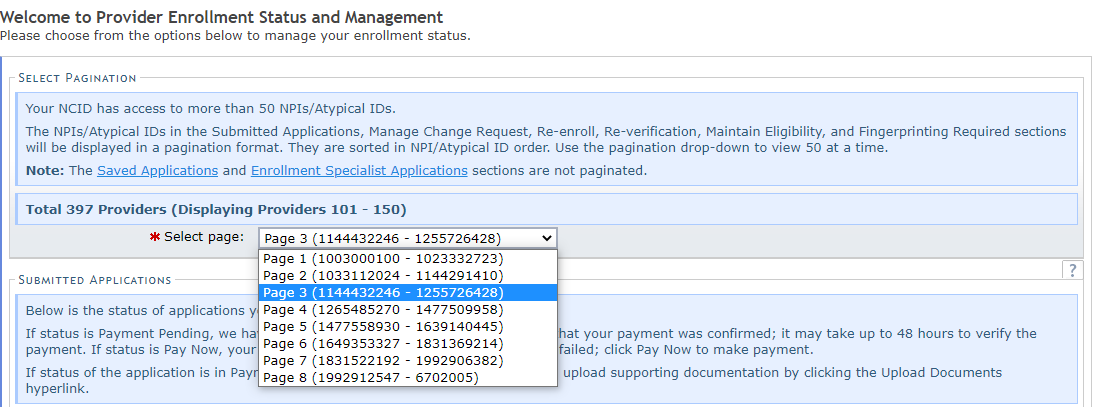
Effective Oct. 11, 2020, a change will be made to the Status Management page of the NCTracks Secure Provider Portal for authorized users (office administrators, enrollment specialists and managing employees/owners) who have access to over 50 National Provider Identifiers (NPIs).
Providers who have access to over 50 NPIs will now use a filter to display NPIs in the Submitted Applications, Manage Change Request (MCR), Re-enroll, Re-verification, Maintain Eligibility and Fingerprinting sections by selecting the page that corresponds to the NPI requested. The NPIs will be in numerical order and each page will consist of 50 NPIs.
Note: There will be no change to the Status and Management page for users who have access to 50 or less NPIs.
Columbus Day Holiday Monday and Checkwrite Schedule
This Monday, Oct. 12, 2020, is Columbus Day, which is a federal holiday, although not observed by the N.C. Department of Health and Human Services (DHHS) or GDIT.
However, in keeping with the published 2020 checkwrite schedules, because of the federal holiday, the checkwrite date next week will be on Wednesday, Oct. 14. The posting and availability of funds to provider bank accounts will depend on the provider's financial institution. Bank of America customers should see their payments in their accounts on the day that the EFT is processed, which will be Thursday (Oct. 15). Providers who bank at other financial institutions should see payments the business day following the date that the EFT is processed, which will be Friday (Oct. 16) afternoon. (Some may post sooner.)
The 2020 and 2021 checkwrite schedules can be found under Quick Links on the provider portal home page.
REMINDER: Immunizations and Keeping Kids Well: Trends and COVID-19 Webinar on October 15
Please tune in to the first webinar in the Clinical Quality Series on Thursday, Oct.15 at 5:30 p.m. Hosted by Chief Medical Officer of the NC Division of Health Benefits Shannon Dowler, MD, and Tom Wroth, MD, CEO, Community Care of North Carolina, the webinar will review pediatric immunization trends during the COVID-19 public health emergency. Agenda items include:
- What does the data tell us about vaccines?
- Getting kids back to school
- Advanced planning for possible shortages of vaccines for children
- Priority vaccines in pregnancy
- Planning for a COVID-19 vaccine
- Tips from the field on vaccines in a pandemic
- Tools in your toolbox to close vaccine care gaps
- Closing care gaps now will influence attribution later
Register to attend the webinar here. This webinar series, which reoccurs on the third Thursday of each month, is one of two monthly evening webinar series designed to help prepare providers, practice managers and quality managers for Medicaid Managed Care going live on July 1, 2021.
|
|
COVID-19 Response Fund awards $3M to 72 nonprofits
Charlotte Weekly - October 09, 2020
More than $3 million has been awarded to 72 nonprofits in the latest round of grants from the COVID-19 Response Fund. Nearly $18 million has been granted to date to more than 200 nonprofits helping those affected by the pandemic with basic needs such as child care, education, housing, food, emergency financial assistance, legal advocacy, health and mental health, and workforce development. The latest grants were awarded via a competitive grant cycle open to all Mecklenburg County nonprofits that met eligibility requirements.
|
|
Office of Justice Programs Awards $261 Million to Support Youth Mentoring, Protect Children
The Office of Justice Programs (OJP) today announced that it has awarded $261 million in grant awards to support mentoring services for youth and to protect children from abuse, exploitation and threats such as sex trafficking. Principal Deputy Assistant Attorney General Katharine T. Sullivan made the announcement at an event with leaders and representatives of the Cal Ripken Sr. Foundation and local chapters of the Police Athletic League, along with local police chiefs.
"Young people in America face an array of challenges, from social and academic pressures to dangerous predators and lethal drugs. They are better equipped to meet those challenges with a model of care and compassion to guide them along," said Sullivan. "These awards will support outstanding youth-serving organizations like the Cal Ripken Sr. Foundation, Big Brothers Big Sisters, Boys and Girls Clubs and their local affiliates across the country as they help youth discover their talents, find their purpose and realize their full potential. We are incredibly grateful to our mentorship programs, both nationally and locally. Badges in Blue and Badges for Baseball are great examples of successful community partnerships through law enforcement and mentoring." Grants from OJP's Office of Juvenile Justice and Delinquency Prevention (OJJDP) will allow national, state and local organizations to provide mentoring to youth who are at risk of juvenile delinquency, victimization and juvenile justice system involvement. Funds also support the National Mentoring Resource Center, which last year provided training and other support to 362 school-, community- and faith-based mentoring programs that served more than 79,000 youth nationwide.
|
|
CMS Takes Action to Protect Integrity of COVID-19 Testing
Agency issues cease and desist letters to laboratories testing without appropriate certification
The Centers for Medicare & Medicaid Services (CMS) is taking every action to ensure U.S. laboratories are fit to deliver reliable, accurate and timely patient test results for coronavirus disease 2019 (COVID-19) by confirming Clinical Laboratory Improvement Amendments of 1988 (CLIA) certifications are up- to-date. A recent record check by CMS resulted in the issuance of 171 cease and desist letters to facilities that did not have proper CLIA certifications in place. CLIA certification is important because it verifies that laboratories meet federal performance, quality and safety standards to properly diagnose, prevent and treat diseases.
"Testing capacity has rightly been at the top of President Trump's priority list since the early stages of this pandemic," said CMS Administrator Seema Verma. "But we also understood that for testing to fulfill its potential, tests must be reliable. Today's announcement will help ensure that Americans can rest secure that they will receive test results that are both fast, accurate, and trustworthy."
Every facility that conducts COVID-19 testing is considered a "laboratory" and must be certified under CLIA. To make certification easy, CMS implemented an expedited review process at the beginning of the public health emergency and recently released a quick-start guide that helps laboratories with the application process. It is imperative to public safety that facilities apply for CLIA certification and only operate within the scope of that certification to prevent false results that could adversely alter diagnosis, treatments and contribute to the further spread of COVID-19.
Since August 12, 2020, CMS issued 171 cease and desist letters to entities across the U.S. that were testing for COVID-19 without an appropriate CLIA certificate. Of those 171 letters, 34 percent went to facilities conducting laboratory testing without a CLIA certificate and 66 percent were issued to laboratories performing COVID-19 testing outside the scope of the existing CLIA certification. The letters ordered these laboratories to stop immediately to safeguard the integrity of COVID-19 testing, and protect patients from potential endangerment if provided inaccurate or unreliable test results. Following receipt of the letter, laboratories are required to provide CMS an attestation certifying they have ceased testing.
In the letters, CMS provided non-certified laboratories with information on how to become CLIA certified and encouraged certified laboratories to obtain the proper CLIA certification to resume testing. CMS has taken this action to promote compliance with CLIA and keep patients safe.
CMS Announces New Repayment Terms for Medicare Loans made to Providers during COVID-19
New recoupment terms allow providers and suppliers one additional year to start loan payments The Centers for Medicare & Medicaid Services (CMS) announced amended terms for payments issued under the Accelerated and Advance Payment (AAP) Program as required by recent action by President Trump and Congress. This Medicare loan program allows CMS to make advance payments to providers and are typically used in emergency situations. Under the Continuing Appropriations Act, 2021 and Other Extensions Act repayment will now begin one year from the issuance date of each provider or supplier's accelerated or advance payment. CMS issued $106 billion in payments to providers and suppliers in order to alleviate the financial burden healthcare providers faced while experiencing cash flow issues in the early stages of combating the coronavirus disease 2019 (COVID-19) Public Health Emergency (PHE).
"In the throes of an unprecedented pandemic, providers and suppliers on the frontlines needed a lifeline to help keep them afloat," said CMS Administrator Seema Verma. "CMS' advanced payments were loans given to providers and suppliers to avoid having to close their doors and potentially causing a disruption in service for seniors. While we are seeing patients return to hospitals and doctors providing care we are not yet back to normal," she added.
CMS expanded the AAP Program on March 28, 2020 and gave these loans to healthcare providers and suppliers in order to combat the financial burden of the pandemic. CMS successfully paid more than 22,000 Part A providers, totaling more than $98 billion in accelerated payments. This included payments to Part A providers for Part B items and services they furnished. In addition, more than 28,000 Part B suppliers, including doctors, non-physician practitioners, and Durable Medical Equipment (DME) suppliers, received advance payments totaling more than $8.5 billion.
Providers were required to make payments starting in August of this year, but with this action, repayment will be delayed until one year after payment was issued. After that first year, Medicare will automatically recoup 25 percent of Medicare payments otherwise owed to the provider or supplier for eleven months. At the end of the eleven-month period, recoupment will increase to 50 percent for another six months. If the provider or supplier is unable to repay the total amount of the AAP during this time-period (a total of 29 months), CMS will issue letters requiring repayment of any outstanding balance, subject to an interest rate of four percent.
The letter also provides guidance on how to request an Extended Repayment Schedule (ERS) for providers and suppliers who are experiencing financial hardships. An ERS is a debt installment payment plan that allows a provider or supplier to pay debts over the course of three years, or, up to five years in the case of extreme hardship. Providers and suppliers are encouraged to contact their Medicare Administrative Contractor (MAC) for information on how to request an ERS. To allow even more flexibility in paying back the loans, the $175 billion issued in Provider Relief funds can be used towards repayment of these Medicare loans. CMS will be communicating with each provider and supplier in the coming weeks as to the repayment terms and amounts owed as applicable for any accelerated or advance payment issued.
|
|
| |
'Would You Stay' takes an in-depth look at job quality in the direct care workforce, proposing a new framework to transform these jobs.
The COVID-19 crisis has amplified the many long-standing challenges facing the direct care workforce-our new job quality framework aims to address these inequities.
Would You Stay? Rethinking Direct Care Job Quality examines how poor job quality has defined the direct care job for decades, negatively impacting workers, long-term care employers, consumers, and the economy. The report also reviews how the COVID-19 pandemic has endangered the lives of these essential workers and left them unprepared to manage the crisis.
To improve these jobs, this report delineates PHI's new framework for quality jobs in direct care, which spans five pillars: quality training, fair compensation, quality supervision and support, respect and recognition, and real opportunity.
This report series was made possible through generous support from the W. K. Kellogg Foundation and the Woodcock Foundation.
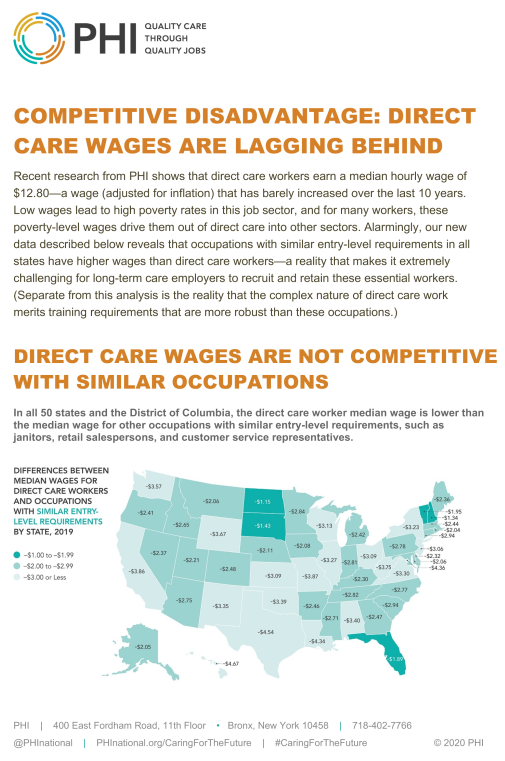
This fact sheet shows that in all 50 states and the District of Columbia, the direct care worker median wage is lower than the median wage for other occupations with similar entry-level requirements, such as janitors, retail salespersons, and customer service representatives. In many states, direct care worker wages also cannot compete with occupations with lower entry-level requirements.
|
IRS Issues Final Rules For ABLE Accounts
Federal officials are firming up rules for a relatively new type of account that allows people with disabilities to save money without jeopardizing their government benefits.
The accounts, which were established by the 2014 ABLE Act, allow individuals with disabilities to accrue up to $100,000 without risking eligibility for Social Security and other government benefits. Medicaid can be retained no matter how much money is saved in the accounts.
The rules released this month stem from when the accounts were originally created as well as tweaks to the law that came in 2017 tax-cut legislation. Many of the changes have already been in effect, but the IRS said the final regulations clarify specifics and address comments the agency received in response to previous proposals about how the law would be applied. Annual deposits to ABLE accounts are capped at the value of the gift tax exclusion for any given year, currently $15,000 annually. However, under the final rules, people with disabilities who are employed can deposit their earnings in ABLE accounts, above and beyond the existing contribution cap for the year. These individuals can save whatever money they earn in their ABLE account up to the value of the poverty line in the state where they live. The IRS said that workers with disabilities who have ABLE accounts can also qualify for a Saver's Credit, which can reduce their federal tax bill. Separately, money saved in a traditional 529 college savings plan for an individual with a disability or a family member can be rolled over into an ABLE account up to the maximum annual contribution limit. The rules indicate that this option is available until Jan. 1, 2026. The regulations also offer guidance on the record-keeping and reporting requirements of ABLE programs as well as other specifics about the mechanics of the accounts. ABLE accounts are open to people with disabilities that onset prior to age 26. Money saved in the accounts can be used for education, housing, transportation, employment training and support, assistive technology, personal support services and other "qualified disability expenses." Currently, 42 states and Washington, D.C. have active ABLE programs, many of which are open to people with disabilities nationwide, according to the ABLE National Resource Center. As of June, data from ISS Market Intelligence shows that there are nearly 71,000 ABLE accounts open nationally with $469.4 million in assets.
|
Diabetes in Special & Vulnerable Populations: A National Learning Series
To continue the national conversation around diabetes and health centers, 14 National Training and Technical Assistance Partners (NTTAPs) are collaborating on a four-part national learning series to engage health centers, PCAs, and Health Center Controlled Networks. The goal is to increase foundational knowledge of effective strategies to prevent, treat, and manage diabetes among special and vulnerable populations.
This will be a deep dive on topics related to team-based care, patient health literacy, and community engagement to address diabetes in the context of COVID-19.
Based on HRSA recommendations, ongoing conversations will focus on health centers and incorporate how NTTAPs, PCAs, and HCCNs support diabetes quality improvement around specific topic areas and emerging issues (i.e. COVID-19, health equity, social determinants of health, telehealth, clinical guidelines, reimbursement, etc.)
The series kicks off next week.
National Assessment of Rural FQHCs: Roles and Opportunities Related to Rural Hospital Closures
Health centers that serve rural communities face a number of interlocking challenges, including determining how to respond when a local hospital faces financial vulnerability or closure. To better understand the health center experience with rural hospital closures, Capital Link, a HRSA-funded NTTAP, is conducting a national assessment of Federally Qualified Health Centers (FQHCs) in rural communities. They hope to identify and share successful strategies health centers have used to respond to this challenge.
If you are a FQHC serving rural communities, please share your experience by completing this short assessment by Friday, October 16. Capital Link will summarize and share the results. Individual responses will not be disclosed without prior approval.
UDS Mapper Celebrates 10 Years with Modernized Website
The UDS Mapper, a mapping and decision-support tool depicting the geographic extent of health centers, is celebrating 10 years of service with the relaunch of its website!
The site has a modernized and streamlined look and feel, and includes enhancements to the UDS Mapper tool, newly updated with 2019 UDS data. Additionally, you can now access U.S. Census population data-such as race/ethnicity, insurance status, poverty, and employment-and map your own data at the census, county, or state level.
Telehealth for Formerly Homeless and Vulnerable Populations in Supportive Housing Fact Sheets
Social distancing protocols have elevated use of telehealth, which can be challenging for formerly homeless and vulnerable populations in supportive housing. The Corporation for Supportive Housing (CSH), a HRSA-funded NTTAP, created fact sheets to support health centers and supportive housing providers working in partnership to provide health and case management services through telehealth.
|
Family Group Decision-Making for Children at Risk of Abuse or Neglect: A Systematic Review
Family group decision-making is used to make decisions about how best to protect children, and support families. It engages the family, extended family, and people in the community around the family, in these decisions. It features an independent meeting facilitator, private family time away from professionals and the prioritisation of family plans. This review finds that the evidence base supporting this approach is of poor quality with no clear finding that it is any better or worse than conventional approaches.
Read More Here
|
NIH-funded study links adolescent brain differences to increased waist circumference
Differences in the microstructure of the nucleus accumbens (NAcc), a region in the brain that plays an important role in processing food and other reward stimuli, predict increases in indicators of obesity in children, according to a study funded by the National Institute on Drug Abuse (NIDA) and nine other institutes, all part of the National Institutes of Health. The paper(link is external), published today in the journal Proceedings of the National Academy of Sciences, is based on data from the Adolescent Brain Cognitive Development (ABCD) Study(link is external). The ABCD Study will follow nearly 12,000 children through early adulthood to assess factors that influence individual brain development and other health outcomes. Findings from this study provide the first evidence of microstructural brain differences that are linked to waist circumference and body mass index (BMI) in children. These microstructural differences in cell density could be indicative of inflammatory processes triggered by a diet rich in high fat foods.
The National Institute of Allergy and Infectious Diseases (NIAID), part of the National Institutes of Health, today launched a study designed to determine whether certain approved therapies or investigational drugs in late-stage clinical development show promise against COVID-19 and merit advancement into larger clinical trials. The ACTIV-5 Big Effect Trial, which will enroll adult volunteers hospitalized with COVID-19 at as many as 40 U.S sites, is being conducted in collaboration with the NIH's public-private partnership Accelerating COVID-19 Therapeutic Innovations and Vaccines (ACTIV) program.
As public interest and expanded research in human genome editing grows, many questions remain about ethical, legal and social implications of the technology. People who are seriously ill may overestimate the benefits of early clinical trials while underestimating the risks. This makes properly understanding informed consent, the full knowledge of risks and benefits of treatments, especially important.
In response to this emerging need, researchers at the National Human Genome Research Institute (NHGRI), part of the National Institutes of Health, asked patients, parents and physicians in the sickle cell disease community what they wanted and needed to know about genome editing to make informed decisions about participating in genome-editing clinical trials. Gene-editing treatments, which appear to provide a potential for sickle cell, are among the most widely publicized medical advances in recent years.
NCBI Datasets now offers Gene tables: customizable tables of the genes you specify, with key gene information, and the ability to easily download a dataset of genomic, transcript and protein sequences.
Drag and drop a list of Gene IDs or gene symbols, and the data table shows your genes with up to 15 columns of metadata, including genomic coordinates, RefSeq transcript and protein accessions, Ensembl IDs and UniProt accessions, and other gene information. You can browse and select items in your table on the web, or download everything to your computer for later analysis.
|
"Building the Plane While Flying It: HCH, Telehealth and COVID-19, Part I and Part II" Webinar Recordings
Prior to the COVID-19 pandemic, many Health Care for the Homeless (HCH) health centers utilized telehealth platforms in various creative and interesting ways. However, as the pandemic swept across the nation making in-person visits less safe, HCH health centers transitioned rapidly-in some instances overnight-to relying on telehealth for client care.
Recently, Council staff conducted interviews with 17 HCH health centers to learn about their experiences initiating and implementing telehealth to engage people experiencing homelessness living in shelters, in hotels, and on the street. This Coffee Chat will feature representatives from three HCH health centers who will share how they are using backpack telehealth to treat people living on the street; how one agency engaged their Consumer Advisory Board to help improve telehealth offerings; and how telehealth may affect clients.
|
| | Building the Plane While Flying It: Health Care for the Homeless, Telehealth, and COVID-19 |
|
| | Building the Plane While Flying It: Health Care for the Homeless, Telehealth and COVID-19, Part II |
|
A Framework for Public Sector Leadership
The Consortium is committed to developing practical leadership tools and informational resources to help public leaders advance effective health policy and improve health outcomes. Resources developed by the Consortium include:
- Framework for Public Sector Leadership- This framework, which outlines five domains considered critical for public sector leadership, serves as a guide for rising public sector leaders. It provides a uniform language and approach to strengthening public sector leadership.
- Leadership Forward Series- This series of blog posts and podcast episodes explores the application of the Framework for Public Sector Leadership. The resources feature conversations with leaders with a wide range of experiences in public sector leadership and include practical examples of successes and challenges.
We encourage you to follow the links above to see these resources in more detail, and to share them with your partners.
|
Upcoming Events
|
New: Wednesday: October 14, 2020
Western Adoption and Foster Care Alliance (WAFCA) virtual meeting with State DSS Licensing Staff from the Black Mountain
Time: 10:00 am thru 12:00 pm
|
New: Thursday: October 15, 2020
Family First and Medicaid
Time: 1:00 pm thru 2:00 pm
|
Thursday: October 15, 2020
Lifting the Load-Bearing Walls:
Resilience Strategies That Work In Your Community
Time: 1:00 pm thru 2:15 pm
|
New: Thursday: October 15, 2020
Provider Relief Fund - Phase 3 Informational Webcast
Time: 3:00 pm thru 4:00 pm
|
New: Thursday: October 15, 2020
Program strategies to support foster care youth as they transition to adulthood
Time: 3:00 pm
|
Thursday: October 15, 2020
Immunizations and Keeping Kids Well: Trends and COVID-19
Time: 5:30 pm thru 6:30 pm
Continues on the third Thursday of each month
|
Monday: October 19, 2020
Get the SCOOP on Ok to ASK for Help
Time: 11:30 am thru 12:30 pm
|
Monday: October 19, 2020
COVID-19 and Mental Health in the Workplace: Solutions for Employers and Employees
Time: 1:00 pm thru 2:00 pm
|
New: Wednesday: October 21, 2020
NIMH Livestream Event: Managing Attention-Deficit/Hyperactivity Disorder in Children and Adolescents
Time: 1:00 pm thru 1:30 pm
|
Wednesday: October 21, 2020
A Building Accessible for All: Equity and Inclusion Principles that Assure Participation and Positive Outcomes for Everyone in the Community
Time: 11:00 am thru 12:15 pm
|
New: Wednesday: October 21, 2020
Telehealth Hack - Telehealth Technology Trends
Time: 2:00 pm
|
Thursday: October 22, 2020
Benchmarks FAR Meeting-Legislative Agenda Planning
Time: 8:00 am thru 10:00 am
|
New: Thursday: October 22, 2020
Management of Alcohol Use Disorder
The HRSA-funded National Clinician Consultation Center presents an interactive webinar for health center clinicians. Unhealthy alcohol use remains a growing public health issue in the U.S., contributing significantly to the global burden of disease and posing challenges to the everyday practice of primary care. In this webinar, speakers will define the spectrum of unhealthy alcohol use and compare therapeutic approaches, focusing on pharmacological treatment options. They will also provide strategies for managing withdrawal, an especially important issue during COVID-19. Participants will be able to more confidently assess and care for patients with unhealthy alcohol use.
Time: 1:00 pm thru 2:00 pm
|
Thursday: October 22, 2020
COVID-19 Q&A Webinar for Behavioral Health Care
Time: 1:30 pm thru 3:00 pm
|
New: Thursday: October 22, 2020
New Certificates of Achievement: Professional Development Plans for DSPs and Other Staff in IDD Organizations
|
New: Thursday: October 22, 2020
Mental Health First Aid: A Primer for Public Health Professional and Communities
|
Monday: October 26, 2020
Triangle: Regional Policy Institutes
Time: 9:00 am thru 11:30 am
Keynotes: Youth Transition Program Director, NC Families United - Lacy Flintall
MomsRising - Sheila Arias
Advocacy 101: Beth Messersmith, MomsRising
Legislative Panelists:
Senator Valerie Foushee - Chatham/Orange
Senator Natalie Murdock - Durham
Representative Verla Insko - Orange
Counties Include: Wake, Johnston, Chatham, Orange, Durham, Franklin, Granville
|
New: Monday: October 26, 2020
Telehealth Hack - Building Accessible Telehealth for Patients with Disabilities from the Ground Up
Time: 2:00 pm
|
Tuesday: October 27, 2020
Incorporating Youth Leadership into Treatment
|
New: Tuesday: October 27, 2020
Provider Recruitment and Retention Training for Health Centers
Staffing-related shortages are a common barrier identified by health centers-especially in light of the pandemic. Join a session featuring HRSA, HRSA-funded NTTAPs (Community Health Center, Inc., and the Association of Clinicians for the Underserved), and a health center. Speakers will discuss recruitment and retention promising practices and provide resources.
Time: 3:00 pm thru 4:30 pm
Call-in: 888-323-9689
Passcode: 7945934
|
New: Wednesday: October 28, 2020
Independent Living Initiative
Time: 10:00 am thru 12:00 pm
|
Wednesday: October 28, 2020
A Building of Warmth and Light: Strategies to Support Rural Leaders Facing Challenging Conditions
Time: 11:00 am thru 12:15 pm
|
Wednesday: October 28, 2020
Time: 12:00 pm thru 5:00 pm
|
Thursday: October 29, 2020
Benchmarks' Medicaid Forum-Legislative Agenda Development
Time: 8:00 am thru 9:30 am
|
New: Thursday: October 29, 2020
Continuing Medicaid & CHIP Outreach During COVID-19 to Keep Kids Covered
Time: 2:00 pm thru 3:00 pm
|
Monday: November 2, 2020
Time: 11:30 am thru 12:30 pm
|
Friday: November 6, 2020
NC AHEC Annual Rural Nursing Conference
Time: 8:30 am thru 12:30 pm
There is a small fee of $25 to attend that includes 3.0 Nursing Contact Hours/3.0 Contact Hours/.3 CEUS
|
New: Monday: November 9, 2020
Bridging the Gap: Behavioral Health and Oral Health in Public Housing
The National Network for Oral Health Access (NNOHA) will join the National Center for Health in Public Housing (both HRSA-funded NTTAPs) to host a webinar to review behavioral health data and resources from a recent survey of residents of public housing. Speakers will highlight how a health center dental program located in public housing integrates behavioral health screenings and referrals into oral health care. 1.0 Continuing Dental Education (CDE) credit will be offered.
Time: 1:00 pm thru 2:00 pm
|
Tuesday: November 10, 2020
A Virtual Discussion on New Jersey's Direct Care Workforce
Time: 11:00 am thru 12:30 pm
|
Tuesday: November 10, 2020
When IDD Co-Occurs with Mental Illness Training
Time: 1:30 pm thru 4:30 pm
|
Please click on each of the following links to view details sent out from each LME/MCO.
Benchmarks' wants to be sure to make the following list handy for our members to visit and suggests a peek at least once per week to find information that may be pertinent to your agency and contracts.
|
Update on Alliance Health's COVID-19 Response Initiatives
Alliance wanted us to be sure to share with you the following update that was just placed on the Alliance Health "Provider News" stream:
This update details several of their recent COVID Response investments to support access to behavioral health and IDD services in our communities, including provider rate increases designed to stabilize front-line providers by helping offset their extra costs and time related to obtaining and using PPE, high-risk pay for staff working in residential facilities, overtime expenses, and higher pay rates to retain and recruit direct care professional and clinicians.
They sent great appreciation to Benchmarks' for meeting with them to discuss provider workforce development issues, particularly with respect to direct support professionals.
|
|
|
|
|
|