Weekly News From Los Alamos County
September 2, 2022
|
|
Inside this newsletter, you will find...
The Epidemiology Corner - COVID-19 Update, New Testing Locations/Options,
LANL Research News, Survey & Results, COVID-19 data, and more.
|
|
|
|
COVID-19 Update: County Transmission Rates Remain Elevated and Excess COVID-19 Mortality Observed...
|
|
Nationwide Hospitalizations Show Encouraging Declining Trend as Variant Proportions Gradually Drift
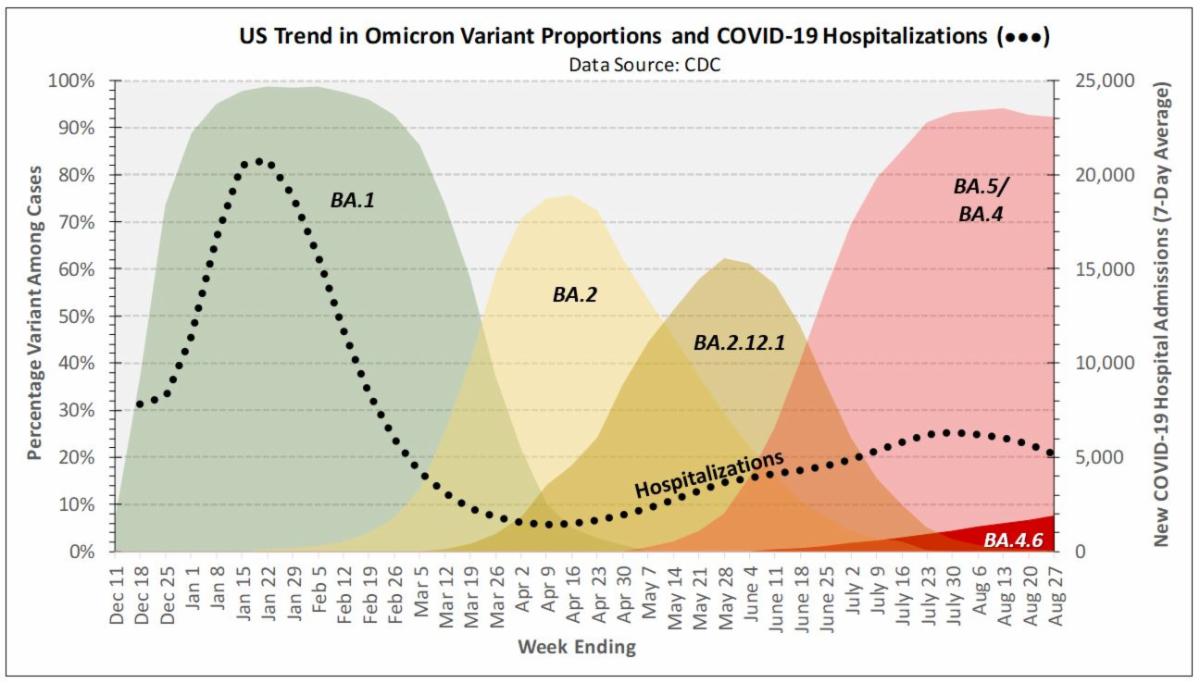
For the week ending August 27, CDC estimates that Omicron variants BA.4/BA.5 accounted for 92% of U.S. cases nationwide, with BA.5 alone accounting for 89% of cases. The newest emergent variant, BA.4.6 increased in prevalence over the past week from 6.7% to 7.5% nationwide. The central Midwestern states, which include Iowa, Kansas, Missouri, and Nebraska, were the first to see growing proportions of BA.4.6 and are still seeing the highest percentage, with the variant now making up 17% of samples compared to about 16% in the prior week. These data indicate that BA.4.6 is slowly increasing in prevalence, but at a much slower pace than that seen with prior Omicron variants. See HERE.
Hospital admissions for COVID-19 are in a gradually declining trend, suggesting a similar decline in virus transmission. New hospital admissions have declined about 23% since the peak admissions seen in late July, but are still over 3-fold higher than that seen in April 2022. CDC continues to recommend up-to-date vaccination to reduce risks for severe disease, hospitalization, and death, as well as Paxlovid treatment for mild to moderate COVID-19 in persons at high risk for progression to severe disease - despite “Covid-19 rebound” occurring in some treated patients. See HERE. A just published peer-reviewed study from Israel showed that among COVID-19 (Omicron) patients 65+ years, Paxlovid reduced rates of hospitalization and death by 4- to 5-fold in patients receiving treatment compared to untreated patients. See HERE
|
|
COVID-19 in the County: Transmission Rates Unchanged and Excess COVID-19 Mortality Observed
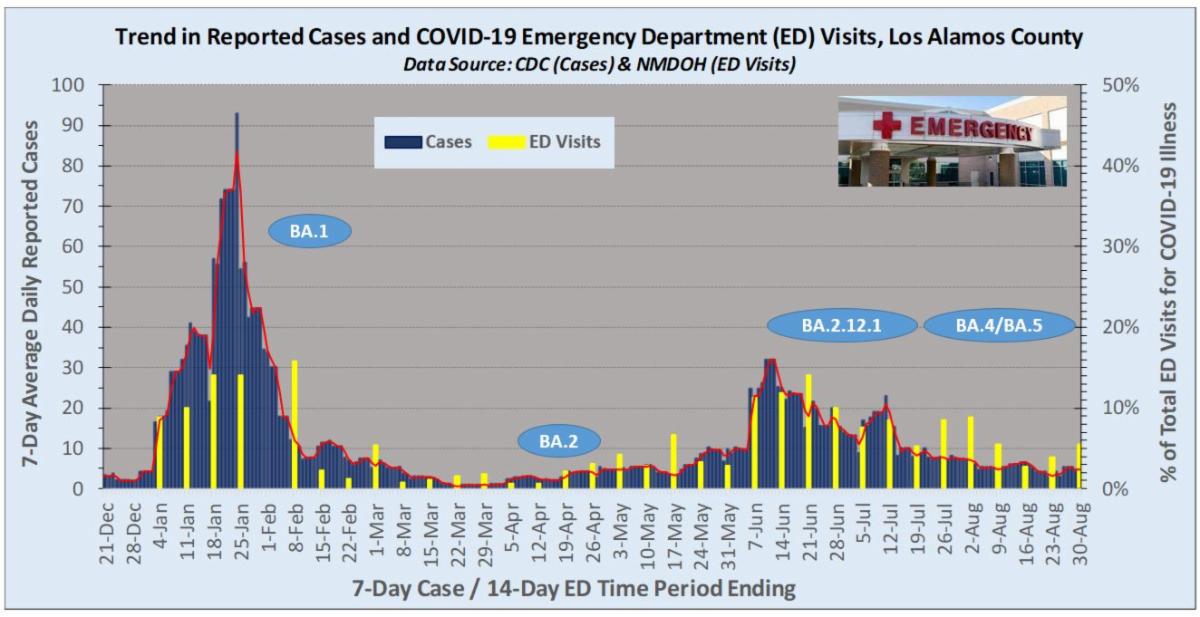
An average 4.4 cases per day were reported for the week ending August 31, which represents essentially no change from the 4.1 daily cases reported the prior week ending August 24. The current level of reported transmission remains about 4-fold higher than the average of one reported case per day during late-March/early-April 2022. According to the NMDOH, 5.5% of all Emergency Department (ED) visits for the two weeks ending August 30 were for COVID-like illness compared to 3.9% for the two-week period ending August 23. COVID-like illness includes ED encounters with chief complaint consisting of fever and cough, shortness of breath, or difficulty breathing, while also including COVID-19 associated discharge diagnoses codes. See HERE. According to the NMDOH, six COVID-19 deaths were registered in the county during the three-month time period May 23 - August 22, 2022. See HERE. The county’s crude death rate for this time period was 31 per 100,000 compared to a rate of 18 per 100,00 in Santa Fe County and 13 per 100,000 in New Mexico. Based on the state and neighboring county mortality statistics, an excess of two or three COVID-19 deaths occurred in the county during the recent three-month case wave that began in early June. Data is on request from NMDOH which will provide for an analysis of COVID-19 deaths by vaccination status and age group.
|
|
Age-Specific Analysis of Reported COVID-19 Cases in County
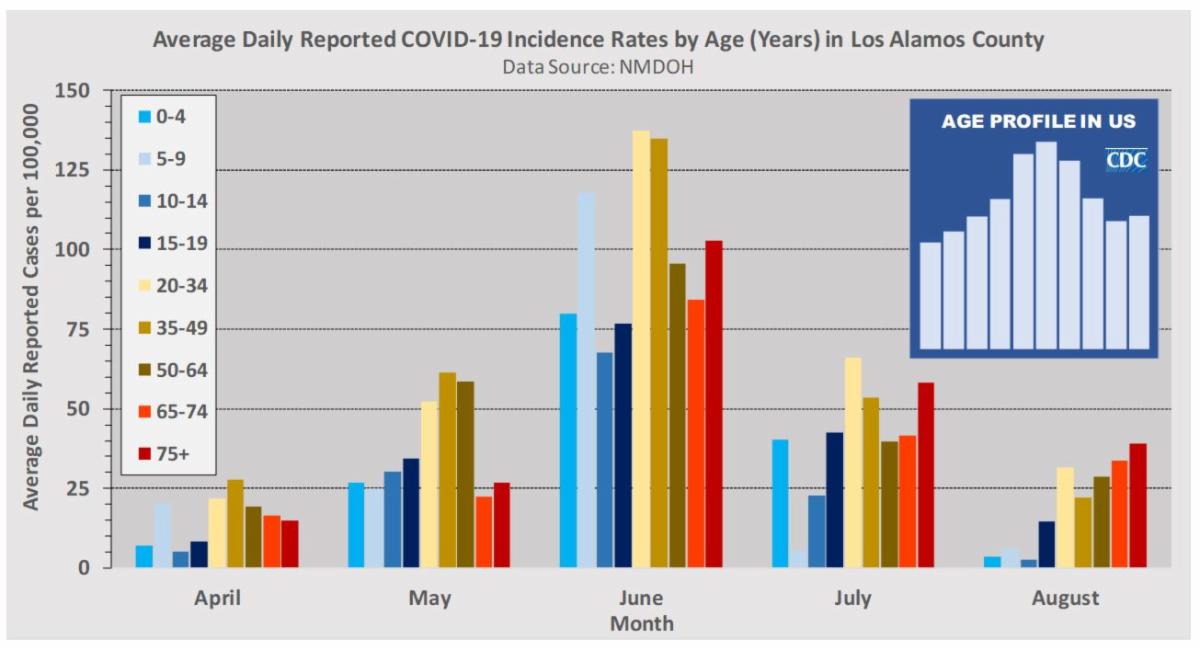
All age groups in the county, including the very young and the very old, contributed to the recent summer case wave. Other than the month of August, the age profile of COVID-19 incidence largely corresponded to that seen nationwide in the U.S., as shown in the graph insert. Factors influencing the discrepant August pattern are uncertain, but may relate to changes in the age-specific pattern of PCR-testing during the month. The advent of at-home rapid antigen testing, which is non-reportable, has placed challenging limitations on the interpretation of COVID-19 incidence statistics, particularly when an unexpected pattern appears.
|
|
Wastewater Surveillance Continues to Detect SARS-CoV-2 Virus in County
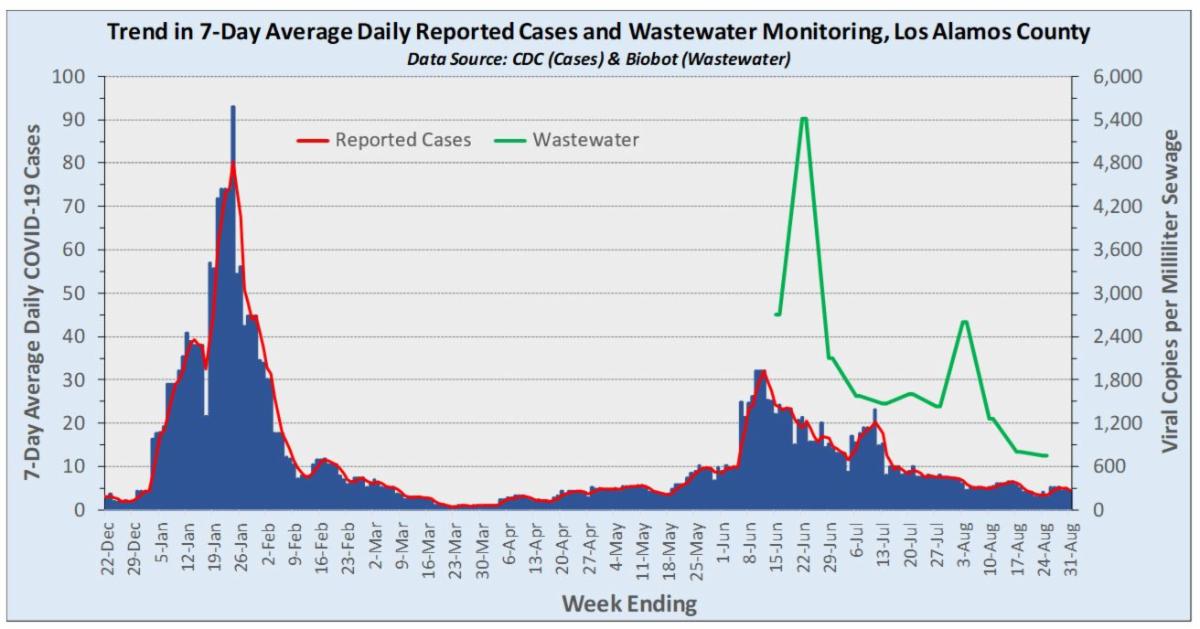
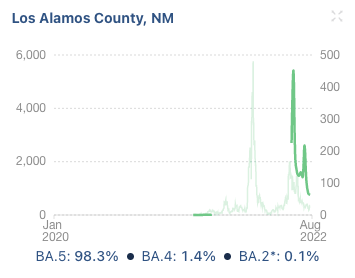
The wastewater surveillance program involves collection of two weekly samples (Tuesday/Thursday) at both the townsite and White Rock sewage treatment facilities. Biobot, the CDC contractor for the program, reports sample virus concentration levels as an “effective concentration”, which is a measure normalized by the amount of sewage in the system at sample collection time and the size of the population served by the treatment facility. See HERE Samples collected at each facility in the county have consistently detected SARS-CoV-2 virus in wastewater since the first samples were collected on June 14. The chart below shows the smoothed trend in SARS-Cov-2 effective concentration levels complied at the county level using combined data from the townsite and White Rock treatment facilities. Results through August 24 show a generally declining trend consistent with the overall declining trend in daily reported cases. For samples obtained during the week of August 17, Biobot reports the BA.5 variant accounted for 98% of all viral copies detected in county municipal sewage. The small remainder involved BA.4. See https://biobot.io/data/
|
|
CDC Community Level Risk Remains at LOW
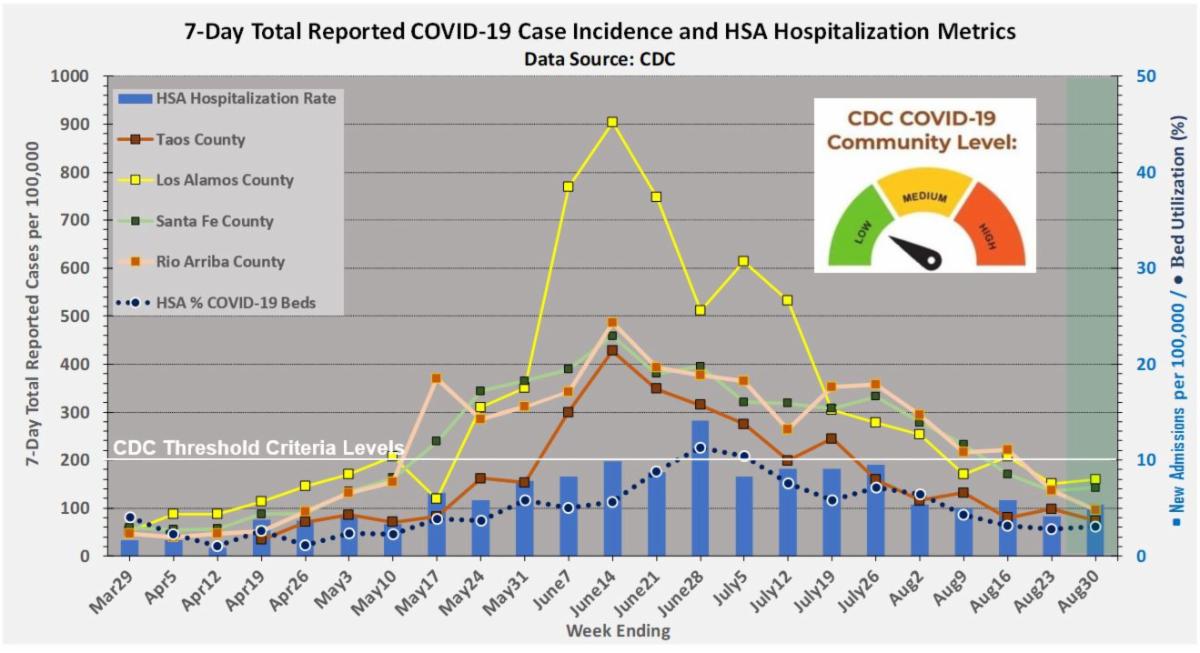
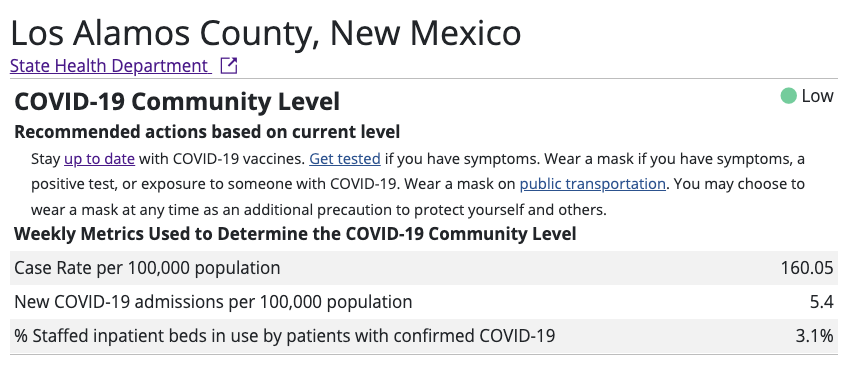
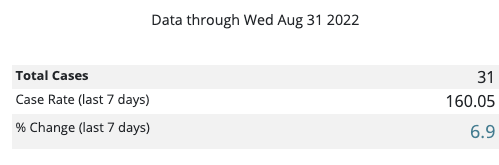
For the week ending August 30, the CDC Community Level is LOW. The reported case incidence in Los Alamos County (160 per 100,000) is below the CDC criteria threshold (200 per 100,000). Health Services Area hospitalization metrics remain stable and below CDC thresholds as well. CDC recommendations at LOW Community Level risk can be accessed here. See HERE CDC recommends that persons use information about the current level of COVID-19 impact on their community to decide which prevention behaviors to use and when (at all times or at specific times), based on their own risk for severe illness and that of members of their household, their risk tolerance, and setting-specific factors See HERE
|
|
NOTE: The COVID-19 incidence data reviewed here are based on PCR-confirmed testing results compiled by CDC and NMDOH and do not include data on positive at-home antigen tests. As such, case counts are likely underestimated, but how much cannot be determined at any given time point.
To assist with more complete case monitoring in New Mexico, NMDOH provides for online reporting of positive at-home antigen results HERE.
|
|
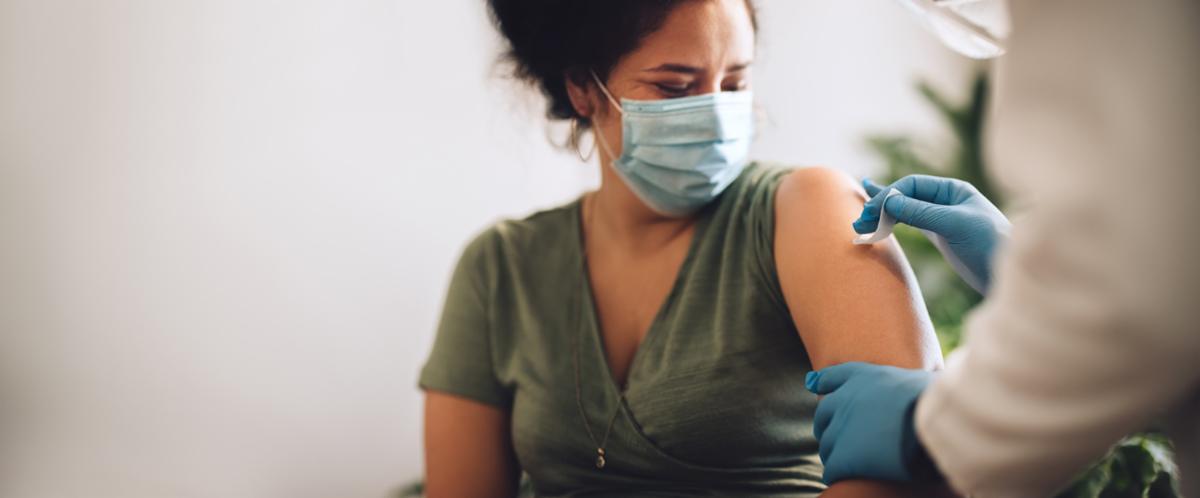
Omicron booster shots are coming—with lots of questions
COVID-19 vaccines get their first update since the pandemic began.
Here's what you need to know about them
Update, 31 August, 1:30 p.m.: The U.S. Food and Drug Administration announced today it has granted an emergency use authorization for Moderna’s and Pfizer-BioNTech’s updated booster vaccines, which target the BA.4/BA.5 coronavirus subvariants. The U.S. Centers for Disease Control and Prevention’s Advisory Committee on Vaccine Practices is scheduled to discuss recommendations for who should receive the vaccines and when at their meeting on 1–2 September.
For the first time since the start of the pandemic, COVID-19 vaccines look set to receive an update. Boosters reformulated to protect against the Omicron variant, which has dominated globally since early this year, may get deployed on both sides of the Atlantic Ocean as early as this month.
The data on the updated boosters are limited, however, and the impact they will have if greenlit is unclear. Here are some of the questions surrounding this new generation of vaccines.
What do the new boosters contain?
A bit of the old and a bit of the new. Both the Pfizer-BioNTech collaboration and Moderna make their vaccines from messenger RNA (mRNA) coding for the spike protein of SARS-CoV-2. The new vaccines are bivalent. Half of the mRNA codes for the spike protein of the ancestral virus strain that emerged in Wuhan, China, in late 2019, which is also in the original shots; the other half codes for the spike protein in BA.1 or the one in BA.4 and BA.5, which have identical spikes. Because they contain a lower dose of mRNA, the shots are meant to be used as boosters only, and not in people who were never vaccinated.
What sort of data have the companies collected?
Human data are only available for the companies’ boosters targeted to BA.1. At a June meeting of FDA’s vaccine advisory committee, both the Pfizer-BioNTech collaboration and Moderna presented data showing that the shots had side effects similar to those of the original vaccines—including soreness at the injection site and fatigue—and induced strong antibody responses to both the original strain and Omicron BA.1. The companies also showed that the BA.1 vaccines prompted significant antibody responses to BA.4 and BA.5, although lower than that to BA.1.
For the BA.4/BA.5 boosters, the companies have submitted animal data. They have not released those data publicly, although at the June FDA meeting, Pfizer presented preliminary findings in eight mice given BA.4/BA.5 vaccines as their third dose. Compared with the mice that received the original vaccine as a booster, the animals showed an increased response to all Omicron variants tested: BA.1, BA.2, BA.2.12.1, BA.4, and BA.5.
How can authorities consider authorizing vaccines without data from human trials?
Influenza vaccines are updated each spring to try to match the strain most likely to circulate in the fall and winter. The reformulated shots don’t have to undergo new clinical trials unless the manufacturers significantly change the way they make the vaccine. A similar approach for new COVID-19 variants makes sense, says Leif Erik Sander, an infectious disease expert at the Charité University Hospital in Berlin. The changes to the mRNA are minor and providing updated vaccines as quickly as possible is “an ethical issue,” Sander says. “We need to allow people to protect themselves from a virus that we can’t fully control.”
Will the strain-specific mRNA lead to better protection?
That’s hard to predict. It depends in part on how much BA.4 and BA.5 are still circulating by the time the shots are delivered and how closely the next dominant strain matches them. It also depends on how many people have immunity from a recent infection.
In their preprint, Cromer and colleagues attempt to calculate the possible impact of strain-specific vaccines. They combined data from eight clinical trial reports that compared vaccines based on the original spike protein with formulations targeted to the Beta, Delta, and Omicron BA.1 strains. The studies all measured the ability of recipients’ serum to neutralize virus variants in the lab.
They found that the biggest effect came from administering any booster: On average, an additional dose of a vaccine coding for the ancestral virus’ spike protein resulted in an 11-fold increase in neutralizing antibodies against all variants. But strain-specific vaccines improved things slightly. Recipients of updated vaccines had, on average, antibody levels 1.5 times higher than those who received an ancestral strain vaccine. Even if the vaccine didn’t exactly match the viral strain, there was still some benefit.
Strain-adapted boosters had some benefit at the population level as well, according to Cromer’s models, although much depends on the existing levels of immunity in a population. If, for example, a population already has 86% protection against severe disease, ancestral-strain boosters could increase that to 98%, and updated boosters to 98.8%. That might not sound like much, Cromer admits, “but if you have a large population and limited hospital beds it can make a difference."
Read the full article HERE.
|
|
|
Do you plan on getting the updated booster when it becomes available?
|
|
|
|
Mining the body's immune system to boost COVID-19 virus detection
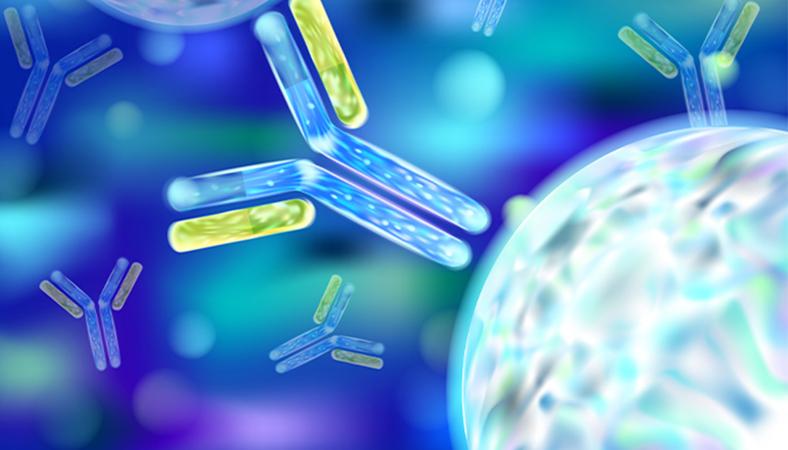
An antibody library created from healthy donors before the COVID-19 outbreak has yielded antibodies with therapeutic and diagnostic potential. They are specific to the SARS-CoV-2 virus and could be used in highly sensitive diagnostic assays. Some of the antibodies also prevented the virus from entering human cells, potentially useful as treatment to facilitate faster recovery from COVID-19.
(source LANL)
|
|
Had COVID-19 already? You're now less likely to get the new BA.5
A study conducted with data from Portugal shows that previous infections by the BA.1 and BA.2 Omicron COVID-19 variants, dominant earlier this year, confer protection against the highly transmissible and increasingly prevalent BA.5 variant, especially for people with more recent infections.
“Previous SARS-CoV-2 infection appeared to have a protective effect against BA.5 infection,” said Ruy Ribeiro, a Los Alamos National Laboratory scientist on the project. “In addition, this protection was at its best for those whose previous infection was with the BA.1 or BA.2 variants, more so than with the older Delta and original Wuhan forms.”
(source LANL)
|
|
CDC COVID Data Tracker - September 2, 2022
To get today's break down of positive case data, demographics information, vaccine status and more for Los Alamos County or other counties across the United States, click HERE
|
|
The charts available with this TOOL layout the key metrics for understanding the reach and severity of COVID-19 in a given area.
|
|
Johns Hopkins
COVID-19 Status Report Dashboard for
|
|
Daily COVID-19 Data in Motion
The Johns Hopkins' Daily COVID-19 Data in Motion report is a 60-second, daily summary of the most important data on COVID-19 in the U.S., updated every morning. The report shares critical data on COVID-19 from the last 24 hours.
|
|
NMDOH Epidemiology Reports - Daily and Weekly Data
As part of the COVID-19 pandemic response, NMDOH collects and analyzes statewide data for COVID-19 positive cases, hospitalizations, and deaths. The reports reflect these critical data and are updated weekly - click HERE
|
|
QUESTION:
The CDC website lists 2 locations in Los Alamos County - Sewershed: 853 and Sewershed: 1386. Can you tell me what the difference is between the two sites? Is one White Rock and the other Los Alamos?
|
|
ANSWER:
Sewershed 853 is in fact the Los Alamos townsite. Watershed 1386 doesn’t match White Rock and appears to be an error. We recommend using the Biobot website: https://biobot.io/data/ that combines both the townsite and White Rock data.
|
|
We are listening to you!
Your feedback is helping to shape future newsletters, inform decisions regarding services, and make Los Alamos County healthier and safer. Make sure to participate each week to be heard!
|
|
Remember, we appreciate your questions! We always try to respond in a timely manner, and if appropriate, we will include those Q&As in future newsletters.
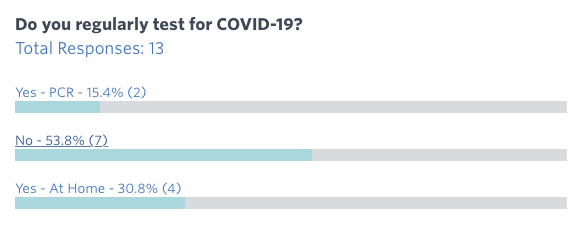
Take a look at these results from the last survey:
|
|
Have a question? Email us. |
|
Los Alamos Testing Information |
|
Los Alamos County COVID Testing Resources
Visit the County COVID Page for information regarding testing, click below:
|
|
Los Alamos Vaccine & Booster Information |
|
COVID-19 Rapid PCR testing now available
Curative and Pathology Consultants testing sites change locations and hours
Curative will move on Tuesday, Aug. 23 from the Los Alamos townsite to White Rock to begin offering Rapid PCR COVID-19 tests with results in two to three hours. Pathology Consultants of New Mexico (PCNM) COVID-19 standard PCR testing site will relocate Monday, Aug. 22 from White Rock to the Los Alamos townsite.
On Monday, PCNM new testing location will be sited at the Mari Mac Village shopping center parking lot located at 759 Central Avenue, Los Alamos. Hours of operation are Monday-Friday, 9:00 a.m. to 3:00 p.m. No appointments are necessary, but individuals are asked to bring their insurance card. For those who are uninsured, PCNM does charge $99 per test. PCR test results are provided within 48-72 hours. For more information, visit https://PCNM.com.
Curative will now be located at the White Rock Town Hall near the Senior Center at 139 Longview Drive, White Rock. Testing hours will be expanded to Monday-Friday, 8:00 a.m. to 3:00 p.m. Curative will now be offering Rapid PCR (R-PCR) tests with results available in two to three hours. Visit the Curative website at https://curative.com to schedule a date and time.
For more information regarding testing options for Los Alamos County, visit the County website at www.lacnm.com/covid.
|
|
How do I know if I'm eligible for a vaccine or booster?
Follow these links to review the CDC eligibility guidelines:
|
|
Los Alamos County COVID Vaccine/Booster Resources
Visit the County COVID Page for information regarding vaccinations/boosters, click below:
|
|
Los Alamos Treatment Information |
|
Los Alamos County COVID Treatment Resources
Visit the County COVID Page for information regarding treatments, click below:
|
|
What else would you like to see in this newsletter?
Click below to email us your feedback and questions!
|
|
|
|
|
|
|