Dear Cranford Residents,
Recently, the Centers for Disease Control (CDC) issued a recommendation for all individuals in areas of the US with substantial or high levels of COVID-19 transmission to consider wearing masks in public, indoor spaces (this includes fully-vaccinated individuals). Additionally, Governor Murphy and Commissioner of Health Persichilli also issued a recommendation that all New Jerseyans wear masks in public, indoor spaces. While the public health emergency was officially ended in July, COVID-19 did not leave us and in fact we are seeing case counts rise in all communities across the state. The reasoning behind these recommendations is influenced by several factors.
To begin, cases in Cranford are not isolated to Cranford. It is critical to consider what is happening in the county, in the region, the state, the nation, and the world overall. What happens in our neighboring communities and even on the other side of the globe has a direct impact on what happens in our own small community. Secondly, while 70%+ of eligible NJ residents are vaccinated against COVID-19, no child under 12 is vaccinated and there is still a remaining portion of the adult population who remain unvaccinated. When you combine these two groups with the fact that the Delta variant is causing a small amount of breakthrough cases, the virus is still moving throughout all of the Garden Sate (albeit at a much slower rate than some of our southern states with highly un-vaccinated populations).
For those individuals who do contract Delta, we have several additional concern. Delta is much more highly transmissible than the original SARS COV-2 virus that appeared in late 2019. Research shows that even breakthrough, vaccinated individuals who come down with mild cases of Delta have a much greater viral load (1000x more, in fact) compared to the original virus and other variants; therefore, Delta is considerably MORE transmissible than the original SARS COV-2. I’m guessing you heard this week that it is comparable to Chicken-pox. For every person sick with Delta, they have the potential (on average) to infect an additional 7-9 people. There is also preliminary evidence (at the national level) that Delta causes more severe illness and is resulting in increased hospitalizations and potentially deaths. The monitoring of those figures is ongoing and we will have a better picture in the coming month.
It should be noted that breakthrough cases of Delta represent a small portion of overall COVID-19 infections nationwide. Over 95% of currently-hospitalized individuals are UNVACCINATED. In NJ, we have seen a large increase in hospitalizations in the last few weeks (around a low of 300 hospitalized COVID-19 patients in late June to 600 today). If you are fully-vaccinated against COVID-19 and you manage to contract COVID-19, you will likely only have mild (if any) symptoms; the vaccine is highly effective against severe illness and death. The flip side is that even as a mildly symptomatic or asymptomatic individual, you still have the potential to infect other people… including every unvaccinated child, immunocompromised individuals, or those who have refused/been unable to receive a vaccine thus far.
Delta cases are not confirmed by the standard PCR test that you might get in a doctor’s office. Once that PCR test has been run, the lab either performs genetic sequencing in-house or sends the sample to the NJ Public Health Environmental Laboratory. We do not have information on the number of case of cases of Delta in any one municipality, just estimates for the state. What I can say is that for those samples being sequenced in NJ, Delta variant represents ~90% of the variants identified.
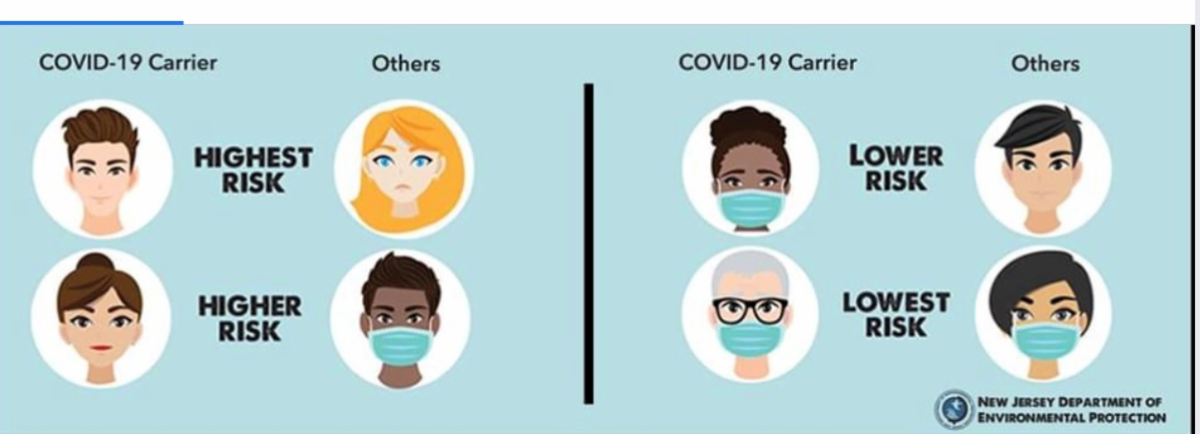
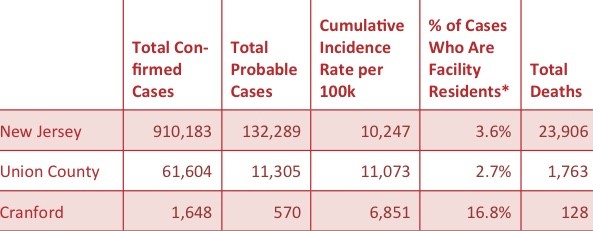
If you are interested in digging into the numbers, I encourage you to visit the NJ COVID-19 Data Dashboard (HERE). There is a wealth of information, including epidemiologic curves for NJ and every county. It is critical to consider what happens in Cranford in the larger context of Union County, our surrounding counties, and even the state/nation/globe overall. The recommendation to require the use of masks in the municipal building was based on the guidance from our national and state public health authorities as well as a monitoring of the overall COVID-19 trends regionally. Wearing a mask is one simple step you can take to lower the risk of transmitting and contracting COVID-19 by reducing the spread of droplet transmission from person-to-person.
On a personal note, I too understand the “pandemic fatigue” that our community members are experiencing. As an infectious-disease epidemiologist, an ongoing global pandemic is the last thing I want to see. Unfortunately, despite the fact that NJ is doing a pretty great job with vaccinations and really worked hard to drive down infection rates, we just aren’t at the finish line. It is important for all of us to continue to take simple measures to protect ourselves and the most vulnerable in our communities so that we do not see another variant emerge that is able to even better evade our available vaccines. We appreciate your concern and willingness to do your part in protecting your fellow community members; this situation is just so much bigger than any one person. We are all in this together.
Sarah A. S. Perramant, MPH, HO
Health Officer/Epidemiologist