CPCE is accepting applications to our Pilot Grant Program through April 2.
|
|
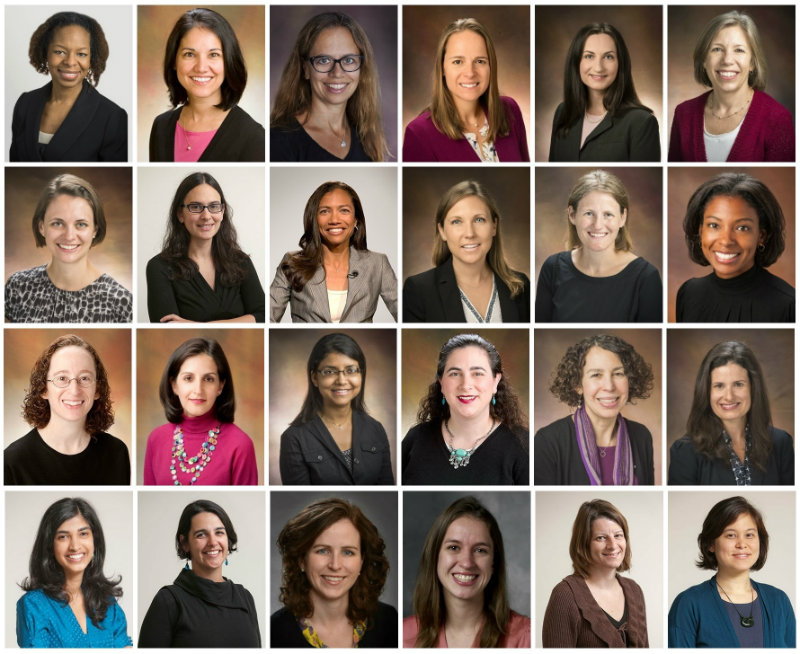
Spotlight on: CPCE Women
In honor of National Women's History Month, we have been highlighting the women of CPCE via Twitter. Below are just a sample.
Pediatric sepsis research from
Dr. Fran Balamuth
aims to improve sepsis care by improving the ability to identify children who need aggressive care and improving timeliness of therapy once these children are recognized.
Dr. Sandra Amaral is medical director of the hand transplant program at CHOP and was involved in the care of Zion Harvey, the first child to successfully receive a
double hand transplant.
Mental health is an important component of overall health in children.
Dr. Stephanie Doupnik's research
asks how mental health conditions influence hospital outcomes & what interventions ensure best-possible outcomes for all children.
One-third of American babies are exposed to antibiotics around the time birth. Dr. Sagori Mukhopadhyay recently received a Career Development Award (K23) to assess the relationship of these antibiotic exposures to the development of early childhood allergy and infections.
Haven't followed us on Twitter yet? Find us
here
.
|
|
|
|
Human Factors Lunch and Learn
Date: April 3, 2018
Time: 12:00 - 1:00 pm
Location: Stokes Auditorium, CHOP Main Hospital
Come learn about human factors applications in health care and how CHOP has been incorporating human factors into a variety of improvement projects across the enterprise.
Learn more.
Improving Your Chances of Grant Proposal Success: NIH F and K Awards
Date: April 12, 2018
Time: 2:30 - 3:30 pm
Location: Abramson Research Center (ARC), Room 124
Matthew Weitzman, PhD, Professor, Division of Cancer Pathobiology will leverage his extensive experience writing and reviewing grant applications to help you significantly improve your chances of creating an application that stands out and is fundable. This session will specifically focus on the Specific Aims and Biosketch sections of NIH grants. Space is limited. To register, e-mail
Janet Stuart. Learn more
here.
Save the Date: 10th Annual CHOP Research Safety Day
Date: April 19, 2018
Time: 10:00 am - 2:00 pm
Location: Colket Translational Research Building lobby and conference rooms
Formal invitations and more details will follow soon. Please feel free to contact Research Safety with any questions at (267) 426-2272 or at
researchsafety@email.chop.edu.
K Awards: Day-Long, Hands-on Workshop
Date: April 27, 2018
Time: 10:00 am to 3:00 pm
Location: Colket Translational Research Building, Room 1200A
Dr. Beth Schachter holds a PhD in Cell and Molecular Biology. She currently dedicates her time to her consulting work and has over ten years’ experience presenting grant-writing workshops at the Perelman School of Medicine. Register
here.
Neonatology Clinical Research Symposium
Dates: May 9 - 10, 2018
Location: The Union League of Philadelphia
Children's Hospital of Philadelphia (CHOP) is sponsoring a research symposium in recognition of the retirement of Barbara Schmidt, MD, FRCP(C), MSC, and Haresh Kirpalani, BM, MRCP, FRCP, MSc. This course is designed to highlight evidence-based medicine and innovative, randomized clinical trials in Neonatology. Learn more
here.
CHOP Quality and Safety Day 2018
Date: May 15, 2018
Time: 8:00 am - 4:00 pm
Location: Stokes Auditorium, CHOP Main Hospital
Paula Davis-Laak, JD, MAPP, will present the keynote address, “Thriving in Healthcare: Your Blueprint for Stress Resilience.”
Register for the conference or
submit an abstract that highlights the way your team has applied the CHOP Improvement Framework, Safety Behaviors for Error Prevention, or other strategies. Abstracts are due Friday March 30, 2018 at 5:00 pm.
Penn MSHP 2018 Implementation Science Institute
Dates: June 19 - 21, 2018
Location: Jordan Medical Education Center
The purpose of the Implementation Science Institute is to provide participants with the tools to design and execute rigorous implementation science research. The Institute will give an introduction to the foundations of implementation science, cover implementation strategies and sustainability, tips for grant writing and skill development. Limited scholarships will be available for affiliates of CHOP. Register
here or contact
mshp@mail.med.upenn.edu for more information.
|
|
March 27, 2018
March 23, 2018
March 12, 2018
March 12, 2018
March 8, 2018
March 7, 2018
March 6, 2018
February 27, 2018
February 15, 2018
January 30, 2018
January 30, 2018
January 17, 2018
|
|
The incidence of thyroid nodules and cancers in children and adolescents has consistently increased over the past 30 years. Most thyroid nodules are benign, but the risk of malignancy is significantly higher in children than it is in adults. Current guidelines for the evaluation of thyroid nodules in adults recognize combinations of ultrasound features associated with low risk of thyroid cancer and support withholding immediate biopsy. This study was designed to examine the diagnostic accuracy of thyroid ultrasonography with color flow Doppler in children, and determine whether any ultrasound features alone or in combination could be associated with a low enough risk of malignancy that it would allow for the same conservative approach currently practiced in adults. While ultrasound is useful tool for the evaluation of thyroid nodules, Dr. Goli Mostoufi-Moab and colleagues found no combination of ultrasound features sufficient to exclude thyroid cancer without a biopsy.
Italian pediatric antimicrobial prescription rates are among the highest in Europe, but little action has been taken to improve the appropriateness of antimicrobial prescriptions. CPCE’s Dr. Theo Zaoutis collaborated on this study which assessed changes in antibiotic prescribing rates after the implementation of an acute otitis media and group A streptococcus pharyngitis clinical pathway in an Italian pediatric emergency department. Researchers found that after clinical pathway implementation there was a decrease in overall prescription of broad-spectrum antibiotics. They also saw a significant reduction in total antibiotic costs. These results indicate that the implementation of a clinical pathway is an effective antimicrobial stewardship tool in this setting.
Reducing variability in practice has been shown to improve both resource utilization and traditional patient outcomes for pediatric patients with congenital heart disease. Using data from the IMPACT (IMProving Adult and Congenital Treatment) registry, a multicenter clinical registry of catheterization procedures performed in the United States, Dr. Andrew Glatz, Dr. Michael O’Byrne, and colleagues sought to measure variation in the practice of balloon aortic valvuloplasty (BAV) and balloon pulmonary valvuloplasty (BPV). They found measurable hospital-level variation in the practice of BAV and BPV. Further research is necessary to determine whether this affects outcomes or resource use.
Hopes of parents of children with serious illness play an important role in decision-making and coping but little is known about how parent hopes change over time. Dr. Chris Feudtner and team describe the changes in parent hopes across multiple domains and time intervals, examine hopes in a subgroup of parents whose child died, and explore the maintenance of domains over time.
Children with spondyloarthritis (SpA) and axial arthritis are at risk of progression to ankylosing spondylitis, an inflammatory disease that causes joint fusion and leads to permanent functional impairment. While there are similarities between juvenile and adult SpA, there are distinct differences that warrant specific focus and clinical trials in juvenile disease. Validated measures to assess inflammation in the adult sacroiliac joint include the modified Berlin magnetic resonance imaging method and the SPondylo Arthritis Research Consortium of Canada (SPARCC) Sacroiliac joint Inflammation Score (SIS). Dr. Pamela Weiss and colleagues evaluated the reliability and construct validity of the SPARCC SIS in children with suspected or confirmed juvenile SpA. Their research demonstrated the feasibility and reliability of this scoring method in children with SpA.
|
|
Grants of up to $20,000 are available to help support the research of faculty members or post-doctoral researchers affiliated with non-profit human service organizations in the United States and Canada. Areas of interest to the Fund are: studies to develop, refine, evaluate, or disseminate innovative interventions designed to prevent or ameliorate major social, psychological, behavioral or public health problems affecting children, adults, couples, families, or communities, or studies that have the potential for adding significantly to knowledge about such problems.
CPCE offers awards twice each year through its Pilot Grant Program. The purpose of this program is to promote and support CHOP investigators in clinical effectiveness pilot research studies that will attract external support for large-scale studies. Selected proposals will be supported for up to a maximum of $10,000 for one year. Projects should be able to be completed within one year.
The American Cancer Society is accepting proposals for research projects with the potential to generate new knowledge of the effects of the United States healthcare system structure and the role of insurance in both access to and the outcomes of cancer screening, early detection, and treatment services. Awards will not exceed $200,000 per year (direct costs) for up to four years. Independent investigators at all stages of their career are encouraged to apply.
The mission of the American Society for Hematology is to further the understanding, diagnosis, treatment, and prevention of disorders affecting the blood, bone marrow, and immunologic, hemostatic and vascular systems through the promotion of research, clinical care, education, training, and advocacy in hematology. To that end, ASH is accepting proposals from hematologists whose research would not otherwise be accomplished due to cuts in NIH funding. The Bridge Grants program will provide at least thirty one-year awards annually, in the amount of $150,000 each, to ASH members who applied for an NIH R01 grant or equivalent but were denied funding due to budget cuts. Grants will support projects in basic, translational, patient-oriented, or outcomes-based research.
The foundation awards grants for research focused on issues faced by care providers that, when implemented, will improve health, nutrition, and/or developmental outcomes for infants and young children. Projects can address the etiologic mechanisms of disease; new, improved, or less invasive diagnostic procedures; the reduction or elimination of side effects; the alleviation of symptoms; new, improved, or less invasive therapies or treatments; dosage or dosing requirements or mechanisms for drugs, nutrient supplementation, or other therapeutic measures (under or overdosing); and preventative measures. The total requested grant size should be no more than $350,000.
The Children’s Cardiomyopathy Foundation is accepting Letters of Intent from investigators for basic science, clinical, population/epidemiologic, and translational research on cardiomyopathies affecting children age 18 and younger. Grants of up to $50,000 will be awarded to studies focused on the causes, diagnosis, or treatment of dilated, hypertrophic, restrictive, arrhythmogenic right ventricular, and left ventricular non-compaction cardiomyopathy. The grants are designed to provide seed funding to help secure long-term funding by the National Institutes of Health and other major granting institutions.
The Rheumatology Research Foundation is accepting applications for its 2018 Scientist Development Award, an annual program designed to provide support for a structured, formal, clinical, or basic science research training program for rheumatologists or health professionals in the field of rheumatology. Grants of up to $225,000 for up to three years will be awarded to individuals in the early stages of their careers or those without significant prior research experience who plan to embark on a career in biomedical and/or clinical research in arthritis and rheumatic diseases.
The American Legion Child Welfare Foundation supports organizations that contribute to the physical, mental, emotional, and spiritual welfare of children. The foundation awards grants for the dissemination of information about new and innovative programs designed to benefit youth or information already possessed by well-established organizations. Projects must have the potential to help American children in a large geographic area (more than one state).
Last year, the NIH received approximately $30 billion in federal support. In spite of this amount, about 42,500 grants were not funded. To address these unfunded proposals, the NIH has a new Pilot Program that is designed to match researchers with nonprofit disease Foundations or with investments from private companies. Through a new collaboration between the NIH and the private contractor Leidos, researchers can now upload their unfunded NIH Proposals into an online portal at the Online Partnership to Accelerate Research (OnPAR). Foundations and other potential funders can review the NIH scores, and decide whether they might be interested in funding the Projects. Currently, this Pilot Program allows researchers with priority scores better than the 30th percentile to submit their abstracts. Interested Foundations might ask that a researcher send their full NIH Application along with its scores. The consensus opinion is that there are a lot of worthy grants being submitted to the NIH, but there is only so much funding available. OnPAR is one way of trying to match researchers with private Foundations.
|
|
About CPCE
We are a pediatric research center dedicated to discovering and sharing knowledge about best practices in pediatric care by facilitating, organizing and centralizing the performance of clinical effectiveness research -- research aimed at understanding the best ways to prevent, diagnose and treat diseases in children. CPCE’s multidisciplinary team conducts research on a diverse range of clinical effectiveness topics grouped within four areas of research:
|
|
|
|
|
|
|